EDITS.WS

Author: Christina Gwira

  • Download a FREE Category Page Template for Divi’s Poke Restaurant Layout Pack

    Hey Divi Nation! Thanks for joining us for the next installment of our weekly Divi Design Initiative where each week, we give away brand new freebies. This time around we’re building upon the Poke Restaurant Layout Pack with a brand new Category Page Template that matches the rest of the pack perfectly. Hope you enjoy it!

    divi layout

    Check Out The Poke Restaurant
    Category Page Template Below

    Get it for free today!

    Desktop View

    Divi Poke Restaurant Category Page Layout Desktop

    Tablet and Mobile View

    Divi Poke Restaurant Category Page Layout Tablet and Mobile View

    Download The Category Page Template For The Poke Restaurant Layout Pack

    To lay your hands on the free Poke Restaurant Category Page Template, you will first need to download it using the button below. To gain access to the download you will need to subscribe to our newsletter by using the form below. As a new subscriber, you will receive even more Divi goodness and a free Divi Layout pack every Monday! If you’re already on the list, simply enter your email address below and click download. You will not be “resubscribed” or receive extra emails.

    How to Upload The Template

    Go to Divi Theme Builder

    To upload the template, navigate to the Divi Theme Builder in the backend of your WordPress website.

    Getting started with the Divi Conference Layout Pack

    Upload Website Template

    Then, in the top right corner, you’ll see an icon with two arrows. Click on the icon.

    Importing the Header and Footer Layout into the Divi Theme Buidler

    Navigate to the import tab, upload the JSON file that you could download in this post, and click on ‘Import Divi Theme Builder Templates’.

    Import settings for the header and footer layout pack

    Save Divi Theme Builder Changes

    Once you’ve uploaded the file, you’ll notice a new template with a new body area that has been assigned to All Category Pages. Save the Divi Theme Builder changes as soon as you want the template to be activated.

    Save the category page layout after importing it into the Divi Theme Builder

    How to Modify The Template

    Open Category Page Template Body Layout

    To modify the template’s elements, start by opening the template’s body layout.

    Begin the process for editing the Category Page Layout

    Inside the Body Layout Editor, you can edit the design on the front end using the Divi Builder just like you would with a normal Divi page.

    About the Divi Poke Restaurant Category Template

    This category page template has a few dynamic elements that will work automatically including:

    • Category Page Post/Archive Title: This will show the name of the category/archive.
    • Post Slider Module: This will cycle through the first three posts within the category/archive every 3.5 seconds.
    • Blog Module: This will display 6 blog posts in 3 columns within the selected category/archive. This module includes an offset of 3 posts to account for the posts within the Post Slider Module in the header.

    Here is a quick illustration that identifies the dynamic elements of the Poke Restaurant Category Page Template.

    Divi Poke Restaurant Category Page Layout Explainer

    Updating the Template’s Dynamic Elements

    Post Slider Module

    Posts for Current Page

    Since this is a template that has been assigned to all category pages for the site, there are going to be one or more blog modules that are set to display posts for the current page. This is how the template displays the posts dynamically for each category page. For this template, that will be the Post Slider Module and the Blog Module.

    Post Count

    When you install the Divi Poke Restaurant Category Layout, the Post Count for the Post Slider Module will be set to the number three. However, you can change this value to suit your needs.

    Editting the Post Slider Module in the Poke Restaurant Category Template

    Automatic Animation

    We also have set the speed of the Post Slider Module to 3,500 ms (milliseconds), which is also 3.5 seconds. However, you can change the speed of the transition within the Design tab of the Post Settings Module.

    Editing the automatic animation settings within the Post Slider Module

    Blog Module

    Post Offsets

    Similar to the Post Slider Module, the Blog Module will show the current posts for the selected category or archive. However, remember that if you have modified the number of posts that show up within your Post Slider Module, you will also need to update the Post Offset setting within this Blog Module so that there isn’t any repeated blog posts.

    Blog Post Count and Post Offset Settings within the Blog Module

    It is also recommended to keep the Post Count within a multiple of 6 (6, 12, 18 etc.).

    Updating the Template’s Static Elements

    Some elements on a category page template will need your immediate attention before using it live on your own website. These elements are called static because they will not update dynamically.

    Email Optin

    To allow the Email Optin Module to show up in your design, you’ll need to link an email account.

    Linking up a email marketing solution

    New Freebies Every Week!

    We hope you’ve enjoyed the Poke Restaurant Layout Pack and the Category Page Template freebie that goes along with it. We look forward to hearing your opinions in the comment section below. Make sure you check back next week for more freebies!

    The post Download a FREE Category Page Template for Divi’s Poke Restaurant Layout Pack appeared first on Elegant Themes Blog.

  • How to Add a Gallery to Your WordPress Website in 2023 (Easy Guide)

    Adding a gallery to your WordPress website allows you to showcase many photos. Whether you’re looking for your standard grid gallery or a unique masonry gallery experience, learning how to add a gallery to your WordPress website is always a good idea. In this tutorial, we’ll work through two ways to add a gallery to your WordPress site: with the Block Editor and one of the best gallery plugins available, the Envira Gallery Plugin.

    How to Add an Image Gallery Using the WordPress Block Editor

    To begin this tutorial, we’ll learn how to add a gallery using the default WordPress block editor. This process will work with most WordPress themes that have compatibility with the Block Editor.

    Setup Your Gallery Page

    Login to your WordPress website. Then, hover over the Pages menu item. Then, click Add New.

    Add a new gallery page to your WordPress website

    After giving your page a title, Click the black plus icon in the content area of the Block Editor. This will open up the available blocks. In the search bar, enter “gallery.” The Gallery Block will present itself. Click on the Gallery block to add the block to your page.

    Add gallery block

    Once your Gallery Block has been added to your page, we can move on to adding photos.

    Customizing and Populating Your Gallery Block

    With your Gallery Block in place, you have two options for populating your gallery. You can upload new photos directly from your hard drive. Or, you can choose photos already available on your website through the Media Library. For our tutorial, we’ll choose photos from our Media Library. To do this, click on the Media Library link in blue.

    Add photos to your photo gallery

    This will open up your Media Library for you to select your photos.

    Select your gallery photos

    Select your chosen photos, then click the blue Create a new gallery button. Now, you can add a caption or edit each photo in your gallery. Finally, click the blue Insert Gallery button to add your gallery to your page.

    Add completed gallery to page

    Now that your Gallery Block is populated, you can use the block settings column to make aesthetic changes to your gallery. You can change the column number, crop images, and link individual images to various places on and off your website.

    Style your Gallery Block

    Once you are happy with your gallery, you can save your page. Feel free to add more galleries or individual images using the image block for more creative layouts. To learn more about how to use the Gallery Block in your next WordPress project, check out our post, How to Use the WordPress Gallery Block.

    While the Gallery Block is a simple and efficient way of adding an image gallery to your WordPress site, it does have some drawbacks. For example, you can’t use it to showcase your product photos, nor can it be customized deeply. This is where reaching out for a plugin may be more helpful. Plugins provide robust features when it comes to expanding the native capabilities of WordPress. This can be seen in how much more functionality you receive when working with a plugin for a gallery.

    How to Add an Image Gallery in WordPress Using a Plugin

    As with most WordPress plugin types, there is a wide selection of gallery plugins that you can choose from for your next project. We’ve even compiled a list of the most popular gallery plugins! While there are many options, we’ll work with the flexible Envira Gallery plugin for our tutorial.

    Envira Gallery is a robust gallery plugin that beautifully manages videos and photos. A key feature of this plugin is its powerful drag-and-drop interface. Additionally, it integrates beautifully with WooCommerce, and social media and has a slew of templates that you can use to style your gallery. Deep linking, watermarks, and right-click protection are features you can experience with Envira Gallery. If you’re looking for a solid plugin to handle your image galleries, Envira Gallery should be your top pick.

    Install & Configure Envira Gallery

    After creating a new page on your WordPress website, hover over Plugins. Then, click Add New. In the search box, type in Envira Gallery. Then, activate the plugin by clicking the blue Activate button.

    Install Envira Gallery plugin

    After having the plugin installed, you’ll now notice that there is a new menu option. This is where all your galleries will be created.

    The new Enivra Gallery menu item

    Let’s look at the Envira Gallery dashboard and create our first gallery!

    Creating Your First WordPress Gallery with Envira

    To create your first gallery, hover over the Envira Gallery menu option. Then, click Add New.

    Add your first Envira Gallery

    Next, give your gallery a title by clicking within the Add Title textbox.

    Give your gallery a title

    Under the native Envira Gallery tab, you can upload new photos from your computer or select files from other sources like the Media Gallery. Click the green Select Files from Your Computer button to upload new photos. Click the grey Select Files from Other Sources button to add files from your Media Library.

    Add photos to your gallery from your hard drive of the Media Gallery

    Under the External Gallery tab, Envira Gallery allows you to use photos from your Instagram feed within your gallery. This is a premium option that you can utilize when you upgrade to the premium version of the Envira Gallery plugin.

    Envira Gallery and Instagram integration

    For this example, we will select photos from within the Media Gallery. To do this, Click the grey Select Files from Other Sources button under the Envira Gallery tab. Then, scroll through your media gallery. To select multiple images, press the CTRL button while selecting the photos you want to add to your gallery.

    Bulk select images for your gallery

    Once you’ve added your photos, you’ll notice that they show in the Gallery tab.

    The Gallery tab within the Envira Gallery plugin

    Once you’ve uploaded photos to your gallery, click on the green Publish button. This will make your gallery live and generate a shortcode you can use throughout your WordPress website to showcase your gallery. You’ll also have a code snippet generated if you want to input your gallery into your template files.

    Saved Envira Gallery

    Next, let’s add our gallery to our page.

    Adding Your Envira WordPress Gallery to Your Page

    Eniva Gallery comes with a block that we can use to add our gallery to our pages and posts. To do this, click the black plus icon. This will bring out the pop-out with your various blocks. In the search bar, enter Envira. This will bring up the Envira Gallery’s block. Click on the block to add it to your page.

    Add your Envira Gallery to your website via Block Editor

    Click the dropdown menu once you’ve added your block to the page. Then, select the gallery that you’d like to add to your page.

    Select your gallery from the Envira Gallery

    With your gallery selected, you can use the native block editor sidebar to edit your gallery’s settings. Or, you can click the edit button icon which will allow you to edit your gallery’s settings within the Envira Gallery dashboard.

    Edit settings via the Block Editor or the Envira Gallery dashboard

    Now that we’ve added our gallery to our page let’s look at some of the customizations we can make.

    Customizing Your WordPress Image Gallery

    These features can be edited within the free version of the Envira Gallery plugin.

    The Config Tab

    The Config tab allows you to control aspects of your gallery, like the number of columns, image dimensions, and lazy loading settings.

    The Config tab of the Enivra Gallery plugin

    The Lightbox Tab

    The Lightbox tab gives you all the settings you need to adjust the lightbox to match your needs and requirements for your gallery.

    Envira Gallery's lightbox settings

    The Misc Tab

    Change your gallery’s title and slug, and add custom CSS classes to have deeper control over your gallery’s appearance.

    Miscellaneous options within the Envira Gallery plugin

    Mobile, video, social, tags, and pagination settings are all a part of the premium feature set that you can expect from Envira Gallery. For a complete list of all the features that the premium Envira Gallery plugin provides, check out this exhaustive list.

    A strong gallery plugin like Envira Gallery makes adding an image gallery to your WordPress website straightforward. Using a plugin to add galleries to your WordPress site is a sound choice and leaves all the heavy lifting of managing your photo and video assets to your plugin. Now, let’s look at some other popular gallery options you can consider for your WordPress website.

    Other Popular WordPress Gallery Options

    There are multiple ways to add a gallery to your WordPress website. From using the Block Editor to a plugin, we’ve highlighted a few other ways that make adding an image gallery to your WordPress website easy for anyone to handle.

    NextGEN Gallery (Imagely)

    Nextgen Imagely gallery plugin

    With more than 32 million downloads, NextGEN Gallery is one of the most downloaded WordPress image gallery plugins for a reason. Available in both a free and premium version, this gallery plugin gives you all the tools you need to make the best gallery for your site. With eCommerce integration allowing you to sell your photography, photo proofing for professional photographers, and a slew of premade templates and styles, NextGEN Gallery does it all. Automatically resize your images, add watermarks, and manage albums and galleries. For another plugin option for your WordPress website, check out NextGEN.

    Get NextGEN Gallery

    10Web Photo Gallery

    10Web Photo Gallery

    10Web Photo Gallery is another WordPress plugin with drag-and-drop functionality, easy gallery management, and rave reviews. A key feature of this plugin is its spotlight on image SEO, which you should look out for if search engine optimization is key to your website’s success. Of course, this plugin comes with multiple styles and layouts, mobile responsiveness, and social sharing capabilities allowing your website visitors to show your beautiful galleries to their networks.

    Get 10Web Photo Gallery

    Modula

    Modula Gallery Plugin

    Modula is a Gutenberg-compatible gallery plugin, meaning that it adds Filters, password protection, sliders, and more are all part and parcel of using this unique plugin for your next image gallery. While other plugins may focus on themes and styling, Module has a proprietary solution that combines image optimization with a blazing-fast CDN. Say hello to better site performance, even with a heavy library of photos!

    Get Modula

    Divi

    Divi Gallery Module

    Divi is a powerful WordPress theme that has a highly-customizable gallery module. Divi’s Gallery Module gives you two orientation options, customizable overlay styles, and much more. Creating a full-width image gallery is a simple process with the Gallery Module, as is crafting unique and eye-catching border decorations that you can use to make your gallery match perfectly with your branding. Furthermore, Divi’s gallery capabilities can be further expanded through finds on the Elegant Themes Marketplace. Plugins like DiviFilter Grid and Divi Masonry Gallery are great additions to your Divi theme to easily create beautiful, eye-catching galleries.

    Conclusion

    Adding an image gallery to your WordPress website has been made simple. Gone are the days of manually preparing photos in image programs before organizing them by hand online. Creating a basic image gallery with the Block Editor is an easy process that takes a few minutes. For deeper functionality, it’s possible to use a plugin like Envira Gallery or Modula to create feature-rich galleries using photos, videos, and even social media posts. If you’re still looking for a list of gallery plugins that you can test out and review, here are our top gallery plugins for you to research and try.

    Image by denayunebgt / shutterstock.com

    The post How to Add a Gallery to Your WordPress Website in 2023 (Easy Guide) appeared first on Elegant Themes Blog.

  • How Much Does it Cost to Build a Website? (2023 Price Breakdown)

    There is no easy answer to the question, “How much does it cost to build a website.” Building a website in and of itself is a complex process. There are thousands of tools that can bring your website to life at a variety of price points. Before building a website, you should assess what your website needs and the most cost-effective method to build it. In this post, we’ll give you a price breakdown of everything you’ll need to make the right decision for your website investment.

    The Typical Cost of Building a Website (Pricing at a Glance)

    The cost of building a website depends on many factors, which makes it difficult to determine a set price. Not all websites are built the same, and as such, each will have its own needs and reasons that will affect the price of building it. However, there are key factors that affect the cost of any website.

    Key Factors That Affect Website Cost

    Here are some of the essential costs you can expect to pay when building a website.

    Key Factor
    Typical Cost Range
    Domain Name Registration
    $10 – $25 per month
    Hosting
    $5 – $500 per month
    Website Builder/Platform
    $10 – $200 per month
    Content Management System (CMS)
    $0 – $500+ one-time
    eCommerce Platform
    $0 – $200+ per month
    Website Theme/Design
    $0 – $299 per year
    Website Addons/Plugins
    $0 – $299 per year
    Security
    $0 – $249 per year
    SSL Certificate
    $0 – $249 per year
    Ongoing Maintenance
    $99 – $450 per month
    Custom Web Design/Development
    $1000- $10,000+ one-time

    Depending on the type of website you’re building, you may be investing more into some factors than others. For example, when building with WordPress, you may want to invest more in your hosting for better performance. If building with a website builder, you will pay more per month for advanced features like eCommerce.

    Another important factor to consider is the type of website you need. Typically, a website will fall under these main categories:

    • Informational – simple sites or blogs that don’t require a lot of pages or advanced functionality.
    • Small Business – sites that need more advanced tools for SEO and marketing
    • E-commerce – online stores that require complex functionality for selling and managing products.

    So you can expect to pay more to build an online store than you will for a personal site with only one page. However, how much more will largely depend on the method you choose.

    Three Most Common Methods of Building a Website

    There are many ways to build a website. The three most common methods, however, are as follows:

    1. Using WordPress (DIY)

    Typical Cost Range: $0 – $1,000 per year
    Considering most websites are built on WordPress, using it has proven to be one of the best DIY approaches to building a website. With WordPress, it’s possible to have the most flexibility when building your website. As such, you will have more control over how much you want to spend. The software is free, so the real cost will be determined by how much you want to pay for hosting, themes, plugins, and other features.

    WordPress comes with a large selection of plugins that allow you to extend its base install further. Plugins can range in price from free options to paid options. On average, the most popular plugins are between $49 – $99 annually.WordPress has some of the best website themes for making your website beautiful. You can find themes on marketplaces like Template Monster and Creative Market. They can also range in price from $19 – $99 annually.

    2. Using a Website Builder Platform (DIY)

    Typical Cost Range: $10 – $200 per month
    Building a website with a website builder is an excellent way to offset some of the heavy lifting of your website while quickly taking control of the design, layout, and functionality. A website builder is an online platform that gives you everything you need to build a website. Some popular website builders include Squarespace, Wix, and Weebly. All website builders have some form of monthly fee which can be as low as $10 per month. They also have free and paid add-ons you’ll need to keep paying for if you want your website to keep functioning.

    3. Hiring a Professional Web Designer or Agency

    Typical Cost Range: $500 – $50,000+ one time
    If you want a white-glove approach to your web design, consider hiring a professional web designer or web design agency. Building your website with a professional can cost you thousands of dollars. But with this comes peace of mind knowing that experts are on the job. You can also find cost-effective web designers on platforms like Upwork and Fiverr.

    Using WordPress
    Using a Website Builder
    Hiring a Web Designer/Agency
    Pros:
    • Allows more flexibility and control
    • Software is free and open source with huge community support
    • Addons like plugins and themes are available for free or low-cost
    • Pay what you want for hosting and other features as needed
    • All-in-one solution that is easy to use and manage
    • Low monthly recurring payments available
    • No extra payments on web hosting
    • All essential features are built-in (builder, hosting, SEO, security, etc.)
    • Get a professional website built by experts
    • Less hassle. They do most of the work for you.
    • Plenty of affordable designers and agencies available with such a competitive market
    Cons:
    • Cheap hosting and poor plugins can cause security and performance issues
    • Can be overwhelming to beginners
    • Recurring fees for themes and plugins are often necessary
    • Locked into a monthly/yearly recurring payment
    • Addon costs can escalate quickly
    • Finding experts for your builder can be expensive
    • Less hands-on control
    • Most expensive option
    • Finding a reliable web designer/agency can be difficult
    • Adding new features and changes can be more costly and time consuming than DIY methods
    Price Range:
    $0 – $1,000 per year
    $10 – $200 per month
    $500 – $50,000+ one time

    Now, let’s break down the costs in further detail for building a website with WordPress, a website builder, or a web design professional.

    How Much Does it Cost to Build a Website with WordPress?

    Typical Cost Range: $0 – $1,000 per year

    When building a website with WordPress, you can build a website inexpensively or spend lots of money building your site. It all depends on what you need your website to do. Building a website with WordPress can cost as little as zero dollars. The CMS supports many free templates and plugins, and several cheap web hosts are available to help keep your costs as low as possible. With WordPress, you can build any type of website imaginable. WordPress can do everything from a simple informational website to a fully powered online community.

    Here are some cost factors to consider when figuring out how much it costs to build a website with WordPress.

    Domain Name Cost

    Typical Domain Price Range: $10 – $25+ per year

    Namecheap, an affordable domain name provider

    On the internet, your domain name is the address where your customers can find your website. No matter the type of website you’re building, you’ll need to register a domain name. When choosing a domain name, it’s best practice to reflect your business, be unique, and be easy to remember. Most web hosts offer you free domains at the start of your term, but domains are pretty inexpensive as a whole. Namecheap provides .com domains for as little as $6, but on average, expect to pay from $10 per year for your domain. Costs can increase significantly for more niche and SEO-friendly domain names.

    Your hosting provider may also allow you to register a domain directly on their platform for a few bucks more per year, which can make it easier to manage. For example, Siteground offers an easy way to pick a domain and start building your site all in one place.

    For more, check out the pricing on the best domain registrars.

    Hosting Cost

    Typical Hosting Price Range: $2 – $500+ per year

    Web hosting or hosting is the service that holds your website’s files. Different types of hosting can provide an array of features and benefits, depending on the type of website you are looking to build.

    SiteGround WordPress hosting

    Types of Web Hosting

    There are five main types of web hosting available, and each has its strengths and weaknesses that should be considered from both a feature and cost perspective.

    Types of Hosting Best For: Price Range:
    Shared Hosting Those that are price conscious and less focused on performance $1.99 – $25.99+ per month
    Managed WordPress Hosting Non-techies who want better performance on a platform optimized for WordPress $15.99 – $150+ per month
    VPS Hosting Those who want more consistent performance and security than shared hosting $4 – $150+ per month
    Cloud Hosting Those who want to run a lean, custom hosting environment $10 – $500+ per month
    Dedicated Hosting Larger websites that need a dedicated environment for the best in performance $100+ per month

    1. Shared Hosting

    Typical Shared Hosting Price Range: $1.99 – $25.99+ per month

    The cheapest option on our list is shared hosting, the most common form of web hosting. This type of hosting is great for the budget-conscious, but it can incur performance and security issues depending on the provider. Here’s our rundown of the best shared hosting providers that you can use for your next website project.

    2. Managed WordPress Hosting

    Typical Managed Hosting Price Range: $15.99 – $150+ per month

    Not all hosting environments are built for WordPress. Managed WordPress hosting makes sure your website is hosted on a platform optimized for WordPress for better performance and easier management. They’ll take care of the technical side for you, but you’ll still have access to manage hosting settings if needed. It will cost a little more than traditional shared hosting but may be worth the investment in the long run. We recommend you check out the price of the best managed WordPress hosts for more.

    3. VPS Hosting

    Typical VPS Hosting Price Range: $4 – $150+ per month

    VPS hosting is similar to shared hosting in that multiple website instances are hosted on the same server. This is done via powerful virtualization software. VPS hosting is a good balance between shared hosting and dedicated hosting. Dreamhost, Hostinger, and IONOS are among the best VPS hosts.

    4. Cloud Hosting

    Typical Cloud Hosting Pricing: $10 – $500+ per month

    With a focus on resource management and scalability, cloud hosting is the best choice for websites that need speed and agility. This helps create a lean environment for your website to run on. Pressable is one of many popular cloud hosting providers to consider when costing out your next website build.

    5. Dedicated/Semi-Dedicated Server Hosting

    Typical Dedicated Hosting Price Range: $100+ per month

    Dedicated server hosting means you and your website will encompass all the resources within a single physical server. This frees up more resources for your website, granting you better performance and tighter security. Because of this, its price is much higher than shared hosting. Here’s a list of the best dedicated server hosts to get you started on your search.

    Here’s a look at our recommendations for the best WordPress hosting providers:

    Ranking: Hosting Provider: Best Known For: Starting Price:
    1 Siteground Shared & Managed Hosting $14.99/month
    2 Hostinger Shared & Managed Hosting $9.99/month
    3 Cloudways Managed Cloud Hosting $11/month
    4 Pressable Managed VPS Hosting $19/month
    5 A2Hosting Shared Hosting $11.99/month

    Once you’ve chosen the type of hosting that works for your budget and project, it’s time to look at themes and plugins for your WordPress website.

    WordPress Themes

    Typical WordPress Theme Price Range: Free – $299 per year

    Creative Market WordPress Themes

    To make your website beautiful, you’ll need a theme. WordPress lets you download thousands of themes directly from the WordPress Theme Repository. Typically, WordPress themes cost between $19 – $299 per year, depending on how intricate your chosen theme is. As you purchase your themes, you’ll also need to consider the price of customizing them before purchasing them. Some – like Divi – can be edited easily through a visual interface, while others may require you to learn how to code or hire a designer to assist you in making your changes. Here are some of the top WordPress themes that you may want to look into:

    Rating Themes Price
    1 Divi $89/year
    2 Genesis Pro $360/year
    3 OptimizePress $179/year
    4 Responsive Pro $59/year
    5 Avada $138/year

    And if you’d like to see more options, here’s our list of the best overall WordPress themes. You might find one that works for your website!

    WordPress Plugins

    Typical WordPress Price Range: Free – $200+ per year

    WordPress Plugin Repo

    You’ll need additional plugins or addons to take your WordPress website to the next level. While a simple website will do well with a basic setup, an eCommerce website will need more bells and whistles to keep customers and increase sales. Here are some categories of plugins you should consider adding to your website:

    Plugin Type Use
    Price Range
    Backup Plugins Make a copy of your website for safe keeping
    $0 – $100 per year
    Security Plugins Keeps your website secure from threats and attacks
    $0 – $199 per year
    Performance Plugins Enhances your website by making it faster and optimized
    $0 – $252 per year
    SEO Plugins Helps your content get found on search engines
    $0 – $99 per year
    Social Sharing Plugins Assists with connecting to social media networks
    $0 – $149 per year
    Contact Form Plugins Collect data from your website visitors
    $0 – $99 per year

    eCommerce Plugins Allow your website visitors to buy on your website
    $0 – $199 per year

    Plugins for websites can vary vastly in price based on their function. For example, WooCommerce, a popular eCommerce plugin for WordPress, is free. However, additional addons and features for WooCommerce can range from $29 – $299 annually. Here’s a list of the top plugins you should consider using and investing in for your WordPress website:

    Best WordPress Plugin Plugin Type Starting Price
    UpdraftPlus Backups $59 per year
    iThemes Security Security $99 per year
    WP Rocket Performance $59 per year
    Rank Math SEO $59 per year
    Monarch Social Sharing $89 per year
    WP Forms Contact Form $49.50 per year
    WooCommerce eCommerce Free

    To start your plugin search, this list of the best WordPress plugins will help you on your way.

    SSL & Security Costs

    Typical Website Security Price Range: $10 – $249+ per month

    ithemes security plugin

    Security for a website can come in a variety of forms. Who you choose to be your web host is one area often overlooked regarding website security. SSL certificates, firewalls, server hardening, and monitoring services are all things that can be looked into when counting the costs of building a website. However, these things are necessary to protect your website. Free SSL certificates like LetsEncrpyt exist, but you may want to invest in one, which could cost you, on average, $250 annually. While options like Sucuri, a free WordPress plugin, are available, its service starts at $199.99 annually. Most reputable security services incur some form of recurring fees. Our list of the best security plugins could help you find the right service. Having peace of mind is something worth paying for, so including security as a factor in your website cost is money well spent.

    Maintenance Costs

    Typical Maintenance Price Range: Free – $450+ per year

    Last but certainly not least is the maintenance of your website. When building any website, like a car, it needs a tune-up here and there. An excellent place to start is by checking out our list of the best WordPress backup plugins, as backups are a keep maintenance task. Other maintenance tasks include updating plugins, adding new content, and more. You’ll need to keep your plugins and themes up-to-date and secure by renewing your license yearly. Furthermore, some service providers have monitoring and maintenance services ranging from as little as $49 per month to several hundred dollars, depending on your website type.

    How Much Does a Website Builder Cost?

    Typical Cost Range: $0 – $200 per month

    Wix Website Builder

    When building a website with a website builder, you have a good mix of features and cost savings. Many tools and features you’ll need to build your website with a builder are already included. And they make it really easy to get a site up and running quickly. Some, like Wix, allow you to use artificial intelligence (AI) to build your site. These AI builders can design your website in minutes based on simple text prompts.

    Website builders are primarily web-based and use some form of visual builder. This eliminates the need for coding and lowers your worries about security and maintenance, as your recurring payment covers these. On average, website builders have an entry-level option ranging from $7 to $99 monthly. However, they may also have enterprise-level pricing, which can easily jump to $2000+ per month.

    The costs for website builders can escalate when it comes to adding features. While many tools already come with your website builder, for more complex tasks, you will need to invest in add-ons that are on the more expensive side. Shopify is a website builder geared towards eCommerce businesses. Its app store has free and paid apps, like the premium version of their Mailchimp apps, starting at $350 per month. With a website builder, you will incur some form of monthly or annual cost for the entirety of the time that you use said builder.

    The Best Website Builders: Price Breakdown

    Here’s a look at how the top website builders fare when compared based on price.

    Website Builder
    Free Plan/Trial
    Cheapest Plan
    eCommerce Plan
    Most Expensive Plan
    Wix
    ✔️
    $15 per month
    $25 per month
    $149+ per month
    Weebly
    ✔️
    $7 per month
    ✔️
    $30 per month
    Shopify
    ✔️
    $51
    ✔️
    $517+ per month
    Squarespace
    ✔️
    $23 per month
    $33 per month
    $65 per month
    Godaddy
    ✔️
    $11.99 per month
    $26.99 per month
    $26.99 per month

    If you want to learn more about website builders, we did a deep dive into the best website builders you should check out before starting your next project.

    How Much Does it Cost to Hire a Web Designer or Agency to Build Your Website Cost?

    Typical Web Designer Cost Range: $50 – $100 per hour

    Typical Web Agency Cost Range: $500 – $50,000+ one-time

    Fiverr Pro Accounts/Agencies

    Hiring a web designer or web design agency to build your website is an option that will give you the most peace of mind but will require the most investment. Depending on the type of agency or designer that you choose to procure for your website, you may be paying hundreds or thousands of dollars upfront.

    Hiring a Web Designer

    A web designer is an individual who you hire to build your website. This makes it easier for you as you’ll only be responsible for a fraction of what you’d need to consider when building a website yourself. Many factors come into play when hiring someone to build a website. Their experience level, the tools they use, and their locale all factor into the price. On average, a web design professional may charge $61 – $80 per hour. On a project basis, you can find professionals on job boards that charge as little as $100 to build a WordPress website, although it is more common to pay between $1500 – $5000 for a quality website.

    Hiring a Web Design Agency

    Web design agencies typically have several people who will be working on your website as well as additional tasks for your website. A web designer may ask you to provide your content and photos for your website. However, a web design agency may have a copywriter or photographer on their team who’ll carry out these tasks for you. However, these things will bring with them additional costs.

    A smaller agency can charge you $500 to build a simple informational website or landing page. But a larger agency may charge you $50,000+ to build a custom eCommerce website, including product photography and copywriting services.

    You can find agencies and designers in other countries that can build your website for you at a fraction of the cost. Typically, these agencies charge $500 for a website. But there may be cultural and language barriers that may cost more in time than money. And, remember, you always get what you pay for. When working with a web design professional, you sometimes don’t have to worry about hosting, security, design, or content. However, this may become a recurring cost you may be responsible for. Your web design team will carry out all these tasks for you but at a cost. Working with a web designer instead of an agency may bring you more significant cost savings, but both have pros and cons.

    How Much Does it Cost to Build a Website?

    The topic of figuring out how much it costs to build a website is vast. Overall, here are the most important items to consider, depending on the type of website you are looking to build:

    WordPress Price Range Website Builder Price Range Web Design Agency Price Range
    One-time Recurring One-time Recurring One-time Recurring
    Simple Informational Website $0 – $500 $0 – $249 $0 $0 – $250 $500 – $1,000+ $50 – $500
    Small Business Website $0 – $1,500 $0 – $450 $0 $25 – $250 $500 – $1,000+ $249 – $775
    eCommerce Website $0 – $3,500 $0 – $450+ $0 $0 – $2,500 $1,000 – $50,000+ $450 – $1,000+

    When building a website with WordPress, it is possible to keep costs as low as possible. Website builders incur recurring costs that will never go away. However, with that, you don’t have to worry about tasks like security or maintenance, but you may be limited in your website features. Lastly, building a website with a professional grants you the most peace of mind. But this confidence will come at a premium price and may include additional fees after your initial investment. We hope this guide gives you some direction on building your website in a reasonable cost range.

    Featured Image via paper cut design / shutterstock.com

    The post How Much Does it Cost to Build a Website? (2023 Price Breakdown) appeared first on Elegant Themes Blog.

  • 5 Ways to Style Divi’s Circle Counter Module

    Showcase stats, skills, and more with Divi’s Circle Counter Module. Utilizing this module helps break up the monotony that can be present on pages that contain a lot of numerical data. The Circle Counter Module gives you a beautiful and visually-compelling way to display a single data point. Upon page load, the module has an eye-catching animation that showcases data in an exciting way. Say goodbye to boring tables on your web pages! In today’s blog post, we’ll learn how to style Divi’s Circle Counter Module, with the help of some of the free layout packs that come with Divi.

    Examples of How-to Style Divi’s Circle Counter Module

    We’ll use a variety of layout packs throughout this tutorial. Each layout pack is from a different sector. This will showcase that there are many instances where the Circle Counter Module can be put to use.

    Option One: Divi Streamer

    With this layout pack, we used the Circle Counter Module to showcase the demographic stats of the Divi Streamer.

    Style Divi's Circle Counter Module - Divi Streamer

    Style Two: Divi Chocolatier

    For a chocolatier, we used the modules to showcase the number of orders that had come into the business.

    Style Divi's Circle Counter Module - Divi Chocolatier

    Design Three: Divi Jewelry Designer

    In this case, we used the Circle Counter module to present information to the viewer.

    Style Divi's Circle Counter Module - Divi Jewelry Designer

    Look Four: Divi Hostel

    Measuring the “happiness quotient” among guests with an animated module just makes sense.

    Style Divi's Circle Counter Module - Divi Hostel

    Demo Five: Divi Toy Store

    We use Circle Modules here to promote a sale on an online store.

    Style Divi's Circle Counter Module - Divi Toy Store

    Preparing to Style Divi’s Circle Counter Module

    Before we begin to style Divi’s Circle Counter Module, we need to first create a separate section that will house these modules. Whether you are adding this section to a new page or an existing page, you will need to do the same preparation. Prior to styling, decide which data points you would like to showcase in the Circle Counter Module. Next, you will need to create a section for your modules. Thirdly, you will need to decide how many columns will be within the row. This is why you’ll need to know which data points will be populating the data for your Circle Counter Module. Your data points will influence the number of columns that you will be using. Once this is set up, you will then add your Circle Counter Module to each column.

    Creating Your Section

    First, click on the blue plus icon. This will add a new section to your page.

    Add a new section to your page.

    Selecting Your Columns

    Next, you will use the green plus icon to add a row with the number of columns that you’ll be using. Each column will hold one Circle Counter Module.

    Add a new row with columns to your page.

    Add Circle Counter Modules

    Once you have your columns created, click on the gray plus icon. This will open the Modules Modal. From here, select the Circle Counter Module.

    Add the Circle Counter Module

    For consistency, I would recommend styling one Circle Counter Module at a time. Then, use Divi’s right-click menu to duplicate each Circle Counter Module and modify the data point within.

    Now that we have the fundamentals down pat, let’s start styling the module.

    Style One ft. the Divi Streamer Layout Pack

    You can follow this blog post to see which layout from the Divi Streamer Layout Pack suits your needs best. For this tutorial, we’re going to modify the About Section within the landing page layout.

    About section of the Divi Streamer Landing Page Layout

    Prepare the Section

    First, let’s delete the Number Counter Modules that are currently in this section. Hover over the module, and from the gray popout menu that appears, click the trash can icon.

    Remove Number Counter Modules

    Repeat this for the other Number Counter Module within the section.

    Add Circle Counter Module

    Next, click on the gray plus icon to add a Circle Counter Module to the first column of your row. Next, click on the Circle Counter icon to add one of the modules to the column.

    Adding the Circle Counter Module to the row

    Adding Your Content

    Once your first Circle Counter Module has been added, you’ll now need to enter your data point. In the Content tab of the module, enter a description for your data point. In our case, we’ll be showcasing a percentage of users who are from Toronto. So, we enter our text and the number 78 (without the percent sign!)

    Enter your content and data

    Style the Circle Counter Module

    We now will move to the Design tab. As our section is part of the Divi Streamer Layout Pack, we’ll use the font, text, and colors that are a part of the pack to influence the styling of our module.

    Styling the Circle Graph

    Let’s start first by clicking on the Circle tab to decide on the colors used for the circle part of the module.

    Circle Design Settings:

    • Circle Color: #5200ff
    • Circle Background Color: #ffffff
    • Circle Background Opacity: 0.4

    The Design Tab Settings for the Circle Tab

    Styling the Title Text

    Following styling the circle graph, we’ll move on to the Title Text of the module. Click on the Title Text tab, then use the following settings to add some life to the title text of our Circle Counter Module.

    Title Text Settings:

    • Title Font: Poppins
    • Title Font Weight: Bold
    • Title Font Color: #ffffff

    Styling the Title Text for the Circle Counter Module

    Adding Style to the Number Text

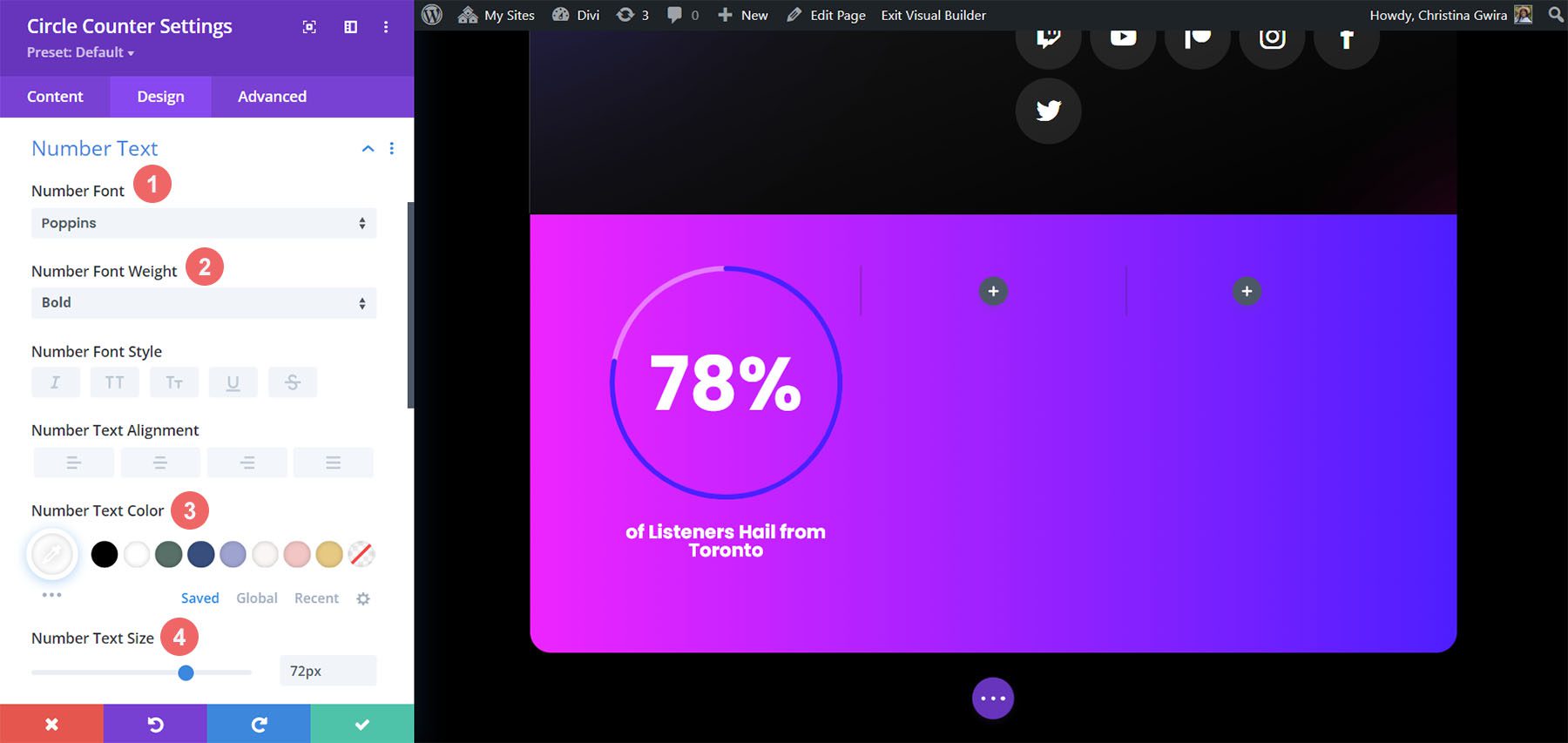
    Last but not least, we’ll be fixing the numbers within the Circle Counter Module. For this, we click on the Number Text tab. Then, we’ll use the following settings to style. Notice, we pulled inspiration from the layout pack, but also the Number Counter Modules that were there before.

    Number Text Settings:

    • Number Font: Poppins
    • Number Font Weight: Bold
    • Number Text Color: #ffffff
    • Number Text Size: 72pt

    Circle Counter Number Text Settings

    Once you have ended these final edits, click on the green check mark at the bottom of the modal box. This will save your changes.

    Copy and Update Module

    With styling complete, we can now duplicate this module. We will modify it with our other data points and their corresponding titles. To do this, hover over the module. This will bring up the modules settings menu popup. Click the copy icon. Then, move the module to the other columns in your row.

    Duplicate Circle Counter on the Divi Streamer Page

    In our case, in addition to updating the title and the data for the module, we also changed the colors to match the layout pack.

    The finished Divi Streamer Circle Counter example

    Design Two with the Divi Chocolatier Layout Pack

    Follow the Divi Chocolatier Layout Pack blog post to find out how to install the layout onto your website. We’ll be modifying the events sections on the home page layout. Let’s add some Circle Counter Modules to show data on how many orders have been collected.

    The section we'll be replacing on the Divi Chocolatier home page layout

    Remove Current Content

    Firstly, we want to remove the current modules. While the Text and Image Modules here look great, they’re quite static. By using the Circle Counter Modules, we’ll add some excitement and animation to this section. Hover over each module and click the trash can icon. The icon will appear in the module settings popout menu.

    Remove old modules to prepare the row for the Circle Counter Modules

    We’ll end up with an empty 3-column row.

    The empty row in preparation for our new modules

    Update Titles

    You may also want to consider updating the text modules for the titles to something that is more aligned with the upcoming content for the section. To do so, hover over the text modules, and click on the gear icon to edit the module text.

    Edit title Text Modules

    Add Circle Modules

    Before we add our Circle Counter Modules, we’re going to change the column number for our row. Hover over the row, and click on the grid icon. This will bring a popup where we can select the number of columns we need. For this design, we’ll be visualizing four pieces of data. So, we’ll choose to add four columns to this row. Click on the four-column icon.

    Change column number for Circle Counter Modules

    Now, we’ll add the Circle Counter Modules to the first column by clicking on the gray plus sign icon. Then, when the module popup appears, we click on the Circle Counter icon to add our first Circle Counter Module.

    Add Circle Counter Module to the first column of the row

    Add Data to Circle Modules

    With our first module in place, we can begin to style and add content to it. Firstly, let’s add our title for this module. Next, we’ll add our data point.

    Add your data and content

    For this design, we’ll remove the percent sign that comes with the module by default. To do this, we click on the Elements tab. Next, we uncheck the toggle next to the Percent Sign option.

    Remove percent sign from Circle Counter Module

    Now, we can style this module.

    Styling the Circle Counter Module

    To begin, we switch to the Design tab of the module.

    Switch to the Design tab

    Adding Branding to the Circle Graph

    Next, we click on the Circle toggle to access the design settings for the circle graph aspect of the module. We’ll use the following settings to style it:

    Circle Design Settings:

    • Circle Color: #ff6a28
    • Circle Background Color: #000000
    • Circle Background Opacity: 0.3

    Circle Background Color Settings

    Stylizing the Title Text

    For the title text, we’ll use the following settings after clicking on the Title Text tab:

    Title Text Settings:

    • Title Font: Jost
    • Title Font Weight: Regular
    • Title Text Color: #000000

    Title Text Settings

    Designing the Number Text.

    We’re going to use the same font and color for the number text. However, we’re going to change the size. We have more room within the Circle Counter Module since we are not using the percent sign. We’ll use this to our advantage in our design. Click on the Number Text tab, and enter the following settings:

    Number Text Settings:

    • Number Font: Jost
    • Number Font Weight: Regular
    • Number Text Color: #000000
    • Number Text Size: 72px

    Number Text Settings

    Duplicate and Finish

    Now that we have our first Circle Counter Module designed, we can go ahead and duplicate it.

    Duplicate our Circle Counter Module

    We’ll move the duplicates into their own row, and update the content within to reveal our finished product.

    The Completed Divi Chocolatier Layout with Circle Counters

    Style Three with the Divi Jewelry Designer Layout Pack

    For this design, we used the Divi Jewelry Designer Layout Pack as our starting point. We wanted to add an educational section to the product page of this layout, and will be using the Circle Counter Module to showcase this information. We’ll convert the testimonial section at the bottom of the page into this.

    The testimonial section of the Divi Jewelry Designer Product Page Layout

    Remove Modules

    As with our previous work, we need to go in and delete the current modules within this section.

    Remove old modules from section

    Update Section and Row Design and Structure

    For this layout pack, we also want to change the section’s background to add some interest. Click on the gear icon within the blue settings menu of the section.

    Edit section settings

    First, let’s remove the background image. Click on the Background tab. Then, click on the image icon. Finally, click on the trash can icon to remove the background image.

    Removing the background image from the section

    We want to leave the background gradient and color. Now, let’s add a background pattern to the section. Click on the Background Pattern icon. Then, click the plus icon to add a Background Pattern.

    Add background pattern

    We’ll use the following background pattern.

    Selecting background pattern

    Click the green check icon to save your settings for the section. We’re now going to change the column count of our row. For this design, we’re going to have five columns for our Circle Counter Modules.

    Change column number to five columns

    Add Circle Module

    With the columns and sections created, click on the gray plus icon to add our Circle Counter Module.

    Add Circle Counter Module to the Jewelry Designer

    With the module added to the column, as before, we add in our content. We’ll use the percent sign in this design.

    Add content to the Circle Counter Module

    Style Your Circle Counters

    Now, we’re going to begin to style our counters.

    Stylizing the Circle Graph

    We first start with the circle portion of our counter. The following settings will be used:

    Circle Design Settings:

    • Circle Color: #000000
    • Circle Background Color: #ac8961
    • Circle Background Opacity: 0.5

    The Circle design of the Circle Counter Module


    Notice how we changed the background opacity for this design. We went with a similar beige color, but increased the opacity to add an air of luxury to our design.

    Adding Style to the Title Text

    For the title text, we’ll use the same font family that is used throughout the layout pack. You can find the settings by clicking on the Title Text tab. Below, find the settings that were used to style the title text:

    Title Text Settings:

    • Title Text Font: GFS Didot
    • Title Font Weight: Bold
    • Title Text Color: #000000

    Styling for the Divi Jewelry Designer Layout Pack

    Styling the Number Text

    For the number text, we’ll use a gold color to call back to the colors used within the branding of this layout pack. We click on the Number Text tab to enter the settings which we’ll use below:

    Number Text Styling:

    • Number Font: GFS Didot
    • Number Text Color: #ac8961 
    • Number Text Size: 48px

    Styling for the number in the Divi Jewelry Designer Layout Pack with Circle Counter Modules

    Saving and Duplicating Our Work

    Once we’ve entered in all these settings, we now click on the green check mark at the bottom of the settings box. This will save all our hard work. Now, we can duplicate the module, as we did in previous styles, and edit the content with the remaining data.

    The finished Circle Modules for the layout pack

    We also added some Text Modules in another row above our Circle Modules to add context to our data points.

    Onto the next design!

    Design Four ft. Divi Hostel

    We’ll use the Divi Hostel Layout Pack for our fourth design of this post. Specifically, we’ll modify the amenities section within the landing page template.

    Divi Hostel amenities section within the landing page template

    Remove Modules from the Section

    To prepare for our circle module, we need to remove the modules that are within the section.

    Remove old modules from the Divi Hostel page template

    We want to have four columns for our circle modules, so we’ll leave the row structure as it is.

     Add Circle Module

    Click on the gray plus icon to add the Circle Counter Module to the first column of the row.

    Add Circle Counter to your first column

    Add Content

    Once in the Content tab of the module settings, add in your title and data point.

    Add content to Circle Counter Module

    Start Designing the Circle Counter Module

    Switch to the Design tab to start styling your Circle Counter Module. We’ll start with the circle graph.

    Styling the Circle of the Circle Counter Module

    We’ll use the following settings to style the circle graph of the module:

    Circle Design Settings:

    • Circle Color: #008186
    • Circle Background Color: #d37643
    • Circle Background Opacity: 0.2

    Title Text Styling

    Next, we’ll move on to styling the Title Text of the module. We’ll use the following settings:

    Title Text Settings:

    • Title Text Font: Manrope
    • Title Font Weight: Ultra Bold
    • Title Text Color: #000000

    The Title Text settings for the Circle Counter Module ft. the Divi Hostel Layout Pack

    Number Text Styles

    Finally, we’ll style the number within our Circle Counter Module. The settings that we’ll use are here:

    Number Text Styling:

    • Number Font: Manrope
    • Number Font: Regular
    • Number Text Color: #d37643
    • Number Text Size: 54px

    Number font styling for the Circle Counter Module Divi Hostel

    Add Border and Padding

    Let’s add a border and some spacing to the module to add some interest to the Circle Counter Module. Within the Circle Counter Settings Design tab, click on the Border tab. There, here are the settings to use:

    Border Settings:

    • Borders: All borders
    • Border Width: 4px
    • Border Color: #008186
    • Border Style: Solid

    Adding a border to the Circle Counter Module

    As you can see, we need to add some padding to the module so that the borders don’t stick to the modules. First, we click on the Spacing tab. Next, we’ll use a 25px padding for all the sides.

    Adding spacing to the Circle Counter Module

    Duplicate and Update Your Module

    To save time, we’ll use the right-click menu to duplicate our finished work for the other columns. Right-click on the finished Circle Counter Module, and click the copy icon. Update the content as needed for your needs.

    Final look of the Circle Counter Modules

    Final Example: Divi Toy Store

    For our last example of styling Divi’s Circle Counter Module, we’ll use the Toy Store Layout Pack. We’ll be modifying the home layout within the pack, specifically, the call to action section at the bottom of the page.

    The default Divi Toy Store Footer

    Add Rows to Section

    Unlike our previous examples, we’ll add two rows to this section. This row will be where we’ll add our Circle Counter Modules. To add a new row, hover over the row, and click on the green plus icon. Do this twice.

    Adding two rows to the section

    Then, move the Button Module from the first to the third row. So, we’ll have three rows within this section now: the first row will hold the call-to-action, the section will remain empty (for now), and the third row will have the button.

    Setting up the section with three rows

    Change Column Structure and Add Module

    Now, let’s change the structure of the row that will house our Circle Counter Module. To do this, hover over the grid icon on the green row menu. Select the 3-column structure,we’ll add three modules to this row.

    Change column structure for the row

    In the first columns, we’re going to add the Circle Counter Module by clicking on the gray plus icon, then clicking the Circle Counter Module icon.

    Adding Circle Counter Module

    Add Content to Circle Counter Module

    Now, we’re going to add our content and data to our Circle Counter Module.

    Adding text to the Circle Counter Module

    Style the Circle Counter Module

    As with our previous examples, we move to the Design tab to style the title text, number text, and more. However, we’ll be doing something a little differently to round out this tutorial.

    Styling the Circle Counter

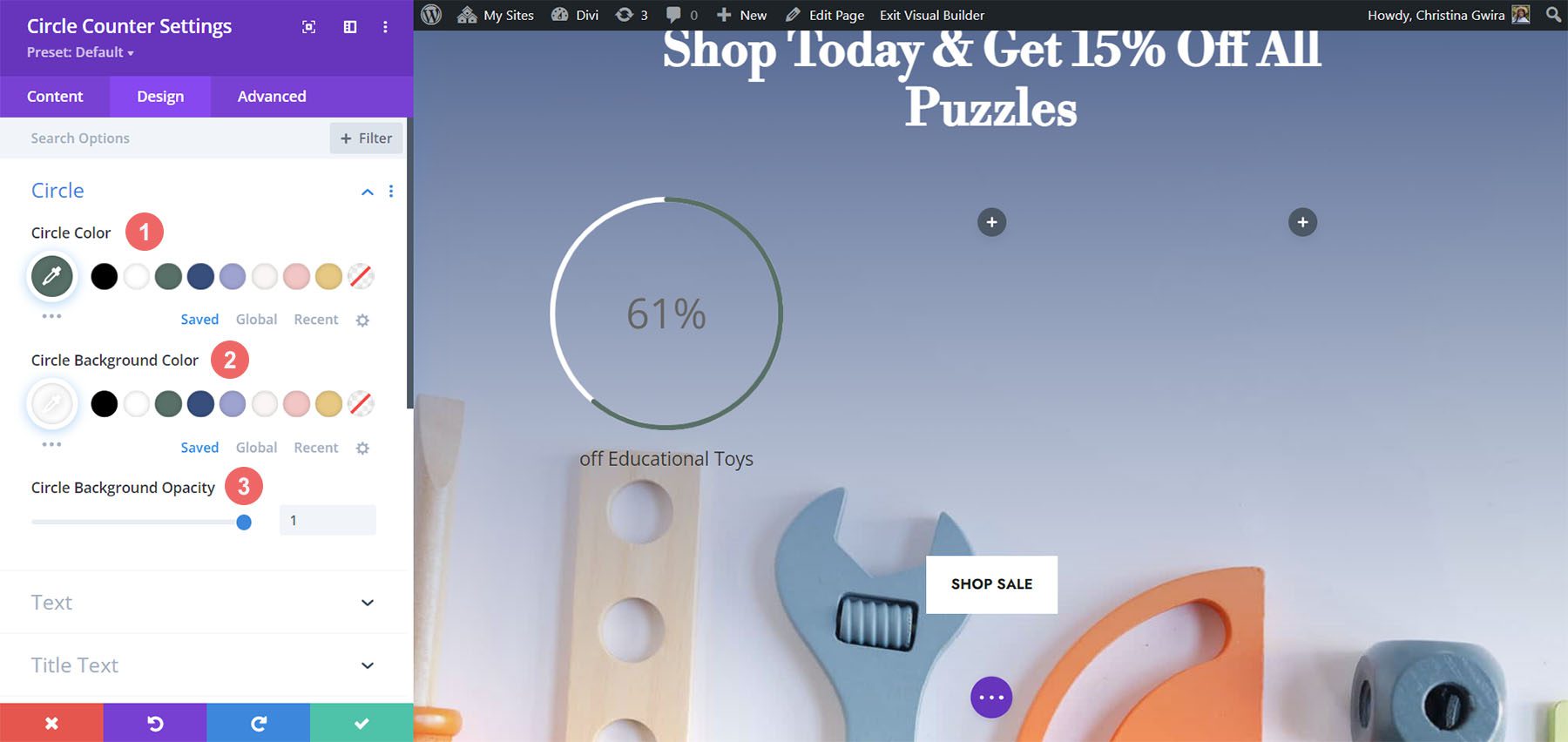
    We’ll start by styling our circle counter with the following settings:

    Circle Design Settings:

    • Circle Color: #557068
    • Circle Background Color: #ffffff
    • Circle Background Opacity: 1

    Styling Circle Graph Circle Counter Module

    Notice how we’re using no transparency for the circle’s background opacity. For this design, we’ll click on the Text tab, and select Light as the text color. This will make the title and the number will be white, or the color you’ve set as the light font color for the page.

    Text Design Settings:

    • Text Alignment: Center
    • Text Color: Light

    Setting text color

    Adding Style to the Title Text

    For the Title Text styling, we’ll use the same font used through the Divi Toy Store Layout Pack. Here are the settings to use:

    Title Text Settings:

    • Title Font: Libre Baskerville
    • Title Font Weight: Bold

    Title Text Settings for the Circle Counter Module

    Styling the Number Text

    For the number text, we’ll use the following settings:

    Number Text Settings:

    • Number Font: Libre Baskerville
    • Number Font Weight: Bold
    • Number Text Color: #ffffff
    • Number Text Size: 72px

    Number Text Settings for the Toy Store Layout Pack

    Adding Accents to Circle Counter Module

    To finish this tutorial, we’re going to go back to the Content tab. We’re then going to click on the Background tab for us to add some accents to our Circle Counter Module. We’re then going to move to the Background Mask icon.

    Background mask as an accent to the Circle Counter Module

    Styling the Background Mask for the Circle Counter Module

    For the Background Mask, we’ll use the following settings to add an accent to your Circle Counter Module

    Background Mask Settings:

    • Background Mask Design: Rock Stack
    • Mask Color: #eac989
    • Mask Transform: Rotate, Invert
    • Mask Aspect Ratio: Square

    Styling Background Masks as accents

    For the second module, we use the following settings:

    Background Mask Settings (Module 2):

    • Background Mask Design: Rock Stack
    • Mask Color: #354e7c
    • Mask Transform: Invert
    • Mask Aspect Ratio: Square

    Styling Background Masks as accents for the second module

    For the last module, these are the settings to use:

    Background Mask Settings (Module 3):

    • Background Mask Design: Rock Stack
    • Mask Color: #f6c6c5
    • Mask Transform: Flip Horizontal, Rotate, Invert
    • Mask Aspect Ratio: Square

    Styling Background Masks as accents for the last module

    With all the accents in place, this is what the final product looks like:

    Final look of the Circle Counter Modules with the Divi Toy Store

    Final Thoughts

    With some guidance and great data, you can change the way in which your users will interact with the content on your site. Using the Circle Counter Module helps to add some interest into your page while showcasing information about your product or service in an eye-catching way. We look forward to seeing you implement some of these tutorials on your site. If you are inspired, let us know in the comments section down below!

    The post 5 Ways to Style Divi’s Circle Counter Module appeared first on Elegant Themes Blog.

  • 10 Best AI Audio Tools in 2023 (For Podcasts, Music & More)

    Artificial intelligence (AI) is transforming the audio industry. What used to require complex software and a high skillset is now accessible to the masses. AI audio tools are opening up new possibilities for anyone to create podcasts, videos, music, and more, in ways we’ve never seen before. Whether you are a podcaster, musician, or content creator, these AI tools can take your productivity and creativity to a whole new level. In this post, we’ll explore the best AI audio tools with various useful applications. We’ll compare features, pricing, and how they can best be used to fit your needs.

    What is an AI Audio Tool?

    In its basic form, an AI audio tool uses artificial intelligence, advanced algorithms, or state-of-the-art neural networks to manipulate audio. With AI audio tools, users can tap into the power of AI to edit, create, and enhance audio in different ways with ease. There are many different types of AI audio tools with various applications, including:

    • Audio enhancers to can help refine audio tracks automatically
    • Voice generators to create humanlike speech for podcasts or videos
    • AI music creators to help anyone make their own music with the help of AI
    • Text-to-speech tools for content creation
    • AI Video generators with built-in AI audio tools for faster video production.
    • and more

    With that in mind, let’s explore some of the top AI audio tools out there.

    10 Best AI Audio Tools in 2023


    Subscribe To Our Youtube Channel

    Our list of the best AI audio tools hopes to provide a platform for everyone. Whether you plan to use these tools for personal or professional use, our list has the top AI audio tools to make your process a smoother experience.

    1. LANDR

    LANDR AI audio mastering suite

    LANDR is an AI-powered audio tool that allows you to create, collaborate, master, distribute, and promote your music. From one intuitive interface, you can do more regarding audio engineering. LANDR is lauded as the first and best AI audio tool used by megastars like Lady Gaga, Gwen Stefani, Snoop Dogg, and Seal.

    Its claim to fame is its powerful, unrivaled AI mastering, which can automatically create personalized masters based on your music with amazing precision. LANDR’S AI is toasted as being the best in the industry, providing excellent quality, clarity, and security when it comes to using AI to master audio, regardless of the size of your studio. LANDR has a fantastic drag-and-drop interface that allows you to master tracks with ease. Additionally, the suite comes with bespoke mastering plugins that help you produce the best tracks without investing additional resources on incompatible extras.

    Key Features of LANDR:

    • Boasts of a large selection of curated samples
    • 30+ exclusive VST (virtual studio technology) plugins
    • Unlimited online masters and revisions with full album mastering
    • Audio distribution to platforms like Spotify, Tidal, YouTube Music, Apple Music, and More
    • Collaborate directly on tracks from within the studio or remotely using state-of-the-art text and video messaging

    LANDR's exhaustive sample library

    LANDR’s sample library provides a great starting point for your mastering journey. You have access to a wide array of tracks that you can use within your work. Additionally, you can save and use individual stems (or music mixes) from said samples to further power your AI audio mastering journey.

    Best For:

    For serious sound engineers, producers, and those looking for a total solution for mastering, complete with the ease of AI in the editing process, consider adding LANDR to your suite of tools. It has a robust feature set utilized by industry greats that can be harnessed from the comfort of your studio.

    Pricing: Paid plans start at $19.99 per year

    Get LANDR

    2. Descript

    Descript, an AI audio editor

    Descript is more than just a simple AI-based audio editing studio. While it stands out as a podcast editing solution, as a platform, it can do so much more for the creator. Descript perfectly merges video editing in an environment powered by artificial intelligence. With AI, your transcripts are automatically transformed, so you can easily edit them like a Google Document. Add your visuals, and you can enjoy the freedom of merging text, audio, and video in a format similar to putting together a PowerPoint presentation. Descript gives you access to thousands of premium stock media like photos and videos, so creating content for YouTube, TikTok, and other social media channels can be done from the same platform you use to edit your next podcast. Indeed, for a user-friendly editing experience, choose Descript as your AI audio tool today.

    Key Features of Descript:

    • A powerful, AI multitrack production engine
    • Transforms low-quality recordings to studio sound with machine learning
    • Filler word removal
    • Clone your voice using overdubbing
    • A massive gallery of presentation and video templates

    Descript's interface design is it's key feature

    Descript’s key feature is its easy-to-navigate editing interface. You can input your text for text-to-audio, perform video editing tasks, splice audio tracks, and more from one sleek panel.

    Best For:

    Podcasters, video essayists, journalists, and those working with mediums that utilize audio and video within their content will love working with Descript. The simple interface and its powerful features allow you to edit video and audio simply yet powerfully.

    Pricing: Free, Paid plans start at $15 per month

    Get Descript

    3. Mubert

    Mubert AI generative music

    Mubert melds human-created audio and AI to create stunning music for your content. Never again will you need to spend time looking for creative commons music or paying for expensive royalty-free music. You can create your theme song, music, and more with Mubert. With AI, Mubert can take your English prompts and generate any track you can think of. Mubert comes with over 100 AI-generated tracks that you can use for free immediately after creating your account. As a creator, you can monetize your digital assets through Mubert Studio. If you’re looking for a way to add AI-generated music to your product, Mubert has an API that you can use to bring truly royalty-free music to your next project. If you’ve ever thought of making your music, Mubert is one of the best AI audio tools you can use to make your music today.

    Key Features of Mubert:

    • 20+ genres, 10+ moods, and 5+ activities to use as a reference for music generation
    • Four AI generation modes: track, jingle, loop, and mix
    • Explore and search for AI-generated and user-submitted tracks
    • Set the track length up to 25 minutes, beats per minute as well as the key of your track

    Mubert's simple and effective interface

    The Mubert interface is simple yet effective. At its most basic level, you enter your prompt, set a duration, and generate your track. However, you can choose your song’s genre, mode, and activity or set its BPM or key. With a few short sentences, you could have the theme for your next YouTube video or a jingle for a Facebook ad campaign.

    Best For:

    Creatives that create video content, podcasts, and apps will have tons of fun creating their music with Mubert. Creating unique and royalty-free music has become more accessible with the power of AI used through a platform like Mubert.

    Pricing: Free, Paid plans start at $14 per month

    Get Mubert

    4. LALAL.AI

    LALAL.AI, and AI audio stem splitter

    LALAL.AI is an AI audio tool that specializes in stem splitting, allowing users to extract the individual parts of any audio or video. Vocals, instruments, and accompaniments can be separated and edited using its AI-powered technology. LALAL.AI also has a voice cleaner that lets you strip away the vocals on a track and leave behind just the instruments and background music. Powered by its Phoneix algorithm, LALAL.AI is twice as fast as its competitors because of its evolutionary signal processing method. Furthermore, it boasts cleaner results with fewer mistakes and muddier sounds (artifacts) than its predecessors.

    Key Features of LALAL.AI:

    • Clip instruments, vocals, and background music from video and audio files
    • Vocal cleaner with effective noise reduction and complete background music removal
    • API available to bring noise reduction and stem splitting into your next product or project
    • Works with: drums, bass, piano, electric guitar, acoustic guitar, and synthesizer tracks without loss of quality
    • Works on Linux (Ubuntu), Mac OS, and Windows

    LALAL.AI and it's stem splitting capabilities

    LALALA.AI’s ability to identify and separate multiple instruments and vocals is their platform’s vital and powerful feature. From their minimal interface, you can easily and quickly see which parts of your uploaded track you’d like to isolate,

    Best For:

    Overall, LALAL.AI is a tool anyone who works with audio engineering, remixing, and music should consider adopting. Sound engineers, beat makers, producers, and those who create instrumentals will love having LALAL.AI in their toolkits. With their highly trained AI and easy-to-maneuver interface, routine tasks like stem splitting have been made easier with the help of artificial intelligence.

    Pricing: Free, Paid plans start at a one-time fee of $15

    Get LALAL.AI

    5. Murf

    Murf, a text-to-speech audio tool

    Murf is a text-to-speech (TTS) AI tool that’s great for voiceovers. Using Murf’s TTS tool is often used to create humanlike voices for podcasts, videos, and multimedia presentations. Adding and editing your script is a simple process within the Murf Studio. Murf boasts over 120 AI voices you can use in many languages. Plus, you can upload your own voiceovers and use AI to change them to match the tone needed to make your next presentation stand out. There are also more than 8,000 licensed audio tracks that you get access to when you use Murf Studio to work on your next project. Murf also supports video import from YouTube and Vimeo, providing a seamless process for video editors. Common audio and video editing functionalities are possible when you use Murf, an AI audio tool that does more than just text-to-speech.

    Key Features of Murf:

    • 20+ languages for text-to-speech
    • Edit your voiceovers through a simple, clean, and easy-to-understand interface
    • Easily emphasize specific words, change and edit pitch, and add pauses to your voiceovers
    • Pitch-perfect, life-like, and editable voice cloning
    • Comes with a collection of royalty-free background music

    Murf's Google Slides integration

    You’re in luck if you use Google Slides to craft your presentations! Adding professional yet simple voiceovers to your next presentation is possible with Murf. When you write and edit your slide content, Murf will enable you to select your favorite AI voice from the Murf library and add a voiceover to your next Google Slide document.

    Best For:

    If you’re looking for a platform that seamlessly combines video editing and text-to-speech, look no further than Murf. This handy audio tool packs a punch and can be easily maneuvered through its minimal online interface.

    Pricing: Free, Paid plans start at $29 per month

    Get Murf

    6. Listnr

    Listnr AI, An AI text-to-speech tool

    Listnr is an AI audio tool with text-to-speech, speech-to-text, and voice cloning capabilities. Make realistic audio from text inputted into Listnr. Add pauses, check pronunciation, change your speech speed, and more when you use Listnr as your text-to-speech generator. Alternatively, you can upload your finished audio file to Listnr and have a transcript created. For example, this is a great way to generate show notes for your podcast. For voice cloning, in less than 5 minutes, Listnr can duplicate your voice. You can then use your voice to have greater control over your voiceovers, add pauses, change your pitch, and much more.

    Key Features of Listnr:

    • 600+ voices, 75+ different languages
    • Export audio files in WAV and MP3
    • Provides podcast hosting and distribution
    • Embeddable audio player widget

    Listnr's native podcast creator

    Quickly start your very own podcast through the Listnr dashboard. Add your title, select your category, and edit your show cover with Canva. Then you can either use Listnr’s Speech Synthesis Engine to record your episode from your browser directly. Or, you can upload your podcast episode directly to Listnr to use its podcast hosting services. Furthermore, it’s simple to distribute your latest podcast to your platform of choice via RSS, URL, or with an iframe embed.

    Best For:

    Listnr is a platform you want to get acquainted with for a dedicated AI audio tool. Whereas other platforms seek to work with multiple mediums, Listnr sticks to working with AI audio and provides you with the tools to work with this medium.

    Pricing: Free, Paid plans start at $19 per month

    Get Listnr

    7. Speechify

    Speechify, a text-to-speech reader

    Speechify is a reading assistant that is powered by artificial intelligence. As a speech reader, it makes listening through long documents, articles, emails, and more a straightforward task. With a vast library of voices and accents, you can easily read textbooks, emails, and documents. Speechify’s interface is uncomplicated, making turning text-to-speech a simple one. In addition to playing back your documents, Speechify has a library of royalty-free music tracks that you can use to accompany your next listening session. Export and share your audio with just the click of a button with Speechify. If you want to be more proactive and productive with your time, leave all the heavy reading to Speechify.

    Key Features of Speechify:

    • 200+ high-quality AI voices, 20+ languages, and accents
    • Detailed control over pitch, tone, pauses, and speed
    • AI voice dubbing for video with over 100 languages supported
    • Works as a Chrome extension and an app for Apple and Android devices

    Speechify's upload settings

    Speechify allows you to upload full documents or import a YouTube video to begin its reader service. Once you’ve imported your content, you can manipulate the speech speed, add advanced pauses, change the pitch, and more. And all of this is possible from a light and crisp interface.

    Best For:

    If you need to consume long documents, need help with studying, or want to read my books, Speechify can help you reach all of your goals. Its ability to upload documents easily, plus its highly customizable voice playback, make it an excellent AI audio tool.

    Pricing: Free, Paid plans start at $11.58

    Get Speechify

    8. Otter

    Otter, live AI-powered transcription and more

    Otter has a suite of AI audio tools that work with your favorite chat programs. Firstly, it’s a live transcription service that is excellent for meetings. With AI, Otter can listen in on your meeting and create notes with key points and takeaways that can be ready by the meeting’s end. When it comes to being more productive, Otter has got your back. Otter can record audio while taking notes. Using AI, the software can highlight any vital information that it may find important. This is a great way to capture lectures, meeting notes, and more. Real-time captions are also a feature of Otter. Make your meetings inclusive and accessible by providing a way for people who may interact with online meetings differently. When it comes to a solid AI audio transcription tool, Otter is one of the best.

    Key Features of Otter:

    • Record and transcribe meetings on Zoom, Microsoft Teams, and Google Meet
    • Automatically captures slides and presentations, then generates meeting notes
    • Share notes with meeting attendees right after or during meetings
    • Sync transcriptions to the cloud
    • Provides captioning within your next online meeting

    Otter's dashboard

    Otter’s dashboard makes editing your transcriptions a smooth process. With features like takeaways, you can add notes to certain transcript parts. Use the highlights feature to point out poignant points from your meeting. You can include your meeting link for automatic translations that can take place even if you aren’t on your browser.

    Best For:

    If you need an AI audio tool to help you with all your transcription needs, look no further than Otter. Packed with exciting and necessary features, every meeting note-taker will be thrilled to have Otter in their back pocket as they enter their next meeting.

    Pricing: Free, Paid plans start at $16.99 per month

    Get Otter

    9. Krisp

    Krisp, a voice productivity tool

    Krisp is touted as the world’s best noise-canceling app. Another tool focused on online meetings, Krisp, helps to keep your background noise to a minimum with the power of its neural networks and artificial intelligence. Background noise and echo can be removed while you are live on a call. This will ensure your voice is crisp and clear during the meeting and that you’re clearly understood by your team members, even if you may be in the busiest Starbucks in your city. Furthermore, Krisp allows meeting transcription to take place on its platform. Automatically take meeting notes and show your best self using Krisp’s bot-free and non-intrusive meeting assistant in your next meeting.

    Key Features of Krisp:

    • It provides both inbound (through your speakers) and outbound (through your microphone) noise cancellation
    • Removes background noise from live and pre-recorded meetings
    • Unlimited meeting transcriptions
    • Real-time meeting assistant and automated meeting notes
    • Automatic summarization of transcriptions and meeting notes

    Krisp's transcription summaries

    In addition to optimizing your voice calls, Krisp has stellar transcription features that allow you to turn your meetings and calls into polished notes. Automatically summarize, add critical points, and download the transcription of your calls through the Krisp interface.

    Best For:

    Virtual assistants, digital nomads, and anyone who carries many online and virtual meetings will be thrilled to use a product like Krisp in their day-to-day work. Additionally, those who work in call centers will be thrilled to know that a product like Krisp exists.

    Pricing: Free, Paid plans start at $12 per month

    Get Krisp

    10. Podcastle

    Podcastle AI audio tool

    Podcastle is an all-in-one AI-powered podcasting platform. Record, edit, and export your podcasts from one web-based interface. Podcastle gives you multiple AI audio tools under one roof. First, you can publish and stream your podcasts on multiple platforms. Secondly, you can use a sample of your real voice to create a custom AI-generated voice that you can use to create content with Podcastle’s Revoice feature. Upload or import audio files from Dropbox, Google Drive, or your computer to create your next podcast episode. Then, use Podcastle to upload it to your favorite platforms. Podcastle’s audio tools are easy-to-use and understand based on its unique and clean online dashboard. Lastly, use Podcastle to create show notes from your new podcast recording. The modern podcaster can rely on a platform like Podcastle to assist them with their podcast production needs.

    Key Features of Podcastle:

    • Unlimited lossless, high-quality audio recording
    • Multitrack recording, Auto-leveling, dynamic fading, audio effects, and more
    • 10+ hours of transcription, 8+ hours video recording
    • AI-powered noise cancellation
    • Publish podcasts to Apple, Spotify, Google Podcasts, and more

    Podcastle's resource library

    Podcastle has a library of music and special effects when editing your next podcast episode—filter by genre, instrument, and more. Adding additional accouterments to your podcast makes for a thrilling experience for your listeners.

    Best For:

    As the name implies, podcasters will most benefit from this platform. With everything that a podcaster could need under one roof and for one reasonable price, if you plan on starting a podcast soon, consider using Podcastle as your platform and editor.

    Pricing: Free, Paid plans start at $14.99 per month

    Get Podcastle

    Comparing the Best AI Audio Tools

    Our list of the best AI audio tools has something for everyone. Whether you’re a producer, looking for the latest AI-powered technology, or a business owner searching for a tool to help you through your meetings, our list has some of the top AI audio tools you can use to make your life easier.

    Best AI Audio Tools Price Comparison

    Here’s how we’d rank our top AI audio tools and see how they compare regarding price. Also, we’ve highlighted the tools on our list that have a free trial or free version on our list, so you can give them a spin before buying:

    Rank AI Audio Tools Starting Price Free Option
    🥇 LANDR $19.99/mth ❌ Visit
    🥈 Descript $15/mth ✔️ Visit
    🥉 Mubert $14/mth ✔️ Visit
    4 LALAL.AI $15 one-time fee ✔️ Visit
    5 Murf $29/mth ✔️ Visit
    6 Listnr $19/mth ✔️ Visit
    7 Speechify $11.58/mth ✔️ Visit
    8 Otter $16.99/mth ✔️ Visit
    9 Krisp $12/mth ✔️ Visit
    10 Podcastle $14.99/mth ✔️ Visit

    What are the Best AI Audio Tools?

    AI is becoming commonplace in tools and software. So it’s no surprise that AI tools can be found to help you with your various tasks when working with audio. If you’re a producer or audio engineer looking for an AI-powered mastering tool, LANDR is an excellent platform for your process. For an all-in-one AI-powered platform to handle all your podcast and video editing needs, Descript is the platform that will give you all the necessary features within its easy-to-use studio. Lastly, if you want to explore the world of audio creation and make music that uses both human and AI components, Mubert provides several products to help you do just that. Overall, we know that an AI audio tool is available for any personal or professional need that you may have, and we know that our list will assist you in finding the one that’s perfect for you.

    For music lovers, you might also like these top AI music generators that are changing the music industry. And, if you need help picking out a platform for your music or podcast, this list of the best podcasting platforms is right up your alley!

    And if you’re looking for more AI tools, check our ultimate list of the best AI tools.

    Featured Image via smashingstocks / shutterstock.com

    The post 10 Best AI Audio Tools in 2023 (For Podcasts, Music & More) appeared first on Elegant Themes Blog.

  • How to Use Divi’s Circle Counter Module to Showcase Your Skillset

    Although a traditional resume is timeless, consider creating an online resume website to showcase your skills as well. Especially if you’re searching for a job in the tech industry. In this tutorial, we’ll show you how to use Divi and the FREE Creative CV Layout Pack to create an online resume website design! We’ll focus on using the built-in Divi Circle Counter Module as well.

    Online Resume Website Design: Why is it Important?

    While dropping off a paper resume may work in some industries, in tech, that is a thing of the past. It is important to consider resources that will give your resume the boost it needs to get the job. At the very least, we want an interview! An online resume website creates a central place where recruiters, headhunters, and potential managers can learn more about you. Building a strong personal brand online allows your future employers to see the real you, in addition to what’s on your resume. Some pages that you can consider adding to your personal resume website include:

    • An About Page: Firstly, and more importantly, remember to craft a brand voice that is uniquely you. Don’t forget to brag about yourself!
    • An Online Resume: An online resume puts you in front of the companies looking at your job application. Additionally, search engines like Google and Bing can find it as well. The more eyes that see it, the more chances you have of finding your next opportunity!
    • A Testimonials Page: Showcasing praise and good work from prior (or current!) bosses and is great social proof.
    • A Portfolio/Gallery: If you have examples of your work, putting them into a portfolio adds dimension to your resume.
    • A Contact Page: A contact form and email address make it easy for people to get in touch with you, and give you that job!

    If this is all new to you, don’t worry! We’ll help you get started with designing your online resume website. At Divi, we created the FREE Creative CV Layout Pack that you can download. In this pack, we have page layouts for each of the pages listed above. Also, we’ll be using Divi’s animation features, as well as cool modules like the Circle Counter Module to showcase our various skill sets online.

    Let’s get started and get that tech bag!

    Starting Your Online Resume Website Design

    Download and Install the Layout Pack

    The first step to building our online resume website is downloading and installing the Creative CV Layout Pack. We have instructions on the process in this blog post. This tutorial will focus on upgrading the home layout of the pack with the Circle Counter Module. This is a native Divi module and is the perfect way to showcase your skill set. With clean lines, animation, and more, you can display your skills in a highly visual way, setting you and your resume apart.

    This is what the home layout looks like out of the box:

    The Creative CV Home Layout, the foundation of our online resume website design

    Though this layout is a good jumping-off point for our online resume website design, we will make it more personalized. Firstly, we will use Circle Counter Modules to animate the skills section. Then, we will add some animation to the other modules on the page. Finally, we’ll add some more visual interest to the page with the Icon Module.

    Updating the Skills Section

    Changing the Row Structure

    First, let’s remove the Text Modules that are currently in this section. Hover over each module, and click on the trash can icon in the Module Settings menu that appears.

    Remove Text Modules from the skills section in our online resume website design

    Secondly, change the structure of the row. Click on the grid icon within the row’s hover menu. Then, select the number of columns that match up with the number of skills you want to showcase. We went with 5 columns, so we clicked the icon for 5 columns.

    Change number of columns

    Styling the Row

    For each column within the row, we want to add a border. This is a callback to the borders that are used throughout the Creative CV Layout Pack. To do this, click on the gear icon to open the Row Settings modal box.

    Edit row settings to prepare for column styling

    Adding the Column Border

    Once in the Row Settings, click on the gear icon on the first column.

    Edit column for border styling

    This will open the Column Settings. Within the Column Settings, click on the Design tab. Next, click on the Border tab. We’ll add a thick, black, bottom border to each of the 5 columns in this row. Here are the settings to use:

    Bottom Border Settings:

    • Border Weight: 5px
    • Border Color: #000000
    • Border Style: Solid

    Styling the bottom column border

    Once your settings are inputted, click the green checkmark to save your column settings. Follow the steps for the remaining columns in the row. When that is complete, save the row.

    Integrating Circle Counter Module

    Now that our foundation is set, let’s add the first star of the show, the Circle Counter Module. Click on the gray plus icon in the first column. Select the Circle Counter icon to add the first module to the row.

    Add Circle Counter Module

    Adding Content

    We’re going to take inspiration from the branding of the Creative CV Layout Pack to style our newest addition. To start, add the skill that you want to showcase in the Title field under the Content tab. Next, add in the percentage that correlates to that skill. Remember, authenticity is key when building your personal brand and showing up online.

    Adding text content to Circle Counter Module in our online resume website design

    Styling the Circle

    Using the brand design of the Creative CV template as a guide, we move to the Design tab to start adding color to our Circle Counter Module. In the Design tab, we start by clicking the Circle tab. We use the following settings to style the circle part of our module:

    Circle Design Settings:

    • Circle Color: #fe5a25
    • Circle Background Color: #000000
    • Circle Background Opacity: 0.2

    Circle Counter circle design and branding

    Setting Up Title Text Styles

    Next, we move to style the title of our module by clicking on the Title Text tab. We will use the same font that is used throughout the layout: Candal. The settings for the Title Text styling is as follows:

    Title Text Design Settings:

    • Title Font: Candal
    • Title Text Color: #000000

    Title Text settings for the Creative CV layout

    Styling the Number Text

    The Number Text styling follows the same pattern as the Title Text. However, we use a larger font size. This draws attention to our skillsets displayed in the Circle Counter Module. Here are the settings for the Number Text that we access by clicking the Number Text tab:

    Number Text Settings:

    • Number Font: Candal
    • Number Text Color: #000000
    • Number Text Size: 46px

    Number Text Styling

    Add Animation

    The final touch to our Circle Counter Module is to add an entrance animation. Once our visual design is established, we can set up our motion design. With Divi, it’s easy to add micro animations to various modules used throughout your design. In our case, we’ll add a slide animation to our Circle Counter Modules. To do this, we first start by clicking on the Animation tab. Next, we click on the Slide Animation Style. Lastly, we click on the Up Animation Direction.

    Animation Settings:

    • Animation Style: Slide
    • Animation Direction: Up

    Circle Counter Animation Settings

    As you can see, there are quite a few settings available to further style the animation of this module. However, we want to keep our motion design simple and classic, so we will leave most settings at their default.

    Click on the green icon at the bottom of the Circle Counter Setting menu to save your settings.

    Duplicate and Edit

    Now that the first Circle Counter Module is complete, we can duplicate our work. This will allow us to save time and create continuity within our work. To do this, hover over the Circle Counter Module and click on the Duplicate icon. Next, on the newly duplicated module, click on the gear icon to enter the settings.

    Duplicate the Circle Counter Module

    Update the Content tab with your other skills and talents. However, leave the Design tab alone. After saving your work within that module, hover over the module again, and click and drag it to move it into the second column.

    Update and move circle counter module

    Repeat this until all your skills are within the columns of your row.

    Final Circle Counter Modules in the Creative CV Online Website Resume Design

    With our Circle Modules beautifully in place showing our skills, let’s add some excitement to the other modules on this page.

    Add Animation to Profile Photo

    At the top of our page, we have an Image Module. Here, upload a professional, bright, and crisp headshot of yourself. To do this, click on the gear icon after hovering over the module. Then, click on the Design tab for us to add an exciting animation to the photo.

    Upload professional headshot to online resume website design

    Once in the Design tab, click on the Animation tab. Like the Circle Counter Modules, we’ll keep our animations relatively simple. In this case, we’ll use a Zoom animation with the default settings to grab visitors’ attention to our website. Here are the settings that we use to apply a zoom animation to our image:

    Animation Settings:

    • Animation Style: Zoom
    • Animation Direction: Center

    Adding animation to the Image Module

    As we’re working through the online resume website design, remember to modify the static modules such as text to personalize the template to your needs.

    Add Blurb Modules

    Next on our hit list, we’ll replace the contact text with Blurb Modules. We do this for two reasons. The first is to add more color to the icon that is included within the module. Secondly, we can add a subtle animation to a single Blurb Module, as opposed to having several lines of text flying across the screen if we were to keep the section as is.

    To get started, we hover over each Text Module, click the trash can icon, and remove them from the section.

    Replace text modules within the

    Next, we click on the gray plus icon to add a Blurb Module to the first column. Like the Circle Counter Modules, we’ll duplicate the module once we have styled it.

    Add Blurb Module to the first column

    Next, we click on the Blurb Module icon.

    Click on the Blurb Icon

    Add Your Content

    We navigate to the Text tab and add our content. We’ll showcase our phone number, email address, and location. For this first module, we’ll be inputting our phone number details.

    Add content to blurb module

    Add Icon

    Next, we click on the Image & Icon tab. Once there, we select yes on the Use Icon toggle. We then use the search box to select a phone icon. This is the one we chose.

    Choosing the phone icon for the Blurb Mobile

    Style Icon

    Now we click and move to the Design tab to style our blurb. We use the following settings for the icon:

    Image & Icon Design Settings:

    • Icon Color: #fe5a26
    • Image/Icon Placement: Top
    • Image/Icon Width: 96px

    Styling Blurb Icon

    Set Text Alignment & Color

    Now, we click on the Text tab. We want to center-align our text and make the text throughout the module Dark. Therefore, we click the center icon, and then we click Dark from the Text Color dropdown.

    Setting text alignment and base color

    Style Title Text

    As with the Circle Counter Module, we’ll use the font throughout the layout pack. Clicking on the Title Text tab, the only setting we change is for the font family, which will be Candal.

    Styling the Title Font

    Body Text Styling

    For the Body Text, we’ll be using a different font. As such, we’ll have to add a few other tweaks to the settings to make the Blurb Module mimic the styling of the Text Modules that used to grace this section. Here are those settings:

    Body Text Settings:

    • Body Font: Montserrat
    • Body Font Weight: Regular
    • Body Text Size: 16px 

    Body Text Styling

    Add Animation

    To wrap up our design of the Blurb Module, we’re going to add an entry animation. Like the Image Module, we want this entrance to catch the eye. After clicking on the Animation tab, we click on the Bounce icon. We leave the Animation Direction, as well as the other settings, at their default options.

    Animation Settings:

    • Animation Style: Bounce

    Adding animation to the Blurb Module

    Duplicate Module

    After clicking on the green icon to save all our hard work, we will duplicate our Blurb Module.

    Duplicate Blurb Module

    After duplicating the module, go back to the content tab to update the Text and Image & Icon tabs to match your needs. While we used the Blurb Modules to showcase our phone, email, and location, you may want to use them to display other relevant things to your role or industry. Get creative!

    Contact Information Related Blurb Modules

    Adding the Final Touches to Your Online Resume Website Design

    Using one of the newest Divi native modules, the Icon Module, we will add a sprinkling of iconography to our digital resume. To do this, we will first scroll to the resume section of our page.

    Adding the Icon Module

    Then, we will click on the gray plus icon to add one Icon Module to the column. We want the icon to go at the start of each entry within our resume. Ideally, we also want the icon to be a general visual representation of the company or role.

    Adding Icon Module

    Then, using the search box, type in a term that resonates with the position this icon will represent on your resume.

    Searching for an icon within the Icon Module

    In our example, we used a color swatch to represent the role that color plays in UI, UX, and ultimately the work of a product designer.

    Styling the Icon

    We then click on the Design tab. We use the following settings to change the color and size of the icon:

    Icon Settings:

    • Icon Color: #fe5a26
    • Icon Size: 32px

    Icon Color Settings

    Our last design change will be to left align the Icon Module. To do that, click on the Alignment tab. Then, click on the left align icon. Finally, click on the green checkmark button at the foot of the settings window to lock in your icon settings.

    Change icon alignment

    With the Icon Module designed, we will now click and drag it to the top of our role title.

    Icon positioned over online resume

    For each entry in your resume, add an icon to represent the mentioned role. For this current resume, these are the icons chosen:

    Icons used within the online resume section

    Final Look

    With these subtle animations and additional modules like the Icon Module and the Circle Counter Module, we’ve been able to bring new life to the Creative CV home layout:

    The final look!

    If you’d like to take the layout a step further, you can also check out the FREE header, footer, and blog post template which can supplement the Creative CV Layout Pack as a whole. You can see the header and footer freebie in use above. Making your work public online can be a scary step in your job search journey. But with a tool like Divi in your arsenal, the pressure to build and maintain an online presence can be reduced. Having the right resources to create a visually appealing yet professional website requires balance and skill.

    Final Thoughts

    All in all, we’d love to hear your thoughts on your tech journey. If you’ve been looking to get into tech, would you consider making a website for your resume? If you’re not in tech, do you think a website like this could help you in your career? Let us know in the comments down below, and let’s get a conversation going.

    The post How to Use Divi’s Circle Counter Module to Showcase Your Skillset appeared first on Elegant Themes Blog.

  • 10 Best AI Avatar Generators in 2023 (Free & Paid)

    AI art is all the rage and with good reason. With artificial intelligence (AI), you can create photos with only your imagination as the limit. Build extraordinary worlds or create a cat with feathers; AI art generators help you realize your design dreams. Previously, you would need quite a few tutorials and hours on the computer to create digital art. But now, with the help of AI art creators, you can make the most sophisticated pieces with only a few words. When it comes to AI art generators, there are quite a few categories that they fall into. In this post, we’ll be focusing on AI avatar generators. These allow you to create profile photos – or videos – that you can use around the web and on social media. AI avatars are a fun way to add your personality to the photos that you’ve taken.

    What is an AI Avatar Generator?

    An AI avatar generator is an art generator that uses artificial intelligence, algorithms, and neural networks to create unique AI avatars based on user input and prompts. These avatars can be used across the internet and are popularly used as profile pictures for social media accounts. AI avatars typically use a selfie or photo as a starting point. However, some can start with simple text prompts. AI avatars are not just static images. Creating an AI avatar that can be used in the video is possible. AI avatars can be used in gaming, live-streaming, tutorials, and business presentations. At the end of the day, AI avatar generators allow you to be creative with your likeness. Whether you picture yourself as your favorite anime character or want to make your profile photo look more lively, our list has an AI avatar generator.

    10 Best AI Avatar Generators in 2023


    Subscribe To Our Youtube Channel

    Our list of the best AI avatar generators carries a range of platforms for creating AI avatars in both image and video formats. If you’re looking for a generator with lots of features, or one with a more streamlined approach, there’s an AI avatar generator here that you can use to explore your creativity.

    1. Picsart

    Picsart AI avatar generator

    Picsart has a suite of AI tools for editing photos, including a popular AI avatar generator. It allows you to generate an AI avatar from your photos quickly. It is a mobile app available on Android and Apple devices. The app works by synthesizing 10-30 photos and applying an AI style to the photos, creating new avatars. Picart generates between 50 – 200 avatars for you using the styles and photos that you’ve chosen. As an easy-to-use app, Picsart requires no prompts or text to generate your AI avatars. Instead, its powerful algorithms can scan your photos, apply your presets of choice, and create many unique images. Additionally, Picsart has a suite of AI tools that can further edit and enhance your creativity for photos and videos. Using their gallery of tools, you can add further embellishments to your AI-generated avatars, such as stickers, text, and more.

    Key Features of Picsart:

    • 20+ avatar styles
    • Three types of avatar generators: individuals (selfies), couples, and animals
    • Thousands of templates, fonts, and stickers to add to avatars
    • Available in PNG and JPG formats at 512px x 512px

    Picart's community features

    Picart’s community features are a great way to use and share your AI avatars. You can gain ideas from other creators, learn about different filter combinations, and more. You can create your own space, join other spaces, join competitions, and check leaderboards to see who has created the best avatars.

    Best For:

    Picsart is an excellent AI avatar app for those who want to have fun creating avatars in an environment shared by other digital creators and artists.

    Pricing: Paid plans start at $7.50 per month

    Get Picsart

    2. Synthesia

    "</a

    Synthesia is an AI video creation platform that focuses on creating life-like AI avatars for video, whereas most AI avatar generators focus on static imagery. It has a wide array of avatars for you to use when creating video avatars for your presentations, tutorials, and online courses. It works in a variety of languages, with different life-like avatars. Additionally, it is possible to create custom video avatars using just a few video snippets you upload.

    Furthermore, you can use your voice within these avatars. Synthesia also does an excellent job of preparing extensive tutorials and documentation on creating your professional video avatar. If you’re a business looking to create an AI mascot or spokesperson and want to save money, using an AI avatar in your content is imperative, and Synthesis makes the process painless.

    Key Features of Synthesis:

    • 90+ diverse AI avatars
    • 120+ languages and voices
    • Change the attire and age of AI avatars
    • AI script assistant
    • Upload background music, images, and videos

    "</p

    The Synthesia Studio is their most powerful feature for creating videos with an AI video avatar. You can set your scenes, add text, and even create custom AI avatars from your videos! The studio is a vital part of the Synthesia AI avatar generation process and a significant feature that makes creating video avatars simple.

    Best For:

    Small businesses and companies who want to create video content with AI avatars should consider using Synthesia for their next video training or documentation project.

    Pricing: Paid plans start at $22.50 per month

    Get Synthesia

    3. Aragon

    Aragon AI headshot generator

    Aragon produces AI-generated headshots. While most of the generators on our list have a more creative focus, this generator is all about business. Aragon focuses on transforming your selfies into polished headshots that will rival the work of many veteran photo retouchers. Instead of hiring a photographer, studio, or your cousin, upload 12 or more selfies to Aragon, and see their proprietary AI model handle the rest. Aragon works either for business professionals or for teams that may require headshots for their entire group. Create a team on Aragon, and add members who can create their headshots. Generate AI headshots in bulk for company websites, LinkedIn, and more.

    Key Features of Aragon:

    • Creates 200+ AI-generated headshots
    • Choose up to 40 high-quality, AI-created headshots
    • 120-minute turnaround time
    • 20+ different editing styles and techniques
    • Photos are made available in 1024px x 1824 px

    Aragon and it's questionnaire

    Aragon requires you to fill out a detailed questionnaire before generating your headshot. The questionnaire provides you with a list of professions and uses cases that it uses to generate an accurate set of headshots. This helps ensure that your headshots have the right hair color, ethnicity, and poses.

    Best For:

    Aragon is an AI avatar generator for business professionals. If you want polished corporate headshots while building your brand on websites like Indeed and LinkedIn, use Aragon to upgrade your selfies into stylized headshots.

    Pricing: Paid plans start from $29 per 40 avatar headshots

    Get Aragon

    4. Fotor AI Avatar Generator

    Fotor AI Avatar Generator

    Fotor AI Avatar Generator is an online and mobile-based AI avatar generator. Like most generators, it works best with selfies. You select your gender, upload 8-15 photos, and then select the plan you want to purchase before generating your avatars. On both mobile and desktop devices, Fotor has an intuitive interface, making AI art generation accessible to those who may not be familiar with digital art tools. Furthermore, Fotor’s AI Avatar Generator is a part of the full suite of Fotor’s photo and graphic design tools. From premium templates to collages, online photo editing, and more, choosing Fotor as your AI avatar generator is the best choice if you’re looking for a digital photo studio that embraces new and exciting AI tools.

    Key Features of Fotor AI Avatar Generator:

    • Available on Apple, Android, and web
    • Generates up to 10 avatar styles automatically
    • Bulk download or individual download created avatars
    • Access to the Fotor Online Photo Editing Studio for advanced edits to your avatars
    • Generates up to 200 unique avatars

    Fotor's AI avatar gallery

    A separate area on both the Fotor web interface and the mobile app allows you to re-download and preview your generated avatars after they have been created. Each generation you create is added to its folder, which is timestamped and dated so that you can organize, arrange and compare all the avatars you’ve created with the Fotor AI avatar generator.

    Best For:

    If you want an AI avatar generator with additional AI editing tools for your phone or desktop, using the Fotor Face Generator would be a great fit.

    Pricing: Free, Paid plans start at $10.99 per month

    Get Fotor AI Avatar Generator

    5. Lensa AI Magic Avatars

    Lensa AI avatar generator

    Lensa AI is a popular photo editing app well-known for its Magic Avatars.  It is one of the most popular AI avatar generator apps available, providing a seamless process for turning your selfies and photos into creative AI avatars. Magic Avatars gives you a large selection of styles that you can use to create your avatars. Additionally, Lensa’s full suite of photo editing features makes it easy to edit your AI avatars once they have been generated. You can download each individually or enter the pack of avatars in two resolutions. You can easily share your favorite avatars on social media or save them on your phone for offline use. It has had a rocky history dealing with privacy issues; however, with special precautions, it is still a contender on our list of the best AI avatar generators. The mobile app is available on both Apple and Android devices.

    For more, check out our step-by-step guide to creating magic avatars with Lensa AI.

    Key Features of Lensa AI Magic Avatars:

    • Generate AI avatars for humans, cats, and dogs
    • 30+ avatar styles that you can use in your generations
    • Generates between 56 – 200 unique avatars
    • It provides a push notification or allows you to navigate outside the app while generating avatars
    • Download avatars in 4k or standard resolution

    Lensa AI and Pixels.com for printing off your AI avatars

    Lensa’s AI avatars can be brought to life by collaborating with Pixels.com. This integration allows you to print, frame, and receive a physical hard copy of your AI avatar. If you’ve created a beautiful and creative avatar you’re proud of, Lensa allows you to turn it into a puzzle, canvas, and more.

    Best For:

    Lensa provides a staggering number of styles to generate your AI avatars. If you want to stretch AI’s creativity with the sheer number of styles and filters available, use Lensa as your AI avatar generator.

    Pricing: Paid plans start at $3.99 per 50 avatars

    Get Lensa AI Magic Avatars

    6. Magic AI Avatars

    Magic AI Avatars, AI generator

    Magic AI Avatars is a mobile app for Apple and Android that generates AI avatars. Unlike most of the generators on our list, Magic AI Avatars allows you to generate AI avatars for free. While these avatars may not be available in high resolution and are a smaller dimension than their premium counterparts, you can still create custom, AI-generated avatars quickly and easily from your mobile device. It is also one of the few AI avatar generators working with selfies and full-body photos, though this is only available when you purchase credits. While it doesn’t have a suite of AI tools available to edit further and optimize your avatars, it provides a one-click enhancement feature that provides basic image touch-ups to your newly created avatars.

    Key Features of Magic AI Avatars:

    • Generates 200+ avatars in each generation
    • 25+ different avatar themes
    • Can create full-body AI avatars as well as headshots
    • Ability to download standard and high-resolution avatars

    Take a selfie within the Magic AI Avatar mobile app

    While most AI avatar generators require you to upload a photo as a starting point for your avatar, Magic AI Avatars allows something different. You can quickly snap a selfie and use that to create your avatar. No longer will you need to scroll through your photo folders or search for the perfect selfie; you can take one right on the spot and use that to create your AI avatar.

    Best For:

    If you’re looking for a free AI avatar generator, you’ll be hard-pressed to find one. Luckily, Magic AI Avatars provides a decent selection of AI avatar themes that you can use for free to see if you’re a platform fan before committing to purchasing credits.

    Pricing: Free, Paid plans start at $4.49 per 200 avatars

    Get Magic AI Avatars

    7. Reface

    Reface, an AI avatar generator

    Reface is known for being a face swap web and mobile application. You can also create custom AI avatars with your uploaded photos, but it does so much more than that. Reface has an enormous library of more than 100 preset avatars that you can switch the face with your own. Upload your selfie, select your template, and Reface will do the rest. You can save up to five different faces within the app. Add friends, family, or your favorite selfie to this app’s hundreds of AI avatar presets. Unlike most AI avatar generators, Reface does have a lot of free options that you can use. However, they do come watermarked. Nevertheless, Reface is a fun way to use AI to create avatars in various styles using your and your loved ones’ faces.

    Key Features of Reface:

    • 35+ AI avatar styles
    • 100+ AI avatar styles for face swapping
    • Generates avatars for people and pets
    • Generates 48 unique AI avatars per generation cycle
    • Create video and GIF avatars in addition to static images

    Reface''s AI avatar animator

    Reface’s photo animation feature is a great way to add some life to your newly created AI avatar. This feature’s free and pro versions give you an easy way to swap your face onto popular memes and songs. You can also use this to animate your AI avatars, creating a static and interactive way to share your new avatar with your friends.

    Best For:

    If you want to be able to create fun animated avatars in addition to custom AI avatars, use Reface as your AI avatar generator. Also, its face-swapping feature is a fun way to get creative with your digital art.

    Pricing: Free, Paid plans start at $9.49 per month

    Get Reface

    8. Dawn AI

    Dawn AI, an AI avatar generator

    Dawn AI is an avatar AI generator that uses 8 – 12 different selfies to create highly realistic self-portraits. While many of the AI avatar generators on our list have features like photo editing, video studios, and more, Dawn AI is an AI avatar generator that focuses heavily on creating for you the best avatars possible, and that’s it. You can save your favorite avatars in your gallery, download them quickly to your phone, or share them on social media. Dawn AI has the most styles of all the AI avatar generators on our list, boasting over 400 and counting. The free app version also provides over 40 avatars generated in their Essenitals style pack. This is great as it allows you to see how their AI will function with your photos down the line, should you choose to purchase credits or a membership.

    Key Features of Dawn AI:

    • 400+ AI avatar styles
    • Generates 48 avatars immediately
    • Provides two new themed packs every day
    • Available for both Android and Apple devices

    Dawn AI free video avatar

    An added perk of the Dawn AI avatar generator is the avatar video. With each pack of avatars you generate, Dawn AI creates a slideshow of some of the avatars you’ve generated. This is a fun and unique way to incorporate video into your AI avatar generation process.

    Best For:

    If you’re looking for a simple AI avatar generator that has hundreds of avatar styles that you can quickly use, Dawn AI is the tool for you. With a steady focus on creating AI avatars, this dedicated AI avatar generator is excellent for people who don’t want additional fluff getting in the way of them creating their avatars for use on social media and beyond.

    Pricing: Free, Paid plans start at $2.69 per week

    Get Dawn AI

    9. Starry AI

    Starry AI avatar generator

    Starry AI is an AI art generator that offers an AI avator generator that stands apart from others in our list, especially for its free version. You can generate and download five free AI avatars (or “Starrytars”) daily without watermarks! This is a great way to test and use the product, which is very generous of this popular avatar generator. This AI avatar generator gives you three ways to create an avatar. You can upload your selfie and use text prompts; you can directly draw in-app with a stylus or your finger. You can generate either 4 or 8 images at a time, increase the number of iterations generated or remove objects from your uploaded images before turning them into avatars. Starry AI also comes with a growing community of other artists who use the app and share their AI art and avatars for inspiration.

    Key Features of Starry AI:

    • Generate AI avatars using text prompts, images, or sketches created in-app
    • 1000+ AI avatar styles
    • Bulk-generate avatars with your custom prompts
    • Set canvas ration to: 1:1, 4:5, 9:16 or 5:3
    • Upscale and use digital painting to edit and customize your generated avatars

    The custom prompt generator by Starry AI is a powerful way to get the exact AI avatar generation that you want. You can choose from artists’ styles and popular prompts, as well as their large selection of styles, to build the perfect prompt to create the best AI avatar for you. Also, you can save and manage these prompts, turning them into presets you can reuse continuously when using Starry AI.

    Best For:

    If you want to use prompts to generate your AI avatars, use Starry AI. While you can use the premade styles that Starry AI provides to create your next AI avatar, you can also gain greater control of your outputted avatars by using text prompts.

    Pricing: Free, Paid plans start at $15.99 per month

    Make Avatars with Starry AI

    10. Photoleap

    Photoleap AI avatar generator

    Photoleap is an AI avatar app and platform that allows you to create and edit AI avatars. The app allows for the creation of AI avatars with both text prompts and uploads you’ve made from your phone or computer. Photoleap has a vast library of styles that range from comical to mythical and everything in between. The app’s free version allows you to download your AI avatars as images. Still you also can download a video showing the transformation from your original image to the AI-generated avatar. Photoleap also boasts excellent photo editing tools. Whether you want to change the exposure, add a different sky, or smooth your skin, Photoleap’s suite of editing tools will help you create the perfect AI avatar to share on social media and beyond.

    Key Features of Photoleap:

    • Available online as well as on Andoird and Apple devices
    • Works with selfies, headshots, and full-body photos
    • Generate avatars from a single person, multiple people, or pets
    • Change the background of AI avatars with AI Room and AI scenes features
    • Advanced photo editing tools for avatars, including animation, enhancements, colorizations, and more

    Photoleap Google Photos integration

    Photoleap allows you to pull photos from the cloud to use in your AI avatar generations. If you use Google Photos to store your photos, Photoleap allows you to upload directly from the cloud to create your AI avatars and art. Furthermore, you can use your camera in-app to take a real-time photo and use that as the base for your AI avatar.

    Best For:

    While Photoleap has a web app version, if you prefer to edit your AI avatars from your phone, Photoleap will be a handy tool for you. Additionally, their editing tools make mobile photo editing a simple process that can be done with photos from your phone, the cloud, or your camera.

    Pricing: Paid plans start at $4.09 per month

    Get Photoleap

    Comparing the Best AI Avatar Generators?

    We’ve looked at the best AI avatar generators and found some that work with images and some with video. We have AI avatars that let you explore the furthest reaches of your imagination and some that focus on helping you craft a stellar impression for your brand. All in all, our list will help you find the best AI avatar generator that you can use to start creating refined digital art today.

    Best AI Avatar Generators Price Comparison

    Let’s compare our top contenders based on price. We’ll also see which ones give you free credits or a free trial that you can use to test out their services before committing to purchasing:

    AI Avatar Generator Price Free Option
    🥇 Picsart $7.50 per month ❌ Visit
    🥈 Synthesia $22.50 per month ❌ Visit
    🥉 Aragon $29 per 40 headshots ❌ Visit
    4 Fotor AI Avatar Generator $10.99 per month ✔️ Visit
    5 Lensa AI Magic Avatars $3.99 per 50 avatars ❌ Visit
    6 Magic AI Avatars $4.49 per 200 avatars ✔️ Visit
    7 Reface $9.49 per month ✔️ Visit
    8 Dawn AI $10.76 per month ✔️ Visit
    9 Starry AI $15.99 per month ✔️ Visit
    10 Photoleap $4.09 per month ❌ Visit

    What is the Best AI Avatar Generator?

    Our list of the best AI avatar generators has a tool for everyone who wants to start getting creative with AI. However, some made the top of our list for a reason. Firstly, Picsart is excellent for those new to creating digital art with AI. While it has robust avatar generation tools, its community features can inspire you as you embark on this journey of creating art with AI. Secondly, Synthesia is the best tool for creating video AI avatars. Its powerful studio makes online courses, tutorials, and presentations a walk in the park. It is one of the best AI avatar generators for businesses that want to incorporate AI video into their processes. Lastly, Aragon is the best AI avatar generator for the ambitious career person to create the perfect headshot for your LinkedIn profile or professional online accounts. Save money using AI to perfectly edit your headshots without hiring a photographer.

    All in all, AI avatar generators allow us to think outside the box when representing ourselves online. Whether we want to look

    Want to learn more about photo editing, image generation, and AI? Check out our recent articles surrounding the best AI art tools and more.

    Featured Image via Studio_G / shutterstock.com

    The post 10 Best AI Avatar Generators in 2023 (Free & Paid) appeared first on Elegant Themes Blog.

  • 11 Best WordPress Theme Builders in 2023 (For Easy Full Site Editing)

    If you’ve ever found yourself wanting more control over the design of your website, you may want to consider using a theme builder. WordPress theme builders allow you to build every aspect of your website, from headers to footers and everything in between—no need to add complex PHP to your template files. You can easily design and manage all your templates with the right theme builder. In this post, we’ll lay out some of the best WordPress theme builders available for you to use in your next project.

    What is a WordPress Theme Builder?

    A WordPress theme builder is a tool that gives you complete control over the design of every aspect of your website or theme on the front end. With a theme builder, you can use modules (or blocks) to custom-build your header, footer, and templates without adding custom code to your theme’s PHP files. For example, with our Divi theme builder, you can visually design your entire site from top to bottom on the front end. And you can build new templates and assign them to any part of your site using a drag-and-drop interface.

    Theme builders typically allow you to change the look and feel of:

    • Post templates
    • Page templates
    • Archive templates (category, tags, etc.)
    • Search Result Page templates
    • 404 Pages
    • Headers and Footers
    • Custom Post Types
    • and more…

    Without a theme builder, you are forced to edit templates and other global elements on the backend using custom code which will require creating a child theme.

    WordPress Theme Builders vs. Page Builders

    In many cases, the most popular WordPress page builders are also theme builders. But this isn’t always the case. Some page builders may only work within a page or post and don’t allow access to the templates created by the theme. This is why choosing a theme builder to build your website is imperative to have maximum control over your website.

    WordPress Theme Builders vs. Website Builders

    In general, website builders are all-in-one platforms (like Wix, Weebly, or Shopify) that provide everything you need to build your website online from the ground up. They are often offered by hosting companies (like Hostinger) or other hosted platforms that may or may not use WordPress. You can get your domain, hosting, website builder, and other tools for eCommerce, marketing, SEO, and more all under one platform. AI website builders can use artificial intelligence to design a website for you.

    The main difference (or drawback) of using website builders over WordPress Theme Builders is flexibility. Website builders tend to be much more limited when it comes to customization than using a theme builder on WordPress.

    WordPress Full Site Editing vs. Theme Builders

    Older classic WordPress themes typically lack support for full site editing and limit your control over certain aspects of your website. But this is not the case anymore. WordPress block themes now support full site editing, allowing users to customize templates in the Site Editor using dynamic theme blocks. For example, the default Twenty Twenty-Three Theme is a block theme with full site editing features, allowing you to build headers, footers, templates, and more.

    WordPress Theme Builders take full site editing in WordPress to a new level. The default WordPress block editor may give you control over the design of your entire site, but the options for design and functionality pale in comparison to those of top theme builders. Many theme builders have hundreds of no-code design options for each module and allow you to build pop-ups, mega menus, scroll animations, and more. All without having to use additional plugins or code. Overall, a theme builder makes building your own unique and one-of-a-kind WordPress website an easy task that requires no coding experience.

    10 Best WordPress Theme Builders

    Our list of the best WordPress theme builders has a theme builder for every niche — blogs, small businesses, eCommerce stores, and more. Even if you are a beginner building a website for the first time, these theme builders can help you create the perfect website from top to bottom.

    1. Divi

    Divi, Elegant Themes premier page builder project

    Divi is our premier WordPress theme builder crafted for those who want maximum control over the design of their entire website. With over 800,000 users, Divi is one of the most popular themes in the World. Out of the box, Divi’s Theme Builder lets you build templates for pages, blog posts, archive pages (including date, category, tag, and author pages), search results, and the 404 page.

    Divi has over 40 native modules to add everything you need to your templates. You can also use Divi’s 20+ WooCommerce modules to build unique pages and templates for your online store, including shop, cart, checkout, and my account pages.

    Divi's Theme Builder

    Template assignments in Divi’s Theme Builder allow you to get granular with your designs. You can build different headers and footers for different templates. And you can assign or exclude pages you want to inherit your custom template designs. With Divi, the sky is the limit when building a custom WordPress website.

    Frontend editing with Divi

    The Divi Theme Builder supports full-site front-end editing. That means your template design elements (Sidebars, headers, menus, footers, etc.) are accessible when using the visual builder on any page or post. You don’t have to jump back and forth to make changes to your header or footer while editing a post.

    Divi has 2,000+ free page layouts to jumpstart your designs, as well as premade headers and footers, and other downloadable templates from our blog. You can also find more theme builder products from our marketplace, including the Divi Headers Pack and the Divi Footers Pack.

    Key Features of Divi:

    • Visually build headers, footers, 404 pages, archives, blog pages, and more
    • Create an unlimited number of templates for pages, posts, and custom post types
    • Easy template management with options to edit, duplicate, copy, page, and hide
    • 2,000+ layouts are available in the Divi Layout Library. Easily import these layouts to pages and templates.
    • Save Theme Builder templates to the cloud with Divi Cloud
    • Assign templates to anything: pages, posts, categories, custom post types, and much more
    • Use Divi’s Dynamic Content features to pull data from custom fields to add dynamic content to your templates.
    • Conditional logic options can show elements based on a set of criteria that you determine, which is great adding member-exclusive content or triggering popups based on page visits.

    Theme Builder Sets by Divi

    Theme Builder Sets are a key feature of Divi’s Theme Builder. These allow you to compile your favorite Theme Builder templates and instantly download them onto any Divi website or your Divi Cloud account. Efficiently build websites with complete website templates stored in Divi’s Theme Builder Sets.

    Best For:

    Divi is one of the best WordPress theme builders that anyone can use, with no coding necessary. Divi melds the flexibility of no-code building with the power of WordPress, giving you the ultimate website-building tool for anyone who wants to build their perfect website on WordPress.

    Pricing: $89 per year

    Get Divi

    2. Astra

    Astra fastest WordPress themes

    Astra is rated one of the most popular WordPress theme builders available. It’s fast, highly customizable, and has a free version available from the WordPress Theme Repository. As a theme builder, Astra has a dedicated header and footer builder. Easily drag-and-drop various elements to craft your perfect header and footer. Astra’s theme builder has live editing, so you can immediately see what you’re building as you build it. WooCommerce pages can also be customized with Astra. There are hundreds of options available for you to edit things like your cart icon, the layout of your product variations (colors, sizes, etc.), and so much more. For WooCommerce, Astra focuses on being mobile responsive from the very beginning, so you can give your customers a beautiful mobile experience as they shop your site. All in all, Astra is one of the fastest and best WordPress theme builders available.

    Key Features of Astra:

    • 240+ importable templates for theme building
    • Clone, delete, edit, and set global presets for elements,
    • Accessible, SEO friendly, and Schema.org ready
    • 3-layered header and footer structure to build above and beneath the header and footer
    • Build separate headers and footers for mobile

    Astra's checkout options for WooCommerce

    Astra’s checkout page options are a vital feature that should be noted by those looking to build online stores with WooCommerce. In addition to the default WooCommerce checkout process, with Astra, you can have a distraction-free checkout process, a two-step checkout process, and much more. A conversion-ready checkout process can be easily created using Astra as your WordPress theme builder.

    Best For:

    If you’re looking for a free theme builder that has a premium feel, use Astra. Even at its free version, you can still build custom headers and footers, and if you need more functionality, that is also an option when you upgrade to a paid plan.

    Pricing: Free, Paid plans start at $59 per year

    Get Astra

    3. OceanWP

    OceanWP ecommerce WordPress theme

    OceanWP is a theme builder that is the most generous of the theme builders on our list. It provides a wide array of options you can work with when using the free version of the builder. Quickly turn on or off features for your product pages. Choose from a wide selection of blog post templates you can assign to all your blog posts or a select few. There are multiple pagination styles, editable metadata elements, and more. OceanWP has created a set of bundles that can be used to extend the already feature-rich theme builder further. The Ocean eComm Treasure Box is a premium addon for OceanWP geared toward taking your online store to higher heights. Whether you’re building a blog, an online store, or a simple informational website, get the control needed to make a standout website customized to your specifications with OceanWP.

    Key Features of OceanWP:

    • 7 header styles, 4 page title styles, 3 archive page layouts, 3 mobile menu styles, and more
    • Set global page layouts, typography, and branding
    • Regular or distraction-free checkout for WooCommerce
    • Assign default styles to all forms on your website

    "</p

    Building a mega menu for your website is accessible with OceanWP. Use widgets or create templates in the OceanWP library and easily assign them to your menu to create mega menus without the need for programming or shortcodes.

    Best For:

    OceanWP is the best WordPress theme builder for designers on a budget. Many of OceanWP’s free version features are considered premium options throughout some of the contenders from our list. So if you’re looking to save money as you build your next website, choose to use OceanWP to build your website.

    Pricing: Free, Paid plans start at $43 per year

    Get OceanWP

    4. GeneratePress

    GeneratePress fastest WordPress themes

    GeneratePress is one of the first block-based theme builders for WordPress. It allows you to build anything your website needs using blocks. From posts to metadata, footers to custom post types, GeneratePress uses blocks to make building your website easy. In addition to a strong focus on block-based building, GeneratePress is a fast, secure, and accessible theme builder. If you want to build a site that looks good and performs well, especially for those who use the internet differently, you should consider building your website with GeneratePress. While you can use code with GeneratePress via their Dynamic Block Elements, you don’t have to if you decide to use one of their stater templates. With over 75 starter sites and the GenerateBlocks plugin, you don’t have to build your website entirely from scratch. For building a solid website that works perfectly with Gutenberg, trust GeneratePress as your theme builder.

    Key Features of GeneratePress:

    • Block-based theme building and full-site editing
    • Advanced layout system with custom display rules
    • Expert-level and well-documented hooks system
    • Multiple navigation customization like mobile headers, secondary navigation, off-canvas panels, and more

    "</p

    Pictured above, you’ll see how GeneartePress uses every aspect of Gutenberg within its theme-building processes. With GeneratePress, you can select dynamic text (like the page title) and insert dynamic images (like a featured image) to create repeatable content elements that you can use throughout your site. This example will use this content block as the template for all blog posts in a particular category.

    Best For:

    As one of the first block-based theme builders, GeneratePress is on the cutting edge of theme building in the WordPress ecosystem. If you love building with Gutenberg, GeneratePress is one of the best WordPress theme builders for you to use.

    Pricing: Free, Paid plans start at $59 per year

    Get GeneratePress

    5. Elementor

    Elementor WordPress page builder

    Elementor is a theme builder that does it all. Headers, footers, blog posts, product pages, pop-ups, and more can all be created with this theme builder. It has over 100 elements, from basic widgets like counters and tabs to more complex elements like price lists and animated headings. These can be used together to create incredible templates for all aspects of your website. Elementor works well in building custom product pages for your WooCommerce websites. Create a custom cart page, add additional content to your purchase summary pages, or even build an off-canvas menu cart without writing a single line of code. If you don’t want to start from scratch, Elementor has an extensive library of pre-built website kits that you can tap into. All this and more can be done without programming and using Elementors simple visual builder.

    Key Features of Elementor:

    • 100+ elements and website kits for theme building
    • Visually build templates for 404 pages, headers, footers, posts, products, and more
    • Custom field integration with Toolset, Advanced Custom Fields, and Pods
    • Loop builder for creating archive, product, and category pages
    • Easily manage all aspects of your website within the Elementor All Parts library

    Hello Elementor fastest WordPress theme

    Elementor is unique among our list because it can function as a separate theme builder. This means it does not depend on a specific theme to function and can work on many available themes. As such, Elementor suggests using their Hello Theme, a bare-bones framework from which you can add everything you need to the theme through Elementor. Hello Elementor is a perfect canvas for you to start building your WordPress website because the theme-building power of Elementor shines through beautifully in this fantastic pairing.

    Best For:

    Widely compatible with many themes, Elementor is a theme builder that you can use with almost any theme. Many themes available are compatible with Elementor, so if you haven’t decided on your theme yet, choose Elementor to help you build your perfect website.

    Pricing: Free, Paid plans start at $59 per year

    Get Elementor

    6. Beaver Themer

    Beaver Themer

    Beaver Themer is an addon of the popular page builder Beaver Builder. It allows you to extend the Beaver Builder plugin by adding theme-building capabilities to this beloved plugin. With Beaver Themer, creating headers, footers, 404 pages, and more is simple. Its easy-to-use interface makes it quick and easy for anyone to build the perfect website for their business or project.  It should be noted that while Beaver Builder can work with almost any WordPress theme, Beaver Themer works best with the Beaver Theme and a small number of popular themes. There are some instances where you may need to use code with Beaver Themer to get the layout you want. However, for most use cases, you can use its drag-and-drop functionality to create beautiful websites.

    Key Features:

    • Create layouts for custom post types, blog archives, products, 404 pages, search pages, and more
    • Integrates with BigCommerce and WooCommerce for eCommerce customization
    • Works with Podcs and custom fields for deeper theme customization through dynamic content
    • Build partial layouts (called Theme Parts) like headers, footers, announcement bars, etc., and control with display

    Themer Parts

    Beaver Builder’s Themer Parts is a unique feature that differentiates it from other builders on our list. Themer Parts allow you to place elements and pieces of content in various areas of the page outside the content area. Whereas the page builder focuses on the content area, and most theme builders focus on areas outside of the content area, Themer Parts fill in the gaps of both of these locations regarding site-building. There is a long list of parts that Beaver Themer provides for you to add your content and designs, making it easier to ensure that you are building the perfect website for your needs.

    Best For:

    If you’re already a fan of Beaver Builder, then you’ll also be pleased to have the Beaver Themer in your back pocket to help you fully customize your websites. Consider adding the Beaver Themer product to your web design process and bring full site editing to your next Beaver Builder-led project.

    Pricing: $147 per year, in addition to a paid plan for Beaver Builder, which starts at $99 per year

    Get Beaver Themer

    7. SeedProd

    SeedProd responsive WordPress theme

    SeedProd is a theme builder that is geared toward those who are working in digital marketing. If you need to build a landing page, create a sales funnel or get a squeeze page off the ground, SeedProd is the theme builder that should be in your toolkit. Each template that SeedProd provides is designed with conversions in mind. Knowing that each template you choose covers some ground regarding sales optimization is helpful for marketers who need to build a slew of landing pages repeatedly. Like other builders on our list, you can create templates for pages and posts with SeedProd. Additionally, you can customize login screens, create 404 pages and use domain mapping to point your landing pages to specific domains without additional WordPress installs. As a marketer, SeedProd is one of the best theme builders you can use when building your online business with WordPress.

    Key Features of SeedProd:

    • 150+ landing page templates, 90+ pro blocks for drag-and-drop building
    • Deep version control through revision history, undo, redo, and draft mode features
    • Saved page templates, sections, and blocks, plus favorited templates and sections
    • Built-in coming soon, maintenance mode functionality with access controls
    • WooCommerce integration, subscriber management, and premium integrations

    SeedProd template variety

    As a theme builder geared towards online marketers, SeedProd’s library of templates is outstanding. They have a library of over 150 landing page templates and starter themes, and you can find templates for webinars, thank you pages, login screens, and more. Each template can be customized and assigned to pages, posts, or other custom post types you’ll need as you build your WordPress website.

    Best For:

    Marketers, entrepreneurs, and those who make money online will love working with SeedProd. As one of the best WordPress theme builders for digital business owners, SeedProd makes building high-converting websites accessible with its powerful theme builder.

    Pricing: Paid plans start at $79 per year

    Get SeedProd

    8. Genesis Pro

    StudioPress and Genesis Pro

    Genesis Pro is another blocks-based theme builder. It comes with a library of pre-built sections and custom content blocks that you can add to your theme templates to save you from building your website entirely from scratch. You also can create your blocks and content and build your library of reusable elements. Genesis Pro enhances the WordPress editor through its free additional plugins, Genesis Blocks, and Genesis Custom Blocks. As a theme builder, Genesis Pro differs from many other builders in our list as it requires quite a bit of custom coding to move around features like headers, footers, and sidebars. Coding will be needed when using Genesis Pro. Because of this, Genesis Pro does move faster, is more accessible, and ultimately be as customizable as possible if you are familiar with coding.

    Key Features of Genesis Pro:

    • Comes equipped with Genesis Blocks and Genesis Custom Blocks for easy theme building
    • Visually build custom blocks for use throughout your website
    • Library of code snippets within its Documentation to help with custom coding
    • Role-based editing permissions to ensure layouts stay on-brand
    • Pre-built sections and layouts to help the theme-building process

    Building custom blocks with Genesis Pro

    Custom Blocks is a powerful feature of Genesis Pro. With this, the ball is in your court to use your imagination to code and design the perfect block for your WordPress website. Mixing visual design and programming, Genesis Pro adequately bridges the gap for those who want the highest level of customization through custom code but also want the support that is working with a visual builder like Gutenberg brings.

    Best For:

    If you like building with blocks and are comfortable coding, build your entire website with Genesis Pro. For true flexibility, Genesis Pro allows you to custom code blocks and reuse them quickly. It makes building a custom, lightweight WordPress website simple, melding coding and block-building together.

    Pricing: Free, $360 per year

    Get Genesis Pro

    9. Thrive Theme Builder

    Thrive Theme Builder, for building marketing focused WordPress websites from scratch!

    Thrive Theme Builder is a theme builder geared toward those in the online marketing space. The theme builder focuses on giving you the tools that you need to build conversion-focused websites. As such, Thrive Theme Builder’s modules for building your website make it easy to craft landing pages, sales funnels, and more. Testimonials, countdown timers, and lead generation forms that integrate with popular marketing tools are all part and parcel of building a website with Thrive Architect. The theme builder is packed with various landing page templates and pre-built sections called Page Blocks and is optimized for getting you leads and closing sales online.

    Key Features of Thrive Theme Builder:

    • Instant drag-and-drop editing with 1-click global color customization
    • Six marketing-focused Companion Themes for easy site setup
    • 40+ integrations with popular online marketing, email, and CRM solutions
    • 100+ design, conversion tools, and site-building elements included

    The Thrive Theme Builder Wizard

    The Thrive Theme Builder Wizard takes the guesswork out of setting up the necessary templates for the various pages, posts, custom post types, and more you’ll use to build your site. Set up your brand colors, choose your typography, create your menu, and much more with only a few clicks. No more is there a need to struggle with building each template for each page or post type on your website. The Thrive Theme Builder Wizard will help you do all this while ensuring your site is up to the best online marketing practices and standards.

    Best For:

    Digital marketers, agency owners, content creators, and online entrepreneurs will enjoy using Thrive Theme Builder as their theme builder. With an extensive library of templates, a thriving ecosystem of products, and design elements crafted with conversions in mind, using one of the best WordPress theme builders available for digital business owners is the right choice for your next launch.

    Pricing: Paid plans start at $599 per year

    Get Thrive Theme Builder

    10. Brizy

    Brizy next gen website builder

    Brizy is a relatively new theme builder in the WordPress market. It’s different from most theme builders on our list as it comes in a cloud platform and a WordPress plugin. If you’d rather have a managed platform for your theme builder, Brizy can assist you in this department. Like many theme builders, Brizy is a visual, no-code builder. It is powered by a library of elements that you can click and drag to build templates for almost any aspect of your website.

    Furthermore, Brizy connects with various marketing tools and email platforms like ActiveCampaign, Drip, and Calendly, to name a few. Brizy also supports the use of custom fields within its content. So pulling dynamic information from tools like ACF, Pods, and Meta Box is welcomed. If you’re looking for a new way to build in WordPress, consider testing Brizy today.

    Key Features of Brizy:

    • 36+ powerful drag-and-drop design elements
    • 500+ beautiful design templates for pages, blocks, pop-ups, or stories
    • Customize blog posts, archives, headers, footers, 404 pages, and more visually
    • Define global branding and typography
    • Customizable animation options, including Lottie animations, hovers, entrance animations, scroll reveals, and more

    Brizy white label capabilities

    As an agency owner, Brizy has impressive white-label capabilities. Invite unlimited team members and assign roles to staff for easy collaboration between your team and your clients. You can sync content between websites and still have access to the powerful theme builder that makes it easy to build with Brizy. Furthermore, your platform comes packed with SEO tools ensuring you can provide your clients with a unique white glove service.

    Best For:

    Brizy is a theme builder that is best for those who want to have a hosted and managed WordPress experience. No longer will you need to worry about updates or patches. Brizy allows you to build with WordPress while having the comfort and security of a managed platform.

    Pricing: Free, Paid plans start at $60 per year

    Get Brizy

    11. Oxygen Builder

    Oxygen Builder

    Oxygen Builder is one of the few theme builders on the market that is genuinely theme agnostic. It does not require a theme at all to work beautifully. It has a library of design assets and elements to build your templates visually. You can use code to get a pixel-perfect design for your website. Write custom CSS, PHP, and Javascript directly in the builder, and see a live result of your code. Oxygen has more breakpoints than any theme builder on our list, so responsive design is a breeze for this builder. Of course, you can set global colors throughout your site and use dynamic data within your templates. Oxygen Builder has a steeper learning curve than other builders on our list. However, if you are unafraid of using code to build your website, consider using Oxygen as your theme builder today.

    Key Features of Oxygen Builder:

    • Dedicated header builder element
    • Build layouts with both Flexbox and CSS grid
    • Global WooCommerce styles and styling controls for WooCommerce elements
    • Fully granular client access control with edit-only builder mode
    • Visually build editable Gutenberg Blocks

    Composite elements are a key feature of Oxygen Builder

    Composite elements within Oxygen take your visual building to the next level. They allow you to have multiple native Oxygen elements combined to create beautifully feature-rich ways of displaying your content. Additionally, the code for these elements is light and clean, meaning you don’t have to sacrifice beauty for function. Mega menus, section indicators, icon buttons, and more are all composite elements you can find when you use Oxygen as your theme builder.

    Best For:

    Oxygen Builder is your theme builder if you want complete flexibility over your WordPress website and are familiar and comfortable with coding. Oxygen beautifully meshes coding and visual building as a theme builder, making it one of the best WordPress theme builders for those unafraid to program.

    Pricing: Paid plans start at $129

    Get Oxygen Builder

    Top WordPress Theme Builders: Price Comparison

    Now that we have our list of the best WordPress theme builders, let’s see how they stack up on price. We’ll also see which ones have a free version you can use today to test their capabilities and see if it’s the right theme builder for your project.

    Theme Builder Price Free Option
    🥇 Divi $89/yr ❌ Visit
    🥈 Astra $59/yr ✔️ Visit
    🥉 OceanWP $43/yr ✔️ Visit
    4 GeneratePress $59/yr ✔️ Visit
    5 Elementor $59/yr ✔️ Visit
    6 Beaver Builder $147/yr ❌ Visit
    7 SeedProd $79/yr ❌ Visit
    8 Genesis Pro $360/yr ❌ Visit
    9 Thrive Architect $599/yr ❌ Visit
    10 Brizy $60/yr ❌ Visit
    11 Oxygen Builder $129/yr ❌ Visit

    What are the Best WordPress Theme Builders?

    For those who want to build their following website without writing a line of code, Divi is the best choice. As our top selected theme builder, you never have to use code to build a beautiful website wholly customized to your specifications. Astra is a great freemium theme builder that allows you to build beautiful websites while still giving you the option to upgrade to unlock deeper functionality. It’s also one of the most downloaded theme builders from the WordPress repository. Lastly, if you’re on a tight budget but still want the freedom of visual theme building, start your website with OceanWP.

    If you feel a theme builder is too much responsibility, consider using a page builder with your favorite WordPress theme. Check out this article on the best page builders for WordPress and see if a page builder may be a better approach for your next project.

    Featured Image via Katy Flaty / shutterstock.com

    The post 11 Best WordPress Theme Builders in 2023 (For Easy Full Site Editing) appeared first on Elegant Themes Blog.

  • 10 Best AI Logo Generators in 2023 (Most are Free)

    You no longer need to be a graphic designer to create a professional logo. AI logo generators make the task quick and easy. The best AI logo generators use advanced AI technology to create logos in various styles, formats, and more. In this post, we will compare today’s top AI logo generators to help you find the one that works best for you. Most have a free version of the trial that you can take advantage of, which is created to test out the interface to see if it works for you and your needs.

    What is an AI Logo Generator?

    An AI logo generator is an online application that allows you to create a logo for your business or brand using artificial intelligence. Generators use machine learning to analyze patterns, colors, shapes, and typography commonly found in logos, melding them together and then creating a logo matching your criteria list. Firstly, most generators will ask for your business name. Next, you’ll be required to choose fonts, colors, and your logo’s general feel and style. Based on this, an AI logo generator will create a series of logos you can use on the web, print, and media.

    10 Best AI Logo Generators in 2023


    Subscribe To Our Youtube Channel
    All the best AI logo generators can take your vision, add machine learning, and produce a suitable logo for your branding. We hope that our list of the best AI logo generators will help you find the right platform for you to be able to design the perfect logo for your next brand launch or products.

    1. Wix Logo Maker

    Wix AI logo generator

    The Wix Logo Generator is a part of the Wix suite of products. In addition to being one of the best AI website builders, Wix has a broad collection of applications that can help you build your online presence. One such product is the Wix Logo Generator. Their logo maker tool is the most flexible on our list, allowing you to make deep edits to your logo once it has been generated with AI. Once you have created your logo, you can create several more, download themes, or integrate them into the Wix Brand Studio. Your logo is provided in eight file formats, including full-color, grayscale, and monochrome versions. You also have the option to get the SVG versions of your logo, allowing you to edit your design further in programs like Gimp and Adobe Illustrator.

    Key Features of Wix Logo Generator:

    • Over 40 color palette combinations
    • Hundreds of font selections, including Google Fonts
    • Over 100 full-color and monochrome icon choices
    • Add and customize geometrics shapes within your logo
    • Upload your own design assets and logos to the generator

    Freeflow logo design with Wix's AI logo generator

    Unlike many of the logo generators on our list, Wix’s Logo Generator allows you to click and drag the various elements of your logo to create your pixel-perfect visual identity. Change the alignment, opacity, outline width, and much more. Whereas other generators give you cookie-cutter logos, Wix’s generator gives you powerful graphic design tools to build an AI-informed, custom logo for your business or brand.

    Best For:

    If you’re looking for a combo deal when designing your logo and getting a good website builder, start your design journey with Wix’s Logo Generator. Additionally, for a fully customizable logo-building experience, Wix’s Logo Generator allows you to edit your logo deeply.

    Pricing: Free, Paid plans start at $26.40 one time

    Try Wix Logo Maker

    2. DesignEVO

    DesignEVO, an AI logo generator

    DesignEVO is a free logo maker and AI logo generator. Of all the AI logo generators on our list, DesignEVO has the most extensive library of assets that you can use to inform your AI-created logo. It starts first with a pre-designed logo. Then, you can edit it and add your colors, fonts, and icons. Using AI, DesignEVO helps you decide which templates match your business’s branding and style. The builder is highly functional and intuitive, allowing you to edit every aspect of your logo to meet your needs. You can click-and-drag elements of your logo around freely, add shapes, change icons, and much more. Additionally, once you are happy with your logo, you can download a free version or purchase a premium version that gives you lifetime updates, high-quality file downloads, and font files, among other things.

    Key Features of DesignEVO:

    • 10,000+ logo templates to start from
    • Millions of free vector icons to add to your logos
    • 100+ font styles to use and choose from
    • Editable solid and gradient color schemes
    • Download high-quality print-ready file types like SVG and PDF

    DesignEVO's gradient builder

    The gradient builder is a unique feature of the DesignEVO interface. While most logo generators on our list stick to plain, flat colors, DesignEVO provides a selection of pre-generated gradients and the ability to build your two-stop gradients for your logo. Add depth to your logos by adding gradients that will take your designs to the next level with DesignEVO.

    Best For:

    If you get stuck in analysis paralysis when deciding what you’d like your logo to look like, choose DesignEVO to help you with your logo-building needs. This generator provides tons of inspiration to help you build the perfect logo for your brand. With its colossal library of pre-built logos for you to edit, finding the spark of imagination to build and create your logo is easy with DesignEVO.

    Pricing: Free, Paid plans start at $49.99 one time

    Try DesignEVO Logo Maker for Free

    3. Looka Logo Maker

    Looka, an AI logo generator

    Looka is an online logo generator that starts building your logo by collecting market research. Its logo design process begins by asking you questions about the industry that you’re in. Next, the logo designer provides several common styles within the industry you are designing for. You can add a slogan to your logo, ensuring your brand messaging is clear to your audience. Once your logo is created, you can further edit it unlimited times. Looka also uses machine learning and artificial intelligence to give you what they classify as modern-day suggestions to help spruce up your logo.

    Key Features of Looka:

    • Generates more than 75 logos in one fell swoop
    • Seven color scheme categories with hundreds of choices and selections
    • More than 300 font options in a variety of styles, including handwritten, vintage, sans serif, and much more
    • Saves previous logo generations and allows you to favorite generations that speak to you
    • Upload your own logo to edit and generate a brand kit from

    Looka's brand kit is generated everytime to update and edit your logo

    After generating your logo, Looka also helps you to create the branding kit to support it. From business cards to letterheads, invoices to apparel, Looka provides myriad ways to use your logo to promote your brand, all from within its logo generator.

    Best For:

    Looka is an AI logo generator that provides many supporting materials for your logo. Social media banners, email signatures, brochures, and more can all be created once you use this platform for your logo. If you need help crafting your branding collateral for your website, Looka is the AI logo generator you need to use for your business.

    Pricing: Free, Paid plans start at $20 one time

    Make a Logo with Looka

    4. Tailor Brands Logo Maker

    Tailor Brands, an AI logo generator

    Tailor Brands is a full-scale platform for businesses and brands. Whether you need to get your business registration papers in order or need help with a website, Tailor Brands has the tools to help you get your business off the ground. This includes its AI logo maker. The logo maker has a clean and easy-to-understand layout, making creating a logo simple. From its vast library of fonts, icons, colors, and styles, Tailor Brands AI logo maker gives you plenty of options to create your perfect logo. Once you’ve made the logo of your dreams, the platform can also assist you with other business necessities with your new logo in tow. Overall, Tailor Brands’ logo generator is the best place to start building your brand for a one-stop shop that starts with your logo.

    Key Features of Tailor Brands:

    • The straightforward visual logo design process with hundreds of icons, color schemes, and layouts
    • Generates over ten different logo options based on your color, font, and style selections
    • Ability to download high-quality PNG and JPG versions of your logo on a white or transparent background
    • Save your favorite logo combinations and download a free sample
    • Generates business card designs, branding books, and more

    Tailor Brands logo style settings sets it apart from other generators on our list

    Tailor Brands questionnaire is one of the most thorough on our list. From asking about your logo style to colors and fonts to specific icon shapes, this AI logo generator does an excellent job deducing how you want your logo to look in just a series of clicks. Whereas other generators provide generic questions and options unrelated to branding, Tailor Brands questionnaire asks you the correct design queries to build a perfect, AI-powered logo.

    Best For:

    If you’re looking for a one-stop shop for your business needs, build your logo with Tailor Brands. Its full suite of tools takes your logo and adds it to design collateral like flyers, business cards, and a website. So if you need more than just a logo generator, Tailor Brands’ is a great place to start building your business online.

    Pricing: Free, Paid plans start at $12.99 per month

    Try Tailor Brands Logo Maker for Free

    5. LogoAI

    LogoAI an AI logo and brand generator

    LogoAI is an AI logo generator that has a simple interface. While LogoAI’s interface allows for click-and-drop design, it can be limited in some options when generating your logo, depending on the logo generation you choose to customize. Certain styles have a restrictive color scheme, making it difficult to use your custom colors when building your logo. However, there are many areas where LogoAI shines. For starters, it’s one of the few generators on our list that provides you with an animated version of your logo. Secondly, LogoAI has plenty of options for editing each aspect of your logo. From your icon to your text, LogoAI provides editing options such as skewing, rotation, and deep color customization of icons with solid colors and gradients that other logo generators skip out on entirely.

    Key Features of LogoAI:

    • Over 50 fonts to choose from, including Google Fonts
    • Upload your custom font for use within the AI generator
    • Seven primary color schemes with a custom color picker option as well
    • Logos can be made available in PNG, SVG, and PDF file formats
    • Download video and GIF animated versions of your logo

    LogoAI's text options

    LogoAI has a bountiful list of options for editing the text within your logo. Change the shape, solidify your text and outline, or choose your favorite Google Font. All these options and more are available to you when you use LogoAI. Additionally, you can edit the layout of your text, add accents like backgrounds and lines, and so much more.

    Best For:

    For those looking for an in-depth logo generator that will provide you with the tools to edit your logo deeply, LogoAI is for you. With its extensive customization options and a vast library of icons, creating an AI-powered logo that’s easy to customize is possible with this platform.

    Pricing: Free, Paid plans start at $29 one time

    Make a Logo with LogoAI

    6. Designs.AI

    Designs.AI an AI logo generator

    Designs.AI is a full-scale design studio with multiple AI generators for copy, videos, and logos. The AI logo generator allows you to build numerous logos based on your industry and branding. Once your logo is generated, you have a variety of controls that you can use to customize your logo. From changing its background to switching out icons from its extensive icon library, Designs.AI is an easy-to-use logo generator with enough tools to make a simple logo. Google Fonts power the generator, so you can choose from a selection of popular and web-based fonts that you can use in your branding and eventually on your website. Once you’ve designed your logo, you can download it in SVG, PNG, JPG, and PDF formats. With a monthly subscription, you can create and manage a complete branding and social media kit, brand story, and mockups using your logo.

    Key Features of Designs.AI:

    • 10,000+ icons available for use
    • Smart suggestions for font, color, and style combinations
    • Eight font style categories, 20+ color palettes, and 60+ icon border styles
    • Alignment, vertical and horizontal transformation, and undo/redo tools and options
    • Change font letter spacing, font size, and positioning of business name and slogan

    Designs.AI brand kit maker

    Designs.AI’s brand kit maker is a great and free way to track the colors used in your logo for use throughout the rest of the software. Add as many colors as you’d like and be able to copy their hex code for use on the Designs.AI platform or outside its ecosystem. Furthermore, when you upgrade your package, you can create an unlimited number of color palettes and brand fonts, which you can use to create more assets within Designs.AI.

    Best For:

    To have all your graphic brand assets hosted in one place, you need to use Designs.AI as your logo generator. With its easy-to-use logo maker and great online platform, building a brand is an uncomplicated process with this tool by your side.

    Pricing: Free, Paid plans start at $29 per month

    Make a Logo with Designs.AI

    7. Hatchful Logo Maker (by Shopify)

    Hatchful by Shopify, a free AI logo generator

    Hatchful by Shopify is a completely free logo generator. Because of this, it is one of the more basic generators on our list. You can’t change the spacing of your business name, can’t choose your colors, or upload your logos and fonts like other AI generators. Nevertheless, Hatchful uses AI to create color and logo combinations that you can use to get the basics of your visual identity established. The Hatchful interface is clean and easy to use, with only three main options. You can edit your business name and slogan, change your font and select a color from the generated color palettes. Overall, for the most basic of logos, consider using Hatchful. And if you haven’t settled on a business name yet, you can use Shopify’s Business Name Generator.

    Key Features of Hatchful by Shopify:

    • Integrated with Google Fonts
    • Ten different color styles
    • Hundreds of color and font options
    • Free social media assets based on your newly created logo

    Hatchful's free logo files

    Hatchful provides you with the most logo files from all the logo generators on our list. Once you’ve completed designing your logo, you’ll receive a ZIP folder in your email with your logo resized to the correct resolution and dimensions for many social media networks. You will also receive banners and have access to edit your logo if you need to make any changes and re-download your design assets.

    Best For:

    If you do not want to create all the design assets for your social media pages, like profile photos, banners, and more, use Hatchful. The logo generator creates all these files for you when you create your logo saving you time editing and resizing your logo and creating your social media branding assets.

    Pricing: Free

    Make a Logo with Hatchful for Free

    8. Logomaster.ai

    Logomaster.ai, an AI logo generator

    Logomaster.ai is genuinely one of the masters of AI logo generation, allowing you to create a professional logo in 5 minutes. The process starts with a simple questionnaire that allows you to share your industry, slogan, business name as well as the style of your logo. Next, you can select your fonts, colors, and icons. With all these options, the combinations you can generate with AI are extensive. Additionally, Logomaster.ai has a powerful editing interface, allowing you to make quick edits to your logo without using any design software. The platform is integrated with Google Fonts, so you can find your favorite fonts and choose from a deep library of backgrounds, shapes, and lines to add to your logo. You can download your logo in high-resolution and web-ready file formats when you’re happy, and depending on the package you choose, you can receive other variations of your logos.

    Key Features of Logomaster.ai:

    • 100+ logo design templates
    • 100+ icon options
    • 15+ premade color palettes
    • Six font categories, boasting over 100 fonts in total, powered by Google Fonts
    • Add decorations like frames, borders, patterns, separators, and decorative lines.

    Logomaster.AI's logo editing interface

    With click-and-drag functions, a wide array of editing tools, and layers, Logomaster.ai’s editing interface is one of the better ones on our list. While the interface is full of tools, bells, and whistles, it is easy to navigate, especially if you are familiar with concepts used in programs like Canva and Adobe Photoshop. Changing colors, moving layers, and more is easy with this platform, making your logo-building experience suitable.

    Best For:

    Logomaster.ai is an AI logo generator for those who want to do more with their logo. If you want more than the primary icon and text logo, you can add and customize additional flourishes and accents to your logo and edit them to match your needs.

    Pricing: Free, Paid plans start at $54 one time

    Make a Logo with Logomaster.ai

    9. Logobean

    Logobean, AI logo generator

    Logobean is an online AI logo generator with a complex yet powerful interface. Logobean’s interface has a slew of options that you can use to edit and style most aspects of your logo. You can select an icon, font, and color palette like the other logo generators. However, Logobean gives you additional controls. Rotating and flipping icons, line and letter spacing, font size, and text alignment can all be applied to the business name, slogan, and icon of the logo you create. Furthermore, you can pick various hues and tints from the color picker, opening up the possibilities for colonizing your logo.

    Key Features of Logobean:

    • Integrated with Google Fonts
    • Five central color palette schemes, with over 20 color palettes within each scheme
    • Generates interactive, digital logo style guide complete with brand guidelines for logo and typography usage
    • Download logo files in PNG and SVG.
    • Online logo management portfolio where your users or team can download your logo and associated brand guidelines

    Logobean's preview interface

    Logobean’s preview interface lets you see how your logo will interact in various use cases. See what your logo will look like on a darker background or if it is a lighter shade. See the placement on an envelope and decide how it will look on a notebook. Logobean provides multiple mockup previews of your logo once you’re done designing it so that you can see what your future logo will look like in the wild.

    Best For:

    If you’d like to see your logo in various real-life use cases as you design it, Logobean is a great tool. Its many editing options make it a great AI logo generator for those who want to customize their logos to match their needs while seeing what their options will look like out in the wild.

    Pricing: Free, Paid plans start at $29 one time

    Make a Logo with Logobean for Free

    10. Logo.com

    Logo.com, an AI logo generator

    The Logo.com platform offers a vast library of logo templates, icons, fonts, and colors, allowing users to customize their logos based on their unique requirements and preferences. Logo.com also provides tools and features to help users fine-tune their logo designs. Users can adjust the layout, change the colors, modify the font styles, and add or remove elements to create a logo that represents their brand effectively. In addition to logo design, Logo.com offers additional branding services. Users can explore various options for business card designs, social media assets, stationery, and other brand identity materials, allowing for a consistent and cohesive brand image across different platforms.

    Key Features of Logo.com:

    • Generates an unlimited of logos from your questionnaire
    • 100s of custom color palettes and themes
    • Easy-to-use interface with simple tools and controls for logo design
    • Save and share logo variations for use and download later

    Logo.com free brand board

    Logo.com’s free version provides you with a brand board that is easy to view and share. It includes all the visual elements of your brand. You can see variations of your logo and brand colors with their CMYK and RGB codes and your font faces in one document you can share with your team.

    Best For:

    The Logo.com generator will be an excellent choice for a simple logo. Its branding suite is also a great addition to the entire branding process.

    Pricing: Free, Paid plans start at $10 per month

    Make a Logo on Logo.com

    Comparing the Best AI Logo Generators

    Now that we’ve presented our list, we encourage you to take each platform for a spin as you journey to creating your logo and visual identity. Consider that each platform has pros and cons, and test each out with an open mind before choosing the tool that will assist you in building a critical piece of your business or brand’s visual identity.

    Best AI Logo Generator Price Comparison

    With most of the AI logo generators on our list coming with feature-rich free versions, let’s take a look and see how our AI logo generators compare to each other based on price:

    AI Logo Generators Price Free Option
    🥇 Wix Logo Maker One time fee of $99 ✔️ Visit
    🥈 DesignEVO One time fee of $49.99 ✔️ Visit
    🥉 Looka One time fee of $20 ✔️ Visit
    4 Tailor Brands $12.99/mth ✔️ Visit
    5 LogoAI One time fee of $29 ✔️ Visit
    6 Designs.AI One time fee of $29 ✔️ Visit
    7 Hatchful by Shopify $0 ✔️ Visit
    8 Logomaster.ai One time fee of $29 ✔️ Visit
    9 Logobean One time fee of $29 ❌ Visit
    10 Logo.com $10/mth ✔️ Visit

    What is the Best AI Logo Generator?

    After looking at the price, here are some of the top AI logo generators we’d recommend for various users. The Wix Logo Maker is the top AI logo generator because of its flexibility and easy-to-use interface. It provides a premium logo designing experience at an affordable price point. DesignEVO is the logo generator with the most options regarding icons, fonts, and colors. Use this tool to experiment thoroughly with color before settling on your logo. The Looka Logo Maker is a great choice for those who want a great logo with additional marketing tools. With their Brand Kit, you can apply your logo to t-shirts, letterheads, and more through the Looka interface.

    Need more design tools? Check out all our articles featuring the best design tools, tutorials, and plugins you can use as an aspiring designer.

    Featured Image via Siberian Art / shutterstock.com

    The post 10 Best AI Logo Generators in 2023 (Most are Free) appeared first on Elegant Themes Blog.

  • 10 Best WordPress Podcast Themes in 2023 (Compared)

    Podcasts have become a growing media form over the past few decades. What was once a highly technical form of content is now accessible to the masses. With WordPress, you can quickly launch your very own podcast website to share your podcast with the world. While podcast hosting platforms are great, having your own podcast website gives you more control, allowing you to share your show notes, sell merch, and more. You can do all this and more with the right WordPress theme. So, if you’re a podcaster looking to make the most out of your online platform, it’s time to explore the best WordPress podcast themes available.

    What is a WordPress Podcast Theme?

    WordPress podcast themes come in various forms and functions. At their core, a WordPress podcast theme will allow you to connect to your podcast’s hosting platform or RSS feed. This will allow you to display episodes of your podcasts on your WordPress website for your website visitors to listen to. In addition to its podcast playback functions, WordPress podcast themes may come with the ability to sell merchandise to listeners, display show notes, connect to your show’s social media accounts, and more. Some themes will work seamlessly with the best podcast plugins for WordPress or have their own built-in features.

    With that in mind, we’ve selected some of the best WordPress themes for your podcast that are packed with features every podcaster will enjoy.

    10 Best WordPress Podcast Themes

    Below you’ll find a list of our top best WordPress podcast themes. Within our list, you will find a theme that will work best for your podcast. Take a look, test the demos, and choose your new podcast theme today!

    1. StreamKing

    StreamKing, a podcast theme for WordPress

    StreamKing – as its name suggests – is a king among WordPress podcast themes. To begin, the theme’s podcast player is exciting and feature-rich. It supports playlists and individual episodes and can do all this as your listeners move through your website without missing a beat (thanks to Ajax!). Furthermore, StreamKing supports both famous and lesser-known podcast platforms. This also allows you to manage multiple podcast feeds from one place, your WordPress website. If you’d like, StreamKing can also support natively uploaded audio files directly from WordPress’ media library. You can use the Elementor page builder to build the various pages throughout your website, and you have at least 40-page templates that you can mix and match to make your perfect podcast website. StreamKing also allows you to show your podcast notes, has a series manager, and efficiently manages photo and video galleries.

    Key Features of StreamKing:

    • 40+ pre-designed page layouts, editable with Elementor
    • Dynamic, continuous podcast audio player
    • 1-click import of episodes from existing streaming platforms
    • Integrates with more than 12 podcasting platforms, including Icecast, Stitcher, Shoutcast, Mixcloud, and Podbean
    • Automatically generate Podcast RSS Feeds that can be used in iTunes, Apple Podcasts, Google Podcasts, and more

    StreamKing's dedicated subscribe button

    StreamKing has a dedicated subscribe button that opens into a unique vertical menu. Attach all your podcast platforms – and social media networks – as links and efficiently direct your listeners to your various podcast platforms easily with this eye-catching call-to-action.

    Best For:

    StreamKing is the best WordPress podcast theme for those who want to make an impact with their podcast. Its extensive list of platform integrations, its number of page templates, and its impactful audio player makes StreamKing one of the best WordPress themes for podcasts.

    Pricing: Paid plans start at $79 per year

    View Demo

    Get StreamKing

    2. Podcrafter

    Podcrafter, a WordPress podcast theme

    Podcrafter is one of the most complete podcasting themes available for WordPress. Powered by the Sonaar Music Plugin, there is so much that Podcrafter can accomplish for your content. With Podcrafter, you can pull episodes from many podcast platforms onto your WordPress site. The theme also supports natively uploaded MP3 files. Then, you can arrange and manage your episodes, putting them into albums, seasons, or categories you choose. The Sonaar Music Player can be made sticky, so it stays at the bottom of your site as listeners browse it. It also features optional skip-forward buttons, an audio speed rate, a scrubbing bar, quick jump links to other episodes, and more. On the design front, Podcrafter comes with more than 15 native widgets and blocks that you can use within Elementor. Quickly edit the provided page templates to create the perfect website for your podcast.

    Key Features of Podcrafter:

    • Continuous AJAX-powered audio player
    • Audio and playlist manager
    • Showcase multiple podcast hosts
    • Events and gigs manager
    • WooCommerce ready

    Podcrafter, single event page

    A feature you wouldn’t typically associate with a podcast theme, the gigs manager allows you to showcase your past and present events on your site. Showcase your brand events, shows, and more. Each gig can show a map, description, featured image, directions, and more.

    Best For:

    Those looking to build an exciting, feature-rich website for their podcast will enjoy using Podcrafter. With its unique features and powered by the Sonaar music plugin, building your podcast website with Podcrafter is an obvious choice.

    Pricing: Paid plans start at $79 per year

    View Demo

    Get Podcrafter

    3. Divi

    Divi as a podcast theme

    Divi is our very own WordPress theme and visual page builder that can give you more control over the design and functionality of your podcast website. It has over 2,000+ design layouts that are free to use within the Divi Builder. Complete website layout packs are also available that are specifically designed for the podcasting niche. Use them to get a new podcast site design up and running in minutes.


    Divi integrates seamlessly with popular plugins that allow you to equip your podcast site with everything it needs. You can use Blubrry Powerpress with Divi to build your podcast content, embed podcast players from other platforms like Libsyn, add Advanced Custom Fields to display podcast content dynamically, and more. You can even add a booking form and showcase events with Amelia Booking or the Events Calendar. And with Divi, you can have full control over the design of your site with a drag-and-drop visual builder with tons of style options.

    Key Features:

    • Intuitive drag-and-drop website theme builder for full site editing
    • Premade layouts for stunning website pages for podcasters
    • Customizable Audio Module for displaying audio players
    • Video module for displaying podcast videos
    • Integrations with popular podcast plugins and platforms
    • Connects with popular events management, booking, membership, and social media platforms

    Divi has built-in design modules that will make it easy to showcase your podcast features, including a  customizable audio module, video module, and video slider.

    Best for:

    Our Divi theme is best for podcasters looking to have more control over their podcast website from the ground up. The design resources and easy-to-use Divi Builder sets it apart from other themes. There aren’t as many built-in features specifically for podcasters, but Divi’s integrations make it a great choice for those looking for more flexibility with their theme.

    View Demo

    Get Divi

    4. VideoBox

    VideoBox, one of the best WordPress themes for podcasts

    VideoBox does not only focus on the audio aspect of podcasting but also has deep functionality for video. So, if you’re a podcaster who also creates video content for or from your podcasts, VideoBox is a great option for you. The theme has an audio player that allows you to connect your podcast through file upload, a URL, or embed code. VideoBox automatically detects links from popular platforms like SoundCloud, Spotify, Buzzsprout, etc. You can easily change the site’s branding with the WordPress Customizer and its built-in theme panel. For those looking to conquer the podcast realm, VideoBox is the theme for you.

    Key Features of VideoBox:

    • Integrates with SoundCloud, Mixcloud, Spotify, Buzzsprout, Radio Public, and other podcasting platforms
    • Customizable, sleek audio player
    • WooCommerce ready
    • Multiple header options and blog layouts
    • Widgetized homepage builder

    VideoBox's featured player and video player

    A key feature of VideoBox is its multimedia player. The player can play podcasts from a wide array of podcast platforms. In addition to the platforms listed prior, Transistor, Simplecast, Stitcher, Overcast, and Anchor are all natively supported by VideoBox. On the video front, Facebook, YouTube, and Vimeo videos can be showcased in the header of your blog posts and the body.

    Best For:

    VideoBox is one of the best WordPress themes for podcasts that also have a video component to them. If you plan on also creating video content alongside your podcast content, VideoBox is an excellent theme for you to use for your WordPress website.

    Pricing: Paid plans start at $69 per year

    View Demo

    Get VideoBox

    5. Ovation

    Ovation, a podcast WordPress theme

    Ovation is a beautifully designed, minimalistic podcast theme that does more. While you can use it to showcase your podcast episodes, that’s not all it does. The theme opens with an eye-catching header image but can be replaced with a video if you choose. The theme features a sidebar hidden by a hamburger menu with an audio player and newsletter module. However, this can be customized with its entire library of widgets. Ovation is also integrated perfectly with the AudioTheme plugin for those who want to add deep functionality to their WordPress websites. You can connect your social media accounts to Ovation and display them beautifully in the header and footer of your website. If your podcast is well established, you’ll like the out-of-the-box features Ovation provides to the experienced podcaster.

    Key Features of Ovation:

    • Episode management through the AudioTheme plugin
    • Manage and display video and photo content in galleries
    • Organize your podcast in either episodes and seasons
    • Display a list of upcoming events, such as live shows, meetups, and more
    • Build your homepage with the drag-and-drop homepage sections

    Ovation's sidebar playlist module

    Visitors on your website can use the secondary menu to choose a podcast episode they’d like to listen to as they browse their site. Sticking to its minimalistic roots, Ovation has a podcast playlist player neatly tucked into the sidebar that can be opened anytime as listeners visit your WordPress website.

    Best For:

    Ovation is best for the established podcaster. If you have multiple podcast seasons, do live events, and need more room to share all that your podcast does, both online and offline, consider choosing Ovation as the WordPress theme for your podcast.

    Pricing: Paid plans start at $69 per year

    View Demo

    Get Ovation

    6. Podcast Plus

    Podcast Plus, a WordPress podcast theme

    Podcast Plus is the theme for you if you’re looking for a WordPress theme for your podcast focusing on integrations. Firstly, this WordPress theme integrates with a wide array of podcast platforms. Popular and more niche podcast hosting platforms are integrated seamlessly with Podcast Plus. Secondly, Podcast Plus connects with some of the best podcast plugins available to WordPress. Building a fully integrated podcast website provides listeners with a distraction-free listening experience. Like most themes on our list, Podcast Plus is easily customizable with WordPress’ Customizer, so adding in your custom fonts, branding, and logos is a straightforward process. Finally, Podcast Plus has several page templates packed with blocks and patterns that can be used seamlessly with Gutenberg.

    Key Features of Podcast Plus:

    • Six one-click website demos
    • Integrates with Spotify, Apple Podcasts, Google Podcasts, SoundCloud, Stitcher, Libsyn, Captivate, YouTube, and more
    • Compatible with popular WordPress podcast plugins like Seriously Simple Podcasting (Castos) and PowerPress (Blubrry)
    • WCAG 2.0 compliant
    • GDPR Friendly Local Fonts

    Podcast Plus' playback options

    Podcast Plus gives your listeners many call-to-actions that can increase listenership and subscribers to your podcast. Easily allow your website visitors to subscribe to your podcast, download your episodes, or even listen in another window.

    Best For:

    If you’re looking for a podcast theme that integrates with many podcast and video platforms, Podcast Plus is for you. Additionally, if accessibility and search engine optimization are paramount to your theme requirements, choose to use Podcast Plus for your website.

    Pricing: Paid plans start at $80 per year

    View Demos

    Get Podcast Plus

    7. Mozzy

    Mozzy, a podcast theme for WordPress

    Mozzy is a simple podcast theme that focuses on bringing your podcasts online. While Mozzy doesn’t have all the bells and whistles of other themes in our list, this theme focuses on bringing your podcast episodes to your audience. The AudioIgniter media player is the crown jewel of this theme. The player allows unlimited tracks, playlists, shuffles, repeat modes, and more. AudioIgniter also has an analytics dashboard option to see how listeners interact with your episodes. Mozzy works with Elementor and Gutenberg, so building the pages of your podcast’s site will be a breeze. Mozzy allows you to showcase your episodes either within.

    Key Features of Mozzy:

    • Integrated with the AudioIgniter media player
    • Create audio or video playlists
    • WooCommerce ready
    • Compatible with Gutenberg and Elementor
    • Supports embeds of hundreds of platforms like SoundCloud, Castos, RadioRepublic, Sticher, Spotify, and more

    Mozy's subscribe page

    Showcase all the outlets where you host your podcasts with a subscribe page on your Mozzy-powered website. No matter where you home your podcast, this page template allows you to showcase the multiple avenues you have for your website. Additionally, your listeners can choose their platform to listen to your podcast, allowing them to enjoy your work anywhere they listen to podcasts.

    Best For:

    If you’re looking for a simple podcast theme that is easy to edit with a page builder, Mozzy is the theme for you. While it may not have advanced podcasting features, Mozzy holds your hands through creating a podcast website for the newbie to podcasting or website building.

    Pricing: Paid plans start at $49

    View Demo

    Get Mozzy

    8. ChicMoxie

    ChicMoxie, one of the best WordPress themes for podcasts by business owners

    ChicMoxie is the theme for coaches, consultants, and business owners who want to add podcasts to their websites. You may have specific pages on your website that sell to your clients, and with its additional page templates, ChicMoxie makes it easy for you to build and edit your coaching business website with Elementor. As a podcast theme, ChicMoxie allows you to show off video and audio content. You can embed your podcast code from anywhere. If you have a YouTube video to support your podcast episode, ChicMoxie allows you to showcase it alongside your podcast’s audio. ChicMoxie is also integrated with WooCommerce, so selling merchandise for your podcast is simple, straightforward, and expertly branded for your business. As a coach or consultant, selling your services and promoting your latest podcast episode is effortless.

    Key Features of ChicMoxie:

    • One-click demo and nine page templates
    • Dedicated podcast plugin and podcast custom post type
    • Compatible with Elementor
    • Dedicate podcast section on the homepage
    • SEO-friendly, GDPR cookie consent banner and announcement bar banner built-in

    BluChic's podcast plugin

    BluChic’s podcast functionality comes from its podcast plugin. This plugin creates a custom podcast post type, allowing you to organize and add your podcasts by date. Add a featured image, including show notes, and even add a video to your podcast posts.

    Best For:

    If you are a coach, content creator, or business owner with a podcast, ChicMoxie is a theme you can get behind. With its conversion-focused design, multiple page templates, and compatibility with Elementor, this WordPress theme is for the creative who wants to add a podcast to their business website easily.

    Pricing: $149

    View Demo

    Get ChicMoxie

    9. Bolden

    Bolden, a podcast network WordPress theme

    Bolden is a WordPress theme for those looking to build a website for a podcast network. If you have multiple podcasts, hosts, or shows you’d like to manage on the same website, choose Bolden as your podcast theme. Each show can have its own page with its own episodes. Furthermore, no code is required to manage this complex website. You can edit your headers, footers, pages, and posts with the popular page builder Elementor.

    Regarding your users browsing your shows, there are various options with Bolden. From sliders to grids, carousels to lists, display your shows and episodes in myriad options. It is painless to create a website for multiple podcast shows with Bolden.

    Key Features of Bolden:

    • Multiple podcast episodes and podcast show layouts
    • Integrates via embeds with Libsyn, SoundCloud, MixCloud, YouTube, Vimeo, and more
    • Supports locally hosted and external MP3 files
    • Supports podcast plugins PowerPress, Castos, Simple Podcast Press, and more
    • Compatible with Elementor

    Individual show page

    A standout feature of the Bolden WordPress theme is its ability to manage multiple shows. Each show can have its own page on the site, with links to its external streaming platforms. The latest episode for each show is showcased, in addition to a feature image, description, and excerpt.

    Best For:

    If you’re running a podcast network or managing multiple podcast shows, Bolden is the best podcast theme for you. Quickly build your podcast network’s website with Elementor and Bolden.

    Pricing: Paid plans start at $69 per year

    View Demo

    Get Bolden

    10. Gumbo

    Gumdo, a WordPress podcast theme

    Gumbo is a powerhouse for podcasts that want to shine. Pull your episodes from many podcasting platforms like Libsyn, MixCloud, YouTube, and Vimeo. Display your episodes in a list, grid, or masonry layout. Add filters to help your visitors navigate through your various podcast categories. Made with Elementor, you can easily edit the provided page templates with drag-and-drop functionality. The media player is compatible with all browsers and mobile devices, and you can add a download button for people to take your episodes offline.

    Furthermore, you can add the option to play your episodes in a new window. With the WordPress Customizer, you can update your typography, branding, and more to match your podcast’s theme. Finally, Gumbo works well with WooCommerce, allowing you to sell merch and more from your new podcast website.

    Key Features of Gumbo:

    • Featured audio and video display with a download feature
    • Multiple episode page layouts
    • 1-click podcast import feature
    • Compatible with Elementor
    • WooCommerce ready

    Podcast hosts and the Gumbo about page

    Show off the hosts of your podcast with the podcast host template. Add a short biography, link to social media profiles, and upload a headshot for all the hosts of your podcasts. This can be easily edited with Elementor; no coding is necessary.

    Best For:

    For those who want to use WordPress podcasting plugins for their show, Gumbo is a good fit. The theme integrates with WordPress’ popular podcast themes, making it simple to bring your podcasts from all over the internet to your WordPress website.

    Pricing: Paid plans start at $79 per year

    View Demo

    Get Gumbo

    11. Tusant

    Tusant, a WordPress podcast theme

    Tusant is a good WordPress theme for those who want a clean, easy-to-use podcast theme. With three show display layouts and over ten layouts for episodes and episode lists, display your podcasts in style with Tusant. The sheer number of podcast platforms that Tusant supports ensures it has a place on our list. Additionally, Tusant works with a wide range of WordPress podcast plugins. This means that building your podcast website on WordPress is made simple, as you can use almost any platform and plugin you want to build your website. Edit the pages of your website with Elementor, as Tusant comes with several podcast-specific widgets that you can use with this page builder. It also has some support for Gutenberg. You can use the Customizer to ensure that your theme matches your podcast branding, customizing everything from typography to branding and everything in between.

    Key Features of Tusant:

    • Integrates with more than 20 podcast platforms and counting
    • Add podcasts, videos, or audio playlists directly on all posts and pages
    • Display podcast episodes and shows in a variety of layouts
    • Beautiful audio and visual playlist player
    • Podcast subscribe button plugin included

    Podcast subscribe button popup

    Easy lead your website visitors to other podcasting platforms using Tusant’s dedicated subscribe plugin. Choose the platforms you’d like your listeners to access and display them to your visitors when they click on the subscribe button on your website. Build brand awareness and gain additional traffic for your podcasts with this neat feature.

    Best For:

    Whether you’re managing multiple podcasts or a single show, Tusant will be a good fit for you. With multiple show and episode layouts and an exhaustive list of supported podcast platforms, Tusant is a WordPress theme for anyone who wants to take their podcast website to the next level.

    Pricing: Paid plans start at $69 per year

    View Demo

    Get Tusant

    Comparing the Best WordPress Podcast Themes

    With all our themes lined up, you’ll notice a podcast theme for every kind of podcast. Whether you’re looking for something complex, want to run multiple shows, or have a theme that’ll help you sell your podcast merch, there’s a podcast theme on our list.

    The Best WordPress Podcast Themes Price Comparison

    Let’s compare the contenders for best podcast theme and see how they rank in terms of price and if they have a free version that you can try out today:

    Plugin Price Free Option
    🥇 StreamKing $79/yr ❌ Visit
    🥈 Podcrafter $79/yr ❌ Visit
    🥉 Divi $89/yr ❌ Visit
    4 VideoBox $69/yr ❌ Visit
    5 Ovation $69/yr ❌ Visit
    6 Podcast Plus $80/yr ❌ Visit
    7 Mozzy $49/yr ❌ Visit
    8 ChicMoxie $149 ❌ Visit
    9 Bolden $69/yr ❌ Visit
    10 Gumbo $69/yr ❌ Visit
    11 Tusant $69/yr ❌ Visit

    What is the Best WordPress Podcast Theme?

    As you’ve read through our list, we hope you’ll get some ideas and decide on the WordPress theme you’ll use for your podcast. If you’re looking for a podcast theme that will excite listeners and shame your competitors, try StreamKing. Our top-rated podcast theme, StreamKing, was made for the podcast that wants to make its mark on the scene. For a WordPress theme that can handle multiple podcast shows quickly, Podcrafter is your best bet. Display all your shows equally with ease from one WordPress installation. Lastly, if you plan on deep diving into customizing and building your perfect website for your podcast, Divi is the clearest option for you.

    Here’s a roundup of the best podcast plugins you can use with your new podcast theme. Which theme will you be using for your podcast? Was there any that caught your eye or that we missed from our list? Let us know in the comments section below!

    Featured Image via Elena Kalinicheva / shutterstock.com

    The post 10 Best WordPress Podcast Themes in 2023 (Compared) appeared first on Elegant Themes Blog.