EDITS.WS

Author: Christina Gwira

  • Download a FREE Header & Footer for Divi’s Interior Designer Layout Pack

    Hey Divi Nation! Thanks for joining us for the next installment of our weekly Divi Design Initiative where each week, we give away brand new freebies. We recently shared a brand new Interior Designer Layout Pack. To help you get your website up and running as soon as possible, we’re sharing a global header & footer template that matches this layout pack perfectly as well! Hope you enjoy it.

    divi layout

    Check Out The Interior Designer
    Global Header & Footer Template Below

    Get it for free today!

    Header Design

    Desktop View

    Desktop version of the Divi Interior Designer header layout

    Tablet and Mobile View

    Tablet and mobile version of the Divi Interior Designer header layout

    Footer Design

    Desktop View

    Desktop version of the Divi Interior Designer footer layout

    Tablet and Mobile View

    Tablet and mobile version of the Divi Interior Designer footer layout

    Download The Global Header & Footer Template For The Interior Designer Layout Pack

    To lay your hands on the free global header & footer template, you will first need to download it using the button below. To gain access to the download you will need to subscribe to our newsletter by using the form below. As a new subscriber, you will receive even more Divi goodness and a free Divi Layout pack every Monday! If you’re already on the list, simply enter your email address below and click download. You will not be “resubscribed” or receive extra emails.

    How to Upload The Divi Interior Designer Template

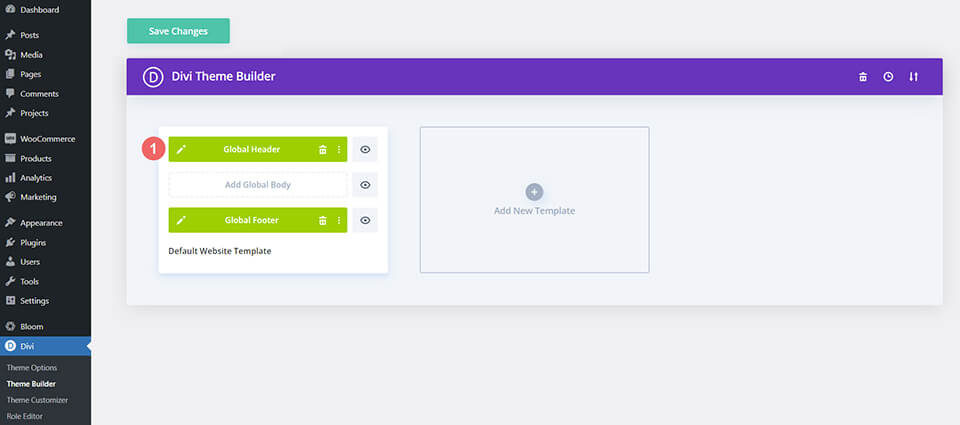
    Go to Divi Theme Builder

    To upload the template, navigate to the Divi Theme Builder in the backend of your WordPress website.

    Open Divi Theme Builder

    Upload The Divi Interior Designer Template’s Header

    Then, in the top right corner, you’ll see an icon with two arrows. Click on the icon.

    Import the template into the Divi Theme Builder

    Navigate to the import tab, upload the JSON file which you were able to download in this post, and click on ‘Import Divi Theme Builder Templates’.

    Finish importing the template into the Divi Theme Builder

    Save Divi Theme Builder Changes

    Once you’ve uploaded the file, you’ll notice a new global header and footer in your default website template. Next, save the Divi Theme Builder changes as soon as you want the template to be activated.

    Save Divi Theme Builder Changes

    How to Modify The Template

    Open Header Template

    To modify the global header template’s elements, start by opening the template.

    Open Header Template

    Update Your Logo

    Replace the default template’s logo with your logo. If your background will be a light color, ensure that the logo you upload has a transparent background and is dark. If the background of the logo section will be dark, ensure that your logo is a light, transparent background.

    Change your llogo

    Select Menu of Choice

    Select a menu of your choice in the Menu Module.

    Choose your menu

    Add CTA Link URLs

    This header has a button on the right. Open the settings menu to update the link URL to the destination of your choice.

    Add CTA Link URLs

    Add Social Media Accounts and Links

    On the left hand side, we have a Social Media Follow Module. Update the module with your chosen social media networks. Don’t forget to input the correct links for your various accounts!

    Update and Add Social Media Accounts and Links

    Open the Divi Interior Designer Template Footer Template

    Continue by opening the global footer inside the default website template.

    Open Footer Template

    Update Footer Logo

    Update the Image Module with your own logo.

    Update Footer Logo

    Modify the Divi Interior Designer Template’s Static Content

    You will need to go through and update the content of the footer, including adding your own call-to-action text, link URLs, and social media networks. Don’t forget about the copyright text at the bottom of the footer as well.

    Modify the Divi Interior Designer Template's Static Content

    New Freebies Every Week!

    We hope you’ve enjoyed the Interior Designer Layout Pack and the Header & Footer freebie that goes along with it. We look forward to hearing your opinions in the comment section below. Make sure you check back next week for more freebies!

    The post Download a FREE Header & Footer for Divi’s Interior Designer Layout Pack appeared first on Elegant Themes Blog.

  • Download a FREE Header & Footer for Divi’s Hostel Layout Pack

    Hey Divi Nation! Thanks for joining us for the next installment of our weekly Divi Design Initiative where each week, we give away brand new freebies. We recently shared a Hostel Layout Pack. To help you get your website up and running as soon as possible, we’re sharing a global header & footer template that matches this layout pack perfectly as well! Hope you enjoy it.

    divi layout

    Check Out The Divi Hostel Template’s
    Global Header & Footer Below

    Get it for free today!

    Header Design

    Desktop View

    Divi Hostel Header template preview for desktop

    Tablet and Mobile View

    Divi Hostel Header template preview for tablet and mobile

    Footer Design

    Desktop View

    Divi Hostel Footer Template preview for desktop

    Tablet and Mobile View

    Divi Hostel Footer Template preview for tablet and mobile

    Download The Global Header & Footer Template For The Hostel Layout Pack

    To lay your hands on the free global header & footer template, you will first need to download it using the button below. To gain access to the download you will need to subscribe to our newsletter by using the form below. As a new subscriber, you will receive even more Divi goodness and a free Divi Layout pack every Monday! If you’re already on the list, simply enter your email address below and click download. You will not be “resubscribed” or receive extra emails.

    How to Upload The Divi Hostel Template

    Go to Divi Theme Builder

    To upload the template, navigate to the Divi Theme Builder in the backend of your WordPress website.

    Getting started with the Divi Conference Layout Pack

    Upload Global Default Website Template

    Then, in the top right corner, you’ll see an icon with two arrows. Click on the icon.

    Importing the Header and Footer Layout into the Divi Theme Buidler

    Navigate to the import tab, upload the JSON file which you were able to download in this post, and click on ‘Import Divi Theme Builder Templates’.

    Import settings for the header and footer layout pack

    Save Divi Theme Builder Changes

    Once you’ve uploaded the file, you’ll notice a new global header and footer in your default website template. Save the Divi Theme Builder changes as soon as you want the template to be activated.

    Save global header theme builder

    How to Modify The Divi Hostel Template

    Open Header Template

    To modify the global header template’s elements, start by opening the template.

    Editing the global header within the Divi Theme Builder

    Update Your Logo Image

    We use an Image Module to showcase our website’s logo. Thus, you will need to update the logo file within the Image Module to be your own logo.

    Update and add your logo into the Image Module

    Update Text Module Call-to-Action

    We have a Text Module within the second column which acts as a call-to-action within the Divi Hostel Header Template. You can use this area to share your slogan, a phone number, a testimonial and so much more!

    Update Text Module Call-to-Action within the Divi Hostel Header Template

    Select Menu of Choice for the Header of Your Divi Hostel Template

    Select the menu that you’ll be using as your main menu within the Menu Module.

    Choose your menu for the Divi Hostel template

    Update Social Media Icons and Links

    There is a Social Media Follow Module within this header, under the Menu Module. Ensure that you’ve updated the module with the social media accounts that you use. In addition to that, add the link URLs for each social media network to the module.

    Update social media links and accounts with your accounts

    Open the Footer of the Divi Template

    Continue by opening the global footer inside the default website template.

    Editing the footer template within the Divi Theme Builder

    Connect and Activate Email Optin Module

    The footer of the Divi Hostel Template has an Email Optin Module that needs to be activated. Connect your email marketing solution of choice to the module so that you can gather email addresses for your business. Remember to test your email optin to be certain that you are gathering your user information correctly.

    Select Menu of Choice for the Footer Menu

    The footer of the Divi Hostel Template also has a Menu Module. Please update it with the menu that you would like to use in your footer.

    Update footer Menu Module in the Divi Hostel template

    Update Blurb Modules

    Multiple Blurb Modules are used to showcase contact information. Update the content within each blurb to meet your needs. You can even go a step further and add a module link to the Blurb Modules to make them active.

    Update Footer Blurb Modules

    Update Static Content

    You will need to go through the footer of the Divi Hostel Template and update the static content of the footer, namely the titles of modules and adjusted any dummy text that’s included in the template.

    Update the Divi Hostel template footer static content modules

    New Freebies Every Week!

    We hope you’ve enjoyed the Hostel Layout Pack and the Header & Footer freebie that goes along with it. We look forward to hearing your opinions in the comment section below. Make sure you check back next week for more freebies!

    The post Download a FREE Header & Footer for Divi’s Hostel Layout Pack appeared first on Elegant Themes Blog.

  • How to Set Up Your Divi Contact Form

    A contact form is a great feature to add to a website. As a business owner, you could use a contact form to allow potential customers to send a message. As an influencer, setting up a contact form on a website can open doors for brand deals. A contact form has a variety of uses from collecting information from website visitors to allowing viewers to connect. Of course, inside Divi, you can find a customizable Contact Form Module that you can use for the websites you build.

    Let us go through several things to consider as you embark on setting up a contact form in Divi. We will be using the Contact Page Layout from within the Print Designer Layout Pack.

    Adding Your Fields: Let’s Get Organized

    There isn’t a one-size-fits-all solution when it comes to setting up a contact form in Divi. Nevertheless, you do need to have an idea of what the purpose of your form will be. The types of fields that you’ll use within the Divi Contact Form Module will assist you in ensuring that you are collecting the relevant data from your website visitors. The Divi Contact Form Module comes equipped with six (6) field types that you can use within your form.

    The Divi Contact Form Module Fields

    Input Field: The input field is one of the most common form fields that you will use in your form. It allows users to enter short answers to questions. An example of an input field could be “First Name”.

    Email Field: A pretty self-explanatory field, the email field allows you to collect an email address within your form. You may need to add this field to your form if you intend to reach out to the user who submitted the form.

    Text Area: Similar to the input field, the text area field allows users to input in text. However, the text area field allows them to write quite a bit more than within an input field. An example of when you might use a text area field might be if you are looking to collect information about a project that a client may want to send to you.

    Checkboxes: Checkboxes allow users to make multiple selections from a list of options that you provide. You could use a checkbox field if you needed a custom field to select several different flavors for the cake they will be ordering through your contact form.

    Radio Buttons: Like a checkbox, a radio button provides users with a variety of choices to make a selection from. Unlike checkboxes, a radio button allows users to make only one selection out of the options that you have provided for them.

    Select Dropdown: A dropdown field allows website users to make a selection from a select list of options. Though checkboxes, radio buttons, and dropdowns all provide users with the option of selecting from a list of items, their uses will depend on the question that you are asking as well as the answer you are hoping to receive from them.

    Field options for the Divi Contact Form Module

    Planning Your Form Offline

    Now that you know a little bit about the different types of fields that can be used within the Divi contact form module, it’s time to plan out what your form fields will be. You can use something as simple as pen and paper, or even a Google Doc to first determine the purpose of your form. From your purpose, you’ll be able to plan out what the necessary fields would be for you to add to your form. After that, you’ll need to select the appropriate field for that question.

    As an example, you wouldn’t use the text area field to simply collect the name on a form. Similarly, you wouldn’t use the dropdown field to collect someone’s email address. Careful planning with your form will set you up for success when building your website. This will also create a good user experience for potential website viewers.

    Deciding Which Fields We Want To Make Mandatory

    After you’ve decided on the fields that you’d like to add to your form, consider the fields users must fill in to submit your form. Why would you want to make a field mandatory you ask? Let’s go back to our contact form plan that we created with pen and paper. If we are an influencer, we would want to have the name of the person who is reaching out to us. We would want to make the name field mandatory so that we can properly address the person who is sending us a potential brand deal.

    Alternatively, we may want to make the email address field mandatory as well. This will allow you  to reach back out to this person. However, we may want to make the telephone field optional, in case they have an international number or we don’t want to get too personal and intrusive. In this case, you’d make the name fields and the email address fields mandatory in your form to ensure that you can properly communicate with the person once they have filled out and submitted their form.

    Setting up mandatory fields within the Divi Contact Form Module

    Setting up Our Email Address

    We now know what fields we’ll be using within our form and we know which fields we need to make mandatory so that we can collect the relevant information from users. Next up, we need to set up our email address. By default, all form entries from a Divi contact form will be emailed to the email address that you input within the email section under the content tab. It’s important to have an email address that you’ll easily have access to to collect the entries from this form. You would enter in said email address within the content tab of the contact form module. You can add multiple email addresses to the email field by separating them with a comma.

    Setting up the email address to receive submissions from the Divi Contact Form Module

    Creating a Message Pattern

    Next, you want to be able to properly read the content of the form submission that was just sent to you. To do this, you’ll need to keep track of the field ID that you used for each of the form fields that you created. You can easily find the field ID of each form field by editing the form field. The message pattern textbox allows you to control the content of the email that you receive as the website owner. Using the field ID, you can craft a clear and coherent message to yourself.

    Creating a message patten while setting up the Divi Contact Form Module

    Security: How To Prevent Spam

    For as long as can be remembered, spam has been a problem on the internet, and your website may get its fair share. However, there are spam protection services available that can help make your life a bit easier. The Divi Contact Form Module is able to integrate into reCaptcha. reCaptcha is an internet service that protects forms and websites from pesky spammers. You can connect your account to the form module. Usually, a small arrow will appear on the frontend of your site to show that your site is protected.

    Spam protection while setting up the Divi Contact Form Module

    Adding a Success Message

    After the form has been submitted, there are several other factors to bear in mind. Firstly, You can decide to have a success message briefly shown to those who have successfully submitted the form. You can determine this message by filling out the success message field within the text dropdown in the content tab. Alternatively, you can enable the redirect URL switch to have the user sent to an entirely different page all together. The choice is yours. Please bear in mind however the overall purpose and use of your form.

    Setting up a success message and post submit processes for the Divi Contact Form Module

    Making Sure the Design Matches Your Website

    By default, your Divi contact form will come with a white background and will inherit the button style that has been set for it via the Customize tab under Appearance > Customize. However, you shouldn’t let that stop you from having a rad contact form!

    Some of the ways that you can make your contact form stand out include:

    • Adding a border: Adding a colored border to your form fields can add interest.  This can in turn encourage more people to fill out your form. If you’re using your form to collect leads, product orders, etc. This is a great thing!
    • Changing the focus color: You can change the focus color of your form fields. When someone clicks into a field, it will now have a different styling. This is another way to build interest in your form.
    • Playing with the length of the field
    • Adding hover effects to the submit button: It is recommended to style all buttons across your website based on their use and importance. This also applies to your contact forms’ submit button! Don’t neglect to style this field. You can even go a step further and add some hover and animation effects to it!

    At the end of the day, it is ideal that you should customize and style your contact form to match the rest of the branding of your website.

    If you’d like, you can add a title to your form. This will take on the default heading styling of your website. However, you can use the design tab within the contact form module to style this differently. It’s always a good idea to maintain your branding on the various modules throughout your website. You can also consider changing the wording of the submit button to something other than the word submit.

    Ending Thoughts on Setting up Your Divi Contact Form

    Having a contact form on your website can greatly encourage your users to interact with you. From taking orders to collecting feedback, your contact form provides a means for communication between you and your site visitors By styling it, correcting, securing it, and making it simple for you to collect information, using the Divi contact form module on your site today can help you have a better website, blog and online store.

    The post How to Set Up Your Divi Contact Form appeared first on Elegant Themes Blog.

  • Download a FREE Blog Post Template for Divi’s Interior Designer Layout Pack

    Hey Divi Creators! Thanks for joining us for the next installment of our weekly Divi Design Initiative where each week, we give away brand new freebies. This time around we’re building upon the Interior Designer Layout Pack with a brand new blog post template that matches the rest of the pack perfectly. Hope you enjoy it!

    divi layout

    Check Out The Interior Designer
    Blog Post Template Below

    Get it for free today!

    Desktop View

    Desktop view of the Divi Interior Designer Blog Post Template

    Tablet and Mobile

    Download The Blog Post Template For The Interior Designer Layout Pack

    To lay your hands on the free Interior Designer Blog Post Template, you will first need to download it using the button below. To gain access to the download you will need to subscribe to our newsletter by using the form below. As a new subscriber, you will receive even more Divi goodness and a free Divi Layout pack every Monday! If you’re already on the list, simply enter your email address below and click download. You will not be “resubscribed” or receive extra emails.

    How to Upload The Interior Designer Blog Post Template

    Go to Divi Theme Builder

    To upload the template, navigate to the Divi Theme Builder in the backend of your WordPress website.

    Open Divi Theme Builder

    Upload Website Template

    Then, in the top right corner, you’ll see an icon with two arrows. Click on the icon.

    Import the template into the Divi Theme Builder

    Navigate to the import tab, upload the JSON file that you could download in this post, and click on ‘Import Divi Theme Builder Templates’.

    Finish importing the template into the Divi Theme Builder

    Save Divi Theme Builder Changes

    Once you’ve uploaded the file, you’ll notice a new template with a new body area that has been assigned to All Posts. Save the Divi Theme Builder changes as soon as you want the template to be activated.

    Save Your Blog Post Template

    How to Modify The Template

    Open Interior Designer Blog Post Template

    To modify the template’s elements, start by opening the template.

    Edit blog post template

    Inside the Body Layout Editor, you can edit the design on the front end using the Divi Builder just like you would with a normal Divi page.

    Since this is a template that has been assigned to all posts for the site, there is a post content module that is necessary for displaying the post content. You will need to keep that module in place, but you can adjust the post content module’s design elements, which will design the post content that is displayed dynamically.

    Update Post Content Module

    About the Divi Interior Designer Blog Post Template

    This blog post template has a lot of dynamic elements that will work with your blog posts immediately, in addition to the Post Content Module. This content won’t need updating, but you can tweak the design of each of those elements if needed.

    Other dynamic elements include the following:

    • Featured Image: We use two Image Modules to show the featured image of the post.
    • Post Category: Displays the category/ies that the blog post is found within. This is a Blurb Module.
    • Post Title: A Text Module is used to show the title of the blog post.
    • Post Author Name: Displays the name of the blog post author. We use a Blurb Module with an image for this.
    • Post Content Module: Displays the post content added when editing the post on the backend of WordPress.
    • Post Navigation: Provides previous and next buttons to read other posts within the category of the post.
    • Blog Post Module: Displays the most recent posts that share the same category using the Blog Module.
    • Comments Module: A functional comment area for the post.

    Here is a quick illustration that identifies the elements of the Interior Designer Blog Post Template.

    Interior Designer Blog Post Template

    New Freebies Every Week!

    We hope you’ve enjoyed the Interior Designer Layout Pack and the blog post template freebie that goes along with it. We look forward to hearing your opinions in the comment section below. Make sure you check back next week for more freebies!

    The post Download a FREE Blog Post Template for Divi’s Interior Designer Layout Pack appeared first on Elegant Themes Blog.

  • 5 Ways to Style the Avatar in Divi’s Comments Module

    The comments section of your blog posts — or pages — in WordPress allows you to have meaningful discussions with users and readers of your site. There was a time when the comments section of our favorite websites was a place to connect with one another. With the slow demise of some social media platforms, many are turning back to creating blogs. With this in mind, we can use this opportunity to beautify our comments section.

    In today’s tutorial, we’re focusing on styling the comment avatar in Divi. However, let’s take a look at some of the other elements of Divi’s Comments Module that we can style.

    Elements of Divi’s Comments Module

    Divi’s Comments Module has quite some elements. One can use the module to both showcase comments and submit comments. The module also shows how many comments have been submitted, along with the name and photo of the comment submitter. Here’s a look at the various elements of the module:

    A breakdown of the Divi Comments Module and its various components

    In order, here’s what each numbered section corresponds to:

    1. Name of the comment author
    2. The comment itself
    3. The avatar of the comment author
    4. Metadata of the comment (date, time posted etc.)
    5. Reply button
    6. Submit a comment form

    Within the Design Tab of the Comments Module, you can see that we have many options that we can use interchangeably to style the various aspects of the module.

    Settings within the Comments Module Design Tab

    Styling the Comment Avatar in Divi

    Within the Comments Module settings, we’ll be spending most of our time in the Design and Advanced tab. We will be using the built-in features to lay the framework for styling the comment avatar in Divi. Afterward, we will use a few snippets of CSS to bring our vision to life. For this tutorial, we will be using freebies that are available in the Divi Resources section of our blog. When it comes to styling any aspect of your site, it’s imperative to draw inspiration from the design that you’ve created. This helps there to be cohesion in your work and causes you to build stronger brand awareness with your audience.

    You can see how we plan on doing this through the examples below:

    First Example: Divi Stone Factory

    Divi Stone Factory Blog Layout with Comments Avatar Styled

    Second Example: Divi Consultant

    Divi Consultant Blog Layout with Comments Avatar Styled

    Third Example: Home Care

    Divi Home Care Blog Layout with Comments Avatar Styled

    Fourth Example: Divi NGO

    Divi NGO Blog Layout with Comments Avatar Styled

    Fifth Example: Divi Data Science

    Divi Data Science Blog Layout with Comments Avatar Styled

    For each of these examples, we pull inspiration from assets and designs that are already within the layout template. By doing this we ensure that as we are styling the comment avatar in Divi, we are still speaking to the overall design of our chosen layout.

    Let’s jump into the first example!

    Styling the Comment Avatar in Divi ft. Divi Stone Factory

    Firstly, you will need to follow the instructions in this blog post to download and install the Blog Post Template for the Divi Stone Factory Layout Pack.

    Identifying Inspiration Before Styling the Comment Avatar in Divi

    A major key in this tutorial is to become familiar with drawing inspiration from a design and applying that to the styling throughout a layout. In our case, we’ll be taking inspiration from the way that the featured image is styled. Let’s bring the same idea to our Comments Avatar.

    Divi Stone Factory comment avatar design inspiration from featured image styling

    Open Comments Module Settings

    Once your layout is installed, scroll down to the Comments module and open the settings.

    Entering the comments module settings menu

    Add Border to Avatar Image

    Navigate to the Design tab. Click on the Image tab. Scroll down to Image Border Styles and select the first icon for All Borders. Next, add an Image Border Width of 10px and an Image Border Color of #FFFFFF. We also want to keep the Image Border Style at Solid.

    Adding a border to the comments avatar

    Image Settings:

    • Image Border Styles: All borders
    • Image Border Width: 10px
    • Image Border Color: #FFFFFF
    • Image Border Style: Solid

    Add Image Box Shadow

    Add an Image Box Shadow to your avatar. Adjust the Horizontal and Vertical Position to -10px.  Next, make the Shadow Color #000000.

    Avatar box shadow settings

    Image Box Settings:

    • Image Box Shadow: Shadow #4
    • Box Shadow Horizontal Position: -10px
    • Box Shadow Vertical Position: -10px
    • Shadow Color: #000000

    Add Custom CSS

    Taking a look at our avatar as it stands now, it slightly overlaps the comment body. We’re also missing a thinner border around the image. We’re going to add this in with CSS in the Advanced tab of the Comments settings modal.

    Finishing touches for comment avatar

    Navigate to the Advanced tab within the Comments Module settings. Add the following snippets of CSS to the Comment Meta, Comment Content, and Comment Avatar

    Custom CSS

    Comment Meta:

    margin-left: 15px;
    

    Comment Content:

    margin-left: 15px;
    

    Comment Avatar:

    border: 1px solid #000000;
    

    Custom CSS for the Stone Factory Comment Module's Avatar

    A left margin is added to the comment content and meta so that the added border to the avatar doesn’t cover the comment text and meta information. We add another border to the comment avatar to replicate the design that was found with the featured image.

    With all that said, let’s move on to example number two with the Divi Consultant Layout Pack!

    Example Two: Styling the Comment Avatar in Divi with the Divi Consultant Blog Post Template

    For our second example, we’ll be taking our inspiration for the comment avatar from a design element that is used within this layout pack.

    Design inspiration within the Divi Consultant Layout Pack

    Changing Avatar Shape with CSS Borders

    Firstly, we’re going to scroll down to the Comments Module and enter into the settings menu. Secondly, we’re going to navigate to the Design tab. Within the Design tab, let’s click on the Image tab to start making our border changes. Firstly, let’s make Rounded Corners on our avatar with a value of 55px. This will make our avatar a circle. Next, we’ll add a 2px, solid border in black.

    Adding rounded corners to make our avatar a circle

    Image Settings:

    • Image Rounded Corners: 55px, all corners, linked
    • Image Border Styles: All borders
    • Image Border Width: 2px
    • Image Border Color: #000000

    Adding an Accent to Our Avatar

    Now, we’re going to add a cute blue accent to our avatar. We will be using the Box Shadow setting to create a circle that’ll appear behind each avatar. Notice how this calls back to the inspiration that we took from the image used within the header. To do this, we’ll keep on scrolling through the Image tab till we get to the Image Box Shadow. Here, we’re going to select the first option, which is a soft glow. However, we’re going to adjust the settings to turn this into a circle!

    Adding an accent to our avatar by using Box Shadow settings

    Box Shadow Settings:

    • Image Box Shadow: Shadow #1
    • Box Shadow Horizontal Position: -30px
    • Box Shadow Vertical Position: -30px
    • Box Shadow Blur Strength: 0px
    • Box Shadow Spread Strength: -28px
    • Shadow Color: #3093fb

    Luckily, in this example, there was no need to use any custom CSS! Our avatar was styled completely using settings found natively within the Divi Builder.

    Divi Home Care: Our Third Example of Styling the Avatar within the Divi Comments Module

    In our third example, we’ll be using the Divi Home Care Blog Post Layout. Looking at the call-to-action section within this layout, let’s imitate the orange and yellow boxes for our comments avatar.

    Divi Home Care design inspiration for our avatar

    Shaping Our Comments Avatar with Rounded Corners

    The use of rounded corners will give our avatar an interesting shape. However, we will only apply rounded corners to the top left and top right corners. Both of these will be receiving a radius of 25px. The bottom right and bottom left corners will remain untouched with a radius of 0px. Make sure that you have unchecked the link icon within the border-radius box. This will allow us to have different settings for each corner of our image.

    Adjusting rounded corners to create unique shapes for our avatar

    Image Border Settings:

    • Image Rounded Corners: 25 px 25px 0px 0px (clockwise, unlinked)
    • Image Border Styles: All borders

    Adding a Border

    Now, we’re going to add a border. This will call to the Email Optin module in the header of this Blog Post Template.

    Styling the avatar's border

    Let’s notice something. After we’ve added our border settings, the border now overlaps over the comment body as well as the comment author and meta information. We’re going to rectify this by using a few lines of CSS within the Advanced tab of the module.

    Adding custom CSS to make comment readiable

    Custom CSS

    Comment Meta:

    margin-left: 15px;
    

    Comment Content:

    margin-left: 15px;
    

    These two simple lines of code help to add some breathing room around our avatar image… while also allowing us to read the comments clearly!

    Styling the Comment Avatar in Divi ft. Divi NGO

    For our fourth example, we’ll be using the Divi NGO Blog Post Template. Notice the styling of the avatar’s profile photo. This is what we’ll be emulating for the avatar within our Comment Module.

    Pulling inspiration for our tutorial from elements within the layout pack

    Adding Rounded Corners to Our Avatar

    Similar to some of our previous examples, we’ll be employing the use of Divi’s Rounded Corner features to style our avatar. In our case, we’ll be making all the corners of this avatar 20px.

    Creating rounded corners for our Divi NGO comments avatar

    Image Settings:

    • Image Rounded Corners: 20px (all corners, linked)

    Adding a Box Shadow

    The second part of this styling is to add a solid, opaque box shadow behind our avatar. We’ll be using the same color as the author’s photo, to keep our branding seamless throughout this template. We’ll be using the fourth box shadow option, and using the default Divi settings for this shadow.

    Adding our box shadow settings to our avatar

    Box Shadow Settings:

    • Image Box Shadow: Shadow #4
    • Box Shadow Horizontal Position: 10px
    • Box Shadow Vertical Position: 10px
    • Box Shadow Blur Strength: 0px
    • Box Shadow Spread Strength: 0px
    • Shadow Color: #347362

    Due to the positioning of the shadow, we won’t be needing any custom CSS on this example either.

    Final Example: Divi Data Science Blog Layout

    Our fifth and last example of styling the comment avatar in Divi will be using the Divi Data Science Blog Layout Pack. As in previous examples, we’ll be drawing our inspiration from the styling of the featured image within this layout pack.

    Featured image inspiration for our Comments avatar

    Therefore, we know that we’ll be adding a thick white border and some box shadow to our Comment avatar.

    Adding a Border to our Comment Avatar

    This avatar will remain a square, however, we will be adding a border to it. Let’s go ahead and scroll down to the Image tab, and add a white border to our image.

    Adding a border to the comment avatar

    Image Border Settings:

    • Image Border Styles: All borders
    • Image Border Width: 10px
    • Image Border Color: #000000
    • Image Border Style: Solid

    Adding Shadow to Our Avatar

    In this tutorial also, we’ll be using the default Divi Box Shadow setting to add a shadow to our Comment avatar. We’ll be using Box Shadow option 3.

    Using the default box shadow settings

    Box Shadow Settings:

    • Image Box Shadow: Shadow #3
    • Box Shadow Horizontal Position: 0px
    • Box Shadow Vertical Position: 12px
    • Box Shadow Blur Strength: 18px
    • Box Shadow Spread Strength: -6px
    • Shadow Color: rgba(0,0,0,0.3)

    To prevent our newly styled avatar from covering up our comment information, we’re going to add a few lines of CSS to clean our design up.

    Cleaning up the Comment avatar with custom CSS

    Custom CSS:

    Comment Body:

    margin-top: 50px;
    

    Comment Meta:

    margin-left: 15px;
    

    Comment Content:

    margin-left: 15px;
    

    Bringing it All Together

    The comment avatar is a small piece of a module that can be customized deeply with CSS and Divi’s native tools. Don’t forget to look to your design to draw inspiration from. Through this inspiration, endless designs can be created that speak for your brand!

    The post 5 Ways to Style the Avatar in Divi’s Comments Module appeared first on Elegant Themes Blog.

  • Download a FREE Blog Post Template for Divi’s Chocolatier Layout Pack

    Hey Divi Creators! Thanks for joining us for the next installment of our weekly Divi Design Initiative where each week, we give away brand new freebies. This time around we’re building upon the Chocolatier Layout Pack with a brand new blog post template that matches the rest of the pack perfectly. Hope you enjoy it!

    divi layout

    Check Out The Chocolatier
    Blog Post Template Below

    Get it for free today!

    Desktop View

    The Divi Chocolatier Blog Template in desktop view

    Tablet/Mobile View

    The Divi Chocolatier Blog Template in tablet and mobile view

    Download The Blog Post Template For The Chocolatier Layout Pack

    To lay your hands on the free Chocolatier Blog Post Template, you will first need to download it using the button below. To gain access to the download you will need to subscribe to our newsletter by using the form below. As a new subscriber, you will receive even more Divi goodness and a free Divi Layout pack every Monday! If you’re already on the list, simply enter your email address below and click download. You will not be “resubscribed” or receive extra emails.

    How to Upload The Template

    Go to Divi Theme Builder

    To upload the template, navigate to the Divi Theme Builder in the backend of your WordPress website.

    Opening the Divi Theme Builder to Import the Divi Conference Category Layout

    Upload Website Template

    Then, in the top right corner, you’ll see an icon with two arrows. Click on the icon.

    Importing the Header and Footer Layout into the Divi Theme Buidler

    Navigate to the import tab, upload the JSON file that you could download in this post, and click on ‘Import Divi Theme Builder Templates’.

    Import settings for the header and footer layout pack

    Save Divi Theme Builder Changes

    Once you’ve uploaded the file, you’ll notice a new template with a new body area that has been assigned to All Posts. Save the Divi Theme Builder changes as soon as you want the template to be activated.

    Save the imported blog post layout within the Divi Theme Builder

    How to Modify The Template

    Open Post Template

    To modify the template’s elements, start by opening the template.

    Begin editing the blog post body template within the Divi Builder

    Inside the Body Layout Editor, you can edit the design on the front end using the Divi Builder just like you would with a normal Divi page.

    Since this is a template that has been assigned to all posts for the site, there is a post content module that is necessary for displaying the post content. You will need to keep that module in place, but you can adjust the post content module’s design elements, which will design the post content that is displayed dynamically.

    You can edit the titles, fonts, color etc. of the Post Content Module that will affect the body text in the Divi Chocolatier Blog Page Template

    About the Layout

    This blog post template has a few dynamic elements that will work with your blog posts immediately. Our entire post header is made up of dynamic elements including a featured image, the post excerpt, the post category and the post title. This content won’t need updating, but you can tweak the design of each of those elements if needed.

    Other dynamic elements include the following:

    • Post Author Name: We use a Text Module to show the first and last name of the post author
    • Post Author Bio: Again, we use a Text Module to show the author bio
    • Post Author Photo: An Image Module is in use to bring in the author profile photo from Gravatar
    • Comments: A comment form with a comments section

    Here is a quick illustration that identifies the elements of the Divi Chocolatier blog post template.

    Divi Chocolatier Blog Post Template Breakdown

    Update Static Content Modules

    There are some elements on this post template may need your immediate attention before using it live on your own website. For this post template, you may want to consider updating the Text and  Button modules that are used as call-to-actions above the comments section.

    New Freebies Every Week!

    We hope you’ve enjoyed the Chocolatier Layout Pack and the blog post template freebie that goes along with it. We look forward to hearing your opinions in the comment section below. Make sure you check back next week for more freebies!

    The post Download a FREE Blog Post Template for Divi’s Chocolatier Layout Pack appeared first on Elegant Themes Blog.

  • How to Duplicate a Page in WordPress (3 Simple Ways)

    As we all know, WordPress is a powerful tool that allows users to build websites. You can create articles (more commonly known as blogs or blog posts), upload documents, manage images and so much more. What started out as a blogging platform, has grown over the years into the content management system (CMS) of choice for more than one-third of the internet.

    However, amidst the many features that WordPress can boast of (like full-site editing), you aren’t able to duplicate a post or page out of the box. It seems like a slight oversight, but not one that we can’t fix ourselves. In this article, we’ll go over three easy ways that you can use to duplicate a page in WordPress.

    Reasons to Duplicate a Page

    There are many reasons why one may want to duplicate a page or post in WordPress. An example might be that you’ve built a really awesome landing page for a new product that you’re launching. However, you may want to do some A/B testing for some Facebook ads that you’re running to promote this product. As opposed to redoing all your hard work again, you can simply duplicate said page, make some slight tweaks and cut your design time all the way down.

    Another reason to duplicate a page is to help with your design process. If you have a really large site, you may need to duplicate a number of pages to add additional content for other members of your team. If you had to re-create each page repeatedly, you could slow down your design process which could lead to timelines being missed. Not to mention that you might leave some of your teammates a tad bit upset. As such, having a quick and easy way to duplicate pages is something that can come in handy in your day-to-day while working on your WordPress website. This is one of the reasons we added the Divi Cloud feature in Divi. With it, you can store all kinds of page layouts and more to speed up the design process.

    Watch Out for Duplicate Content

    Duplicating a page in WordPress should always be a means to an end. You don’t want to have two pages with the same content live on your site. This is bad practice and will have a negative effect on SEO. To learn more, check out our ultimate guide on duplicate content and SEO.

    How to Duplicate a WordPress Page (Step-by-Step)

    Now that we know why one would want to duplicate a page, let’s get into the three different ways that you can duplicate a page on your latest WordPress project.

    1. Duplicating a Page Using a WordPress Plugin

    There are a number of WordPress plugins that can be used to duplicate pages on WordPress. Always bear in mind what features you are looking for as well as the ratings and reviews of a plugin before installing it onto your WordPress website. Bearing all these things in mind, for this tutorial, we’ll be using the free version of the Duplicate Page plugin.

    To install the plugin, follow these steps:

    1. In the left-hand menu, click Plugins, and then click Add New
    2. In the search field that appears at the top right of the screen, type duplicate page
    3. Look for the Duplicate Page plugin, and then click Install Now

    Steps to duplicate a page in WordPress using a plugin

    Once the plugin is installed and activated, navigate to the Pages section of your website. To navigate there, click Pages and then click All Pages from the left-hand menu. Now, you will notice that when you hover over the name of a page, an additional menu item has been added titled Duplicate This.

    Using the newly added Duplicate This button from the plugin just installed

    Once you are ready to duplicate your page, simply click the Duplicate This link under the page listing that you would like to duplicate. That’s it!

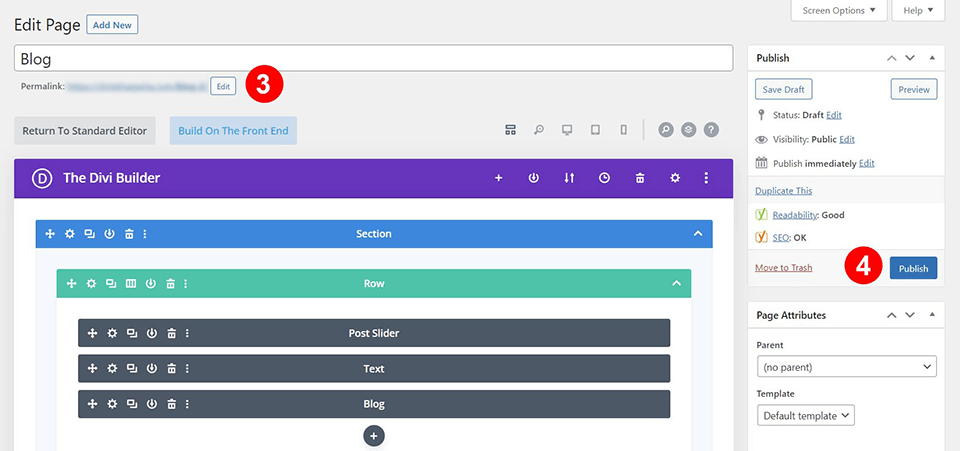
    After that, you can edit the new duplicate page as needed. Make sure to edit the permalink for the new page. As it’s a duplicate, the permalink URL will also be copied over so ensure to edit it to match your new content.

    Remember to change your permalinks after duplicating a page!

    It is a good idea to visit the Duplicate Page plugin’s settings to make sure it is functioning the way you need it to.

    Duplicate Page Plugin - Settings Page

    The options allow you to control how you want pages to be duplicated and where you want the duplicate page link to be displayed.

    2. Duplicating a Page in WordPress with Divi

    For Divi users, you can easily duplicate pages (or templates) in WordPress. When using the Divi Builder, you have a built-in option to duplicate (or clone) existing pages in WordPress whenever you create a new page.

    Cloning an Existing Page Using the Divi Builder

    To duplicate a WordPress page in Divi, simply click to use the Divi Builder when editing a new page.

    When you click to use the Divi Builder to edit a page, you will see a popup that gives you three options as to how to proceed with your new page. The option we’re interested in is the third and last option, Clone Existing Page.

    Duplicating a page in WordPress using the Divi new page popup

    Once you select the clone existing page option, you will see all the existing pages within your site that you can choose to clone.

    select duplicate page in Divi Library

    Simply select the page from the list and the page will be duplicated and ready to edit. You won’t need to change the permalink as you’ll be working from a brand new page.

    Using Divi Layouts

    One of the great features of Divi is easy it is to add, create, and manage page layouts. A page layout contains the entire page design and content. Divi comes with over a thousand pre-made page layouts to jumpstart your page design and content. Plus, you can save your custom page layouts in your Divi Library for later use. Or you can save them to your Divi Cloud and duplicate cloud items all in one place. This takes the process of duplicating pages to a whole new level!

    3. Duplicating a Page in WordPress Manually: Copy and Paste

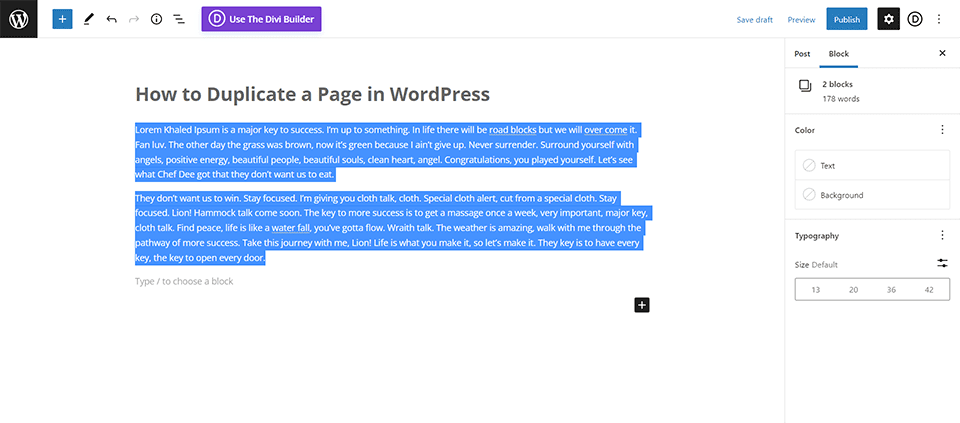
    To duplicate a page in WordPress manually, you can simply go into your page and copy the content within that page. Then paste the content into a newly created page.

    Copy and pasting content also allows you to duplicate the contents of a page in WordPress

    Here’s how to do it. First, navigate to All Pages.

    Navigate to All Pages

    Once you have your list of pages, here’s what happens next:

    1. From the list of pages, hover over the page that you’d like to edit.
    2. Then, select Edit under the page that you would like to duplicate

    Edit all pages

    After you have entered the page editor, do the following steps:

    1. Next, highlight all the content within the main content area.
    2. Using your mouse, move over to the highlighted content and right-click. Then, select Copy from your system menu.
    3. Towards the top of the page, click on the WordPress icon. This will take you back to the All Pages screen.

    Right Click Copy and Go Back to the All Pages screen

    You will now need to create your new page by clicking on the Add New button from this screen.

    Add new page

    Once you have a new, blank page in front of you, using your mouse, right-click, then press Paste. This will bring the content from the former page into this new page. Make any necessary edits that you need to make, and then click Publish from the Publish box at the top right-hand side of the page.

    TIP: If you used any special code within the page, it would be ideal to switch to the text/HTML tab editor to ensure that you are copying the code used on the page, in addition to the written content.

    In Conclusion

    While WordPress doesn’t have an out-of-the-box solution to duplicate pages, it is not something that is out of the question. With handy tools like Duplicate Page plugin and the Divi Builder, plugins and maybe even a bit of code here and there, you’ll be able to speed up your process, create content faster and copy pages across your WordPress install with ease.

    Do you have a favorite method for duplicating pages in WordPress? Let us know in the comments below!

    The post How to Duplicate a Page in WordPress (3 Simple Ways) appeared first on Elegant Themes Blog.

  • Today is Your Last Chance to Save During Our Cyber Monday Sale

    Time is running out and our Cyber Monday sale is almost over. This is your last chance in 2022 to get the best prices we’ve ever offered on Divi and the entire Divi Ecosystem of products and services. Save 25% on Divi, 44% on Divi Cloud and Divi Teams, and up to 60% off on our curated Divi Marketplace bundles and select products. Now is your chance to take advantage of these amazing discounts. Once the sale is over, the discounts, bundles, and freebies are all gone. What are you waiting for? Fill up your cart now and experience Divi like never before!

    TAKE ME TO THE SALE!

    Get 25% Off Divi Before Our Cyber Monday Sale Ends

    Save 25% on Divi, the ultimate WordPress Page Builder during these final hours of our Cyber Monday sale. More than 800,000 people trust Divi to build their websites, blogs, and online stores. With visual builder technology, a no-code interface, and limitless customization options, Divi takes WordPress web design beyond the next level. This Cyber Monday, take advantage of our biggest discount yet and add Divi to your WordPress toolkit.

    TAKE ME TO THE SALE!

    Save 44% on Divi Cloud and Divi Teams During Our Cyber Monday Sale

    They may be newcomers to the Divi ecosystem but they are instant time and money savers for your business. Add your custom designs to Divi Cloud and access them from any Divi website. Grow your team and share API keys, and downloads, and access to your Elegant Themes account. Have confidence in building a bigger, better agency in 2023 by adding Divi Teams and Divi Cloud to your cart.

    Divi Cloud

    Build a library of your favorite Divi elements to the cloud with Divi Cloud. Save your custom designs, CSS, and most used design assets to use on other Divi websites. No longer will you need to save JSON files to move your favorite designs from site to site. Divi Cloud works like Google Drive, Dropbox, or OneDrive, but for WordPress websites running Divi. Share your assets and quickly build websites with your most used designs right at your fingertips. Grab Divi Cloud today at 44% off during our Cyber Monday sale!

    Divi Teams

    Give your team members secure access to your Elegant Themes account with Divi Teams. Stop sharing your critical business information by adding Divi Teams to your organization’s operation plan. With Divi Teams, you can assign roles to different team members, all from the same Elegant Themes account. Your accountant can access invoices while your developer can create API keys without having to see your credit card information. During our Cyber Monday sale, you’ll be able to save 44% off Divi Teams while building a stronger business in 2023.

    TAKE ME TO THE SALE!

    Last Chance to Save 60% on These Divi Marketplace Bundles Only Available During Our Cyber Monday Sale

    We’ve packaged the best of the best from the Divi Marketplace into three amazing bundles that you can only buy during our Cyber Monday Sale. With amazing support and backed by Elegant Theme’s rigorous standards, get your hands on some of the best and brightest from the Divi Marketplace at close to 60% off.

    The Cyber Monday Divi eCommerce Booster Bundle

    This bundle was created especially with online shop owners in mind. Bring high-performance and deep features to your Divi online store with the tools found in this bundle. We’ve got child themes, modules, plugins, and layouts that will equip you as you build out your next eCommerce project. Individually, the plugins in this bundle will set you back $486.99, but when you buy this bundle today during our Cyber Monday sale, you’ll receive more than 10 Divi eCommerce products for just $194.80!

    The Cyber Monday Divi Module Booster Bundle

    Add over 250 new modules to your Divi toolkit with the Cyber Monday Module Booster Bundle. Packed to the brim with amazing community-developed modules, this bundle will breathe new life into your Divi websites with distinctive features. Favorites like Divi MadMenu, Divi Content Toggle, and Divigrid (plus many more!) are included in this bundle at the low price of $187.20. Purchased individually, you’d be paying more than $450 for all the plugins in this bundle.

    The Cyber Monday Divi Blog Booster Bundle

    The Divi Blog Booster Bundle is only available during our Cyber Monday Sale and will give you all the tools you need to craft a successful blog with Divi. Filled with tools like Divi Blog Extras, Blogy, and Divi Blog Pro, you can’t go wrong with this bundle! For a limited time only, you’ll be able to cash in on this great discount by purchasing this bundle for a mere fraction of these products’ regular prices!

    Unreleased, Exclusive Layout Packs, Headers, Footers, and More

    We’ve created unreleased, never-before-seen, exclusive Cyber Monday Layouts and Theme Builder Templates only for Cyber Monday customers and existing Lifetime Members. New and modern designs for your work are available–for free–for you to add to your design arsenal. It’s all yours when you join, upgrade, or make a purchase in the Marketplace. Design inspiration awaits!

    TAKE ME TO THE SALE!

    Unlock Additional Deals on Marketplace Items for Just One More Day

    We’ve partnered with some of Divi Marketplace’s best creators to bring you huge discounts on some of the best the Divi Marketplace has to offer. After you make your first purchase during the Divi Cyber Monday Sale or if you are already a Lifetime Member, you’ll notice a new section in your member’s area called “Perks.” There you’ll find a huge slate of additional deals. These partners have marked down their entire product catalogs. Don’t miss the opportunity to save 25%, 35%, or even 60% off some of the best and most popular child themes, plugins and modules from the Divi Marketplace!

    TAKE ME TO THE SALE!

    We’re Not Done Yet! Get a FREE Prize with Every Qualifying Cyber Monday Purchase!

    We’re giving away over 18,000 prizes valued at over $1.1 million. Unlike our past sales, everyone is eligible to choose a prize… including existing lifetime members! You could potentially win up to five free prizes, several with price tags over $50, $75, or even $100!

    TAKE ME TO THE SALE!

    • One Free 🎁 For Every New Divi Membership
    • One Free 🎁 For Every Divi Account Upgrade
    • One Free 🎁 For Every Divi Cloud Purchase
    • One Free 🎁 With First Divi Teams Purchase
    • One Free 🎁 For Every Marketplace Bundle Purchase

    Time is Running Out!

    There are only hours left to secure the best deals we’ve ever offered across the entire Divi ecosystem. Don’t miss your chance to get Divi, Divi Cloud, Divi Teams, and potentially dozens of Divi Marketplace products at their lowest prices of all time.

    TAKE ME TO THE SALE!

    The post Today is Your Last Chance to Save During Our Cyber Monday Sale appeared first on Elegant Themes Blog.

  • How to Boost Your Blog Post Header with a Background Mask & Pattern Design in Divi

    The new background pattern masks and patterns available in Divi allow you to add interest to your backgrounds, without using images. With a variety of options to choose from, there are tons of opportunities available to your to style your backgrounds within Divi. Today, we’ll be looking at combining both background pattern masks and patterns to upgrade your blog post header design in three unique ways.

    Let’s get to it!

    The Important of Blog Post Header Design

    Before a reader goes through your post, they will first be met by the content above the fold. The fold is the first part of the screen that is seen before scrolling begins. It’s really important for us to ensure that the section above the fold in our design is eye-catching and encourages people to keep on scrolling to read the rest of the page. In our case, we want people to keep on reading our blog posts after interacting with our blog post header. With the new Divi background features, we don’t have to spend hours in Canva and Photoshop to create awesome designs. We have all the tools that we need right within the Divi builder!

    Divi Blog Post Header Design with Background Masks and Patterns

    You can make some really cool designs out of the box with either background masks or background patterns. However, we want to take it a step further and combine the two of these new features together! Let’s see what we’ll be working towards in this tutorial.

    Background Mask and Pattern Example One

    The Divi Corporate Blog Post Template using the Divi Builder's new Background Mask and Patterns

    The header section of our Divi Print Shop Blog Page Template re-imagined Background Masks and Patterns.

    Background Mask and Pattern Example Two

    The Divi Corporate Blog Post Template using the Divi Builder's new Background Mask and Patterns

    The header section of our Divi Fashion Designer Blog Page Template updated using Background Masks and Patterns.

    Background Mask and Pattern Example Three

    The Divi Corporate Blog Post Template using the Divi Builder's new Background Mask and Patterns

    The header section of our Divi Corporate Blog Page Template redesigned with Background Masks and Patterns.

    For this tutorial, we’ll be working with three different FREE Divi Blog Post Templates that can we found on our blog. Now, let’s get into the tutorial!

    Example One: Divi Print Shop

    For this example, we’ll be attempting to keep the background close to the original. We want to imitate the look of the template, but we’ll be using the Divi Background Masks and Patterns feature to re-invent the header section a little bit. To begin this tutorial, download the Blog Page Template from the Divi Print Shop Layout Pack. This is what we’re starting with:

    The initial header layout of the Divi Print Shop Blog Post Template

    Install the Divi Print Shop Blog Post Template

    To upload the template, navigate to the Divi Theme Builder in the backend of your WordPress website.

    Getting started with the Divi Conference Layout Pack

    Upload Website Template

    Then, in the top right corner, you’ll see an icon with two arrows. Click on the icon.

    Opening the import export functionality of the Divi Theme Builder

    Navigate to the import tab, upload the JSON file that you could download in this post, and click on ‘Import Divi Theme Builder Templates’.

    Import settings for the header and footer layout pack

    Save Divi Theme Builder Changes

    Once you’ve uploaded the file, you’ll notice a new template with a new body area that has been assigned to All Posts. Save the Divi Theme Builder changes as soon as you want the template to be activated.

    Save the imported blog post layout within the Divi Theme Builder

    How to Modify The Header Design in the Template

    Open the Divi Print Shop Template

    To modify the template’s header section, start by opening the template.

    Begin editing the blog post body template within the Divi Builder

    Enter the Section Settings

    We’re going to use a combination of Background Masks and Patterns to match the Image and Gradient settings that are currently being used to create the original background for the header section. First, we’ll need to open the settings modal box to start our work. To access the settings for the section, you will click on the gear icon, which is the second icon that appears when you hover over the blue section border.

    Edit the section settings for the Blog Post Template

    Navigate to Background Settings

    We will now scroll within the Section settings modal box till we reach the Background tab. From here, we’ll be modifying the current settings and implementing our new style using Background Masks and Patterns.

    Scroll through the modal till you reach the Background section

    Remove the Background Gradient and Image

    To get started, we’ll need to remove the current background settings to make way for the new changes we’ll be making to the blog post header design. You’ll want to first hover over the Background subtitle. An icon menu will pop out. Within this new menu, click on the Reset icon to give your section’s background a new lease on life.

    Reset section background styles

    Add the Background Mask

    Now that we’re where we want to be, we’ll go in and add the Background Mask to the section. First, we’ll click on the Background Mask icon, then we’ll click Add Background Mask.

    Beginning adding the background mask to the section

    We’ve made the first step in editing our blog post header design.

    Style Your Background Mask

    After resetting the background styles, you’ll notice that your mask is white. Don’t be alarmed! We’re now going to start adding some color and styling into the blog post header design.

    Don't be alarmed by the blank Background Mask! We're going to fill it in right now.

    Select Your Mask Style

    Let’s get started on styling our Background Mask! First, we’ll click on the first dropdown. This will show us all the Background Masks available to us. We’ll be working with the Diagonal Mask.

    Select your background mask

    Assign Your Mask Color and Transformation Settings

    Next, we’ll assign it a Mask Color. Our Mask Color will match the dark blue that was a part of the original blog post design. Finally, we’re going to flip the mask horizontally, rotate it, then invert it. We’ll leave the aspect ratio as it is. Here are the settings that you’ll need to use for this:

    • Mask: Diagonal
    • Mask Color: #000645
    • Mask Transform: Horizontal, Rotate, Invert
    • Aspect Ratio: Wide

    Select your background mask settings

    Add Your Background Pattern

    With the newly added Background Mask, this is what our Blog Post Template is looking like:

    The Divi Blog Post Header Design with the Background Mask

    But we want to jazz it up even further and will add a Background Pattern to this. With the Background Mask, we are able to mimic the navy bar that was originally a part of the Divi Print Shop Layout Pack. By using the Background Mask, we’ve added some texture and interest to the header section. We’ll now be using the Background Pattern feature to hail to the dotted background image that we had within the original design.

    Choosing Your Background Pattern

    While inside the Background tab of the section modal box, we’re going to now click on the Background Pattern icon. Once we’ve clicked that, we will now click Add Background Pattern to see our options.

    Activate the Background Pattern settings within the Background tab

    Styling the Background Pattern

    For this example, we want the Background Pattern to look similar to the image that was used within the original design. We’ll be using the Tufted Background Pattern for this example. As with the Background Mask, click the dropdown to see the available Background Patterns and select Tufted.

    Selecting our option for the Background Pattern

    With our Background Pattern selected, let’s now go in and make some stylistic adjustments. We won’t be making any transformations to the Background Pattern, however we will be using the Pattern Color setting to tie the newly added pattern into the rest of our design. To do this, click on the Eyedropper Tool under Pattern Color and we’ll be using the same navy blue from the Background Mask, but with a slight transparency to it.

    • Pattern Color: rgba(0,6,69,0.3)

    Once you’ve added the Pattern Color, save your section settings by clicking the green checkmark at the bottom of the settings modal box. Finally, save your updated Blog Post Template.

    Example Two: Divi Fashion Designer

    For this example, we’ll be creating a minimalistic blog header design that references the clean lines and sharp edges used through the layout. You’ll need to download the Divi Fashion Designer Blog Post Template for the Divi Fashion Designer Layout Pack to follow along with this example.

    The process for installing and downloading the template is the same as with the Divi Print Shop example from above. You can follow those steps by going back to the start of this tutorial. Before we start on our background transformation journey, let’s take a look at what the blog header design looks like straight out of the box.

    The Divi Fashion Designer Blog Post Header Design

    Add a Background Color

    Unlike our previous example, this blog header design will be utilizing a Background Color. Open the Section Settings, and scroll down to the Background tab. Then, enter in the color details below.

    • Background Color: #fff9f2

    Assigning a background color to the section

    Adding the Background Mask

    With the Background Color we have a good base for our Background Mask. Giving a nod to the angular forms within this layout pack, we’ll be using the Chevron Background Mask for this blog header design. To select Chevron, navigate to the Background Mask icon, and then click Add Background Mask.

    Getting the Background Mask set up

    Once that’s done, click on the dropdown menu that appears and navigate to the Chevron Background Mask.

    Selecting the Background Mask

    Styling the Background Mask

    As our Background Mask has been put in place, we’ll now begin to style it. We’ll keep it the default color of white, but we’ll invert it using the Mask Transform settings.

    • Mask Color: #ffffff
    • Mask Transform: Invert

    Styling the Background Mask's color and transform settings

    Inserting the Background Pattern

    With our soft and minimal blog header design so far, we’ll be adding a Background Pattern to the Background Mask itself. Before we’re able to do this, we’ll click on the Background Pattern icon, and then Add Background Pattern to make our choice of patterns to overlay onto the Background Mask.
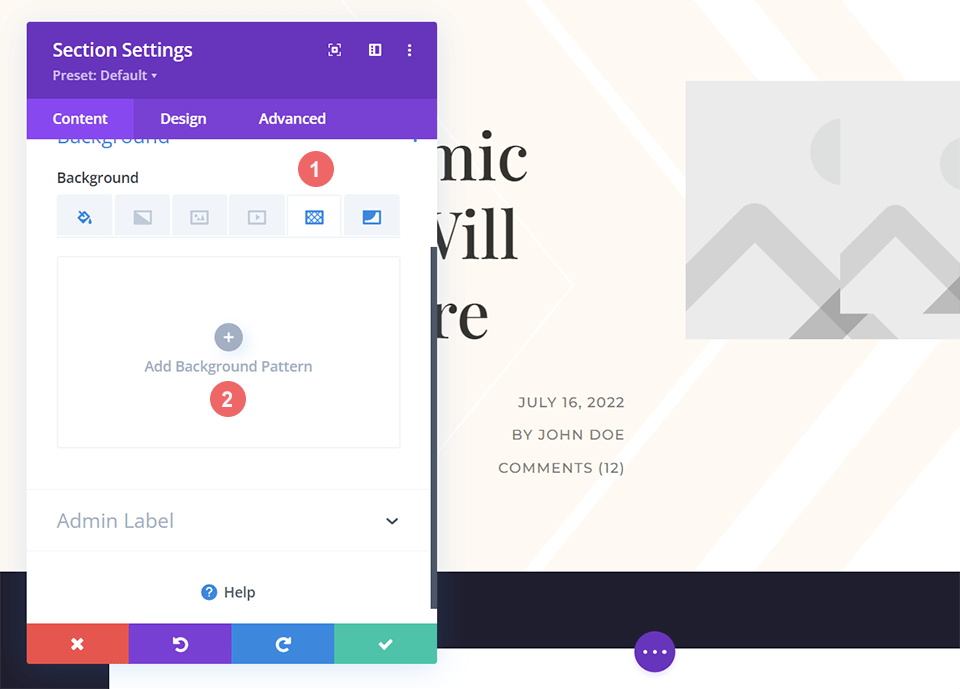
    Inserting the Background Pattern to overlay onto the Background Mask

     Click on the dropdown that appears after clicking Add Background Pattern. We’ll be using the Honeycomb Background Pattern to overlay onto our Chevron Background Mask.

    Selecting the background pattern of choice for our blog post header design

    Add Color to Background Pattern

    To keep in line with the design of the Divi Blog Post Layout, we’ll be changing the color of the Background Pattern to white.

    • Pattern Color: #ffffff

    Choosing the Background Pattern coor

    Remember to save your hard work by clicking the green checkmark to lock in your section settings. Also, save your blog post template by clicking on the green Save button.

    Example Three: Divi Corporate

    In the Divi Corporate blog header design, we’ll be using Background Masks and Patterns to add texture. We’ll be also using transparency to create depth within the various elements of this header design. This is what we’re starting out with after you have imported the Divi Corporate Blog Post Template which is part of the Divi Corporate Layout Pack.

    The Divi Corporate Blog Post Header Design

    Change Background Color

    For this blog header design, we want to change the default background color of the section to make the Background Pattern and Background Mask more subtle. To do this, we’ll enter into the Section Settings and scroll down to the Background tab. Once there, we’ll click on the Background Color icon, and enter in the hex code for black to replace the default dark gray share of the layout pack.

    • Background Color: #000000

    Change background color of the blog header design

    Insert Background Pattern

    With our new background color, we’ll be adding a Background Pattern to add some excitement to the plain, dark background of the default blog header design. To do this, we’ll enter into the Section Settings and scroll down to the Background tab. Next, we’ll click the Background Pattern icon and then click Add Background Pattern to pull up our list of choices.

    Selecting Background Pattern choices for a corporate blog header design

    Style Background Pattern

    We’ll be using a Background Pattern that’s similar to scanlines for this blog header design. To do this, we’ll select the Diagonal Stripes 2 from the Background Pattern dropdown menu. Then, we’ll assign a transparent white color to the pattern. Lastly, we’ll transform this pattern on the horizontal axis.

    Styling a blog header design with a scanlines inspired background pattern

    Here are the settings that you’ll need to use for the Background Pattern:

    • Pattern Style: Horizontal Stripes 2
    • Pattern Color: rgba(255,255,255,0.12)
    • Pattern Transform: Horizontal

    Add the Background Mask

    As with our other blog header design examples, we’ll be adding a Background Mask to the Background Pattern. To do this, we’ll select the Background Mask icon and click Add Background Mask. This will reveal the Background Mask dropdown where we can choose our Background Mask style.

    Adding background mask to the blog header design with a background pattern

    For this blog header design, we’ll be using the Diagonal Lines Background Mask.

    Choosing the Diagonal Lines Background Mask for the Divi Corporate blog header design

    Stylize the Background Mask

    We don’t want to leave the Background Mask as it is, so we’re now going to style it. We’ll be using a transparent version of the green that is used within the layout pack. We will also be inverting the Background Mask. To apply these styles, first, click on the Eyedropper Icon under the Mask Color title and enter in the setting below. Next, select the Invert icon under the Mask Transform setting.

    • Mask Color: rgba(76,89,76,0.54)
    • Mask Transform: Invert

    Using transparency within the background mask styling of the Divi Corporate blog header design

    In Conclusion

    We have many options when it comes to styling backgrounds for our blog posts. Playing with key design concepts like color, transparency and texture allow us to make use of the native background design tools that come with Divi. You can spend a little less time in image editing software by playing around and using our new Background Patterns and Masks on your site today!

    The post How to Boost Your Blog Post Header with a Background Mask & Pattern Design in Divi appeared first on Elegant Themes Blog.

  • Download a FREE Header & Footer for Divi’s Poke Restaurant Layout Pack

    Hey Divi Nation! Thanks for joining us for the next installment of our weekly Divi Design Initiative where each week, we give away brand new freebies. We recently shared a brand new Poke Restaurant Layout Pack. To help you get your website up and running as soon as possible, we’re sharing a global header & footer template that matches this layout pack perfectly as well! Hope you enjoy it.

    divi layout

    Check Out The Poke Restaurant
    Global Header & Footer Template Below

    Get it for free today!

    Header Design

    Desktop View

    Divi Poke Restaurant Header Template Desktop View

    Tablet and Mobile View

    Divi Poke Restaurant Header Template Tablet and Mobile View

    Footer Design

    Desktop View

    Divi Poke Restaurant Footer Template Footer View

    Tablet and Mobile View

    Divi Poke Restaurant Footer Layout Tablet and Mobile View

    Download The Global Header & Footer Template For The Poke Restaurant Layout Pack

    To lay your hands on the free global header & footer template, you will first need to download it using the button below. To gain access to the download you will need to subscribe to our newsletter by using the form below. As a new subscriber, you will receive even more Divi goodness and a free Divi Layout pack every Monday! If you’re already on the list, simply enter your email address below and click download. You will not be “resubscribed” or receive extra emails.

    How to Upload The Template

    Go to Divi Theme Builder

    To upload the template, navigate to the Divi Theme Builder in the backend of your WordPress website.

    Navigating to the Divi Theme Builder

    Upload Global Default Website Template

    Then, in the top right corner, you’ll see an icon with two arrows. Click on the icon.

    Importing the Header and Footer Layout into the Divi Theme Buidler

    Navigate to the import tab, upload the JSON file which you were able to download in this post, and click on ‘Import Divi Theme Builder Templates’.

    Import settings for the header and footer layout pack

    Save Divi Theme Builder Changes

    Once you’ve uploaded the file, you’ll notice a new global header and footer in your default website template. Save the Divi Theme Builder changes as soon as you want the template to be activated.

    Save global header theme builder

    How to Modify The Template

    Open Header Template

    To modify the global header template’s elements, start by opening the template.

    Editing the global header within the Divi Theme Builder

    Select Menu of Choice

    Select a menu of your choice in the Menu Module.

    Choose a menu to use within your header

    Add Button Link URL

    This header has a button on the top right. Open it’s settings update the link URL to the destination of your choice.

    Select header button URL destination

    Update Social Media Icons and Destinations

    With our Social Media Follow Module, you have a wide variety of social media icons which you can use to send people to read various reviews about your business. Select your social media accounts and remember to link them to their respective destinations.

    Adding social media accounts and links to header

    Open Footer Template

    Continue by opening the global footer inside the default website template.

    Editing the footer template within the Divi Theme Builder

    Link Social Media Accounts

    The footer for the Divi Poke Restaurant Layout Pack has two places for social media links. The first Social Media Follow Module is for social media networks that have reviews. So if you’re using a particular website to collect reviews – think Google, Yelp or Foursquare — this will be the place to put them. The second Social Media Follow Module is for your social media pages. This would like to websites like Facebook, Twitter… even TikTok. This module is used to drive traffic to these external social media sites

    Link to different social networks for different purposes to boost sales and drive traffic

    Choose Footer Menu

    We also have a menu in the footer which you’ll need to update to meet your needs.

    Footer menu selection

    Adjust Static Divi Modules

    In addition to two Social Media Follow Modules, our footer template makes use of some static elements that will need to be updated before making your website live.

    • Blurb Module: Used as a call-to-action for reviews. Social proof as an online business is essential.
    • Text Modules: We use text modules for the address, phone number and store hours.

    Footer static elements should be modified to match your needs

    New Freebies Every Week!

    We hope you’ve enjoyed the Poke Restaurant Layout Pack and the Header & Footer freebie that goes along with it. We look forward to hearing your opinions in the comment section below. Make sure you check back next week for more freebies!

    The post Download a FREE Header & Footer for Divi’s Poke Restaurant Layout Pack appeared first on Elegant Themes Blog.