Do you want to show random quotes in the WordPress sidebar?
Displaying quotes from happy customers can convince more visitors to buy your products. Or you might simply want to brighten your audience’s day by showing them a random inspirational quote.
In this article, we will show you how to easily show random quotes in the WordPress sidebar by using a free plugin.
How to Show Random Quotes in Your WordPress Sidebar
You can show random quotes in the WordPress sidebar using the Quotes and Tips plugin. It lets you add an unlimited number of quotes to your site.
It also lets you display quotes on any page, post, or widget area, including your WordPress sidebar.
First, you’ll need to install and activate the plugin. If you need help, then please see our guide on how to install a WordPress plugin.
After activating the plugin, you can start adding quotes. To add your first quote, go to Quotes » Add New.
First you’ll need to type a title for your quote into the ‘Add Title’ field. In a later step, we’ll show you how to choose whether or not to display the quote’s title to your visitors, or use it for internal reference only.
Next, type your quote into the text editor. In our example, we’re using a quote from a case study.
You may want to organize your quotes into categories. This becomes important when it’s time to display your quotes.
Basically, you have two options.
The Quotes and Tips plugin can select a random quote from all of the quotes you’ve added. Or, it can select a random quote from a specific quote category.
For example, if you have an online store, you might want to display quotes about a specific product on that product page only.
If you already have some categories in mind, then it makes sense to organize your quotes into these categories now. But you can always add, remove, and edit your categories later. We’ll be covering that at the end of the post.
If you do want to create a quote category now, then you can find the Quotes Categories box on the right side of the page.
To add your category, first click on the ‘Add New Quotes Category’ link.
A field will display where you can type your category name. The category won’t appear to your visitors, so it’s just for your reference.
After you type it in, click on the ‘Add New Quotes Category’ button.
This category will now appear in the Quotes Category tab. To add the current quote to this category, simply select the category’s checkbox.
You can keep repeating these steps to create more quote categories.
Next, you’ll typically want to show where a quote comes from. This might be a valued customer, a famous brand, or even a celebrity.
To assign your quote to a person or company, scroll down to the ‘Name and Official Position’ section.
You can now type the person or company’s name into the Name field.
You might also want to add this person’s job title, or some information that explains why they’re qualified to make this statement. You can type this information into the Official Position field.
When you’re happy with your quote, click on the Publish button.
You can now repeat these steps to create all of the quotes that you want to show in your WordPress sidebar.
Configuring Your Quotes and Tips Settings
After creating your quotes, it’s time to take a look at the Quotes and Tips settings. This contains some important settings that control how and when your site displays a random quote.
To take a look at these settings, go to Tips » Settings.
By default, Quotes and Tips will display a new quote every time the page reloads. This means visitors will see a new quote every time they visit a new page or press the Refresh button in their web browser.
If you prefer, you can display a new quote automatically every few seconds or minutes. The visitor doesn’t even have to refresh their web browser.
To do this, select ‘AJAX (no page reload).’ You can then find the Change Frequency field. Here, simply type how frequently WordPress should display a new quote in seconds.
Next, it’s time to choose the title that will appear above your quote.
The default setting is ‘Set Title From Post’. This will display the title you entered when adding the quote to WordPress.
Another option is creating a title that WordPress will use for all of your quotes. This might be something such as ‘Words of Wisdom’ or ‘Don’t take our word for it! Here’s what our customers think’ for testimonials.
To use the same title for all your quotes, click on ‘Set Custom Titles.’ You can now type your title into the Quote Title field.
When you’re finished, don’t forget to click on the Save Changes button.
How to Display a Random Quote
Now it’s time to display your quotes.
Let’s start by showing a random quote from your entire quote collection. If you’ve created multiple categories, then this method will ignore all of these categories.
You can add your quote to any page, post, or widget using the Quotes and Tips shortcode. To get this shortcode, go to Quotes » Settings.
Now, copy the shortcode in the ‘Quotes and Tips’ section.
Another option is to simply copy the following: [quotes_and_tips]
Since we want to show random quotes in the WordPress sidebar, you’ll need to go to Appearance » Widgets. This shows all the areas of your site that support widgets.
This screen may look slightly different depending on your WordPress theme. However, most modern WordPress themes have a sidebar.
Find the Main Sidebar or similar section, and give it a click. This section will now expand.
You need to add a Shortcode block to this widget, so click on the + button. In the search field, type Shortcode.
You can now select the Shortcode block when it appears. Next, either paste or type the shortcode into this block.
Finally, click on the blue Update button at the top of the screen. Now, if you visit your website you should see a random quote in your WordPress sidebar.
How to Display Random Quotes From a Specific Category
Another option is to display a quote from a specific quote category.
To display a random quote from a particular category, you’ll need to use a different shortcode.
To get this code, head over to Quotes » Quote Category.
Here, you’ll find a list of all the categories you’ve created. Each category has its own shortcode.
Simply find the category that you want to use, and copy its shortcode. You can then paste this shortcode into any page, post, or widget, following the same process above.
How to Style and Brand Your Random Quotes
By default, Quotes and Tips adds a blue background to the quote area. It also uses a background image of silhouettes.
You can change this default styling to better match the rest of your website’s design. You can even remove the styling completely.
To change the background color, text color, or background image, go to Quotes » Settings.
In the left menu, click on the Appearance tab.
You can now change the background color and text color, by clicking on the Select Color button.
This adds an area where you can choose your perfect color.
If you change your mind, you can restore the plugin’s default colors at any point. Simply click on the Default button.
You can also change the background image. To remove the default background image, scroll to Background Image, and then click on the None button.
You can also add your own background image.
Using your company or product logo as a background image can be a great way to brand your quotes.
To upload a new background image, click on the Custom button. This adds a Choose File button.
Give this button a click. This will open a window where you can select the file that you want to use as your background image.
After making your choice, you can customize how this image looks on your site.
This includes changing the background image alignment and the opacity, which is how transparent the background image is.
Why not experiment, to see what different effects you can create?
How to Add, Edit and Delete Quote Categories
Sometimes, you may want Quotes and Tips to display a completely random quote.
Other times, you may need more control over the kind of quotes that it displays.
You can do this using quote categories. We’ve already seen how to create a category when adding a new quote. However, Quotes and Tips has an entire menu where you can make changes to these categories, and create new ones.
To see these settings, go to Quotes » Quotes Categories.
Here, you can quickly and easily create quote categories. To add a new category, type a name for your category into the Name field.
By default this plugin creates each quote category as a parent category.
Another option is to create a subcategory. For example, you might have an OptinMonster parent category, and then create subcategories for your different promotions, such as ‘OptinMonster summer sale’ and ‘OptinMonster holiday promotion.’
To create a quote subcategory, you’ll need to select a Parent Category.
When you’re happy with your quote category, click on the blue Add New Quotes Category button.
You can also edit any of the categories you created earlier.
To edit a category, hover over it. Then, click on the Edit link when it appears.
This launches a new page where you can make changes to this category. This includes editing the category’s name, and choosing a new parent.
If you liked this article, then please subscribe to our YouTube Channel for WordPress video tutorials. You can also find us on Twitter and Facebook.
Your small business or online store relies on email. However, keeping up with marketing emails, transactional emails, email notifications, and engaging with users can become overwhelming. Automating these emails can save you time and effort while delivering you better results.
In this article, we’ll show you how to send automated emails in WordPress to streamline your workflow and grow your business.
For example, you can use email to welcome new users and let them know when new content or products are available. Email is also useful for marketing campaigns and updating your customers on the progress of their orders.
You can even use email to notify yourself when there is a new post waiting for you to review, or that a WordPress update needs to be installed.
Since email is used for so many tasks on your WordPress website, it only makes sense to save time and effort by automating as many emails as possible.
With that being said, let’s take a look at how to send automated emails in WordPress. Here are the topics we’ll cover in this tutorial:
Making Sure Your WordPress Email Is Being Sent Reliably
Before you start automating your emails, it’s important to make sure that emails from your website are being delivered reliably.
By default, most WordPress hosting companies do not have the mail function configured properly. To prevent their servers from abuse, many hosting companies even turn it off completely. In these cases, your WordPress emails will fail to reach users.
Luckily, you can fix this easily by using WP Mail SMTP. This plugin lets you send your WordPress email through a reliable SMTP platform which is configured specifically to send emails like SendLayer, Gmail, Outlook, etc.
The free version of WP Mail SMTP should be more than sufficient for most websites. For more details, see our guide on how to fix WordPress not sending email.
Sending Automated Drip Emails Using Constant Contact
A good place to start thinking about email automation is the way you market your store or business. And one of the best ways to automate marketing is with a drip campaign.
What Is an Automated Drip Campaign?
Automated drip campaigns are email messages that automatically guide your users along a specific journey. They’re great for boosting user engagement on your WordPress site.
For example, these messages can welcome new users, promote important content, upsell products, target specific geographic regions, and encourage users to register for events.
To send automated drip notifications by email, we recommend using Constant Contact because it’s the best email marketing service on the market. However, you can use any other major email marketing platform, including Sendinblue, HubSpot, and others.
To start, you can visit the Constant Contact website and create an account. The software gives you a 60-day free trial, so you can try it out before committing to a premium plan.
Once you sign up, you can visit the Constant Contact dashboard to create a contact list.
Constant Contact has already created a default list for you. However, you can create your own list by going to the ‘Contacts’ tab in the top menu, and then clicking the ‘Create List’ button.
A popup window will appear where you can enter a name for your list.
After that, simply click the ‘Save’ button.
You can add contacts to the list by going to the ‘Contacts’ tab and then clicking the ‘Add Contacts’ button.
A popup window will open with multiple options for adding new contacts.
Now you can add your contacts manually, upload them in a spreadsheet or CSV file, or import them from other apps.
Creating an Automated Drip Campaign
Once you’ve added your contacts, you need to create the drip campaign.
To do that, head over to the ‘Campaigns’ tab and then click the ‘Create’ button.
Next, Constant Contact will show you multiple options for creating a campaign.
Go ahead and select the ‘Email Automation’ campaign.
From here, you can select single-step automations or multi-step automation.
Single-step automations send just a single email, such as a welcome email. Multi-step automations let you create a series of emails that are automatically sent to your subscribers so you can let them know about your products and services, send special offers, and more.
In this tutorial, you’ll create a multi-step automation for when new subscribers join your email list. Go ahead and select the ‘A contact joins a list’ option.
Next, you will have to enter a name for your campaign.
Make sure you click the ‘Save’ button.
Constant Contact will then ask you to choose what activity will trigger the email. For example, the drip series is automatically triggered when a user joins your email list, opens an email, clicks a link, or buys a product.
You can use the default ‘Contact joins a list’ option as the trigger type. Then you can choose the email list you created earlier. Go ahead and click the ‘Save’ button when you’re done.
Creating the Emails for Your Drip Campaign
Now you need to create the emails to send in your automated drip campaign. The first one you create will be sent automatically when the user signs up.
To begin, simply click the ‘Create New Email’ option.
Constant Contact will now show different email templates to choose from.
For this tutorial, we’ll use the ‘Agent Welcome’ template.
You can customize the email template using the drag-and-drop email builder.
You can choose multiple elements from the menu on your left and place them on the template.
You also need to add the email’s content by removing the placeholder text and adding your own. Once you’ve done this, simply click the ‘Continue’ button at the top right of the editor and the email will be added to the drip series.
Next, you can add a second email by clicking the ‘+ Add to series’ button and then the ‘Create New Email’ button.
You’ll need to select a template and customize the new email as you did earlier. You can set the delay before the drip campaign sends its next email.
By default, this value is set to 4 days. You can change this by clicking the ‘Edit’ button in front of the section titled ‘Wait 4 days.’
This will open the ‘Time Delay Editor’ where you can choose when the next email in the drip campaign will be delivered. You can click the ‘Confirm’ button when you’re done.
Now, you should see all your emails in the campaign summary area.
Go ahead and click the ‘Activate’ button in the upper-right corner to launch your campaign.
Constant Contact will then show a prompt to verify whether you wish to activate your campaign.
Simply click the ‘Continue’ button, and the tool will check if everything is working properly and activate your campaign.
You’ve now successfully launched your automated drip email campaign.
Sending Automated Transactional Emails With FunnelKit Automations
If you are running a WooCommerce store, then your customers will receive different transactional emails. These help them get order confirmations, track their order status, get invoices, and find more information about your online store.
You can customize and automate these emails using FunnelKit Automations, a popular WooCommerce plugin for marketing automation. It is a sister product to FunnelKit (formerly WooFunnels), a powerful sales funnel builder for WooCommerce.
Creating Email Automation Workflows With FunnelKit Automations
Upon activation, you need to go to Campaigns » Automations (Next-Gen) to add a new automation from your FunnelKit Automations dashboard. Here you will see a library of email types that make it simple to create new automations.
You can import an email automation workflow with a single click, then use the visual email automation builder to make any customizations that you need.
Automating Marketing Emails Using Uncanny Automator
Of course, you’ll also still need to send marketing emails outside of your drip campaign. These are most effective when they are personalized and timely.
For example, you can use automated emails to showcase products similar to what your customer has already bought. Or you can automatically send users an email as soon as you publish a new article on your website.
The free version easily connects with popular email marketing services such as Mailchimp, HubSpot, and others, making it easy to automate your email.
For this tutorial, we’ll use the free version of Mailchimp because it’s popular and they offer a free forever plan where you can send up to 10,000 emails per month to 2000 subscribers.
Upon activation, head over to the Automator » Add New page to create your first recipe. In this tutorial, we’ll send an automated email to subscribers whenever we publish a new post.
You’ll be asked to select which type of recipe you want to create. You should choose ‘Logged-in users’ and then click the ‘Confirm’ button.
Setting Up the Automation Trigger
Next, you need to choose whether the automation will be triggered by Uncanny Automator or WordPress.
Since you will be sending an automated email when a new WordPress post is published, you should click on the ‘WordPress’ option.
Now you can choose from a long list of available WordPress triggers.
You need to select the trigger labeled ‘A user publishes a type of post with a taxonomy term in a taxonomy.’
You can use the search feature to find this trigger more quickly.
If you like, you can get specific about the types of posts that will trigger the email. You can choose a post type and a specific category or tag from the drop-down menus.
For this tutorial, we’ll go with the default settings.
Make sure you click the ‘Save’ button when you have finished setting up the trigger.
Setting Up the Automation Trigger
Next comes the action part, where you choose what action will be triggered. To get started, simply click the ‘Add action’ button.
Now you will be shown a long list of integrations that are available for the action.
You should click the Mailchimp icon to connect it to your website.
This will bring up a popup where you need to follow the on-screen instructions to finish the connection by logging into your Mailchimp account or creating a new one. Once connected, you will be able to choose what action you want to perform on your Mailchimp account.
You should then choose the option ‘Create a send a campaign’.
Now you need to type a name for the campaign. You might like to use tokens so that the Mailchimp campaign name for each new post is different.
For example, you can click the ‘*’ button to the right of the field and select the ‘Post title’ token.
After that, you can use the drop-down menus to choose your audience and segment and fill in the subject and other details of your email.
You can compose your email in the ‘Email contents’ field. Make sure you use tokens so that the content is updated for each email campaign.
For instance, you can include tokens for the post title, post author display name, post excerpt, post URL, and featured image URL.
Once you are finished, you can switch the recipe from ‘Draft’ to ‘Live.’
From now on, when you publish a new article on your website, Mailchimp will automatically send an email to your subscribers.
You might also like to see our guide on how to automatically send a coupon to users who leave reviews in WooCommerce. It’s another good example of how you create automated emails using Uncanny Automator to build customer loyalty.
Bonus: Sending Automated Notification Emails
Now that you have set up automated emails for your users, you can do the same for yourself and your team.
For example, you can create automated email notifications to keep track of issues that require your immediate attention, such as when an author submits a post for you to review.
You can also stop the WordPress notifications you don’t need from filling up your inbox, such as comment notifications.
If you liked this article, then please subscribe to our YouTube Channel for WordPress video tutorials. You can also find us on Twitter and Facebook.
Do you want to connect Salesforce to your WordPress forms?
Salesforce is one of the most popular customer management software on the market. Connecting it to your WordPress forms allows you to automatically add leads, customers, and other contacts to your CRM.
In this article, we’ll show you how to easily connect Salesforce to your WordPress forms.
Why Connect Salesforce to Your WordPress Forms?
Salesforce is one of the best CRM (customer relationship management) software on the market. Many of the world’s largest businesses use it to manage customers, leads, and business contacts from one single dashboard.
Most business websites use contact forms to generate leads and then manually add them to their CRM software. This takes time, and you may still forget to follow up with a potential customer.
Connecting Salesforce to your WordPress contact form allows you to remove this hurdle. As soon as a user submits their information, it will automatically be added to your Salesforce contacts.
From there, you can follow up with customers to boost conversions and sales from your WordPress website.
That being said, let’s take a look at how to easily connect Salesforce to your WordPress forms.
You can use it to easily create any type of form using a simple drag-and-drop form builder.
WPForms is a premium WordPress plugin, and you’ll need their Elite plan to use the Salesforce addon. There is also a WPForms Lite version which is available for free.
Upon activation, you need to visit the WPForms » Settings page to enter your license key. You can find this key under your account on the WPForms website.
Setting Up the Connection Between WPForms and Salesforce
Now, you need to set up a connection between WPForms and Salesforce. WPForms comes with the Salesforce addon which lets you easily connect the two apps together.
Simply go to the WPForms » Addons page and locate the Salesforce addon. You can then click on the ‘Install’ button, and it will be installed and activated automatically.
After that, you can go to the WPForms » Settings » Integrations page from your WordPress dashboard.
Here, you need to click on the Salesforce integration to open it up.
Under Salesforce settings, go ahead and click on the ‘Add New Account’ button.
WPForms will show you Salesforce settings with a Callback URL.
Simply keep the tab open in your browser or copy the Callback URL to a safe place. You’ll need it in a later step.
Now, you need to create an app in your Salesforce account. We’ll walk you through the process step by step.
Important Note: You need to have an Enterprise, Unlimited, Performance, or Developer edition of Salesforce. Otherwise, you will not be able to connect your WordPress forms. However, there is a free trial you can use to get started.
If you don’t already have an account, then you can create one by going to the Salesforce’ website and clicking the ‘Start My Free Trial’ button.
On the next screen, you can enter your details like name, work email, job title, company, phone number, and more to create an account.
After entering the data, go ahead and click the ‘Start My Free Trial’ button.
After completing the signup, you’ll reach your Salesforce account dashboard.
From here, you need to switch to the Salesforce Classic dashboard by clicking on your profile icon on the top, and then clicking the ‘Switch to Salesforce Classic’ option.
Next, you’ll the classic Salesforce dashboard.
After that, you need to click on the Setup link at the top to access the Salesforce dashboard settings.
On the next screen, navigate to the Build » Create menu from the column on the left.
From here, simply click the ‘Apps’ option in the menu.
This will bring you to the Apps section.
From here, click on the New button under the Connected Apps section.
Next, you now need to fill in the details for your app.
For the ‘Connected App Name,’ enter the name you want to use, so other users for your Salesforce account can see it.
The API name will default to the Connected App Name. You don’t need to enter or change it. For the contact email, enter your email address.
You don’t need to enter the logo image, icon, info URL, or description. These fields are for Salesforce users who will be publishing their apps.
Below this, you need to check the ‘Enable OAuth Settings’ box.
Once you check the box, you will see the OAuth settings.
First, you need to enter the Callback URL that you found earlier in your WPForms account.
Simply paste the link in the Callback URL field.
After that, scroll to the ‘Available OAuth Scopes’ section. The selected OAuth Scopes let Salesforce know what permissions your app should have.
Next, you need to enable 2 permissions here. They are ‘Manage user data via APIS (api)’ and ‘Perform requests at any time (refresh_token, offline_access).’
Simply select these and then click the ‘Add’ button to add those permissions.
There’s nothing else you need to change on this page. After adding the permissions, simply click the ‘Save’ button at the bottom of the page.
You should then see a message telling you to allow up to 10 minutes for your changes to take effect.
Then, just click on the ‘Continue’ button. On the next screen, you’ll see your API information.
We recommend that you wait 10 minutes before using your app. That way, you can be sure that your app will be ready. After the 10 minutes is up, you need to copy your ‘Consumer Key’ and ‘Consumer Secret’ to WPForms.
Simply click the ‘Manage Consumer Details’ button to continue.
Next, Salesforce will ask you to enter a verification to move ahead. You’ll receive the code in your email.
After entering the code, go ahead and click the ‘Verify’ button.
Next, you’ll see the ‘Consumer Key’ and ‘Consumer Secret’ codes. Go ahead and copy them.
Now, simply switch back to the tab with your WPForms Salesforce settings.
If you have closed this tab, then it’s easy to find it again in your WordPress admin. Just go to the WPForms » Settings » Integrations page.
Simply paste the Consumer Key and Consumer Secret into the Salesforce settings for WPForms.
Then, go ahead and click the ‘Connect to Salesforce’ button.
You will then be prompted to log in to your Salesforce. Simply log in to your account using your username and password.
Next, you need to click the ‘Allow’ button to give WPForms access to your Salesforce account.
After this, you will see your Integrations page again.
There should be a message at the top of the screen to let you know that the connection was successful.
Now that you have connected WPForms to your Salesforce account. You can start creating forms and send entries directly to your Salesforce account.
Creating a WordPress Form with Salesforce Integration
The next step is to create your form. You can connect any type of form to Salesforce.
Simply go to the WPForms » Add New page. This will launch the WPForms drag-and-drop form builder.
First, you can enter a name for your form at the top and then click on a template. We’ll use the ‘Simply Contact Form’ template for this tutorial.
In the form builder, you can drag and drop different fields from the left menu onto the template. For instance, you could add a phone number field.
Plus, you can rearrange their order and further customize each field in the form.
Once you are satisfied with the form, go to the Marketing » Salesforce tab to connect it with your Salesforce account.
Go ahead and click the ‘Add New Connection’ button.
You will then see a popup where you need to name your connection. Your site’s visitors will not see this. It’s just for your own use.
Just enter the name you want to use. Then, click the ‘OK’ button.
Now, you need to select your Salesforce account and ‘Salesforce Object.’
The object is the type of data you are sending to Salesforce, such as a contact or a lead.
Once you’ve chosen your Salesforce Object, you will see some new dropdowns.
Here, the ‘Custom Field Name’ column is the name of the field in your Salesforce account. The ‘Form Field Value’ is the name of the field on your form.
You need to select a ‘Form Field Value’ for each custom field you want to use. This means your form data will be entered into the correct field in Salesforce.
The only required field is the Full Name field in Salesforce. For this, select ‘Name’ as the Form Field value.
Next, go ahead and select a different field from the dropdown below this. Simply choose which WPForms field you want to map it to. To add more fields, click the blue + button.
We have included the email and phone fields from our form here:
Don’t forget to click the Save button at the top of the screen after adding your Salesforce connection.
Adding Your Form to a WordPress Page or Post
WPForms makes it super easy to add forms anywhere on your WordPress website.
Simply edit the post or page where you want to add the form or create a new one. On the content editor screen, click on the (+) add new block button and then add a WPForms block to your page.
Next, you need to choose your contact form from the dropdown list within the block.
Finally, go ahead and publish your page to see your form live on your site.
If you liked this article, then please subscribe to our YouTube Channel for WordPress video tutorials. You can also find us on Twitter and Facebook.
Are you looking for the best electronic signature software for WordPress?
The right digital signature software can help you save time while streamlining your workflow for creating official documents & contracts for your business.
In this article, we’ve hand picked some of the best digital signature software for WordPress.
Why Use Electronic Signature Software?
There are lots of reasons why you may need to get someone’s signature.
Official documents such as contracts and terms of service agreements often require a signature. If you run an online store, then some products, services or subscriptions may need the customer’s signature.
You might even need to collect lots of different signatures. For example, if you run a nonprofit organization, then you can use signed petitions to draw attention to a good cause.
However, getting people to sign a physical, printed document can take a lot of time and effort. Depending on where the person is located, you may need to travel to them or post the document. This can slow down important tasks, such as onboarding new employees or selling your small business.
Electronic signature software allows people to sign a form or document digitally from anywhere in the world. This usually involves drawing with their mouse or touchscreen, or typing in their name using their keyboard.
By using the best electronic signature software, you can save time and money since you don’t need to print, scan, fax, or post documents. It’s also better for the environment, as you’re not using any paper or ink. You can simply email a digital copy to anyone in the world and then store the signed document on your computer, or in the cloud for extra security.
If you want to collect signatures from the public, then the right software can help you get more signups. For example, you might publish a petition to your WordPress website and then collect signatures from supporters around the world.
With that being said, let’s look at some of the best electronic signature software.
With over 500 ready-made form templates to choose from, this plugin makes it easy to add professionally-designed and user-friendly forms to your website. All of these templates are fully customizable, so you can fine-tune them to better suit your needs.
Even better, the plugin has a Signature addon that lets you collect digital signatures with ease.
Every time someone submits a form, WPForms will save their electronic signature as an image and attach it to their form submission. You can see all of these signatures simply by logging into your WordPress dashboard.
After activating the addon, you’ll get access to some ready-made templates that already come with a built-in digital signature field.
WPForms also has a standalone Signature field that you can add to any template.
Simply open the WPForms editor and then drag the read-made Signature field onto any form, and you’re ready to start collecting e-signatures.
Once you’ve added the Signature field to a form, you can use the WPForms settings to customize that field.
For example, you can mark it as mandatory so that visitors must add their digital signature before they can submit the form.
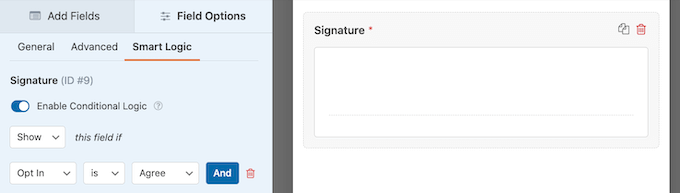
This powerful plugin also has support for conditional logic, so you can hide or show the Signature field based on the information the visitor enters into the form.
For example, you might hide the Signature field unless the visitor opts into a particular service that requires their digital signature. In this way, you can show only relevant fields to visitors, which will reduce form abandonment in WordPress.
Pricing: To use the WPForms plugin and Signature addon, you’ll need to buy WPForms Pro ($199.50 per year) or Elite ($299.50 per year).
If you need to collect legally-binding signatures from multiple people, then signNow is a great option. It even comes with conditional logic, so you can show different fields to different people based on their user roles.
signNow is an online service, so you don’t need to download or set up any software or tools. Simply create an account, and you can start signing documents within minutes using signNow’s user-friendly editor.
signNow allows users to type, draw, or upload their signatures. You can also save your signatures, so it’s easier to authorize future documents.
To save even more time, signNow allows you to save any document as a template. This is perfect for businesses that need to send the same file to multiple people or organizations.
If you’re worried about unauthorized access, then you’ll be happy to learn that signNow has dual-factor authentication options and other advanced security features. This allows you to prove the person’s identity before giving them access to your documents and templates.
This is particularly important if you’re working with sensitive or confidential documents.
If you need to collect data from customers, staff, or other contacts, then you can even build online forms using the same intuitive signNow editor. This makes signNow an all-in-one solution for busy businesses.
Unlike some other esignature solutions on this list, signNow has its own mobile app for Android and iOS. This means you can sign contracts and share documents with other people, directly from your mobile device.
Using the mobile app, you can even work with documents, agreements, and contracts while offline. Then, simply share your work once the internet connection has been restored. This is great for anyone who travels and likes to work on the go.
With its time-saving features, dedicated mobile application, and smart conditional fields, signNow is a great choice for businesses that need to share legally binding documents with lots of different people.
Pricing: You can start using signNow for $8 per month, per user.
Formidable Forms is an all-in-one WordPress form builder with a drag and drop interface that makes it easy to create advanced forms. This includes custom calculators, booking forms, and much more.
This plugin also has a Signature addon that allows you to collect digital signatures.
Visitors can sign your forms using their mouse or touchscreen. However, unlike some of the other software in this list, Formidable Forms also lets visitors type in their signature.
This can make your forms and documents accessible to people who find it difficult to sign using the mouse or trackpad.
Every time someone signs your form, the plugin will save the signature as an image that you can see inside your WordPress dashboard.
After installing the addon, you can simply drop the ready-made Signature field onto any template where you want to collect digital signatures.
Formidable Forms comes with over 170 templates, so you should have no problems finding one that perfectly suits your needs.
Formidable Forms also comes with a ‘Signature’ category where you’ll find a selection of templates that have the e-sign field built-in.
For example, Formidable Forms has an ‘Esthetician Consent’ template where beauticians can collect a client’s information and get their signed consent.
This plugin integrates with WooCommerce, so online store owners can easily collect signatures from their customers. For example, you may want to record the customer’s written consent to collect recurring payments as part of a subscription.
If you have an online store, then Formidable Forms also integrates with all the popular email marketing and payment platforms you may already be using to get sales.
The Formidable Forms builder is targeted more at advanced users and developers, which means it isn’t as user-friendly as WPForms. However, it is a powerful and flexible solution that’s also very customizable.
In fact, after configuring the Signature addon, there are lots more addons that can help you collect and manage digital signatures.
In particular, Formidable Forms has a Visual Views addon that lets you display user-submitted information on your website. For example, if you’ve created a petition, then you can use this addon to show the names of all the people who have already signed. In this way, you can encourage more people to support your petition.
You can simply upload any PDF, DOC, DOCX, RTF, PPT, PPTX, JPG, PNG, or TXT file, and pdfFiller will turn it into an interactive document. Anyone can then view, edit, and sign the document online using their desktop or mobile device.
pdfFiller follows all of the major security laws and guidelines including GDPR, HIPAA, and CCPA. However, some customers or visitors may still be wary about signing a document hosted on an unfamiliar third-party platform. If you do use pdfFiller, then it’s important to talk about the platform in your site’s privacy policy.
Having said that, pdfFiller’s electronic signature software is very powerful and legally binding in all 50 states. It also has some advanced features you won’t find in other electronic signature plugins, such as the option to capture a signature using a webcam.
Pricing: The basic pdfFiller plan starts at $10 per month when purchased annually.
USLegalForms is an online library of over 80,000 national and state-specific legal documents covering a huge range of different industries and use cases.
On their website, you’ll find form templates covering everything from hiring to business agreements, leases, invoices, bills of sale, and much more.
All of these legal documents are organized into categories and you can search by state, so you should have no problems finding what you’re looking for.
With a strong focus on legally-binding documentation, this is a great electronic signature platform for businesses. It would also be useful for anyone who wants to start legal proceedings without having to pay a professional to draw up documents for you.
You don’t need a website to use USLegalForms. If you’re looking for a solution that adds forms or signable documents to your site or blog, then we recommend using a solution such as Formidable Forms or WPForms instead.
Price: You can buy a USLegalForms subscription for $15 per month.
Which is the Best Electronic Signature Software?
After evaluating various eSign software, we believe that WPForms is the best electronic signature software for WordPress. If you’re looking for a eSign software for contracts that need multiple signatures, then we recommend using signNow.
There are dozens of other electronic signature in the market such as DocuSign, HelloSign (aka Dropbox Sign), PandaDoc, and others, but they are all unnecessarily expensive for small businesses that’s why we haven’t included them in our list.
If you liked this article, then please subscribe to our YouTube Channel for WordPress video tutorials. You can also find us on Twitter and Facebook.
Do you want to enable maintenance mode for WooCommerce without affecting other parts of your WordPress website?
Maintenance mode allows you to show a user-friendly notice to shoppers instead of a broken eCommerce site. You can even enable maintenance mode for specific product pages or areas of your WooCommerce store.
In this guide, we’ll show you how to enable maintenance mode for WooCommerce.
Why and When You Need to Enable Maintenance Mode for WooCommerce
At other times you may need to put your WooCommerce store into maintenance mode, while leaving the rest of your site open.
This could be because there’s a problem that’s only affecting your online store, and not the rest of your website. For example, you may be unable to process customer payments. In this case, maintenance mode can stop customers from encountering the error and having a bad shopping experience.
You may also be adding an online store to an existing website and want to keep those pages private while you work on them.
An engaging ‘coming soon’ page can also create a sense of excitement and anticipation while you build your store behind the scenes. You might even encourage shoppers to get ready for the launch by following you on social media, joining your email list, or even entering a WooCommerce contest.
That being said, let’s take a look at how to easily enable WooCommerce maintenance mode without affecting the rest of your website.
Enabling Maintenance Mode for WooCommerce
The easiest way to enable maintenance mode for WooCommerce is by using SeedProd.
There’s a free version of SeedProd that lets you create a maintenance mode page. However, we’ll be using the premium version as it lets you put your WooCommerce store into maintenance mode while keeping the rest of your site available.
The first thing you need to do is install and activate the SeedProd plugin. For more details, see our guide on how to install a plugin in WordPress.
After activating the plugin, SeedProd will ask for your license key.
Once you’ve done that, you’re ready to put your WooCommerce store in maintenance mode.
Creating Your Maintenance Mode or Coming Soon Page
After activating SeedProd, go to SeedProd » Pages. Here, you can choose whether to create a maintenance mode page or a coming soon page.
Although some people use these terms interchangeably, there are some important differences you should know.
If you create a ‘Coming Soon’ page, then search engines will still be able to see and crawl your store pages. This gives your WooCommerce site a chance to get indexed by search engines.
If you’re building a new store, then you’ll typically want to create a coming soon page.
If your store is down for maintenance, then you should create a ‘Maintenance Mode’ page instead. This mode tells search engines that your site is temporarily down, using the special header code 503.
After getting this code, the search bots will recheck your WordPress website later to see whether it’s back online. In this way, you can hide your store from shoppers without affecting your search engine rankings.
Note: We’ll create a maintenance mode page in this guide, but the steps will be the same no matter whether you click on ‘Set up a Maintenance Mode Page’ or ‘Set up a Coming Soon Page.’
The next step is building the page that shoppers will see when you enable maintenance mode for WooCommerce.
You can either choose a ready-made template or start with a blank design. We’re using ‘Celebrate Coming Soon’ in all our images but you can use any template you like.
To select a template, simply hover your mouse over that design’s thumbnail and then click the ‘checkmark’ icon.
After selecting a template, you’ll be taken to the drag-and-drop builder, where you can start customizing the maintenance mode design.
On the left side of the screen, you’ll find blocks and sections that you can add to your design. The right side of the page is the live preview.
Most templates already have some blocks, which are a core part of all SeedProd designs. To start, you’ll typically want to customize these blocks by adding your own text, images, links, and other content.
To change the text in any Headline or Text block, simply click to select that block in your layout. This brings up all the settings for that particular block.
You can now type your text into the small text editor.
You can also use these settings to style the text, including adding bold and italic formatting, changing the text alignment, changing the font size, and more.
You can add more blocks to your maintenance page by dragging them from the left-hand menu and then dropping them onto your design.
For example, if you wanted to add a custom logo then you could simply drag an ‘Image’ block onto your layout.
Then, just click to select that block in your layout and the left-hand menu will show all the settings for that block.
To add a logo, go ahead and click on ‘Use Your Own Image.’
You can then either choose an image from the WordPress media library or upload a new file from your computer.
After adding an image, you can change the size, add image alt text, embed a link, and more using the settings in the left-hand menu.
If you’re using the WPForms plugin then you can quickly and easily add a contact form to the maintenance page. This gives shoppers a way to talk to you even when your WooCommerce site is down for maintenance.
Then, simply click to select the Contact Form block.
In the left-hand menu, open the dropdown menu and choose the form you created earlier.
To remove a block from your design, simply go ahead and click on it.
You can then select the trash can icon.
You can also move blocks around the page using drag and drop.
When you’re happy with how the maintenance page looks, make sure you click ‘Save.’
Turn on Maintenance or Coming Soon Mode for Your WooCommerce Store
Now that you’ve created a custom coming soon or maintenance mode page, let’s go ahead and enable it.
Here, we want to put the store into maintenance mode, and not the entire site. To do this, click on the ‘Page Settings’ tab inside the SeedProd editor.
Then, select the ‘Access Control’ tab.
You can use these settings to specify where the coming soon or maintenance page appears on your site, and who sees it. For example, you might show this page to people who have a particular user role or IP address.
Since we want to put our WooCommerce site into maintenance mode, scroll to the ‘Include/Exclude URLs’ section.
Then, just click on the ‘Include URLs’ button.
Now, you need to enter the URLs for your WooCommerce store. This may vary depending on how your store is set up, and whether you’ve created any custom pages such as a custom WooCommerce cart page or a custom checkout page.
However, it’s smart to start with all the pages that WooCommerce creates automatically:
The asterisk is a wildcard character, which tells SeedProd to include all URLs that match the pattern before it.
This means that shoppers will see the maintenance page when they try to access any product, product category, or product tag.
After adding all these URLs, click on the ‘Save’ button to store your changes.
Putting Your Store In Maintenance Mode
You’re now ready to put your WooCommerce store in maintenance or coming soon mode at any point. In the WordPress dashboard, simply go to SeedProd » Landing Pages.
Then, click on the ‘Inactive’ slider under ‘Coming Soon Mode’ or ‘Maintenance Mode,’ so that it changes to ‘Active.’
Now, simply visit your WooCommerce store in an incognito browser tab and you’ll see your custom design, rather than your online store.
When you’re ready to make your store public, simply go back to SeedProd » Landing Pages.
Then click on the ‘Active’ slider so that it shows ‘Inactive.’ Now, anyone who visits your site will see your WooCommerce store, and can buy products and services as normal.
We hope this article helped you learn how to enable maintenance mode for WooCommerce. You may also want to take a look at our expert pick of the best WooCommerce plugins, and our complete step-by-step guide on how to create an email newsletter.
If you liked this article, then please subscribe to our YouTube Channel for WordPress video tutorials. You can also find us on Twitter and Facebook.
Do you want to add Cloudflare Turnstile CAPTCHA in WordPress?
CAPTCHA and reCAPTCHA can stop spambots, but they’re also unpopular with visitors. By using a non-intrusive technology like Turnstile, you can protect your website from spambots and automated scripts without annoying your visitors.
In this article, we will show you how to add Cloudflare Turnstile to your WordPress website.
Why Add Cloudflare Turnstile CAPTCHA in WordPress?
Spam is a big problem for all websites including WordPress. Spambots can use non-secure forms to send you spammy links, which will make it more difficult for you to do lead generation.
They can also try to break into your site’s login form by using brute force attacks or flooding your site with spam comments that’ll damage the visitor experience and your WordPress SEO.
If you run an online store, then automated scripts may even place fraudulent orders.
Many website owners use CAPTCHA and reCAPTCHA to block scripts and bots. However, a lot of people complain that these technologies deliver a poor user experience, and some even worry about CAPTCHAs stealing their data.
With that being said, Cloudflare has introduced Turnstile CAPTCHA. This alternative technology uses a selection of non-intrusive challenges that often run invisibly in the browser. This allows you to protect your website without asking visitors to complete complex puzzles.
To help keep visitor information private, Cloudflare uses Apple’s Private Access Tokens to test whether the visitor is a real person without collecting extra data.
If you’re using form builders or WooCommerce, then Turnstile also integrates with these third-party plugins. This allows you to add invisible CAPTCHAs across many different areas of your WordPress website.
With that in mind, let’s see how you can add Cloudflare Turnstile CAPTCHA in WordPress. Simply use the quick links below to jump between the different steps.
The easiest way to add Cloudflare’s CAPTCHA to WordPress is by using Simple Cloudflare Turnstile. This free plugin allows you to connect your website to the Turnstile service, and then check that it’s responding to your requests correctly.
First, you’ll need to install and activate the plugin. If you need help, then please see our guide on how to install a WordPress plugin.
Upon activation, go to Settings » Cloudflare Turnstile.
The plugin will now ask you to provide a site key and site secret.
You can get these for free by clicking on the link next to ‘You can get your site key and secret from here.’
Get a Cloudflare Turnstile Site Secret and Site Key
The link will take you to the Cloudflare login page where you can register your domain and create a site key and site secret. This is free, but you will need to create a Cloudflare account using your email address, if you haven’t already.
Once you’re logged into the Cloudflare dashboard, find ‘Turnstile’ in the left-hand menu and give it a click.
This will take you to a screen with some basic information about Cloudflare Turnstile.
If you’re happy to go ahead, then click on the ‘Add site’ button.
On this screen, start by typing in a ‘Site Name.’
This is just for your reference so you can use anything you want.
Next, type your website’s domain name into the ‘Domain’ field.
The next step is choosing which CAPTCHA widget you want to create. The first choice is ‘Managed,’ which is the method recommended by Cloudflare. This is where Cloudflare analyzes the browser’s request and then decides what kind of challenge it should run.
While this is happening, the visitor will see a loading animation.
Wherever possible, Cloudflare will try to run a non-interactive challenge in the background, so the visitor doesn’t have to do anything.
In this case, the user will simply see a ‘Success’ message when their browser passes the test.
Sometimes, Cloudflare may decide that it’s safer to show an interactive challenge instead. However, the visitor will simply need to check a box rather than complete a puzzle, so it’s still easier than the traditional puzzle-based CAPTCHAs.
Unless you have a specific reason not to, it’s smart to use managed CAPTCHAs as this gives you a good level of security with minimum impact on the visitor experience.
Don’t want to use interactive challenges on your WordPress website? Then you can choose ‘Non-interactive’ or ‘Invisible’ instead.
Non-interactive challenges run in the browser so the visitor doesn’t have to take any action. Just like the managed CAPTCHA, visitors will see the loading animation and a ‘Success’ message when the challenge is complete.
If you choose ‘Invisible’ instead, then the visitor won’t see the animation or success message. This setting allows you to completely hide the CAPTCHA from your visitors, which can avoid confusion and won’t add any clutter to your WordPress theme.
After making your decision, click on the ‘Create’ button.
As soon as you’ve done that, Cloudflare will show your site key and secret key.
You can now add this information to the plugin’s settings on your website.
Add Cloudflare Turnstile CAPTCHA to Your WordPress Website
In your WordPress dashboard, head back to Settings » Cloudflare Turnstile. You can now go ahead and add the ‘Site Key’ and ‘Site Secret’ to your WordPress dashboard.
After that, you may want to customize how the CAPTCHA looks on your website, and how it acts. To start, you can open the ‘Theme’ dropdown and choose from light, dark, or auto.
The following image shows an example of how the ‘Dark’ theme looks in the WordPress comment section.
By default, Cloudflare Turnstile shows a ‘Please verify that you are human’ message to visitors. You may want to change this. For example, you might briefly explain why the CAPTCHA is so important, or that it will only take a few seconds to complete.
To add your own wording, simply type into the ‘Custom Error Message’ field.
After that, you can select the forms where you’ll use the Cloudflare Turnstile CAPTCHA.
The options you see may vary depending on the plugins you’ve installed, but by default, you can use Turnstile with all the built-in WordPress forms. This includes the login page, user registration form, and password reset page.
When you’re happy with the information you’ve entered, scroll to the bottom of the screen and click on ‘Save Changes.’
Now, if you visit your website you’ll see the Turnstile CAPTCHA in action.
Bonus: Add Turnstile CAPTCHA to Your WordPress Forms
WordPress comes with different built-in forms, but you’ll often want to create custom forms. For example, you might replace the default forms with professionally-designed alternatives that better suit your website.
Simple Cloudflare Turnstile integrates with the best contact form plugins for WordPress including WPForms and Formidable Forms. This allows you to add the same advanced CAPTCHAs to all your forms, no matter how you created them.
To add a CAPTCHA to any WPForms or Formidable Forms page, simply go to Settings » Cloudflare Turnstile in your WordPress dashboard.
At the bottom of the page, you should see a section for either WPForms or Formidable Forms, depending on which plugin you’re using.
Simply click on either of these sections to expand.
To add the CAPTCHA to all your forms, just check the ‘Enable on all…’ box.
If you’re using a ‘Managed’ or ‘Non-interactive’ CAPTCHA, then you can change whether the loading and success animation appears before or after the form’s ‘Submit’ button.
In the following image, we’re using the ‘After button’ option.
To make this change, simply open the ‘Widget Location’ dropdown.
Then, choose either ‘Before Button’ or ‘After Button.’
Some forms may not need a CAPTCHA. For example, you might disable the CAPTCHA for forms that aren’t getting many conversions, to see whether this improves your conversion rates. For more information, see our guide on WordPress conversion tracking made simple.
To remove the CAPTCHA, you’ll need to type the form’s ID into the ‘Disable Form IDs’ field.
If you’re using WPForms, then you can get this ID by going to WPForms » All Forms.
The ‘Shortcode’ column shows each form’s ID. For example, in the following image the form ID is 62.
If you’re a Formidable Forms user, then head over to Formidable » Forms instead.
On this screen, find the form that you want to exclude and make a note of the number in the ‘ID’ column.
You can now add these IDs to the ‘Disable Form IDs’ field.
To remove the CAPTCHA from multiple forms, simply separate each ID with a comma.
When you’re happy with how you’ve set up the integration, don’t forget to click on ‘Save Changes’ to store your settings.
Now if you visit any form created using Formidable Forms or WPForms, you’ll see the Cloudflare Turnstile CAPTCHA in action.
Bonus: Add Cloudflare Turnstile CAPTCHA to WooCommerce
Scripts and bots aren’t just bad news for WordPress blogs and websites. If you run an online store, then spambots and automated scripts might try to register with your store and place fake orders.
Every transaction comes with processing feeds, so fake orders can cost you a lot of money and make it difficult to grow your business.
The good news is that Cloudflare Turnstile also integrates with WooCommerce. This allows you to protect all your eCommerce pages including the WooCommerce login, signup, and checkout pages.
To add Cloudflare Turnstile to your WooCommerce pages, simply go to Settings » Cloudflare Turnstile.
Then, scroll to the ‘WooCommerce Forms’ section.
If it isn’t already expanded, then click on this section.
You’ll now see all the WooCommerce pages where you can add a Cloudflare CAPTCHA. Simply check the box next to each page that you want to protect.
After that, don’t forget to click on ‘Save Changes’ to store your settings. Now, if you visit any of your WooCommerce pages, you’ll see the Cloudflare Turnstile CAPTCHA.
If you liked this article, then please subscribe to our YouTube Channel for WordPress video tutorials. You can also find us on Twitter and Facebook.
Are you looking to add a countdown timer to their WordPress website?
Countdown timers are a great way to build anticipation, excitement, and create a FOMO effect on your website. There are many different countdown plugins that let you create a countdown timer, so which one should you use?
In this article, we’ll share the best countdown plugins for WordPress and explain the key features of each.
What is a Countdown Timer Plugin & When You Need it?
A countdown timer WordPress plugin allows you to display a timer that counts down to a specific time or date.
Savvy marketers use countdown timers to build excitement and create a sense of urgency among their customers. It helps them take advantage of the FOMO effect to boost conversions.
There are many plugins that allow you to add countdown timers to your website. These countdown timers can be divided into two groups:
Normal Countdown Timers
A normal countdown timer, sometimes called a static or fixed countdown timer, is what most people think of when they imagine a timer. This timer counts down to a certain fixed time. That might be the launch of a WordPress website, the end of a sale, or another event.
The countdown clock’s endpoint is the same for everyone and doesn’t change depending on who’s viewing it.
Evergreen Timer
An evergreen countdown timer, sometimes called a dynamic countdown timer, is specific to each user. It begins counting down when the person arrives on your site. For instance, they might have 4 hours to take advantage of a special offer.
This can be a powerful marketing technique as it lets you create a sense of urgency.
Note that most WordPress plugins are designed to run normal countdown timers, and only some let you run evergreen timers.
Having said that, let’s take a look at some of the best countdown timer plugins for WordPress.
There are lots of ways you can position your countdown timer using OptinMonster. One of the best is to use a floating bar that sticks to the top or bottom of your page. That way, it stays visible at all times.
Here’s a countdown timer we created using the OptinMonster plugin:
You’ll need the OptinMonster’s Pro plan or higher to use countdown timers.
They allow you to add countdown timers on popups, floating bars, full-screen welcome mats, scroll boxes, and inline widgets. On top of that, you can personalize the timers based on the user’s location, which page they’re on, where they’re visiting from, and more.
SeedProd is the best WordPress website builder and landing page plugin. It is a great option if you want to add countdown timer animation to your landing pages.
SeedProd lets you easily set up a special landing page and put your site into coming soon or maintenance mode. Plus, it has a powerful drag-and-drop website builder. You can easily customize your WordPress theme without touching a single line of code.
With this plugin, you can create a normal and evergreen timer for your website. It offers lots of customization options, including pre-built templates for countdown timers.
Here’s a countdown timer we created using SeedProd’s Coming Soon Page Pro plugin:
Countdown Timer Ultimate is another good option to consider if you want to create a normal countdown timer. It’s a simple plugin that allows you to show timers on the entire website or specific to individual site visitors.
You can use Countdown Timer Ultimate to make as many countdown timers as you want, and you can customize how they look to some degree.
Here’s a preview of the countdown timer that you can create using the free version of the Countdown Timer Ultimate plugin:
The pro plugin gives you more advanced options. These include being able to show specific text when the countdown expires and extra design features.
Countdown Builder is a simple countdown timer with multiple different styles built in. These include circle countdowns, flip clock countdowns, and even a coming soon page.
You can place your timer within a post or page in the WordPress block editor by selecting the ‘Countdown’ block or using a shortcode. You can also choose to display it automatically on specific posts or pages.
Here’s a preview of a countdown timer you can create using the plugin:
If you want, you can edit how your clock looks in detail, changing things like the font size, the labels, and the animation style. You don’t need to do this with CSS. There’s a built-in editor in the plugin.
Evergreen Countdown Timer is the next countdown plugin on our list. It lets you create evergreen countdowns, as you might expect from its name. You can also use it to create normal countdowns as well.
You can choose how the plugin detects visitors by a cookie or their IP address.
To add the timers to your page, you’ll need to enter a shortcode. You can simply copy and paste this from the Manager section of your countdown timer settings.
Once your timer hits zero, you can automatically redirect the visitor to a URL of your choice. For instance, you could send them to a registration page if you’re counting down to the launch of your new course.
Here’s a timer we created using the Evergreen Countdown Timer plugin:
There’s a pro version of the plugin, which gives you lots of extra options. It also lets you choose more colors than just black or white for your timer.
With the Pro version, you can provide a countdown for available spots, such as seats or tickets. This could work well if you’re selling places for a paid webinar or another live event.
HurryTimer is a free countdown timer plugin that lets you create both evergreen and regular timers. The evergreen timer uses both cookie and IP detection to display the right timer to each individual user.
You can also set up timers to run a countdown between two fixed dates. This is useful if you want to get ready for an upcoming sale in advance.
The timer works with WooCommerce, though you don’t have to run WooCommerce to use it. You can display your timer several times on the same page if you want to.
Here’s a timer we created using HurryTimer:
If you have the Pro version, you can set up a recurring timer. This is a timer that runs according to the rules that you specify. For instance, you could have a timer that shows shipping cut-off times.
With the pro version, you can also create an announcement bar that sticks to the top or bottom of the screen to keep your timer visible.
7. Sales Countdown Timer
Sales Countdown Timer is designed for WooCommerce stores. It helps show timers for sale events, promotional offers, and the latest campaigns.
You can easily integrate the plugin with your WooCommerce products. Plus, it offers different customization options. You can change the style of the timers, edit the message, change the colors in the timer clock, and more.
Besides that, the plugin also lets you choose the location of the timer, whether you’d like to make it sticky, and also select which type of product pages you’d like to show the countdown timer.
Here is a look at the countdown timer we created using the plugin:
If you liked this article, then please subscribe to our YouTube Channel for WordPress video tutorials. You can also find us on Twitter and Facebook.
Are you tired of your website emails being marked as spam?
Have you ever wished there was an easy and reliable way to get your website emails delivered to your customer’s inbox WITHOUT the high costs?
If you’re like me and most other smart website owners, then you have at least wished for this solution a couple times in your WordPress journey.
Today, I’m excited to announce my new product, SendLayer, which will level up your website’s email infrastructure.
We built this tool to help you get your website emails into your user’s inbox with maximum deliverability, reliability, and scalability.
What is SendLayer?
SendLayer is a SMTP email service API that helps your website emails get into customer’s inbox without being marked as spam.
It offers blazing fast email delivery while protecting your domain reputation from spam filters and giving you detailed email logs along with open & click analytics.
SendLayer seamlessly connects with WordPress, so you can use it to reliably send website emails like store receipts, confirmation emails, shipping notifications, password reset emails, and other WordPress emails with maximum reliability.
Why Do You Need SendLayer?
If you’re like most users, then you have likely run into the problem of WordPress not sending email issue. This is one of the most commonly asked questions on WPBeginner.
Many of our beginner level users ask us why their contact form plugin is not sending emails, or why they are not seeing any WordPress notifications.
That’s because most WordPress hosting servers are not configured to send emails using the default PHP mail() function.
And even if your hosting server is configured properly, many email service providers like Gmail, Outlook, and others use sophisticated tools to reduce email spam. These tools try to detect if an email is really coming from the location that it claims to be.
Emails sent by WordPress websites often fail the test.
This means that majority of the emails sent by your website will either land in user’s spam inbox or not get delivered at all. This include your website’s contact form plugin emails, your online store receipts, password reset emails, admin notifications, and more.
This is why most smart website owners use SMTP for sending emails in WordPress.
And this is why I created the free WP Mail SMTP plugin which is used by over 3 million websites.
But the problem was that a lot of beginner users still didn’t know how to set up SMTP properly because simply installing the plugin isn’t enough.
You still needed to use a SMTP email service that’s built for maximum deliverability, reliability, and scalability. We integrated with numerous service providers like Amazon, Google, etc, but they were all quite difficult to use for beginners.
So after listening to a lot of our user feedback, I decided to work with my team to finally create a beginner-friendly SMTP service, SendLayer, that works for all types of websites including WordPress.
Whether you’re using WordPress, WooCommerce, Magento, Laravel, Drupal, Joomla, or any other platform, you can use SendLayer to improve your email deliverability.
SendLayer gives you access to:
Awesome email deliverability
Spam Filter protection
Detailed email logs
Open and click analytics
Event-based webhooks to setup custom notifications
SMTP relay API for those that want to use SendLayer inside custom apps
Simple suppression list to protect your delivery reputation
… and a whole lot more.
Basically, if you’re serious about your website and want to grow your online business, then you know that email deliverability is important.
And SendLayer offers you one of the best email infrastructure in the market.
Once connected with your WordPress site, it automatically ensures that all your website emails get delivered in your user’s inbox.
While I’m sharing the SendLayer news with you today, SendLayer has actually been out since April of 2022. After extensively testing it through out 2021, we did a soft-launch earlier in the year and have since onboarded thousands of website owners already using the platform.
We have a really exciting roadmap ahead of us, and I’m really proud of our team.
We are working on building ,pre cutting-edge email delivery tools to help small business owners and online store owners get their emails delivered into their user’s inbox, so you can continue to maximize your revenue growth.
Do you want to know about the history of blogging?
If you are thinking about starting a WordPress blog today, then you might like to know that there are 1.9 billion websites in the world, and the blogging industry makes up one-third of it. But it didn’t start out that way.
In this article, we’ll share the small beginnings of blogging, the powerful blogging platforms that evolved, and how WordPress came to power over 43% of all websites.
1993-1994: The First Blogs Were Published
Blogging was born sometime around 1993 or 1994. No one was expecting the impact it would have on the world, and the word ‘blog’ didn’t even exist. As a result, there were no historians watching out for it, and no one kept careful records.
We know that Rob Palmer started a plain text journal online in late 1993. In an article on how he became the first blogger, Rob explains how costly it was to run a website in those days. The domain name cost him $100, and basic hosting cost over $100 a month (for comparison, it costs $2.69 per month now).
However, it’s more widely recognized that the first blog was created by 19-year-old student Justin Hall. His home page contained hyperlinks to interesting content he found online, and articles he wrote himself. The content included basic HTML text formatting and small images.
Ten years later, the New York Times Magazine named him the “founding father of personal bloggersâ€. You can still find an early version of Justin’s page preserved on links.net.
Three or four years later, the tech blog SlashDot was launched in September 1997.
December 1997: The Term ‘Weblog’ Was Coined
Originally, blogs didn’t have a name. They were thought of as online journals or diaries, or personal home pages.
In December 1997, Jorn Barger came up with the term ‘weblog’. He maintained an internet culture website called Robot Wisdom, and the term reflected his process of ‘logging the web’ as he browsed.
August 1998 was the first time a traditional news site tried blogging. Journalist Jonathan Duke ‘blogged’ about Hurricane Bonnie for the Charlotte Observer, but didn’t use the term itself.
October 1998: The Open Diary Platform Was Launched
Creating websites was technical, so eventually blogging platforms were created that made it easy for users to record their thoughts and experiences online.
One of the earlier ones was The Open Diary, which developed an online community by allowing users to comment on one another’s posts.
Here’s an early screenshot preserved on the Internet Archive. Notice that blogs were designed for much lower-resolution screens back then.
March 1999: RSS Made Blog Subscription a Reality
RSS is an abbreviation for Really Simple Syndication or Rich Site Summary. It was initially released in March 1999 and is a format used for delivering frequently changing web content from websites and other online publishers.
It allows users to keep track of updates to their favorite websites without having to visit each site individually. They are able to read the latest content in an RSS feed reader or their email.
In April 1999, developer Peter Merholz added some humor to his website, Peterme.com. He broke up the word ‘weblog’, into two words, ‘we blog’. This caught on, and the term ‘blog’ was born.
April 1999: LiveJournal, an Early Blogging Platform, Was Launched
In April 1999, programmer Brad Fitzpatrick launched the LiveJournal platform as a way to keep in touch with his high school friends. It quickly grew into a community of people recording their thoughts online.
LiveJournal was easy to use because it provided a single open text area. Its competitors at the time offered form-based text fields.
In January 1995, the blogging company Six Apart purchased the company that operated LiveJournal, and the platform is still operating today. Although a lot of LiveJournal users have switched to WordPress by following our guide on how to move from LiveJournal to WordPress because WordPress is more powerful and easier to use.
In July 1999, another blogging platform called Metafilter was launched. It was known as MeFi, and its members could post entries to be published on the main website.
August 1999: Blogger Was Launched by Para Labs
Blogger is another early blogging platform, first launched in August 1999 by Pyra Labs. It offered a quick and easy way to create a blog for non-tech-savvy users.
Every entry on Blogger was given a permanent and shareable URL or permalink. This made it easy for users to access the content they were searching for and made Blogger the platform of choice for a lot of writers.
Later in 2003, Google acquired Blogger and over time redesigned it into the product we know today. It is WordPress’s largest competitor, and you can learn more in our comparison of WordPress vs Blogger (Pros and cons).
In January 2000, the first known vlog entry was created by Adam Kontras, and also the popular blog Boing Boing was born.
Early 2001: b2/cafelog, the Precursor of WordPress, Was Launched
In early 2001, the French programmer Michel Valdrighi launched a personal publishing system with a new design known as b2 or cafelog.
In contrast with most other blogging systems at the time, the software needed to be installed on the user’s own web server, and it dynamically created pages from the contents of a MySQL database. WordPress users will find this familiar.
b2/cafelog became popular and was eventually installed on about 2,000 blogs. Unfortunately, the project was abandoned, paving the way for its source code to form the basis of WordPress in 2003.
October 2001: The Moveable Type Blogging Platform Was Released
The company Six Apart launched the Moveable Type blog publishing system in October 2001. Like b2, it needed to be installed on a web server. They introduced a trackback system in version 2.2 that has been adopted by other blogging platforms including WordPress.
In February 2002, Heather Armstrong lost her job for writing about her work colleagues on her personal blog, dooce.com. As a result, ‘dooced’ has become a term that means ‘fired for blogging.’
April 2002: TheMommyBlog.com Was Founded
In April 2002, Melinda Roberts started TheMommyBlog.com, one of the first blogs focussing on parenting and family life. This would inspire more than 3.9 million other parenting blogs over the next ten years.
The popular Gizmodo blog was also launched in July 2002.
August 2002: Blogads Allowed Blogs to Be Easily Monetized
Blogads, the first broker of blog advertising, launched in August 2002. This allowed many bloggers to turn their hobby into their primary source of income.
Less than a year later, Google launched AdSense, a competing platform.
November 2002: The Blog Search Engine Technorati Was Launched
Technorati provided a search engine for bloggers in November 2002, allowing blog readers to easily find useful content. In 2008, Technorati also launched an ad network.
Gawker, the first gossip blog, was launched in December 2002. It ceased operations in August 2016 after a legal battle and was later relaunched in July 2021.
February 2003: The Birth of Live Blogging
In February 2003, The Guardian made use of live blogging during the Prime Minister’s question time. They called this ‘live text’ and started to use it frequently for sporting events.
Today live blogging has taken many forms from self-hosted live blogs done on CNN and other blogs, to even real-time tweets which in essence are a form of live blog.
In February 2003, Google acquired Blogger, which was at that time the biggest and most successful blogging platform. It continued to grow in popularity until mid-2010.
However, since then WordPress steadily rose in popularity, and has been beating Blogger and dominating the trends since 2014.
Blogger remains the second most popular platform used by about 0.4% of blogs, while WordPress used is by an astonishing 97%.
In March 2003, an anonymous Iraqi blogger known as ‘Salam Pax’ blogged about the Iraq War to a worldwide audience.
May 2003: WordPress Was Released
In May 2003, Matt Mullenweg and Mike Little released the first version of WordPress. It was based on the code of an earlier blogging platform, b2/cafelog, that they were involved in. The new software retained the best parts of the older platform and added new features.
Like b2/cafelog, the software needed to be installed on a web hosting server, and dynamically created web pages from a MySQL database, just as the current version of WordPress does.
One goal of the platform was to be easy to set up. Here’s a preview of the WordPress 1.0 basic settings screen:
After purchasing Blogger, Google launched its online advertising platform Adsense in June 2003. Its unique feature was to match ads with blog content, and it made it easy for bloggers to start making money.
Jason Calacanis founded Weblogs, Inc. in September 2003. It eventually grew into a portfolio of 85 blogs. In 2005 he sold the company to AOL for $30 million.
TypePad, a commercial blogging platform based on Moveable Type, was released in October 2003 and hosted blogs for major multimedia companies such as the BBC.
February 2004: The Year of the Video Blog
In February 2004, videographer Steve Garfield started to upload one or two short videos each month to his personal blog. These often covered news events such as protests and rallies.
Other video bloggers started doing the same, and this became known as ‘vlogging.’ Steve Garfield dubbed 2004 ‘the year of the video blog.’
This led the way for YouTube to be launched the following year.
In September 2004, Darren Rowse launched ProBlogger.net.
December 2004: ‘Blog’ Was the Merriam-Webster Word for the Year
In 2004, the most looked-up word in the Merriam-Webster online dictionary was ‘blog’. It became their word for the year.
This shows how much blogging was impacting the mainstream world. In fact, 32 million Americans were reading blogs at the time according to one study.
In February 2005, WordPress 1.5 was released, introducing themes.
February 2005: YouTube Was Launched
With the growth of video blogging, YouTube was launched in February 2005. This made it much easy for users to upload video content to the internet.
It would be purchased by Google the following year.
Blogging continued to grow in credibility. In March 2005, Garrett Graff became the first blogger to be granted a press pass for the White House. The popular tech blog TechCrunch was launched in June 2005, and Mashable the following month.
August 2005: Automattic Was Founded
In August 2005, WordPress co-founder Matt Mullenweg founded a new company, Automattic. The following year, it launched a new blog hosting service known as WordPress.com.
This allowed you to create a WordPress blog for free, but without the advanced features of self-hosted WordPress. You could purchase additional options like a custom domain name, additional storage, and other premium services.
Because of the similarity in names, beginners often start with WordPress.com thinking they are getting the powerful WordPress.org software.
In December 2005, it was estimated that $100 million worth of blog ads were sold that year. Also, WordPress 2.0 was launched, introducing the new admin dashboard.
November 2005: Google Analytics Was Launched
To create a successful blog, it’s helpful to know how users interact with your website, including the blog posts they enjoy and those they don’t. In November 2005, Google Analytics was launched to help website owners track user activity.
It was initially developed from other analytics software acquired by Google, including Urchin on Demand and Adaptive Path, and additional features were added in the following years.
March 2006: Launch of Twitter, the Popular Microblogging Platform
In March 2006, Jack Dorsey co-founded Twitter and sent out the first tweet. This new platform restricted posts to 140 characters or less, introducing the concept of microblogging.
You can use WordPress Twitter plugins to include your recent tweets on your website or encourage visitors to share your blog posts.
Automattic filed for trademark registration for the WordPress name and logo in March 2006. At the time there were 50 million blogs on the internet according to Technorati.
August 2006: The First WordCamp Was Held in San Fransisco
WordCamps are locally-organized conferences covering everything related to WordPress. The first WordCamp was organized in San Francisco by Matt Mullenweg in August 2006.
Since then local communities around the world have organized hundreds of others. If you would like to attend one, you may be interested in our infographic on what a WordCamp is and why you should attend.
October 2006: Wix Hosted Blogging Platform Was Launched
Wix was launched in October 2006. It is a popular hosted platform that offered a drag-and-drop website builder, allowing small businesses to easily build a website without coding skills. However, themes were limited, and you had to pay for every third-party plugin.
Wix currently has over 110 million users across the globe. Learn how it compares with WordPress in our article on Wix vs WordPress.
Google acquired YouTube in October 2006.
February 2007: Tumblr Microblogging Platform Was Released
Tumblr was launched in February 2007. It’s a microblogging platform with social networking features including following other blogs, reblogging, built-in sharing tools, and more.
The platform was purchased by Yahoo in 2013, then acquired by Verizon in 2017. It is currently owned by Automattic.
Posterous, a similar microblogging platform, was launched in May 2008. On an unrelated note, the White House started its own blog in January 2009.
July 2009: WPBeginner Was Launched
In July 2009, the WPBeginner blog was launched by 18-year-old web developer Syed Balkhi. He decided that instead of maintaining his clients’ WordPress websites, he would teach them to do it themselves.
He scoured the web to find a resource that could help his clients and other new WordPress users, but most WordPress tutorials were written by developers for developers. So he created WPBeginner as a resource targeted toward WordPress beginners and DIY users.
Since then, WPBeginner has become the largest free WordPress resource site in the industry.
In June 2010, Automattic donated the ‘WordPress’ trademark to WordPress.org. By the end of the year, there were more than 152 million blogs across all platforms and 11% of bloggers were earning their primary income from blogging.
August 2012: Medium Was Launched
Evan Williams, a co-founder of Pyra Labs which created Blogger, launched a different type of blogging platform called Medium. It works like a social network where you can publish articles.
Medium has grown into a community of writers, bloggers, journalists, and experts. It is an easy-to-use blogging platform with limited social networking features.
April 2013: Ghost Minimal Blogging Platform Was Launched
Ghost is a minimalist blogging platform with features entirely focused on writing blog posts. It was launched in April 2013 and is available as a hosted platform, and also a version that you can host on your own server, though this is tricky.
Ghost now has over 3 million installs with an active monthly user base of over 10,000. You can learn how it compares with WordPress in our WordPress vs Ghost guide.
In April 2013, LinkedIn acquired the Pulse blogging platform, which was rolled out to all users over the next couple of years.
September 2013: OptinMonster Was Launched
In September 2013, Syed Balkhi and Thomas Griffin co-founded OptinMonster, the most powerful conversion optimization software. It was designed to help bloggers grow their email lists in WordPress and convert website visitors into subscribers.
Over the years, Syed had tried numerous techniques to get more email subscribers. He was able to get 70–80 new subscribers each day by adding a sidebar form, contact form, and other landing pages to his site.
When he started using OptinMonster, he started getting 600% more email subscribers even though his blog was getting the same amount of traffic as before.
In April 2015, there were more than 227 million blogs worldwide.
March 2016: WPForms Was Launched
The following year, Syed Balkhi co-founded another product, this time with Jared Atchison. WPForms is a powerful WordPress plugin that makes it easy for bloggers to create forms using templates and drag and drop.
You can easily create a contact form, online survey form, email subscription form, donation form, billing order form, or any other type of form with just a few clicks without hiring a developer or learning how to code.
In April 2016, Syed Balkhi acquired Yoast Analytics, the most popular Google Analytics integration in the world, and rebranded it as MonsterInsights. The plugin allows you to easily install Google analytics in WordPress and shows you helpful reports in your dashboard.
Google Analytics shows you how your audience interacts with your website, which is crucial for a successful blog. The best part about using MonsterInsights is that you can add the Google Analytics tracking code without editing code or hiring a developer.
In May 2016, WordPress introduced the .blog domain extension as an alternative to .com, .net and .org. By February 2017, there were more than 300 million blogs online.
November 2017: Substack Was Founded
Substack, an online newsletter publishing platform, was founded in November 2017. It allows you to easily send newsletter emails to your subscribers.
You can have both paid and free subscriptions, and Substack gets a share of all your paid subscription fees. Apart from newsletters, you also get a basic website and podcast hosting.
However, Substack doesn’t have all the functionality of a typical blogging platform or a content management system. You can learn how it compares with WordPress in our guide on Substack vs WordPress: which one is better?
WordPress 5.0 was released in December 2018 and introduced the block editor, codenamed Gutenberg.
October 2018: SeedProd Joined Awesome Motive
In October 2018, SeedProd, the popular coming soon and maintenance mode plugin for WordPress joined Awesome Motive through a merger, along with the plugin’s founder, John Turner. At the time it was used by 800,000 WordPress sites.
To celebrate the tenth anniversary of the WPBeginner blog, the WPBeginner Engage Facebook Group was launched in April 2019. It currently has over 89,000 members and is the largest WordPress group on Facebook.
February 2020: All in One SEO Acquired by Awesome Motive
In January, Awesome Motive acquired All in One SEO (AIOSEO), the original WordPress SEO plugin that was being used by over 2 million websites at the time.
The plugin was released in 2007 by Michael Torbert and allows you to easily optimize your WordPress blog for search engines and social media platforms.
Later that year, PushEngage a leading web push notification software was acquired by Awesome Motive to help more bloggers use push notification to notify their users about new blog posts.
Web push notifications have become one of the most effective way to notify blog subscribers about new content, and it’s used by large news sites and publishers.
July 2021: SearchWP Acquired by Awesome Motive
Awesome Motive made another acquisition in July 2021: SearchWP, the leading search engine plugin for WordPress. It was originally developed in 2013 by Jon Christopher.
Effective site search is important to bloggers. It allows their users to find what they’re looking for, resulting in more sales and page views.
By 2022, 43% of the web was built on WordPress. There were 572 million blogs globally, and over 31 million bloggers in the US alone. For more statistics like this, see our list of blogging statistics, trends, and data.
July 2023: End of Life for Google Analytics UA
Google Analytics 4 is the latest version of Google’s analytics platform. It has many changes, like a new reporting system and metrics. The way GA4 collects and processes data is also different from the previous version known as Universal Analytics (UA).
Google will sunset the old Universal Analytics on July 1, 2023. It’s important to switch your blog over to the new version before then.
We hope this article helped you learn about the history of blogging. If you have additional blogging history facts, please let us know by leaving a comment below.
If you liked this article, then please subscribe to our YouTube Channel for WordPress video tutorials. You can also find us on Twitter and Facebook.
Are you wondering how to pick the best theme for your WordPress website?
When starting a blog, choosing the right theme is crucial for your success. During the process, you will likely have to decide between free WordPress themes vs premium WordPress themes.
In this article, we will cover how to choose the best premium WordPress theme for your site.
Free WordPress Theme vs Premium WordPress Theme
One of the main reasons why a lot of users choose a premium WordPress theme over a free one is that you get guaranteed support.
Free WordPress themes are often built as a passion project, so you are not guaranteed to get support or updates. These themes can become outdated with new WordPress releases or don’t work with different plugins.
On the other hand, when you pay for a premium WordPress theme, you get good documentation, access to support, and regular updates. Some theme shops even go beyond and offer video tutorials, demo content, and even a free blog setup service.
Aside from that, premium themes make your WordPress website more unique because free themes are being used by everyone.
Having said that, here’s what you need to look for when selecting a premium WordPress theme.
When you select a theme, you will probably be using it on your website for quite some time. This allows users can become accustomed to it and easily consume content.
That’s why you need to choose a theme that is aesthetically pleasing and can be used for a long time without requiring any significant changes.
There are certain elements of design that all good designers use to create beautiful websites. These include:
Good Color Combination
Awesome Typography
Clean Layout
Beautiful Images
Together these elements create a beautiful harmony and consistency that appeals to your users. It not only looks great, but it also helps you achieve your business goals.
Most premium themes come with unlimited color choices and built-in tools to select fonts. You need to make sure that your premium WordPress theme uses better typography out of the box.
For example, Astra offers lomanyustomization options, even in the free version. You can edit different elements like colors, fonts, buttons, and more. Plus, there are options to change the header and footer layout and edit the appearance of your blogs and sidebar.
Don’t just look at the homepage. Go deeper into the theme demo and explore other sections. For example, if you are building a portfolio site, then check the theme’s demo for the portfolio. If you will be adding testimonials, then check out how testimonials look in the theme demo.
Make sure that there are plenty of page templates and layouts to use. Examine the homepage, single pages, posts, and blog sections to ensure they all maintain the same design consistency and appeal.
2. Features vs Presentation
The main difference between WordPress themes and plugins is that themes handle the presentation part of your website, and plugins handle the functionality.
However, the premium WordPress theme market is highly competitive, and sometimes theme developers cannot resist the temptation to add more plugin-like functionality to their themes.
Why is this considered bad practice?
When a WordPress theme crosses over into the plugin territory, it becomes difficult to switch themes. For example, if a WordPress theme is using a custom post type, then switching to another theme would make those custom post types disappear from the admin menu.
Shortcodes defined by a theme would also stop functioning, which also makes switching a difficult and time-consuming process.
On the other hand, there are WordPress themes that behave exactly like a plugin. Offering functionality needed to create very specific niche websites, like real estate themes or hotel themes.
Some of these themes are really useful, but if you use those themes, then you need to understand that it will be difficult to switch themes later because other themes may not have similar functionality.
3. Security and Performance
Many WordPress beginners don’t pay much attention to speed and good coding practices when choosing a premium theme.
In the race to win new customers, theme developers can integrate unsafe and quick solutions that can compromise your site’s security. The insane amount of features can cost you speed and performance issues.
Now the problem is that most beginner-level users do not have the skills to study code. How do you know that the code behind a premium theme is of good quality?
First, you need to buy your premium themes from trusted and well-reputed WordPress theme shops. Some of the theme shops that we trust and recommend are:
Secondly, look around for reviews and customer testimonials. See who else is using themes developed by that particular theme shop or developer. Are there any big websites or blogs using their themes?
Check out the testimonials page on the theme shop or search for their reviews on Google. You can also view the ratings of any theme on WordPress.org website and look at the reviews.
4. Compatibility Check
Before you start browsing for a premium theme, take a few moments to write down all the features you are looking for. For example:
Many premium themes come with built-in templates and support for popular eCommerce platforms like WooCommerce and Easy Digital Downloads.
If a theme you are looking for is not available in your language, then ask the theme developer to see if a translation is in progress.
Some users may want to use veparticularlugins to create niche websites like job boards and question-answer websites. Feel free to ask the theme developers if their theme would work with a specific plugin.
You need to make sure that you are investing your money in the right place.
5. Opt for a Custom Theme
A good premium WordPress theme would help you easily build high-quality websites. However, there are still many things you might want to customize, but it is not possible.
This is where creating a custom WordPress theme can help you out. It provides a lot of freedom and flexibility over the layout and design of your website. That said, the cost of creating a custom theme may vary based on the level of features and customization options you want.
If you liked this article, then please subscribe to our YouTube Channel for WordPress video tutorials. You can also find us on Twitter and Facebook.