EDITS.WS

Category: elegantthemes.com

  • 15 Best WordPress SEO Plugins in 2023

    Despite how great your website may be, people won’t just stumble upon it accidentally (for the most part). You have to drive traffic to your site. In addition to paying for advertising, there’s also organic (i.e. non-ad) traffic to think about, which requires search engine optimization (SEO). There’s a lot to learn if you want to become an SEO expert, and no single method is going to cover everything there is to learn. However, some aspects are made easier on you by using the best SEO plugin for WordPress that caters to your specific needs.

    What Are SEO Plugins?

    In general, an SEO plugin will help you optimize your web pages so they’ll rank higher in search engines. Out-of-the-box WordPress already has a lot of SEO optimization features built in. You can write titles and headings, create metadata, add tags and alt text, customize URLs, and more. But SEO plugins make juggling these tasks – and other ones – much easier, especially if you’re not at an expert level yet.

    An SEO plugin isn’t going to guarantee that your content will rank higher with search engines. However, it will help you optimize your content for search engines so it has a better chance to rank highly. You still have to do the work, but it’s like having a coach there who already knows the field and can guide you through.

    14 Best SEO Plugins for WordPress

    The following plugins will help you implement an SEO strategy on your website. Some are simple, tackling just an element or two of SEO, while others are more comprehensive. Just about all of them, though, will clue you into audience and traffic stats so you can improve your content and boost engagement. And remember, the actual optimization is still up to you whether you use the best SEO plugin for WordPress or not – the plugin just holds your hand a bit as you make updates.

    1. Rank Math

    Rank Math SEO

    Rank Math’s leading feature is that it offers real-time insights that tell you about your posts so that you can optimize them as you write. On top of that, the SEO data that you can see on your dashboard includes the keywords you’re ranking for, the search impressions your website is getting, and errors that Google spots on your site. The plugin is speed-optimized, too, so it won’t impact the speed of your website.

    Rank Math also includes deep integration with Divi, bringing powerful SEO features right into Divi’s visual builder!

    Key Features of Rank Math

    • Integrates with Google Search Console to bring SEO info to your WordPress dashboard.
    • Snippet preview to optimize titles and metadata so SERPs won’t display errors.
    • Additional tools for 404 monitoring, link building, redirections, local and WooCommerce SEO, sitemaps, and more.
    • Integrates with Divi Theme

    Rank Math is for you if…

    • You’re a team of one that writes content, manages SEO, and is solely responsible for the health of your site.
    • You currently use multiple SEO plugins but are looking for a more compact solution.
    • You use Divi.

    Rank Math Pricing: Free; paid plans start at $59 per year | Learn More About Rank Math

    2. All in One SEO (AIOSEO)

    Best SEO Plugin for WordPress

    The All in One SEO plugin is primarily used for improving on-page SEO, and it’s best for local small businesses that have a high reliance on search. The plugin will analyze your entire site, alert you to errors and offer recommendations so you can improve SEO. Along with its sitemaps generation, AIOSEO helps make your website more present on the web, no matter which search engine is being used.

    Key Features of AIOSEO

    • SEO audit checklist to analyze your site.
    • Recommendations that guide you to improve SEO.
    • Sitemap generation and submission to various search engines.

    AIOSEO is for you if…

    • You’re a local or small business owner focusing on on-page SEO.
    • Your company relies on online searches, especially local ones.

    AIOSEO Pricing: Starts at $49.50 per year | Learn More About AIOSEO

    3. HubSpot

    Best Free WordPress Plugins for Business Websites

    You need good data to create an SEO strategy, and the HubSpot plugin’s main purpose is to collect and present that data. Analytics are shown on user-friendly dashboards that are easy to read. With the info you collect, you can figure out where to spend time improving SEO – and which areas are working just fine for now. Check out our guide on how to integrate Hubspot with WordPress.

    Key Features of HubSpot

    • Marketing performance analytics.
    • Monitor your site or a single page for web traffic.
    • Additional SEO tools, like email marketing, forms, and live chat.

    HubSpot is for you if…

    • You’re scaling a small business.
    • You use other HubSpot products, like its CRM.

    HubSpot Pricing: Free | Learn More About HubSpot

    4. Internal Link Juicer

    Internal Link Juice WordPress plugin

    Adding internal links to your post can be a pain, especially as your website grows. Internal Link Juicer is possibly the best SEO plugin for WordPress for automating internal linking so each post is optimized. Implementing a solid internal linking strategy is great for SEO. But it also makes it easier for visitors to find the content on your website and stay there.

    Key Features of Internal Link Juicer

    • Set anchor keywords for posts so that related internal content will be automatically linked to them.
    • Limit the number of links added to each post.
    • Block content that you never wanted to be linked to.

    Internal Link Juicer is for you if…

    • You have a large library of content and find it difficult to find the best articles to link to.
    • You want to view stats for your internal links.

    Internal Link Juicer Pricing: Free, $69.99 for Pro | Learn More About Internal Link Juicer

    5. MonsterInsights

    Monster Insights SEO

    MonsterInsights is one of the best Google Analytics plugins around. The plugin brings you Google analytics website performance data right to your dashboard. This lets you know how to improve your site so that the visitor experience can be enhanced. You’ll be able to see your Google Search Console reports on how people find your site and how they use it once they’re there. No code is needed to install the Google Analytics tracking script, either.

    Key Features of MonsterInsights

    • Tracks website analytics and performance.
    • Google Analytics is brought to the WordPress dashboard so you don’t have to open another site.
    • Content report shows the pages that are most visited.

    MonsterInsights is for you if…

    • You’re a marketer or stakeholder who wants to optimize your website for conversions.
    • You get overwhelmed by Google Analytics and want a more streamlined way to view the data.

    MonsterInsights Pricing: Starts at $99.50 per year | Learn More About MonsterInsights

    6. Schema and Structured Data for WP & AMP

    Schema and Structured Data for WordPress

    Rich snippets in Google display search results with additional content, like the author of a post, photos, pricing, or ratings. You need schema markup to customize how your content appears in rich snippets, though. The Schema and Structured Data for WP & AMP plugin helps you choose the schema to add for all sorts of content, including blog posts, news articles, product pages, and recipes.

    Key Features of Schema and Structured Data for WP & AMP

    • Auto-assign schema to 35+ types of content.
    • Manually select the markup to add to a post or page.
    • Exclude certain types of content and not include schema markup for them.
    • Supports AMP and AMP for WP for optimizing your site for mobile devices

    Schema and Structured Data for WP & AMP is for you if…

    • You have a blog, review site, or small business site that needs a better presence in SERPs.
    • You want an easy way to display multiple schema types in SERPs according to Schema.org guidelines.
    • You use AMP for WP or AMP by Automattic plugins

    Schema and Structured Data for WP & AMP Pricing: Free | Learn More About Schema and Structured Data for WP & AMP

    7. WP Meta SEO

    WP Meta SEO plugin

    If you’re redesigning your website and need a quick, efficient way to optimize the new pages, consider installing WP Meta SEO. It provides across-site optimization all at once instead of having to do it on each page. You can also use Google data to decide how to handle your keyword strategy.

    Key Features of WP Meta SEO

    • Meta information bulk editor.
    • Integrates with Google Search Console for keyword suggestion features.
    • Other SEO features include a redirection manager and a sitemap generator.

    WP Meta SEO is for you if…

    • You’re an entrepreneur in charge of content, SEO, and your website overall.
    • You want to speed up your workflow so you can focus on content creation.

    WP Meta SEO Pricing: Free or $49 for Pro | Learn More About WP Meta SEO

    8. SEO Press

    SEO Press WordPress plugin

    SEO Press offers a free WordPress plugin that provides all the necessary features to improve the SEO of your WordPress site. You can manage meta titles and descriptions, generate XML and HTML sitemaps, track your site’s visitors with Google Analytics, and optimize your social media presence, among other features.

    Key Features of SEO Press

    • Management of meta titles and descriptions
    • Generation of XML and HTML sitemaps
    • Integration with Google Analytics to track site visitors
    • Optimization of social media presence

    SEO Press Pro offers advanced features for optimizing your business’s WordPress site, including configuring WooCommerce SEO, targeting local audiences, generating video and news XML sitemaps, managing redirects, checking broken links, and monitoring 404 errors. The Pro plan also allows you to install the plugin on unlimited sites and includes 1 year of support.

    SEO Press is for you if…

    • You need an all-in-one SEO solution.
    • You want a plugin for managing SEO on multiple sites.

    SEO Press Pricing: Free or $49 for Pro | Learn More About SEO Press

    9. Ahrefs SEO WordPress Plugin

    Ahrefs SEO WordPress plugin

    Ahrefs is a leader in the world of website optimization, and the SEO WordPress Plugin focuses mainly on backlinks but also has a few other optimization features. Backlink analysis is powered by its backlink index…and that’s the largest one you can find online. You can get a good look at your backlink profile to uncover guest collaboration and partnership opportunities so that you can increase traffic to your site.

    Key Features of Ahrefs

    • Content audit tool offers recommendations as you create.
    • SEO analysis based on Google Analytics data.
    • Actionable insights on your dashboard.

    Ahrefs is for you if…

    • You’re a PR pro or a social media manager who needs to dig into data.
    • You want to know the website’s backlink profile.

    Ahrefs Pricing: Free | Learn More About Ahrefs

    10. Premium SEO Pack

    Premium SEO Pack plugin

    Premium SEO Pack has advanced SEO features that many other plugins don’t include. For example, it will give you insight into your internal linking structure. It also helps you maximize performance even if you have a lot of images on your site by making them more SEO-friendly.

    Key Features of Premium SEO Pack

    • Foundational tools include Google Analytics monitoring and sitemap generation.
    • Minifies CSS to help your site load faster.
    • Additional SEO tools include 404 checkings, page speed monitoring, and rich snippets.

    Premium SEO Pack is for you if…

    • You use your WordPress website as an image-heavy portfolio.
    • You use a lot of media on your site and don’t want to affect performance.

    Premium SEO Pack Pricing: Free light version or paid starting at $44 | Learn More About Premium SEO Pack

    11. Rankie

    Rankie

    Rankie is the best SEO plugin for WordPress to help you make wise optimization decisions. Its insights guide you to smartly modify your pages, without the need to go into Google Analytics or track everything (like keywords) on your own.

    Key Features of Rankie

    • Track target keywords to monitor performance.
    • Add the keywords that visitors are using to find your content.
    • Generate reports for a broader view of performance.

    Rankie is for you if…

    • You’re a marketing or SEO data analyst.
    • You want to know how both the SERPs and visitors feel about your site’s performance.

    Rankie Pricing: $21 | Learn More About Rankie

    12. Redirection

    Redirection

    301 redirects are an important part of an SEO strategy, allowing you to maintain what a page has achieved in the ranks without keeping it active on your site. You specify the new URL that the old page should link to and set up a 301 redirect so Google knows to look at another page instead of that one. The plugin’s URL manager lets you implement 301 redirects without having to use other redirect methods like modifying the .htaccess file or creating manual entries for each redirection.

    Key Features of Redirection

    • Create conditional redirects based on browser, IP address, login status, page type, or other conditions.
    • Change the site’s permalink structure.
    • Track 404 errors.

    Redirection is for you if…

    • You want to delete pages but they’re ranking highly.
    • You’re part of a development or marketing team that’s redesigning a website.

    Redirection Pricing: Free | Learn More About Redirection

    13. The SEO Framework

    The SEO Framework

    The SEO Framework plugin is a powerful SEO plugin that includes many useful features. What makes it unique is its automation. IT can show you SEO ratings (how well your pages are doing) based on your content and that of the competition, all while making sure your website speed stays fast. Their extension manager plugin gives your more functionality including the ability to guide you through the process of creating content with a focus on keywords and synonyms, automatically adding schema structured data to your articles, and much more.

    Key Features of The SEO Framework

    • Keyword targeting includes synonyms, which are aligned with how SERPs analyze content.
    • Colored scale shows you how close the content is to being optimized.
    • Extensions for the plugin add functionality, including local SEO and spam comment caching.
    • Built-in support for custom Social Sharing of content

    The SEO Framework is for you if…

    • You’re just getting started with writing SEO-optimized content.
    • You’re sick of trying to fit in awkward keywords and want to write more naturally.
    • You want an easy way to identify SEO errors automatically and make optimizations.

    The SEO Framework Pricing: Free | Learn More About The SEO Framework

    14. XML Sitemaps

    XML sitemaps

    A lot of SEO plugins will create XML sitemaps for you, but if that’s the only feature you need, then there’s no need to have all of the other features you won’t use. This is a super-simple plugin that will generate sitemaps and, if you want, let the SERPs know whenever your website has been changed in some way.

    Key Features of XML Sitemaps

    • Generates complete sitemaps.
    • Can also create HTML sitemaps.
    • Decide if you want the plugin to notify search engines every time there’s an update to your site.

    XML Sitemaps is for you if…

    • You have the rest of the SEO covered and only need to create sitemaps.
    • You want some control over when SERPs are made aware of site updates.

    XML Sitemaps Pricing: Free | Learn More About XML Sitemaps

    15. Yoast SEO

    Yoast SEO

    To many, Yoast is the absolute best SEO plugin for WordPress, powering many of the big sites you visit all the time. Once you set up Yoast on your site, it includes pretty much everything you need to optimize your site for SEO including content optimization to redirect management, SERP previews, XML sitemap creation, and more. It’s best known for its on-page insights feature that tells you how to include your target keyword and what you may be doing wrong in different areas, from the body copy to the metadata.

    Key Features of Yoast SEO

    Yoast SEO is for you if…

    • You have a team of writers and want to hold them all to the same quality level.
    • You’re not sure where you’re going wrong when writing content.
    • Want powerful SEO optimization site-wide and easy-to-access SEO page optimization when creating content per page/post

    Yoast SEO Pricing: Free; Premium is $99 per year | Learn More About Yoast SEO

    Final Thoughts on the Best SEO Plugins for WordPress

    While a plugin may not be necessary to optimize your pages if you have a good understanding of SEO and stay up to date with industry changes, using a quality SEO plugin can provide valuable guidance and help streamline the monitoring process, even for experts. Additionally, if your website starts experiencing a drop in rankings, an SEO plugin can track data and provide insight when it’s most needed.

    We suggest Rank Math for maximum value due to its extensive range of features for local, mobile, and WooCommerce SEO optimization, its intelligent sitemap and SEO audit features, as well as its seamless integration with Divi. In our view, its TruSEO on-page SEO evaluation is unparalleled. If you’re looking for a complete SEO solution for your WordPress site, you can’t go wrong with All in One SEO.

    Now that you’ve decided on the best SEO plugin for WordPress, let’s lighten the mood a bit. Here are seven fun (and weird) WordPress plugins.

    Featured Image via Sammby / shutterstock.com

    The post 15 Best WordPress SEO Plugins in 2023 appeared first on Elegant Themes Blog.

  • 8 Best WordPress Popup Plugins in 2023

    Whether you’re looking to increase newsletter signups, generate more leads, or boost subscribers, adding opt-in and popup forms to your site can help. Plus, thanks to the many WordPress popup plugins available, you have plenty of options to choose from. However, deciding which tool is the right one for you can be time-consuming.

    In this post, we’ll introduce you to WordPress popup plugins and explain the benefits of using them on your website. Then we’ll provide you with a list of eight of the best options to choose from.

    Let’s get started!

    Why You Might Want to Use a WordPress Popup Plugin

    When most people think of ‘popup plugins,’ they assume these tools can only be used to increase email newsletter sign-ups. While they are certainly helpful for that use case, it’s not the only goal you can pursue.

    There is a wide range of ways you can use popup plugins, such as:

    • Newsletter sign-ups
    • Login forms
    • Subscription opt-ins
    • Exit intent content
    • Content downloads and upgrades
    • Reminders, updates, and announcements
    • Notices and privacy policies

    The purpose of using popups on your website is to grab visitors’ attention. However, you might fear that adding this element to your site could annoy or turn away customers.

    However, popups don’t necessarily need to be irritating. When used correctly, they can effectively and conveniently engage your visitors and help you generate more leads, subscribers, and conversions.

    The key is finding the right WordPress popup plugin for your needs. There are many options available and a handful of factors to consider depending on your specific needs. For example, some tools come with drag-and-drop builders that let you quickly and easily design popups, which can be a significant time saver.

    Other tools let you specify when and where the popups appear on your site. This level of customization can help you seamlessly create engaging and effective WordPress popups for your website.

    8 Best WordPress Popup Plugins

    Now that you understand a little more about the different ways you can use popup plugins let’s take a look at some of the top options. To compile this list, we took into account a handful of important factors, including features and functionality, updates and support, and pricing. Below are eight of the best WordPress popup plugins!

    1. OptinMonster

    OptinMonster banner

    OptinMonster is one of the most popular WordPress popup plugins out there. This freemium tool is designed to help you promote and increase newsletter sign-ups. The easy-to-use popup builder and template library let you create stunning popups and subscription forms for your WordPress site in a matter of minutes:

    OptinMonster settings

    It also includes targeting, personalization, and optimization features. In addition to A/B testing, OptinMonster also lets you gather useful statistics and insights into your conversions.

    Key Features:

    • Drag-and-drop popup maker
    • Pre-built popup templates
    • Intuitive dashboard
    • Exit Intent Technology
    • Page-level targeting and personalization
    • A/B testing
    • Popup analytics
    • Email marketing integrations

    OptinMonster is for you if…

    … you’re looking to create exit-intent popups for your site. Thanks to its unique Exit Intent Technology, OptinMonster excels in this area. It also includes a basic free version that you can use to build forms, as well as a handful of plans if you’re looking for more advanced features and functionality.

    Price: Free, with premium plans starting at $9 per month | More Information

    2. Thrive Leads

    The Thrive Leads plugin website.

    Thrive Leads is part of the Thrive Themes Suite. The premium plugin comes with a variety of opt-in types and customization features, which let you build and personalize popups for your site with ease.

    The features on offer include screen filler overlays, content locking, sticky ribbons, and more. In addition, you can use this plugin to create exit intent popups, timed displays, scroll triggers, and so on.

    Key Features:

    • Form builder for various opt-in types
    • Pre-designed templates
    • A/B testing
    • Advanced targeting and analytics
    • Yes/No, multiple-choice, and two-step opt-in forms
    • Reporting and insights

    Thrive Leads is for you if…

    … you’re looking for a Bloom alternative. While it doesn’t offer as many features and advanced customization options, it can be a powerful and intuitive solution for creating a wide range of popups. What’s more, it can be the ideal choice if you’re already using a Thrive theme.

    Price: Included with a Thrive Suite package, starting at $19 per month | More Information

    3. Icegram Engage

    Icegram logo
    Icegram Engage is a WordPress plugin that allows you to create popups, lead magnets, opt-ins, call-to-action buttons, and promotions for your website. It offers a wide range of customizable options for creating and designing these elements, as well as detailed analytics and reports. My favorite feature is its advanced targeting options that allow you to display popups to specific audiences based on their location or device.

    Key Features for Icegram Engage:

    • Wide range of customizable options for creating popups, lead magnets, opt-ins, and promotions
    • Intuitive form building
    • A/B Testing
    • Mobile-responsive
    • Campaign templates

    Icegram popup creator
    This plugin is highly customizable and lets you edit your content verbiage and placement to tailor-make your campaigns. It also integrates seamlessly with leading email services like MailChimp, Constant Contact, or MailerLite.

    Icegram Engage is for you if…

    … you want a wide range of customizable options for creating popups, lead magnets, opt-ins, and promotions with detailed analytics reporting. Keep in mind you’ll need the pro version to take advantage of the full suite of tools.


    Icegram Engage Pricing:
    Free | Premium plans starting at $97 per year| More Information

    4. Bloom

    Bloom banner

    Bloom is our email opt-in and lead generation plugin, which you can use for free if you’re an Elegant Themes member. It’s a powerful tool that lets you easily convert your website visitors into loyal customers and subscribers.

    With Bloom, you can create highly-targeted content to help grow your email list and significantly increase engagement. Plus, you can choose from our library of over 100 stunning design templates:

    The template library of the Bloom plugin.

    The plugin also comes with six different display types. They include an automatic opt-in popup, fly-ins, below content opt-ins, and more.

    Key Features:

    • 100+ design templates
    • Extensive design options
    • 6 display types
    • User action triggers
    • 19 email marketing integrations
    • Highly-targeted display options
    • Custom admin panel dashboard
    • 24/7 support

    Bloom is for you if…

    … you’re already an Elegant Themes member and are looking for a quick, powerful, and effective way to add popups on your WordPress site. Our plugin is easy to use and highly customizable, with dozens of email marketing integrations and an extensive library of pre-made templates.

    Price: Free with an Elegant Themes membership, starting at $89 per year | More Information

    5. TrustPulse

    The Trust Pulse website.

    TrustPulse is a robust marketing platform that helps you streamline lead generation and conversion processes through your WordPress site. One of the things that makes this WordPress popup plugin so unique is its recent sales and social proof notifications.

    When used on your site, these features encourage shoppers to make purchases and instill a sense of urgency. They can also build trust among your visitors by showing users that other consumers are shopping on your site in real time.

    Key Features:

    • Social proof and recent sales popup notifications
    • Smart targeting
    • Flexible and customizable designs
    • Multi-platform support (WordPress, Shopify, Drupal, etc.)
    • Timed-display control
    • Real-time tracking

    TrustPulse is for you if…

    … you’re looking for a robust marketing and lead generation solution for your e-commerce site. While the platform is a bit more extensive and complex than some of the other WordPress popup plugins on this list, it has a lot of features to offer that make it worth the premium price. That’s especially true if you want plenty of insight into visitor activity.

    Price: Plans start at $5 per month | More Information

    6. Ninja Popups

    The Ninja Popups plugin.

    Next on our list, Ninja Popups is another popular premium tool. With nearly 40,000 sales and an almost 5.0-star average rating, it’s a widely-used and highly-rated option.

    This plugin features an intuitive and easy-to-use visual drag-and-drop builder and a popups library:

    The Ninja Popups theme library.

    It’s also popup blocker proof and includes eight free “opt-in panels”. If you’re looking to create more eye-catching popups, you can choose from over 74 animation effects.

    Key Features:

    • Visual drag-and-drop builder
    • Popups library
    • Over 60 beautiful popup themes
    • Highly customizable
    • Animation effects
    • A/B testing
    • Page-level targeting
    • Mailing systems support and email marketing integrations
    • Social network integrations
    • WooCommerce compatible

    Ninja Popups is for you if…

    … you’re looking for a premium WordPress popup plugin that only requires a one-time fee rather than an ongoing subscription. This tool offers an impressive array of features, and is easy to use for users of any experience level. Plus, it’s more affordable when compared to some of the other premium options on this list.

    Price: $24 | More Information

    7. Popup Maker

    The Popup Maker plugin

    If you’re looking to create email opt-ins for your website, Popup Maker is a WordPress popup plugin worth considering. This freemium tool isn’t as intricate or complex as some of the other options on this list. However, that might be an advantage if you’re looking for a beginner-friendly option.

    To create a new popup, you can use a built-in interface that is similar to the Classic WordPress Editor:

    The Popup Maker plugin interface.

    Beneath the editor, you can conveniently configure the popup’s settings. For example, you can create triggers, select targeting conditions, and more.

    Key Features:

    • Email opt-in, content upgrade, and lead generation popups (and more)
    • Form builder integrations
    • Timed-delay and click-based triggers
    • Conditional targeting
    • Popup campaign analytics (Premium)
    • Exit-intent popups (Premium)

    Popup Maker is for you if…

    … you’re looking for a simple, straightforward popup builder tool. It’s also an excellent choice if you want the option to upgrade if you eventually want more advanced features.

    Price: Free, with premium plans starting at $87 per year | More Information

    8. Popup Builder

    The Popup Builder plugin.

    Rounding out our list of the best WordPress popup plugins is Popup Builder. This flexible tool can help you create multiple elements to increase sales and conversions:

    The Popup Builder plugin interface.

    For instance, you can use it to build HTML, subscription, and image popups. In addition to being easy to use, it also offers a premium version with more advanced options, such as video, login, and exit intent popups.

    Key Features:

    • Unlimited popups
    • Drag-and-drop builder
    • Time-based segmentation
    • Advanced Targeting
    • Analytics
    • Promotion modal popups
    • Display locations
    • Triggers

    Popup Builder is for you if…

    … you want an easy-to-use, freemium plugin that offers unique popup types. However, keep in mind that if you want to create video or exit intent popups, you’ll need to upgrade to the premium tier.

    Price: Free, with premium plans starting at $39.95 per year | More Information

    Conclusion

    Adding popups to your website is a powerful way to help increase your newsletter subscribers. However, they can be used for far more than that. From exit intent to sign-up and lead generation forms, there are a variety of purposes popups can serve. The key is finding the right WordPress popup plugin to help you achieve your goals with ease.

    As we’ve seen, there are plenty of top-quality WordPress popup plugins you can choose from, depending on the specific functionality and features you’re looking for. For example, as a general freemium opt-in tool, OptinMonster and Thrive Leads have a lot to offer! Bloom, our own plugin, will also cover all your needs. Be sure to take a look at your websites and test the water before committing to a plugin.

    Do you have any questions about these WordPress popup plugins? Let us know in the comments section below!

    Featured Image via AI Studio / shutterstock 

    The post 8 Best WordPress Popup Plugins in 2023 appeared first on Elegant Themes Blog.

  • 6 Best WordPress Membership Plugins in 2023

    Membership websites allow marketers, bloggers, and businesses to restrict content, create subscription-based membership levels, build forums, and even incorporate paywalls. In order to build a successful membership website, you’ll need a good membership plugin. In this post, we’ll explore some of the best WordPress membership plugins, both free and paid, so you can decide which one is right for you.

    Let’s get started.

    What is a WordPress Membership Plugin?

    A WordPress membership plugin restricts content to certain posts, pages, and other types of content. In addition to being able to password-protect or gate content, it utilizes user profiles and allows you to create new user roles to create membership tiers. They can be subscription-based, which can control the amount of content a user can access at the membership level.

    There are many membership plugins with different features. They usually have member levels, directories, gated content, forums, courses, and a paywall system.

    6 Best WordPress Membership Plugins

    We have listed popular plugins with good features for any membership website. Out suggestions are all paid options that give you more value instead of free ones that have limited features. We will briefly describe each plugin and show its important features. The best plugin for you depends on what you need for your membership site.

    1. MemberPress

    MemberPress

    MemberPress is one of the more popular membership plugins for WordPress. It serves not just as a membership plugin but also functions as a learning management system (LMS) This allows you to launch a comprehensive online academy without the extra cost for an LMS plugin.

    Key Features for MemberPress:

    • Paywall & content dripping
    • Subscription billing
    • Course/quiz creator
    • Digital downloads
    • Seamless integration with Divi

    MemberPress has built-in paywall functionality and allows you to create paid membership levels and accept payments via Stripe, PayPal, and others. The MemberPress Divi Add-On integration provides added benefits for Divi users by allowing them to restrict modules, rows, sections, or pages within Divi using the MemberPress tab in the Visual Builder.

    Key Features for MemberPress:

    • Paywall & content dripping
    • Subscription billing
    • Course/quiz creator
    • Digital downloads
    • Seamless integration with Divi

    Divi MemberPress integration

    Plus, you can create multiple membership levels to suit your needs, set up community forums without the need for additional plugins, and harness the power of Zapier for even more integrations and functionalities. If you have custom post types on your site, you’ll be pleased to learn that MemberPress supports Advanced Custom Fields and Toolset, which also integrate seamlessly with Divi.

    With MemberPress, you also get the ReadyLaunchâ„¢ page maker to easily create pricing, login, and registration pages with your branding and images. Plus, you can discount courses or subscriptions with coupons, launch affiliate programs, and set up member email automation.

    The lack of chat functionality is a drawback of MemberPress. However, incorporating chat software can enhance engagement with potential members who are considering your site. To address this, there are several good chat plugins that can easily integrate with your MemberPress site.

    MemberPress is for your if…

    • You want to create online courses with ease.
    • You want responsive, no-code custom landing pages.
    • Need a highly customizable option compatible with Divi.

    MemberPress Pricing: starting at $179.50/yr | Learn More About MemberPress

    2. Paid Memberships Pro

    Paid Memberships Pro WordPress membership plugin

    Paid Memberships Pro offers many of the same features as other membership plugins, but with a couple of unique capabilities. Firstly, it allows for content to be hidden based on post type, including posts, products, categories, or tags. Secondly, it provides a dedicated theme for those starting from scratch.

    Key Features for Paid Memberships Pro:

    • Dedicated theme, or seamless integration with page builders such as Divi
    • Restrict custom post types
    • Dedicated theme
    • Content dripping
    • Custom member homepages
    • WordPress multi-site support

    Divi users get seamless integration with Paid Memberships Pro. You’ll have the ability to restrict content to pages, as well as sections of pages or posts. Restricting content can be easily done within Divi’s Visual Builder.

    Paid Memberships Pro Divi-integration

    Paid Memberships Pro boasts several distinctive features, such as content dripping, which schedules the release of content based on a member’s start date. It also provides a dedicated theme and allows for the creation of custom member pages based on membership level. Additionally, comprehensive documentation is available through the Paid Memberships Pro website.

    Lastly, if you opt for the plus price tier, you have the ability to gate content and manage memberships over a network using WordPress multi-site installations.

    Paid Memberships Pro is for your if…

    • You want a highly customizable membership site.
    • A free theme is a must.
    • You need premium-level documentation and support.

    Paid Memberships Pro Pricing: Starting at $247/yr | Learn More About Paid Memberships Pro

    3. Wishlist Member

    Wishlist Member

    Wishlist Member is a powerful membership plugin for WordPress that you may not be familiar with. It enables you to establish a comprehensive membership site, equipped with various membership levels, subscription-based offerings, and payment integration options. Additionally, it functions as a complete Learning Management System, allowing you to create and administer courses and quizzes.

    Key Features for Wishlist Member:

    • Seamless integration with Divi
    • Functions as an LMS
    • Comprehensive configuration wizard
    • More than two dozen payment and email integration options
    • Woocommerce integration
    • Customizable member pages

    The first-time configuration wizard in Wishlist Member is an excellent tool that makes it easy to set up your membership levels, integrate with payment and email providers, and generate important pages such as the registration page, sales page, login page, member welcome page, and member dashboard.

    Wishlist Member dashboard

    The configuration wizard leads to the membership dashboard where you can manage email providers, customize member pages, view member metrics, use shortcode tools, backup data, and access tutorials.

    Wishlist Member is for your if…

    • You need a step-by-step process to set up your membership site.
    • You want a comprehensive dashboard for user metrics.
    • Payment and email provider choices are a necessity.

    Divi users will be pleased with the robust integration with Wishlist Member. Content can be assigned at the module level, assigned to various membership levels, and is easily visible in the content tab for any Divi element.

    Wishlist Member Pricing: Starting at $149.50/yr | Learn More About Wishlist Member

    4. Member Mouse

    Member Mouse WordPress membership plugin

    As one of the more expensive options on our list, Member Mouse is geared toward those who want to build a fully functional sales-based membership site. Rather than yearly billing, you’ll be billed monthly, which makes the cost easier to swallow. Plus, you’ll get a 14-day free trial, so you’ll have plenty of time to decide if it’s right for you.

    Key Features for Member Mouse:

    • Complete e-commerce solution for memberships and subscriptions
    • 14-day free trial
    • Multiple payment gateway options
    • One-click purchase technology
    • Extensive member management dashboard

    Member Mouse is a versatile tool for managing paid subscriptions, memberships, and products. With an intuitive interface, setting up your offerings is straightforward. You can create multiple membership levels and offer one-click product purchases. The dashboard provides a comprehensive membership management system, integration with email automation services such as Mailchimp, Active Campaign, and Constant Contact, and support for various payment options including Stripe, Authorize.net, and PayPal.

    Member Mouse training videos

    Member Mouse lacks the convenience of creating custom forms for your membership site, requiring knowledge of HTML and CSS. However, there are several form plugins available to bridge this gap and provide the functionality you need.

    Member Mouse is for your if…

    • You want a one-stop shop for subscriptions and marketing automation.
    • Want to track members’ purchase history, subscriptions, and revenue.
    • You need a comprehensive subscription system for your website.

    Member Mouse Pricing: Starting at $29/mo | Learn More About Member Mouse

    5. Restrict Content Pro

    Restrict Content Pro membership plugin

    Next on our list is Restrict Content Pro. It comes standard with unlimited membership levels, membership management, Stripe payments, invoicing, and content restriction, to name a few.

    Key Features for Restrict Content Pro:

    • Coupon and discount codes
    • Password sharing prevention
    • Multiple payment gateway options
    • Free trials
    • Member email customization
    • 34 pro add-ons and integrations

    The paid version of the product has extra features compared to the free one. You can create coupon codes to offer discounts to different membership levels, either just once or repeatedly. It also stops people from sharing passwords by limiting how many times certain content can be viewed. Plus, you’ll have more options for payment, like PayPal and Braintree.

    The best thing about the paid version is that you can offer free trials. This lets people try your products before they decide to buy.

    Restrict Content Pro is for your if…

    • You want to limit password sharing.
    • Coupons and discount codes are necessary.
    • You’d like to give your members the option of a free trial.

    Restrict Content Pro Pricing: Starting at $99/yr | Learn More About Restrict Content Pro

    6. Ultimate Member

    Ultimate Member WordPress membership plugin

    The last plugin on our list is Ultimate Member, a user-friendly WordPress membership plugin. With its convenient shortcodes and intuitive drag-and-drop builder, you can effortlessly create stunning member profile pages and directories in just a few clicks.

    Ultimate Member allows for customization of registration, login, and member profile forms using a drag-and-drop form builder with over 50 fields available, including options for member bios and social media profiles.

    ultimate member form creator

    Key Features for Ultimate Member:

    • Drag-and-drop form builder with conditional logic
    • Private messaging system
    • Woocommerce integration
    • Multi-payment gateway support
    • Mailchimp integration
    • User verification system

    Additional notable features include a private messaging system, real-time notification system, social login, online user notifications, and the ability to restrict content to registered users. As an added bonus, Ultimate Member integrates seamlessly with other plugins such as WooCommerce to create subscription and membership-based products for the ultimate sales-driven website.

    Ultimate Member is for your if…

    • You want to integrate a forum into your site.
    • Custom forms are a necessity.
    • You need Woocommerce integration.

    Ultimate Member Pricing: starting at $249/yr | Learn More About Ultimate Member

    We’ve picked the top membership plugins for this list. But we know that sometimes people don’t need such a complicated solution for their website. That’s why we’ve also made a list of the best free membership plugins you can choose from.

    Best Free WordPress Membership Plugins

    The free plugins listed here are very basic in nature, mostly allowing you to gate content, add members, and in some cases, create membership tiers. Don’t expect to run a complex membership site with any of these, but simple membership websites will work just fine using any of the following options.

    • Members s a free version of MemberPress and is one of the most popular options with over 200,000 installs. It doesn’t have many features, but you can add, clone, and edit user roles, restrict access to content using shortcodes, and make your site private.
    • Ultimate Member Free is a lightweight version of its paid version. It still offers custom forms, member directories, email configurations, and conditional navigation menus based on user login status.
    • Simple Membership offers gated content with payment options through PayPal, Stripe, and Braintree. It also has email automation and subscription features.
    • Paid Memberships Pro Free provides basic features to restrict content, create recurring payments, and integrates with Zapier. Ideal for simple paid subscriptions.
    • WP-Members is a simple plugin to gate content, show navigation links based on logged-in status, and create custom fields for profile and registration forms. Bear in mind, this is a no-frills plugin that doesn’t have a ton of options, but it’s easy to use and will have your membership site up and running in minutes.

    Final Thoughts on WordPress Membership Plugins

    There are dozens of membership plugins available for WordPress. Despite this, there is only a handful that has the features most WordPress users will need. Which plugin you choose largely depends on what you need it to do, but there is a couple of entries on our list that are a complete solution for building a successful membership site.

    MemberPress and Paid Memberships Pro tick all of the boxes when it comes to membership sites. Whether you need gated content, paid memberships or subscriptions, paywall integration, or a robust learning management system, both have something for everyone.

    The post 6 Best WordPress Membership Plugins in 2023 appeared first on Elegant Themes Blog.

  • What is Double Opt-in? Why It’s Effective and How to Set It Up

    Email marketers are split over single opt-in or double opt-in strategies. The debate largely centers around short-term goals vs. long-term goals—admittingly an oversimplification—but there are certain things you should consider. But, when it comes to email marketing, the benefits of double opt-in are clear. We’ll go over what you need to know about double opt-in vs single opt-in as well as some key double opt-in strategies.

    What is Double Opt-in?

    Double Opt-in refers to a two-step process that requires new subscribers to confirm their list subscription after they completed an email opt-in form to join your list. This is also called a “confirm opt-in” by some email marketing services (like Constant Contact).

    The idea is to give potential subscribers every opportunity possible to determine whether they really want to subscribe to marketing emails. As we’ll see, this has advantages for both the potential subscriber and the business. But, it also comes with some risk for the business as well.

    Advantages of Using Double Opt-in in Email Marketing

    Builds Qualified Email Lists

    A double opt-in strategy increases the quality of contacts that come in as subscribers. Contacts who don’t double opt-in can still be contacted by a sales team (as a lead) but since they signaled less intent, they are not sent any marketing emails. Double opt-in settings also make sure that people added from eCommerce platforms like WooCommerce (and other integrations) really do want to receive your emails.

    A double opt-in strategy, in the short term, yields fewer subscribers to send emails to. This could make it feel as if email marketing initiatives are floundering. The pain is especially felt by those new to email marketing with smaller lists or who want to maximize their content marketing funnel.

    But, it’s important to keep in mind that any subscribers you may have missed out on with a Single opt-in strategy mostly likely were not interested in your content. And you don’t want your time and money wasted managing those subscribers who will eventually unsubscribe, or worse, mark your email as spam.

    Plus, having a smaller qualified list can save you money if your email provider charges you based on the number of subscribers on your lists (like Mailchimp or AWeber).

    Increases Email Engagement and Reduces Bounce Rates

    Having a qualified list built using double opt-in can ensure you get better results with every email blast. You won’t have to worry so much about sending emails to addresses that are invalid or don’t exist. And because subscribers have already chosen to join your newsletter, they are more likely to open your emails, read them, and click on important links. That’s the main goal anyway.

    Helps with GDPR Compliance

    Double opt-in can provide another level of proof that your subscriber has given consent to receive your emails. Although double opt-in isn’t required for GDPR compliance, it is considered the best practice. That said, GDPR compliance is more dependent on your email opt-in forms including a checkbox consent along with a clear privacy policy so make sure to include those. A good email marketing platform combined with a GDPR-friendly opt-in form should be all you need.

    Improves Email Deliverability

    Using double opt-in to vet your subscribers can protect your email marketing efforts from spam complaints (users marking your email as spam). Too many of those can have a negative impact on your email deliverability and reputation. Regardless, it is important to manage your list and get rid of those unengaged visitors when possible. This kind of housekeeping is key to building a quality list.

    How to Setup Double Opt-in

    Setting up double opt-in is usually a short task with your email marketing service. The hard part is deciding if you should or want to do it.

    We’ll go through how to set this up on Mailchimp, Constant Contact, and MailerLite.

    Setting Up Double Opt-in on Mailchimp

    Mailchimp makes it easy to setup up double opt-in. In the “Audience dashboard” go to “Settings”. Then, find the section header “Form Settings” and check the “Enable double opt-in” check box. This needs to happen for each of your audiences.

    Mailchimp How to Turn on Double Opt-in

    New subscribers, through your forms, will now receive an email asking them to confirm their decision to subscribe to your list.

    Setting Up Double Opt-in on Constant Contact

    Constant Contact also makes it easy to set up double opt-in (confirm opt-in). In the top right, click on “My Account”. Navigate to the “Advanced settings” tab. You’ll see several options buttons but click on the “Manage” button for the “Manage contact emails” settings.

    Constant Contact How to Turn on Confirm Optin

    From there, simply check the “Confirm Opt-in” setting to get it firing for all your forms right away.

    Setting Up Double Opt-in on MailerLite

    MailerLite lets you enable double opt-in on a form-by-form basis. This is nice when there are some forms you want this to work on but not others.

    To start, click on the “Forms” tab on the left. You’ll see all your forms—so choose the form(s) that you want to enable it on. Click on “Overview” and then toggle the “Double opt-in” dial to turn it on for that form. Click “Save and Exit” at the bottom for it to take place.

    MailerLite How to Turn on Double Opt-in

    Now that form is using double opt-in.

    Double Opt-in Email Marketing Tips

    Double opt-in is really the gold standard of contact and subscriber collection. It places the power in the would-be subscriber’s hands. This makes certain their intention to get emails from you creates loyalty, trust, and improved metrics.

    There are a couple of ways to improve your double opt-in strategy.

    1. Incentivize Subscribers to Follow Through

    Offering or incentivizing contacts to double opt-in is a very popular email marketing tactic. The two most popular ways everyone has seen it done is 1) by offering a discount/coupon or 2) by offering a lead magnet/something of value upon successful subscription.

    This could easily offset the positive results of the double opt-in. Subscribers could simply sign up to get the offer and then hit that “SPAM” button on the very first marketing email. That would be a less-than-ideal situation.

    The goal would be to create a call-to-action with an offering that attracts visitors with a genuine interest in your product or service.

    Example Incentive Offer for Opt-in Form

    Try not to offer something that anyone and everyone would want. Giant giveaways often bring in tons of new subscribers but you could be putting your future email marketing at risk by getting too many people who really don’t care about your brand. This can quickly create more instances of Spam complaints and unsubscribes.

    Email service providers (Google, Outlook, Yahoo, etc.) track unsubscribes and spam complaints and reduce sender reputation accordingly. Lower sender reputation means that your emails go to the “Promotions”, “Clutter”, and even “Spam” folders.

    So, offer things that only people interested in your business or industry would appreciate. This will ensure they confirm that double opt-in and are happy to hear from you.

    2. Make Informative and Enticing “Thank You” Messages on Your Forms

    Believe it or not, your forms themselves play a big role in your double opt-in strategy. This comes as no surprise for those who specialize in conversion rate optimization (CRO).

    The worst-case scenario is that someone fills out a subscription form and all the form says, after hitting submit, is “Thank You!”. Thank you means “Thank you, you’re done, have a nice day”, but that is not the case with double opt-in. There is one more step that they need to take. And since that is the case, your forms should inform them of what they need to do next.

    Example Bloom Success Message

    Placing a clear message on the “thank you” or “success” message portion of your form can let your subscribers know exactly what they need to do. They’re never going to be more engaged than the very moment that they signed up—so make sure to capitalize on that intent.

    If you are offering some incentive with the signup, you can mention that they’ll get the promotion after confirming their email address. This helps them know that there is one more step before they get your signup offering.

    The easiest way to do this on your site is to use an email opt-in plugin (like Bloom) that allows you to create custom success messages that instruct users on the next step.

    Bloom Success Message Input

    In addition to having a landing page optimized for conversion, an email opt-in form that gives an instruction success message will go a long way.

    Single Opt-in vs Double Opt-in for Email Marketing

    A single opt-in strategy is very common. A subscriber can fill out a form and be added to a mailing list. No extra work for the subscriber and minimal friction created by the marketer. Single opt-ins add more contacts to lists because of reduced signup friction. And it is legal to do in the U.S. assuming no spam laws are being broken and you are in compliance with GDPR for contacts outside the U.S. The trouble is, adding contacts as subscribers in this fashion is liable to erode brand loyalty and campaign results.

    Double opt-ins may reduce the number of subscribers you send emails to but it often increases the quality of the contacts you are sending to. It also protects your “send reputation” since you are avoiding the most common spam and unsubscribe remarks from contacts who weren’t even really interested in the first place. This helps build loyalty with your subscribers so you can keep sending optimized emails to a vested audience which will eventually lead to more engagement and conversions.

    Do you use double opt-in for your email marketing? Do you have reservations about implementing it?

    Featured Image via Evgenia Vasileva / shutterstock.com

    The post What is Double Opt-in? Why It’s Effective and How to Set It Up appeared first on Elegant Themes Blog.

  • How to Reveal a Hover Background Image in Your Divi Fullwidth Header Module

    Divi’s Fullwidth Header Module has lots of features that add interesting design elements to any Divi website. One example is the ability to reveal a background image when the user hovers over the module. This adds an extra level of detail that most users would not expect. This is easy to do with Divi.

    In this post, we’ll see how to reveal a hover background image in your Divi Fullwidth Header Module. We’ll also create a fullwidth header from scratch based on one of Divi’s free Layout Packs.

    Let’s get started.

    Preview

    First, let’s see a preview of what we’ll build in this post. Since hovering with a mouse isn’t an option for phones, I’ve included the design for phones when the user touches the background.

    Desktop Without Hover

    Desktop Without Hover

    Desktop With Hover

    Desktop With Hover

    Phone Without Hover

    Phone Without Hover

    Phone With Screen Tap

    Phone With Screen Tap

    Build the Hover Background Image Fullwidth Header

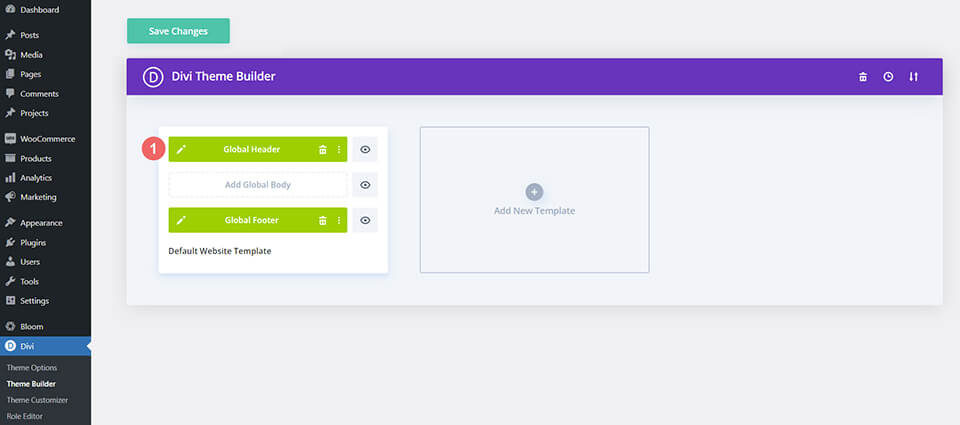
    First, let’s build the fullwidth header that we’ll use in the example. Open the Divi Theme Builder and click Add Global Header to build a new template. Choose Build a Global Header to build it from scratch.

    Build the Hover Background Image Fullwidth Header

    Next, add a Fullwidth Section and delete the Regular Section.

    Build the Hover Background Image Fullwidth Header

    Finally, add a Fullwidth Header Module to your new section.

    Build the Hover Background Image Fullwidth Header

    Now, we can create our hover revealed background and style the module. For this example, I’m using design cues from the hero section from the free Financial Services Landing Page that’s available within Divi.

    Create the Hover Background Image

    Before we style the module, let’s start with creating the hover reveal feature for the Fullwidth Header Module. Once we see how to create it and how it works, we’ll style the rest of the module to match our preview example.

    Hover Reveal Background Image

    The hover revealed background has two elements. The first is the background color that shows as normal. We could also use a gradient or image if we wanted. The second is the element that shows when the user hovers over the Fullwidth Header Module. In our case, this is an image, but we could just as easily use a background color or gradient.

    First, scroll down to Background. On the Background Color tab, change the Color to #f0f3fb.

    • Background Color: #f0f3fb

    Hover Reveal Background Imag

    Next, select the Hover State icon. This is a mouse cursor icon. Clicking it opens a set of tabs that allow us to choose between the regular and hover state settings. Select the Hover State tab to change to the hover options. Next, choose the Background Image tab and choose your background image. I’m using the background image from the Financial Services Layout Pack called financial-services-9.

    • Hover State Background Image: financial-services-9

    Hover Reveal Background Imag

    We now have an image that will reveal when the user hovers over the Fullwidth Header Module. All hover state options work in this way.

    Style the Hover Background Image Fullwidth Header Module

    Now that we have our hover background image in place, let’s style the rest of the module.

    Hover Background Image Content

    Let’s start with the content for the fields, body, and buttons. Add your Title, Subtitle, Button One, Button Two, and Body content.

    • Title: Plan Your Financial Future
    • Subtitle: Welcome to Divi
    • Button One: Get Started
    • Button Two: Get a Free Quote
    • Body Content: your content

    Hover Background Image Content

    Hover Background Image Layout

    Next, select the Design tab. Change Logo & Text Alignment to Centered.

    • Logo & Text Alignment: Centered

    Hover Background Image Layout

    Hover Background Image Scroll Down Icon

    Select Show Scroll Down Button. Select the third icon and change the Color to #1d4eff. Leave the Size at its default setting.

    • Show Scroll Down Button: Yes
    • Icon: 3rd
    • Color: #1d4eff

    Hover Background Image Scroll Down Icon

    Hover Background Image Title Text

    Next, scroll down to Title Text. Select H1 for the Heading Level. Choose Montserrat for the Font, set the Weight to bold, and change the Color to #0f1154.

    • Heading Level: H1
    • Font: Montserrat
    • Weight: Bold
    • Color: #0f1154

    Hover Background Image Title Text

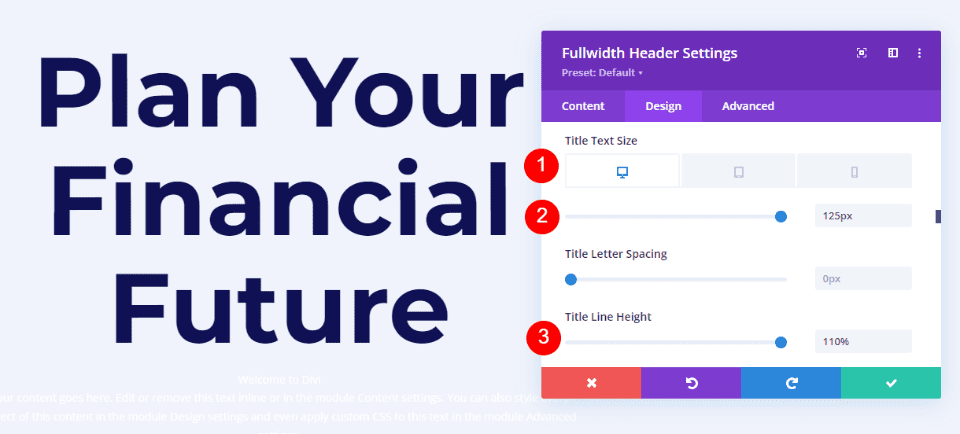
    Change the Font Size to 125px for desktops, 40px for tablets, and 24px for phones. Set the Line Height to 110%. This gives us an oversized title that looks great on any screen size.

    • Size: 125px desktop, 40px tablet, 24px phone
    • Line Height: 110%

    Hover Background Image Title Text

    Hover Background Image Body Text

    Next, scroll to Body Text. Change the Font to Roboto, set the Weight to medium, and change the Color to #0f1154.

    • Font: Roboto
    • Weight: Medium
    • Color: #0f1154

    Hover Background Image Body Text

    Change the Font Size to 18px for desktops and tablets, and 14px for phones. Set the Line Height to 180%. This gives the body text plenty of breathing room.

    • Size: 18px desktop and tablet, 14px phone
    • Line Height: 180%

    Hover Background Image Body Text

    Hover Background Image Subtitle Text

    Next, scroll to Subtitle Text. Change the Font to Montserrat. Set the Weight to bold, change the Style to TT, and change the Color to #1d4eff.

    • Font: Montserrat
    • Weight: Bold
    • Style: TT
    • Color: #1d4eff

    Hover Background Image Subtitle Text

    Change the Font Size to 16px for desktops, 14px for tablets, and 12px for phones. Change the Line Spacing to 0.3em and the Line Height to 1.6em. This sets the subtitle apart from both the title and content without taking up much room.

    • Size: 16px desktop, 14px tablet, 12px phone
    • Letter Spacing: 0.3em
    • Line Height: 1.6em

    Hover Background Image Subtitle Text

    Hover Background Image Button One

    Next, scroll down to Button One and enable Use Custom Styles for Button One. Change the Text Size to 18px. Change the Text Color to white and the Background Color to #1d4eff.

    • Use Custom Styles for Button One: Yes
    • Text Size: 18px
    • Text Color: #ffffff
    • Background Color: #1d4eff

    Hover Background Image Button One

    Next, change the Border Width and Radius to 0px. Choose Roboto for the Font and set the Weight to Medium.

    • Width: 0px
    • Radius: 0px
    • Font: Roboto
    • Weight: Medium

    Hover Background Image Button One

    Scroll down to Button One Padding. Add 14px for the Top and Bottom Padding, and 24px for the Right and Left Padding.

    • Padding: 14px Top and Bottom, 24px Left and Right

    Hover Background Image Button One

    Hover Background Image Button Two

    Next, scroll down to Button Two and enable Use Custom Styles for Button Two. Most of these settings are the same as Button One. Change the Text Size to 18px, the Text Color to white, and the Background Color to #00c9c9.

    • Use Custom Styles for Button Two: Yes
    • Text Size: 18px
    • Text Color: #ffffff
    • Background Color: #00c9c9

    Hover Background Image Button Two

    Next, change the Border Width and Radius to 0px. Choose Roboto for the Font and set the Weight to Medium.

    • Width: 0px
    • Radius: 0px
    • Font: Roboto
    • Weight: Medium

    Hover Background Image Button Two

    Scroll down to Button Two Padding. Add 14px for the Top and Bottom Padding, and 24px for the Right and Left Padding.

    • Padding: 14px Top and Bottom, 24px Left and Right

    Hover Background Image Button Two

    Hover Background Image Spacing

    Next, scroll down to Spacing and add 100px Padding to the Top and Bottom. This increases the size of the fullwidth header without using the Fullscreen option in the Layout settings. In my examples, the fullwidth header leaves a little bit of space at the bottom of the screen where the next section shows. Of course, you could use the full-screen setting in place of the padding if you wanted.

    • Padding: 100px Top and Bottom

    Hover Background Image Spacing

    Hover Background Image Box Shadow

    Lastly, scroll down to Box Shadow and choose the 6th Box Shadow option. This gives the header a more unique look. Close the Fullwidth Header Module and save your settings.

    • Box Shadow: 6th

    Hover Background Image Box Shadow

    Results

    Desktop Without Hover

    Desktop Without Hover

    Desktop With Hover

    Desktop With Hover

    Phone Without Hover

    Phone Without Hover

    Phone With Screen Tap

    Phone With Screen Tap

    Ending Thoughts

    That’s our look at how to reveal a hover background image in your Divi Fullwidth Header Module. The hover state for background images is a simple setting, but it can have a huge impact on the site’s design. It’s a great way to get attention. You can take the design even further if you wanted to add Gradient Stops, overlays, change images, and more. I recommend playing around with the Divi Fullwidth Header Module’s hover background settings to see what you can create.

    We want to hear from you. Do you use a hover background image in your Divi Fullwidth Header Module? Let us know about it in the comments.

    The post How to Reveal a Hover Background Image in Your Divi Fullwidth Header Module appeared first on Elegant Themes Blog.

  • Get a Free Alteration Shop Layout Pack for Divi

    Hey Divi Nation! Thanks for joining us for the next installment of our weekly Divi Design Initiative; where each week, we give away a brand new Layout Pack for Divi.

    This time around, the design team has created a beautiful alteration shop Layout Pack that’ll help you get your next Alteration Shop website up and running in no time!

    This layout pack includes:

    8 Premade page layouts strategically designed for any Alteration Shop website (including a footer design)
    – Original, royalty-free photos and graphics + customizable source file (see below)
    – Plus, a large collection of pre-designed website elements that are customizable and reusable anywhere.

    This layout pack is available right inside Divi for all Divi customers for FREE as the latest addition to our growing Divi library of hundreds of premade layout packs, thousands of page designs, and countless web design elements and resources.

    divi layout

    Check Out The Divi Alteration Shop Layout Pack Below

    Get it for free today!

    Alteration Shop layout pack

    Landing Page Design

    Alteration Shop Pack for Divi

    View The Live Layout Demo

    Home Page Design

    Alteration Shop Layout Pack for Divi

    View The Live Layout Demo

    Services Page Design

    Alteration Shop Layout Pack for Divi

    View The Live Layout Demo

    Service Page Design

    Alteration Shop Layout Pack for Divi

    View The Live Layout Demo

    About Page Design

    Alteration Shop Layout Pack for Divi

    View The Live Layout Demo

    Pricing Page Design

    Alteration Shop Layout Pack for Divi

    View The Live Layout Demo

    Blog Page Design

    Alteration Shop Layout Pack for Divi

    View The Live Layout Demo

    Contact Page Design

    Alteration Shop Layout Pack for Divi

    View The Live Layout Demo

    Key Features

    The Alteration Shop Layout Pack for Divi offers a high contrast design complete with dark backgrounds and bold white text to showcase your alteration business. The warm dark gold accents allow for your site’s visitors to easily identify call to actions, as well as other points of interest. This classic design gives you everything you need to show off your alteration business with class.

    Live Demos

    Click the links below to see a live demo for each of the layouts included in the pack.

    1. Alteration Shop Landing Page (live demo)
    2. Alteration Shop Homepage (live demo)
    3. Alteration Shop Services Page (live demo)
    4. Alteration Shop Service Page (live demo)
    5. Alteration Shop About Page (live demo)
    6. Alteration Shop Pricing Page (live demo)
    7. Alteration Shop Blog Page (live demo)
    8. Alteration Shop Contact Page (live demo)

    Access This Layout Right Now
    Directly from Your Divi Builder

    Since Version 3.0.99 of Divi, you can find and import any of the layouts included in this pack (along with ALL of Divi’s Premade Layout packs) directly from the Divi Builder. They are already waiting for you.

    To access your new layout, simply activate the Visual Builder when editing a page and look for the “Load From Library” icon in the page settings bar (it looks like a plus symbol). Click this icon to launch the Load From Library popup. Under the Premade Layouts tab, you can easily find the new layout by scrolling through the list of layout packs. Once you find the Alteration Shop Layout Pack, click on it. You will see all the individual layouts included in the pack. Select the layout you want to use and then click the “Use This Layout” button.

    Alteration Shop Layout Pack for Divi

    For more, check out this video to learn how you can get this layout pack up and running today.

    Subscribe To Our Youtube Channel

    Authentication Required

    Before you can download Premade Layouts from the Divi Library you must authenticate your Elegant Themes Subscription. You can do this by navigating to Divi > Theme Options > Updates. There you can enter your username and API key and save changes.

    Alteration Shop Layout Pack for Divi

    You can find your API Key under your members area on the Elegant Themes site. After you enter the Username and API Key, you will gain immediate access to our library of hundreds of free layouts (including this one). If you haven’t done this, when you click to import a layout to your page, you will be prompted to enter your Elegant Themes Membership Username and API Key.

    Use Layout Images for FREE with No Licensing Restrictions

    Divi Alteration Shop Layout Pack for Divi

    The image assets included with these layouts (icons, illustrations, photos, etc.) have no licensing restrictions. This means you can use them in all of your commercial projects without having to worry about paying licensing fees or attributing the photographer. Use them in your commercial websites, sell them within your Divi child themes, include them in your own Divi layout packs or just use them on your blog. We know how challenging it can be to find good photos and how confusing and scary the licensing that governs those photos can be. We want to fix that problem for our users.

    Download the Full Res Image Assets

    New Layout Pack Every Week!

    We hope you enjoy this layout pack. We look forward to hearing your opinions in the comment section below. Make sure you check out next week’s layout pack as well!

    The post Get a Free Alteration Shop Layout Pack for Divi appeared first on Elegant Themes Blog.

  • Divi Product Highlight: Header Layout Pack

    The header is one of the first elements to load for any Divi website you create. This means the header often makes the first impression anyone sees for a website, making header design a crucial part of every website. Fortunately, you don’t have to create your header from scratch. There are lots of header layouts in the Divi Marketplace to give you a head start. Header Layout Pack is one example. This is a set of over 80 custom headers that work for just about any type of website. In this post, we’ll look at Header Layout Pack to help you decide if it’s the right product for your needs.

    Upload Header Layout Pack

    Header Layout Pack includes two zipped files. The first is a single file that contains all 81 layouts. These layouts are uploaded together. The second is a supplementary file and includes six files. These are the categories of the header layouts. This allows you to upload just the layouts in a particular category, such as WooCommerce. This is also helpful if you have a file-size upload limit and can’t upload all the files at the same time.

    The process to upload the layouts is the same for all the files:

    1. Go to Divi
    2. Select Divi Library
    3. Click Import & Export
    4. Select the Import tab
    5. Click Choose File and navigate to the unzipped JSON files on your computer
    6. Click Import Divi Builder Layouts

    Upload Header Layout Pack

    Once the import completes, you’ll have 81 new items in your Divi Library (if you chose the main JSON file). They’re labeled and named according to their categories, so they’re easy to identify. These layouts are standard Divi Library layouts, so they can be used with any Divi layout for a page, post, or any layout in the Divi Theme Builder, and stored in Divi Cloud for use on any Divi website. We recommend using them in the Divi Theme Builder and assigning them to global or individual categories.

    Upload Header Layout Pack

    Header Layout Pack Examples

    Let’s look at a few header layouts from each of the six categories. In my examples, I’ll load each layout into the Divi Theme Builder. New layouts are often added to the Header Layout Pack. I’m selecting them at random, but I’ll focus on a mix of older and newer layouts. When viewing them in the Your Saved Layouts tab, you can select the categories or view all the layouts.

    Header Layout Pack Examples

    For my screenshots, I’m using the home page from the free Home Remodeling Layout Pack that’s available within Divi. We’ll look at the wireframe, desktop, and phone versions of the headers.

    Advanced Headers

    Firstly, here’s a look at Advanced Headers, which contains 30 layouts.

    Advanced Header V1

    The first Advanced Header includes a Menu Module, Button Module, and two Text Modules. It also includes a Code Module with CSS.

    Advanced Headers

    The header includes styled dropdown submenus. A quote CTA button stretches on hover.

    Advanced Headers

    While the menus in the desktop version open on hover, the CSS creates a custom mobile menu toggle with buttons that include arrows showing if the menu can be opened or collapsed.

    Advanced Header v1 - Mobile View

    Advanced Header V20

    The Advanced Header version 20 includes four Image Modules, three Blurb Modules, a Menu Module, and a Code Module.

    Advanced Headers

    The Image Modules can be used for logos. All Blurb Modules are clickable buttons for contact information, services, and a CTA to get a quote.

    Advanced Headers

    Mobile menu toggles are added to the phone version with CSS.

    Advanced Header v20 - Mobile View

    Advanced Header V30

    Advanced Header V30 includes three Text Modules, and Menu Module, and a Code Module.

    Advanced Headers

    The Desktop version displays a red top menu bar with a short message and a phone number in large text. A logo and menu are placed under this and include a dropdown submenu styled to match the top menu bar.

    Advanced Headers

    While the desktop version includes red highlights, the Phone Version removes the red background of the submenus and includes the CSS toggles.

    Advanced Header v30 - Mobile

    Fullscreen Overlay Headers

    Secondly, we’ll see Header Layout Pack’s Fullscreen Overlay Headers, which includes 3 layouts.

    Fullscreen Overlay Header V2

    Fullscreen Overlay V2 comes with lots of elements including text, images, buttons, blurbs, code, social media, a menu, etc.

    Fullscreen Overlay Headers

    It includes a hamburger menu icon with a hover animation. The CTA button widens on hover.

    Fullscreen Overlay Header v2 - Desktop

    The menu opens full screen when clicked and includes clickable submenus.

    Fullscreen Overlay Header v2 - Desktop, Open

    Here’s the phone version, which follows the same design.

    Fullscreen Overlay Header v2 - Mobile

    Fullscreen Overlay Header V3

    Fullscreen Overlay Header V3 utilizes similar modules as the previous layout but creates a different design for the full-screen overlay.

    Fullscreen Overlay Headers

    The desktop header includes the CTA and hamburger icon with hover animation.

    Fullscreen Overlay Header v3

    Its menu covers half the screen while an image takes the other half of the screen.

    Fullscreen Overlay Header v3 - Open

    The phone version follows the same design for the menu, but doesn’t include the image.

    Fullscreen Overlay Header v3 - Mobile

    Header with Slide-ins

    Thirdly, we’ll look at Header Layout Pack’s Header with Slide-ins, which includes three layouts.

    Header with Slide-ins V2

    Version 2 creates the slide-in with a Blurb Module, several Text Modules, a Menu Module, a Button Module, and code.

    Header with Slide-ins

    The slide-in menu displays the submenus under a message. At the bottom of the menu, you can find a CTA and an image.

    Slide In v2

    The phone version removes the image while keeping the menu design.

    Slide In v2 - Mobile

    Header with Slide-ins V3

    Version 3 includes Blurb Modules to create the slide-ins.

    Header with Slide-ins

    The desktop slide-in includes hover animation and displays text and icons. Each of the elements is clickable.

    Slide In v3 - Desktop

    The clickable elements for the phone slide-in menu are much larger than the desktop version, making them easy to use on mobile.

    Header with Slide-ins

    Simple Headers

    Fourthly, Simple Headers includes 30 layouts.

    Simple Headers V15

    Simple Headers version 15 has two Rows and includes a Social Media Module and several Blurb Modules.

    Simple Headers

    The desktop version includes a top bar with contact information. A logo is centered, and the menu includes submenus.

    Simple Headers

    The phone version adds the toggle buttons for the submenus.

    Simple Menu 15 - Mobile

    Simple Headers V22

    This one includes two Rows to create the header.

    Simple Headers

    The top bar displays a CTA with a hover animation, the logo in the center, and a phone number. Its menu includes styled submenus.

    Simple Headers

    The phone version displays the submenus with toggles created in the Code Module.

    Simple Menu 22 - Mobile

    Square Logos Headers

    Fifthly, the Square Logos Headers includes five layouts. They’re ideal if you have a logo that’s taller than most logos.

    Square Logos Headers V3

    This one was built with a Specialty Section to include a multi-column layout. The square logo is created with an Image Module in its own column.

    Square Logos Headers

    The desktop version includes a top bar with a search box and contact information. All menus are styled to match the top bar’s background.

    Square Logos Headers

    The phone version includes the submenu toggles created with CSS.

    Square Logo Menu v3 - Mobile

    Square Logos Headers V4

    Version 4 includes three columns to create the logo, menu, and CTAs.

    Square Logos Headers

    The desktop version displays the logo and phone number in the two outer columns. A center column includes two Rows. The top Row shows contact information and a CTA, while the bottom Row displays the menu with a background styled to match the icons and the button of the top Row.

    Square Logos Headers

    The phone version includes a large logo area. The submenus include the toggles created with CSS.

    Square Logo Menu v4 - Mobile

    Woo Headers

    Lastly, we’ll look at Header Layout Pack, which includes 10 WooCommerce headers.

    Woo Headers V3

    Our first Woo Header includes two Rows. The top Row includes a Text Module, while the second Row displays a Menu Module and several Icon Modules.

    Woo Headers

    The Text Module for the top Row creates a sales banner. Graphics include Person, Heart, and Cart icons that can link to the person’s account login, their favorites list, and their shopping cart.

    Woo Headers

    The phone version moves the icons above the hamburger menu. Like the others we’ve seen, this submenu includes toggles created with CSS.

    Woo Header v3 - Mobile

    Woo Headers V7

    Woo header version 7 was built with three Rows that include Blurb Modules to create interesting WooCommerce links.

    Woo Headers

    The desktop version shows a message and the Woo links in the top bar. A middle bar displays a logo and a WooCommerce product search. The menu bar includes social media buttons.

    Woo Headers

    This is the phone version, which places the social media icons under the hamburger menu icon. Everything is spaced well on the phone screen, and it even includes the WooCommerce links and the product search box.

    Woo Header v7 - Mobile

    Woo Headers V10

    Woo Header version 10 also includes three Rows. It includes a product search and uses a Text Module to create a banner.

    Woo Headers

    The desktop version displays a green sales banner at the top. The icons, button, and highlights match the green bar. The middle bar includes the WooCommerce icons, while the menu and search at placed at the bottom.

    Woo Headers

    Here’s the phone version, which places the search box under the hamburger menu. This one also includes the submenu toggles created with CSS.

    Woo Headers v10 - Mobile

    Purchase the Header Layout Pack

    Header Layout Pack is available in the Divi Marketplace for $15. It includes lifetime updates, unlimited website usage, and a 30-day money-back guarantee.

    Purchase Header Layout Pack

    Ending Thoughts

    That’s our look at Header Layout Pack. There are a lot of layouts in this header pack. They look elegant, have lots of design options, and they’re easy to use. Since the layouts were created by the same person, they share a commonality that I find makes them easier to use. The methods are standardized, so if you know how to customize one of the layouts you can customize the rest. If you’re interested in an extensive set of headers, Header Layout Pack is work considering.

    We want to hear from you. Have you tried Header Layout Pack for your Divi website? Let us know about your experience in the comments.

    The post Divi Product Highlight: Header Layout Pack appeared first on Elegant Themes Blog.

  • How to Use the WordPress Site Tagline Block

    The Site Tagline Block is one of many useful blocks that make WordPress so easy to use. With it, you can add your site’s tagline anywhere on your site and customize it using built-in style options. In this article, we’ll discuss everything you need to know about the site tagline block so you can use it effectively on your website.

    What is the Site Tagline Block?

    Your site tagline (along with the site title) is usually added when you first install WordPress and can be found in the dashboard’s general settings. The tagline should be updated from the default “Just another WordPress Site” with a more appropriate summary of what your site is all about. To change your website’s tagline in the back end, you can navigate to Settings > General.

    The Site Tagline Block is a theme block in WordPress that allows to you easily add your site tagline anywhere on your site as dynamic content. You can drag the block into a page, template, or header and customize it however you like. This is one of many blocks introduced with full site editing in WordPress.

    How to Add the Site Tagline Block to your Post or Page

    For this example, we are going to use the Twenty Twenty-Two theme to add the site tagline to the header area of the template.  From the WordPress dashboard, go to Appearance  > Editor.

    To add a Site Tagline block, start by clicking the Block Inserter icon when editing the page template.

    From here you can search Site Tagline from the search bar.

    Either click on it or drag it to your desired location to add the block to your page.

    You can also type /tagline to quickly add your site’s tagline to your page.

    Site Tagline Block Settings and Options

    Toolbar Settings

    If you hover over the block, you’ll see a formatting menu that includes the following options:

    1. Transforming the block into another type of element
    2. Changing the alignment of the text
    3. Additional settings.

    Here’s a quick cheat sheet that shows where each of those options is within the formatting toolbar:

    Additional Settings

    If you click on the three vertical dots on the right side of the toolbar and select show more settings or the cog in the upper right corner you can access the sidebar to view the additional block settings available.

    From this side panel you can view the additional settings, first we’ll look at the Color settings available:

    1. Change the text color.
    2. Change the background color of the text.

    You can also change the font, appearance (Bold, Italic, etc.), line height, letter spacing, decoration (underline, strikethrough), and letter casing by clicking the three vertical dots next to Typography under the Color section.


    You can change the font from the font setting section.


    Adjust the font size under the size setting.

    The font-weight (bold, thin, etc.) can be changed in the appearance section.

    You can also adjust the letter spacing and line height in their respective sections.


    In the letter case setting, we can adjust the capitalization of the site tagline block.

    And we can underline or strikethrough our site tagline by selecting those options in the decoration section.

    Below the settings section, you can find the dimensions tab where you can adjust the padding and margin of your site tagline block.

    Changing the Global Style of Site Tagline Block in WordPress

    As mentioned earlier, your actual WordPress Site Tagline (the text content) can be updated using the Site Tagline Block for all interactions of the block dynamically. However, the style (background color, text color, etc.) of the block won’t apply to all interactions unless you change the default global style of the block.

    For example, below we have adjusted the background color of our site tagline block in the header to blue.

    If we open a blog post, we can see that the header changes with the new style (1), but the style is off if we place the site tagline block somewhere else on the page (2).

    To change the styles of all the site tagline blocks on your WordPress website site-wide, we can navigate to the styles tab by clicking the half-white, half-black circle in the top right of our template editor and selecting blocks.

    From here, search “site tagline” from the search bar and select it.

    Here you can make changes that will change the default style for all current and future iterations of the site tagline block on your website.

    Of course, you can always override these global styles for any individual block as needed.

    Frequently Asked Questions About the Site Tagline Block

    Here are a few FAQs that may help you better understand the Site Tagline Block.

    Do I need a Site Tagline for my website?

    Absolutely! Like your Site Title, the Site Tagline helps define your website’s identity and purpose. Most importantly, a tagline helps SEO. It is used by search engines to help rank your site especially if it is displayed on the SERPs. Even if you choose not to display your tagline on your header, creating one in Settings > General, is still good practice for SEO.

    Where Should I Use the Site Tagline Block?

    Generally, the Site Tagline is used primarily behind the scenes. But it is common practice to add to your header or footer. You can place it next to the site logo block or site tile block to help visitors know what your site is about.

    Can I Add Custom CSS to My Site Tagline Block?

    Under the dimensions section in the additional settings sidebar, you can see the advanced section. Here you can add CSS classes to your block to target the block in your CSS stylesheet or use your theme’s Additional CSS area as needed.

    To access the CSS editor, go to Appearance > Additional CSS:

    Adding a Dynamic Site Tagline in Divi

    You can use the Divi Theme Builder to add a site tagline to your global header in just a few easy steps. You can start by clicking the edit button next to Global Header in your Divi Theme Builder. We’re using a premade template for this tutorial, but these steps will work with any theme.

    Next, add a new Call to Action module in your header.

    Next, hover over the body area and select the “Use Dynamic Content” icon. Then select “Site Tagline” from the list.

    For more, check out our tutorial on how to add a dynamic title and tagline in Divi.

    Conclusion

    The site tagline block gives you full control over where you want to display it throughout your site. Using the built-in block settings available in the WordPress editor, you can easily add, edit, or style the block to fit your design. Use it to add a beautiful tagline to your site’s header, footer, or anywhere you want.

    You may also be interested in our tutorials on WooCommerce Blocks and Block Patterns.

    Let us know in the comments if you have any questions regarding the WordPress site tagline block!

    The post How to Use the WordPress Site Tagline Block appeared first on Elegant Themes Blog.

  • Download a FREE Header & Footer for Divi’s Streamer Layout Pack

    Hey Divi Nation! Thanks for joining us for the next installment of our weekly Divi Design Initiative where each week, we give away brand new freebies. We recently shared a brand new Streamer Layout Pack. To help you get your website up and running as soon as possible, we’re sharing a global header & footer template that matches this layout pack perfectly as well! Hope you enjoy it.

    divi layout

    Check Out The Streamer
    Global Header & Footer Template Below

    Get it for free today!

    Header Design

    Desktop View

    Header design for the Divi Streamer Layout Pack for desktop

    Tablet & Mobile View

    Header design for the Divi Streamer Layout Pack for tablet and mobile

    Footer Design

    Desktop View

    Footer design for the Divi Streamer Layout Pack for desktop

    Tablet and Mobile View

    Footer design for the Divi Streamer Layout Pack for desktop

    Download The Global Header & Footer Template For The Streamer Layout Pack

    To lay your hands on the free global header & footer template, you will first need to download it using the button below. To gain access to the download you will need to subscribe to our newsletter by using the form below. As a new subscriber, you will receive even more Divi goodness and a free Divi Layout pack every Monday! If you’re already on the list, simply enter your email address below and click download. You will not be “resubscribed” or receive extra emails.

    How to Upload The Divi Streamer Template

    Go to Divi Theme Builder

    To upload the Divi Streamer template, navigate to the Divi Theme Builder in the backend of your WordPress website.

    Getting started with the Divi Conference Layout Pack

    Upload Global Default Website Template

    Then, in the top right corner, you’ll see an icon with two arrows. Click on the icon.

    Importing the Header and Footer Layout into the Divi Theme Buidler

    Navigate to the import tab, upload the JSON file which you were able to download in this post, and click on ‘Import Divi Theme Builder Templates’.

    Import settings for the header and footer layout pack

    Save Divi Theme Builder Changes

    Once you’ve uploaded the file, you’ll notice a new global header and footer in your default website template. Save the Divi Theme Builder changes as soon as you want the template to be activated.

    Save global header theme builder

    How to Modify The Divi Streamer Template

    Open Header Template

    To modify the global header template’s elements, start by opening the template.

    Editing the global header within the Divi Theme Builder

    Select Your Menu of Choice

    Select a menu of your choice in the Menu Module.

    Update menu within the Divi Streamer header

    Upload Your Logo

    Within the same Menu Module, upload your logo.

    Update logo within the Menu Module

    Add CTA Link URLs

    The header of the Divi Streamer template has a button on the top right. Open the settings of each to update the link URL to the destination of your choice.

    Update button URL for the main header section

    Update Announcement Bar

    This header template also comes with a secondary menu. Edit the text and add a URL – if you’d like – for this announcement bar.

    Update Text Module within the secondary menu/announcement bar

    Open Divi Streamer Template Footer

    Continue by opening the global footer inside the default website template.

    Editing the footer template within the Divi Theme Builder

    Update Footer Content

    You will need to go through the footer of the Divi Streamer template and make some updates. If need be, you can modify the content that comes with the template. You may also want to update the Social Media Follow Module with your social networks as well as their corresponding links. Don’t forget about the copyright text at the bottom of the footer as well.

    Update footer static content and social media networks

    Update Footer Menu

    Similarly to the header, we will need to connect our footer menu to the Menu Module.

    Update your footer menu in your Divi Streamer Layout Pack

    Connect Email Marketing Platform

    Our footer design has an Email Optin Module. As such, remember to connect your email marketing service provider to the module to begin to collect email addresses from your users.

    Connect your email marketing platform of choice

    New Freebies Every Week!

    We hope you’ve enjoyed the Streamer Layout Pack and the Header & Footer freebie that goes along with it. We look forward to hearing your opinions in the comment section below. Make sure you check back next week for more freebies!

    The post Download a FREE Header & Footer for Divi’s Streamer Layout Pack appeared first on Elegant Themes Blog.

  • Yoast SEO Plugin for WordPress: An Easy Setup Guide

    Search Engine Optimization (SEO) is one of the most important aspects of any website. It works side by side with writing good original content, and keyword research, and is crucial to rank higher in search engine results pages (SERPs). While WordPress does have some search engine friendly aspects to it, you’ll need a little help to truly score a higher ranking. This is where the Yoast SEO Plugin comes in.

    In this post, we’ll give you an overview of what it is, walk you through its first-time configuration of it, and show you how to use it by giving you a step-by-step overview. Let’s get started.

    What is Yoast SEO

    Yoast SEO plugin

    The Yoast SEO Plugin for WordPress is an all-in-one SEO solution for your website. It provides in-depth SEO analysis, snippet previews, robust readability tools, and webmaster tools to make configuring SEO a less daunting task. With so many tools in its arsenal, Yoast is considered one of the top WordPress SEO plugins.

    There are two options for the plugin – a free version that is available on WordPress.org and a premium version, which has advanced features such as multiple keyword phrases, social previews, and link suggestions during writing. Yoast also has other SEO plugins to optimize your SEO strategy even more.

    How to Use Yoast SEO Plugin in WordPress (Step by Step)

    In this section, we’ll give you all of the information you need to configure Yoast SEO. We’ll cover installation, the first-time configuration wizard, how to set up on-page SEO, and give you an in-depth look at the SEO dashboard.

    Install and Activate the Yoast SEO Plugin

    Start by logging in to your WordPress dashboard. Next, navigate to Plugins > Add New.

    Add Yoast SEO plugin

    Type Yoast into the search bar. When the page refreshes, select the plugin then click the Install Now button.

    search for Yoast SEO

    Finally, click the Activate button to activate the plugin.

    activate the plugin

    When the page refreshes, you’ll be directed to the welcome screen, where you can start the first-time configuration.

    Complete First-time Configuration

    The first-time configuration of the Yoast SEO plugin optimizes your data to allow search engines to find your site easier, enter important site information, add social media profile pages, and configure your personal preferences.

    Click the Start first-time configuration button to get started.

    start the configuration

    SEO Data Optimization

    Yoast SEO helps give search engines such as Google a better understanding of your site. First, you’ll want to start SEO data optimization. Yoast will store all metadata for all pages and posts in a database table called the indexibles. It streamlines the indexing process into one database request, reduces page speed loading times, and helps search engines find your site.

    start SEO data optimization

    Site Representation

    The next set of settings will help search engines identify your website by site type, site name, your organization’s name, and logo.

    site representation

    Social Profiles

    Yoast displays Facebook and Twitter by default, but you can add as many additional profiles as needed here.

    Add social profiles

    Yoast SEO Personal Preferences

    Next, select whether you want Yoast to track your data. Yoast tracks plugins, themes, information on your website’s server, and some user data.

    Yoast personal preferences

    At this point, you should have most of what you need already in place. We’ll get to the dashboard options in more detail later. But for now, let’s take a look at how Yoast SEO works for on-page SEO.

    How to Use the Yoast SEO Meta Box (for on-page SEO)

    The Yoast SEO meta box is an on-page SEO tool that allows you to optimize your SEO content for each post/page on your site in real-time. Using the meta box increases the chance of better rankings in SERPs.

    You can find the meta box in at the bottom of the page editor.

    Access the Meta box

    If you are using a block editor, click the Yoast icon at the top right to access the Yoast SEO meta box.

    Yoast SEO block theme

    SEO

    The SEO tab gives you an analysis of your post’s content in real-time. It uses the green light system which rates your post content as good, okay, or needs improvement. Once a keyword is inserted, Yoast gets to work analyzing the content and suggests improvements.

    Focus Keyphrase

    A keyphrase (or keyword) is the main word or phrase you want your content to rank for in search results. You’ll want to do keyword research beforehand to find the right focus keyphrase.

    focus keyphrase

    You can also click the Get related keyphrases button in the meta box to add more related keywords you wish to rack for as well.

    Google Preview

    Google Preview gives you a glimpse of how your post will appear in search results in both desktop and mobile formats.

    google preview

    SEO Title & Slug (URL)

    The SEO Page Title and the URL slug can be optimized in this section for best results. Make sure both are not too long and include your keyphrase for the best results.

    SEO title and slug

    Meta Description

    meta description

    The meta description is one of the most important parts of optimizing on-page SEO. It can give your potential visitors a reason to click. Therefore, it’s important to write a perfect meta description that is concise, includes your keyword(s), and describes the content accurately.

    Yoast allows you to insert variables into the meta description such as site title, post title, primary category, and separator.

    meta description variable

    SEO Analysis

    Under SEO analysis, Yoast provides an on-page SEO score and a checklist that you can use to optimize specific tasks to achieve a green light. It identifies problems, improvements, and good results.

    SEO analysis

    To achieve a green light, the best approach is to write good content from the start. For some great tips, check out how to write quality SEO content.

    For more ways to optimize your post for SEO, check these advanced SEO techniques.

    Cornerstone Content

    cornerstone content

    If the post is considered cornerstone content, you mark it as such here. If you’re not sure what this means, check out How to Optimize Cornerstone Content for SEO.

    Advanced Features

    Yoast SEO plugin advanced options

    Under Advanced, you have additional SEO options for your post. You can choose whether or not to allow search engines to show the post in search results, set follow links, select robot options, assign a breadcrumb title, and insert a canonical URL.

    Insights

    Flesch reading ease

    Here you can view the Flesch reading ease score of the post. This gives you insight as to how difficult it is to read your post, contains the word count, and estimated reading time. Premium options give you a breakdown of the most used words in your content, so you can cross-check your most used words with prominent words in search results focused on the same subject.

    Readability

    Yoast uses a proprietary algorithm to make readability results quite accurate. In most cases, you should try to get a readability score of 8, since the majority of people are comfortable reading at that level, according to the Flesch reading ease scale.

    Like with SEO analysis, the scores are based on factors that are highlighted as problems (red), improvements (orange), and good results (green). In the example below, a section length issue is detected. Plus you can easily locate problem areas by clicking the “eye” icon next to each item in the list.

    readability tab

    To learn more readability tips, check out How to Get the Perfect Yoast SEO Readability Score.

    Schema

    schema

    Under Schema, you can use Schema markup to optimize your site’s SEO so that it is easier to index by search engines. In Yoast SEO, you can change schema settings in the dashboard or on individual posts and pages here.

    Social

    social preview

    The Social tab allows you to control how your post’s preview is displayed on social media platforms. You can assign a custom image, title, and description for each. Because social media platforms have a different display for posts on their platforms, it’s worth considering an upgrade to premium.

    Explore the Yoast SEO Plugin Dashboard

    The dashboard allows you to configure settings by assigning them to four major groups – general settings, content types, categories and tags, and advanced settings.

    In the general settings, you can view potential problems and notifications such as release notes, and upcoming features.

    Yoast SEO dashboard

    Yoast SEO General Settings Tab

    Yoast general tab

    Out of the box, the most important features are enabled. However, others such as inclusivity – which detects content that may be offensive to certain groups – are available.

    • SEO analysis: Measures on-page SEO
    • Readability Analysis: Gain insight on your site’s readability.
    • Inclusive language analysis: Detects derogatory content with options to correct it.
    • Insights: Reveals information about reading ease score, estimated reading time, and word count.
    • Cornerstone content: Enables the ability to assign a particular post as cornerstone content.
    • Text link Counter: Detects the number of internal links in posts.
    • Link suggestions: A premium feature that suggests internal links to posts or pages on your site.
    • Open Graph data: Allows social media to display a preview with images and text.
    • Twitter card data: Allows Twitter to display a preview when your site’s link is shared.
    • Slack sharing: Shares an author byline and reading time estimate in Slack channels.
    • Admin bar menu: Grants access to Yoast tools on the front end of your WordPress site.
    • REST API endpoint: Gives headless WordPress sites the ability to add metadata to individual URLs.
    • XML sitemaps: optimize what to include in your XML sitemap and submit it to Google.
    • IndexNow: A premium feature that enables automatic pings on Bing and Yandex.

    Setup Social Settings

    One major change to Yoast involves the social settings. Formerly located in its own tab in the WordPress toolbar, it’s now located under the site representation > other profiles section in general settings.

    other social settings

    For most users, there won’t be a need to modify settings here. The information you added in the first-time configuration was automatically added to this section once the configuration was completed. That being said, you aren’t limited to just Facebook and Twitter. Unlike other plugins, Yoast allows you to add other social platforms such as Instagram, Pinterest, YouTube, or LinkedIn.

    Content Types

    This tab controls the search appearance options for posts and pages. You can enable all post types, enable only some, and configure the settings for each. Basic settings include options to streamline SEO titles and meta descriptions. If entered in the content types tab, your posts and pages will use the same SEO title structure and meta description.

    content types

    The options include:

    • Title & Meta Description
    • Social image
    • Social title
    • Social description

    Categories and Tags

    In this section, the settings are identical to the content types section, except they apply to taxonomies.

    category settings

    Yoast SEO Advanced Settings

    Under this tab, you can configure crawl optimization settings (with a premium license), breadcrumbs, other pages such as author archives, date archives, format archives and special pages. There are additional settings for media pages and RSS feeds.

    Breadcrumbs

    The breadcrumbs settings in Yoast SEO allow you to customize the appearance of breadcrumbs on your site. There are plenty of options that allow you to customize the display of your breadcrumb navigation, choose which taxonomies to show for content types, and more.

    breadcrumbs yoast SEO

    Archives

    Under the Archives tab, you can disable the author, date, or special page archives in the search results. Plus, you have additional settings to allow you to either show or hide the authors without posting the results. Like other search appearance tabs, you can create a custom SEO title and meta description as well. Those with a premium version of the Yoast SEO plugin can configure how these types of pages will display on social media platforms.

    archive settings

    Media

    By default, Yoast disables media page URLs because they serve no purpose in SEO. If you wish to enable media URLs, you can do so here. Once enabled, you’ll be able to configure search appearance options, schema, and SEO controls and assessments, which determines whether Yoast SEO tools and controls are visible in the attachment editor.

    Media pages

    RSS

    The Yoast SEO plugin has an automatic tool that allows you to add content to your RSS feed. You can assign content to appear before each post in the feed, as well as add content after each post. Additionally, you can input variables that perform various options such as adding a link to the post, where the title is the anchor text and more.

    RSS settings

    Integrations

    Yoast SEO integrations

    Under Yoast SEO > Integrations you’ll find a list of integrations including SEMrush, Wincher, WooCommerce, Jetpack, and more. Some integrations are only available with Premium.

    Yoast SEO Tools

    Yoast tools

    There are a few handy tools available with Yoast that allow you to speed up your site, save time editing, and configure important SEO files on your server.

    1. Import and export: Import settings from another SEO plugin, or export your settings for use in other sites.
    2. File editor: Create a robot.txt file or edit your .htaccess file.
      Yoast SEO file editor
    3. Bulk editor: Bulk edit SEO titles and meta descriptions.
    4. Optimize SEO data:Give your site a speed boost by running the data optimization tool.

    Yoast SEO Plugin FAQs

    Since Yoast SEO is a broad topic, so you’re bound to have questions. Hopefully, these will help.

    Does Yoast SEO Have Tutorials I Can Follow?

    Yes! The Yoast SEO academy is free for you to learn the basics of SEO, as well as the Yoast SEO plugin. If you require more advanced training, they offer a paid version of the courses with your purchase of the premium plugin.

    How Do I Add My Website to the Google Search Console?

    Trying to figure out how to do things in Google can be a bit daunting. Thankfully, we have everything you need to know in our ultimate guide to Google Search Console.

    Is Configuring SEO Different If I Have a WooCommerce Site?

    While the concept of SEO is relatively the same, there are some added components to consider. You’ll still need to configure on-page SEO for your posts and pages, but there are the added elements of products, product categories, and your shop. Yoast has a WooCommerce SEO plugin you can use. But there are other alternatives you can consider as well. Check out WooCommerce SEO: A Complete Guide to Ranking #1 on our blog to learn some tips and best practices to help you dominate the eCommerce market.

    How Important is Google Preview Where SEO is Concerned?

    Taking the time to write a good SEO title, use a captivating feature image, and write an attention-grabbing meta description are crucial for SEO. This is true for desktop users, but for mobile users as well. Since roughly 60% of the internet’s users utilize a mobile device for internet surfing, it is more important than ever. Taking the time to learn the difference between desktop and mobile SEO is a critical aspect of your site’s success. Take a look at our ultimate guide to mobile SEO to learn more.

    Yoast SEO is WordPress’ Best Friend

    SEO is a highly advanced topic that requires quite a bit of understanding to master. You’ve taken the first step in that journey by learning how to use Yoast SEO. Thankfully, we offer countless resources to aid you along the way. By brushing up on your SEO techniques , gaining a better understanding of linking strategies, and recognizing the importance of mobile SEO in today’s digital landscape, you’ll have the tools necessary to up those rankings. With those additional resources, you’ll be ready to reach the top of the proverbial SEO mountain in no time.

    Do you use Yoast SEO on your website? Let us know by dropping a comment below.

    The post Yoast SEO Plugin for WordPress: An Easy Setup Guide appeared first on Elegant Themes Blog.