EDITS.WS

Category: elegantthemes.com

  • Download a FREE Blog Post Template for Divi’s Chocolatier Layout Pack

    Hey Divi Creators! Thanks for joining us for the next installment of our weekly Divi Design Initiative where each week, we give away brand new freebies. This time around we’re building upon the Chocolatier Layout Pack with a brand new blog post template that matches the rest of the pack perfectly. Hope you enjoy it!

    divi layout

    Check Out The Chocolatier
    Blog Post Template Below

    Get it for free today!

    Desktop View

    The Divi Chocolatier Blog Template in desktop view

    Tablet/Mobile View

    The Divi Chocolatier Blog Template in tablet and mobile view

    Download The Blog Post Template For The Chocolatier Layout Pack

    To lay your hands on the free Chocolatier Blog Post Template, you will first need to download it using the button below. To gain access to the download you will need to subscribe to our newsletter by using the form below. As a new subscriber, you will receive even more Divi goodness and a free Divi Layout pack every Monday! If you’re already on the list, simply enter your email address below and click download. You will not be “resubscribed” or receive extra emails.

    How to Upload The Template

    Go to Divi Theme Builder

    To upload the template, navigate to the Divi Theme Builder in the backend of your WordPress website.

    Opening the Divi Theme Builder to Import the Divi Conference Category Layout

    Upload Website Template

    Then, in the top right corner, you’ll see an icon with two arrows. Click on the icon.

    Importing the Header and Footer Layout into the Divi Theme Buidler

    Navigate to the import tab, upload the JSON file that you could download in this post, and click on ‘Import Divi Theme Builder Templates’.

    Import settings for the header and footer layout pack

    Save Divi Theme Builder Changes

    Once you’ve uploaded the file, you’ll notice a new template with a new body area that has been assigned to All Posts. Save the Divi Theme Builder changes as soon as you want the template to be activated.

    Save the imported blog post layout within the Divi Theme Builder

    How to Modify The Template

    Open Post Template

    To modify the template’s elements, start by opening the template.

    Begin editing the blog post body template within the Divi Builder

    Inside the Body Layout Editor, you can edit the design on the front end using the Divi Builder just like you would with a normal Divi page.

    Since this is a template that has been assigned to all posts for the site, there is a post content module that is necessary for displaying the post content. You will need to keep that module in place, but you can adjust the post content module’s design elements, which will design the post content that is displayed dynamically.

    You can edit the titles, fonts, color etc. of the Post Content Module that will affect the body text in the Divi Chocolatier Blog Page Template

    About the Layout

    This blog post template has a few dynamic elements that will work with your blog posts immediately. Our entire post header is made up of dynamic elements including a featured image, the post excerpt, the post category and the post title. This content won’t need updating, but you can tweak the design of each of those elements if needed.

    Other dynamic elements include the following:

    • Post Author Name: We use a Text Module to show the first and last name of the post author
    • Post Author Bio: Again, we use a Text Module to show the author bio
    • Post Author Photo: An Image Module is in use to bring in the author profile photo from Gravatar
    • Comments: A comment form with a comments section

    Here is a quick illustration that identifies the elements of the Divi Chocolatier blog post template.

    Divi Chocolatier Blog Post Template Breakdown

    Update Static Content Modules

    There are some elements on this post template may need your immediate attention before using it live on your own website. For this post template, you may want to consider updating the Text and  Button modules that are used as call-to-actions above the comments section.

    New Freebies Every Week!

    We hope you’ve enjoyed the Chocolatier Layout Pack and the blog post template freebie that goes along with it. We look forward to hearing your opinions in the comment section below. Make sure you check back next week for more freebies!

    The post Download a FREE Blog Post Template for Divi’s Chocolatier Layout Pack appeared first on Elegant Themes Blog.

  • 26 Best WordPress Marketing Plugins for 2023

    Capturing demand and making sales is an uphill battle. Just because you have a website does not mean people will see it or respond to it favorably. Because of this, you should bring in effective tools to better market your website. Thankfully, there are many WordPress Marketing Plugins at your disposal.

    This article will uncover essential plugins that improve both marketing output and quality. We have 26 of the absolute best plugin solutions for you to explore in this 2023 marketing plugin review.

    We’ll look into marketing plugins for:

    WordPress Marketing Plugins for Content Marketing

    Content marketing is the process of creating and distributing valuable, relevant, and consistent content to attract and retain a clearly defined audience — and, ultimately, to drive profitable customer action.

    It’s an ongoing process that helps you create long-term relationships with your customers by delivering value at every touchpoint. And it requires a strategic approach that aligns your content with your business goals.

    Content marketing feeds so much of your marketing strategy. SEO optimizes your content so that it ranks in search engines. Email and SMS marketing uses content to drive traffic to high-value landing pages. Social media marketing uses social content to increase customer touchpoints and stay top of mind. Brand marketing uses content to convey brand value and differentiation in the market. Content marketing simply touches every aspect of your marketing apparatus.

    Here are the top WordPress plugins that can either expand your content marketing or make it easier.

    1. Seriously Simple Podcasting Plugin

    Seriously Simple Podcasting by Castos

    Seriously Simple Podcasting is a podcasting solution that is native to WordPress. It’s a top-rated plugin for beginners and power users. The completely free version is a self-hosted podcasting platform that uses your WordPress installation to host files so you can be sure your podcasts are always available. With Seriously Simple Podcasting, you get an RSS feed, a web player, and links to all your episodes on major podcast platforms.

    The paid versions of Seriously Simple Podcasting let you store your podcast episode off of your website. This allows your site to speed back up to pre-podcast days as it offloads the files and serving of your podcast to reliable servers that are optimized for just that.

    Podcasters and marketers love this simple solution that gives them a podcasting interface that they are used to with WordPress.

    Price: The plugin is free to use on all your websites | More Information

    2. PublishPress Planner

    PublishPress Editorial Calendar Plugin

    PublishPress Planner is a powerful WordPress plugin that takes care of all your content planning needs for marketing your content. It has helpful tools like an content calendar which is a vital tool for any content creator, whether you’re a solo blogger or a team lead managing an entire content operation. Creating an editorial calendar is an effect content marketing strategy that helps you plan and schedule your content so you can stay organized and on track.

    The PublishPress editorial calendar makes it easy to plan and publish your content. With our drag-and-drop interface, you can easily move your content to different post days. You can also create checklists for posts so that you never forget a step in your editorial and publishing processes. Plus, they offer an editorial revision history feature that ensures you always have a record of your changes and who approved what.

    Price: The plugin is free to use with additional features in their Pro Plan for $69 LTD | More Information

    3. Internal Link Juicer Plugin

    Internal Link Juicer WordPress SEM Plugin

    Internal Link Juicer is a WordPress plugin that aims to take some of the manual work out of creating and maintaining internal links. It even made our dedicated list of the best WordPress SEO plugins (#4). It gives you the ability to create automatic links in your content based on anchor text. Internal Link Juicer simply matches anchor text with your linking preferences as defined by your setup configurations. Assign words/phrases to a particular link and Internal Link Juicer will do the heavy lifting for you.

    Having internal links throughout your content is the lifeblood of on-page SEO optimization. Without the connections made across your content, search engines have a really hard time categorizing (and thus ranking) your content.

    Internal links give Google and other search engines an idea of what your content is about and the authority of that content. As you know, Internal linking is a necessary component of SEO link strategies.

    Price: Free version of Plugin available with a Pro upgrade at $69.99/year | More Information

    4. Imajinn Image Generator

    Imajinn Block Based AI Image Generator

    Imajinn is a block element that allows users to input prompts for AI image generation. Outside of it being a cool new technology in the WordPress space, it is also a unique addition to the content marketer’s toolkit.

    Feature images and post images that help convey the meaning of the written content on a given page have always been important. That is why even this post has a clear featured image and supporting images throughout the post. It keeps readers’ attention while also communicating beyond words.

    Gathering images for these purposes is sometimes easier said than done. Sourcing images can be time-consuming and expensive. And if you are creating content in a saturated niche, it isn’t uncommon to see the same images on different blogs.

    Can you count the number of blogs you’ve seen a similar SEO image on?

    Example of Common SEO Stock Image

    Example of Common SEO Stock Image – Image by Rawpixel.com / shutterstock.com

    Too many …

    With AI-generated images, you can use dialed-in prompts to create your own custom images that are fit for editorial. AI can provide a never-ending source of images and visual aids for your own blog that is uniquely yours. You can even experiment by adding brand aspects to your images (tone, colors, and point of view). Content marketing is only benefited from better-quality images.

    Price: First 40 images Free and monthly plans starting at $9/mo | More Information

    NOTE: AI can do more than generate images these days. Check out more AI marketing tools to boost your business.

    Ecommerce Marketing Plugins

    More and more businesses are going online, which means fierce competition. In order to succeed, businesses need to have a strong marketing strategy. Marketing is important for ecommerce websites and brands because it helps businesses to reach their target audience, stand out from the competition, and increase sales. With the right mix of WordPress plugins and tools, businesses can reach a wide range of consumers and promote their products effectively.

    5. WP Mail SMTP

    WP Mail STMP WordPress Plugin

    WordPress has traditionally been quite poor at handling system emails. They are often flagged as spam in email clients because of outdated protocols for sending mail. With WP Mail SMTP, you can be sure that your marketing and transactional emails are delivered correctly and efficiently. This plugin provides a hassle-free solution for managing your email communications so that you can focus on more important things.

    Since Ecommerce businesses rely on effective emails that must be sent from the website, figuring out an SMTP solution is vital for keeping customers in the know.

    Price: The plugin comes free with upgradable Pro plans starting at $49/yr | More Information

    6. FunnelKit

    FunnelKit for WooCommerce Plugin

    The FunnelKit Funnel Builder for WordPress and WooCommerce is the perfect solution for businesses looking to capture maximum ROI with their ecommerce stores. With pre-made funnel templates, a smart rules engine, and powerful store analytics, the FunnelKit Funnel Builder makes it easy to create and optimize marketing campaigns that drive conversions and especially sales.

    Key Features:

    • Frictionless Checkouts
    • Cross Selling Smart Rules
    • A/B Tests for Entire Funnel
    • Opt-in Landing Pages
    • Analytics Dashboard

    Price: FunnelKit sports a free yet limited plugin with Pro Features starting at $99.50/yr | More Information

    7. Google Ads & Marketing by Kliken

    WooCommerce Google Ads Marketing by Kliken

    Google Ads is the easiest way to promote your products on Google and get them in front of millions of potential shoppers. You can create ad campaigns that target interested shoppers across Google, so you can get discovered on any budget. Google Ads by Kliken for WooCommerce stores makes it easy to set up your campaigns and track your results, so you can focus on growing your business.

    Key Features:

    • Connect Your Store to Google Merchant Center
    • Create Smart Product Feeds that Sync Your Inventory
    • Show up in Search Results with Free Product Listings
    • Run and Manage Paid Ad Campaigns to Promote Across Google Products

    Price: Kliken has a free WooCommerce Extension but the service costs $10/mo | More Information

    8. TikTok for WooCommerce

    WooCommerce TikTok Marketing Extension

    If you’re looking to take your online sales to the next level, TikTok for WooCommerce is the perfect solution. By syncing your store catalog and installing the TikTok pixel, you can easily track campaign performance and set up ads for your target audience. With TikTok for WooCommerce, you can reach a wider audience and boost your sales like never before.

    Key Features:

    • Setup TikTok Tracking Pixel with No Code Installation
    • Sync Your Store’s Catalog with TikTok’s Ad Platform to Create Shopping Ads
    • Create Ad Campaigns from Your Website (Conversion Campaign Types Only)
    • Track Campaign and Sales Performance

    If TikTok Advertising has you dancing, checkout the basics of advertising on TikTok. Or, see our list of top TikTok plugins.

    Price: Free Woo Extension but TikTok Ads cost | More Information

    9. Mailchimp for WooCommerce

    Mailchimp WooCommerce Marketing Plugin

    Mailchimp for WooCommerce is a WordPress plugin that connects your online store to mailchimp, giving you access to powerful sales-driving marketing tools that leverage the best of Mailchimp and WooCommerce. With these features, you can engage and build relationships with your customers, increase customer loyalty and repeat purchases, and manage SMS/Email notifications for your store—seamlessly.

    Key Features:

    • Setup Ecommerce Specific Email and SMS Automations (like Abandoned Cart, Welcome, and Re-engagement emails)
    • Use Mailchimp’s Social Advertising Platform to Retarget Customers
    • Leverage AI and Predictive Insights to Serve Product Recommendations to Customers
    • Sync Your Store with Mailchimp’s CRM Tools

    Price: Free Woo Extension and Mailchimp comes with a free email marketing tier | More Information

    WordPress Marketing Plugins for SEO

    SEO, or search engine optimization, is the process of optimizing a website for certain keywords so that it appears higher on search engine results pages. This can be done through various means, such as optimizing the website’s title and meta tags, creating quality content, making your website run quickly, and building backlinks.

    SEO is one of the most important factors in online marketing for websites. This list of WordPress plugins will help you achieve SEO marketing success. If you want more, check out this list of the best SEO Plugins for WordPress.

    10. Rank Math SEO Plugin

    Rank Math WordPress SEO Plugin

    Rank Math is a WordPress SEO plugin that can help you with your website’s on-page SEO content. If you’re a marketer who is responsible for website SEO, then you know how important it is to have a plugin that can help you with your ranking.

    It helps move you along in the right direction with on-page optimization giving top-tier suggestions. Rank Math has features that allow you to optimize your title tags and meta descriptions. It also has a keyword research tool that can help you find the right keywords to use on your pages and posts.

    Something we’re particularly excited about is that they’ve been introducing AI capabilities to help with content creation and other SEO tasks.

    For more, check out how to optimize your Divi website with Rank Math.

    Price: RankMath is a free plugin with excellent Pro features that start out at $129/year | More Information

    11. SiteGround Optimizer Plugin

    SiteGround WordPress Optimizer Plugin

    The SiteGround Optimizer free plugin makes it easier for marketers to manage their website’s speed and performance. This is extremely helpful in improving your website’s ranking in search engines or simply making your site more user-friendly. Site speed and user experience are factors in search ranking factors.

    The plugin is easy to use and can make a significant difference in a matter of minutes. The plugin works especially well with Siteground hosting as it taps into the hosting infrastructure to squeeze out extra performance. If you have or are considering Siteground hosting through Divi Hosting, this is a must-have feature.

    Price: The Plugin is free but works best when integrated with SiteGround hosting | More Information

    12. Broken Link Checker

    Broken Link Checker Plugin

    Keeping your site up and running smoothly is a challenge that time only worsens. One way to mitigate poor website and SEO health is by regularly checking for broken links. Broken links can not only be frustrating for your visitors, but they can also negatively impact your site’s search engine rankings.

    The Broken Link Checker plugin is a great tool for helping you find and fix broken links on your WordPress site. This plugin will scan your entire website for broken links and then report them back to you. You can then choose to either ignore or fix the broken links.

    Content Marketers who are already maxed out on marketing tasks can find a little bit of solace with a plugin that automates some broken link maintenance.

    Price: Broken Link Checker is a completely free plugin, so, enjoy! | More Information

    13. Sirv Image CDN & Optimization

    Sirv WordPress Image SEO Plugin

    The Sirv Image CDN and Image Optimization plugin for WordPress is the perfect way to ensure your images are always served in the right size and format. Sirv dynamically serves the perfect-sized image and optimizes all images for any web or social platform. The WordPress plugin makes it easy to upload your images to Sirv and get started with image optimization.

    Key Features

    • File-size Optimization including JPEG, PNG, and WebP images.
    • Dynamic Imaging
    • Lightening fast Image CDN
    • Advertised 100% Up-time

    Sirv’s Image CDN is the perfect solution for website owners who want to ensure their images are always served quickly and efficiently. By optimizing your images for performance, you can speed up your website and improve your users’ experience. Sirv offers a free plan which allows for 500MB of storage and variable pricing to suit larger websites.

    For more, check out these best practices for optimizing Images for SEO.

    Price: Free for up to .5 GB of storage with more usage starting at $19/mo | More Information

    14. WEGLOT Multi-Language Plugin

    WEGLOT WordPress Translation Plugin

    Weglot is a WordPress plugin that offers automatic translations for your entire website. It even allows for after-the-fact, manual insertion of your own translations. This is particularly useful for content marketing in multiple languages. Website owners can have a rough translation of their entire website in multiple languages and methodically go through the entire website and update the automatic translations with human-edited translations.

    Content marketing teams looking into the new horizons of multi-language content sites need not fret. Also, check out our 8 tips for improving multilingual SEO.

    Price: Free for 1 language and 2,000 words and paid plans starting at $15/mo | More Information

    Email and SMS Marketing WordPress Plugins

    Email and SMS marketing are powerful tools for website owners who want to convert their visitors into subscribers and customers. By segmenting their audience and tailoring their email/SMS campaigns, website owners can increase their chances of success.

    Marketing plugins help automate the SMS and email marketing process by integrating with CRMs and feeding segmentation efforts from the beginning. Most traditional email marketing has added the ability to send SMS messages through the same interface. Incorporating both is a good tactic on your way towards a proper omnichannel marketing push.

    15. Bloom

    Bloom-call-to-action-plugin

    Bloom is a powerful email marketing tool that generates leads and grows online businesses.

    With advanced display rules, you can control when and where your popups are shown, ensuring that they’re always relevant to your visitors. This means that your email marketing segmentation efforts are starting off on their best footing. Bloom also integrates with popular marketing and CRM platforms, making it easy to manage your leads and customers.

    And since Bloom is made by the developers behind the Divi Theme, you can trust that you’ll have unlimited potential to design powerful opt-in forms. Marketers can leverage the best design features and segmentation strategies with Bloom.

    Price: Free plugin with Purchase of the Divi Theme | See Divi Pricing Information

    16. ActiveCampaign

    ActiveCampaign Omnichannel Customer Experience Platform

    ActiveCampaign’s WordPress plugin extends the platform’s functionality to any WordPress website. The plugins provide features such as email opt-ins, contact forms, and integration with ActiveCampaign‘s email marketing and automation tools.

    ActiveCampaign is an all-in-one marketing platform that helps businesses attract, engage, and retain customers. The platform includes email marketing, lead generation, marketing automation, and CRM tools.

    The WordPress plugin brings in these ActiveCampaign features:

    • Embed ActiveCampaign Forms anywhere on your site
    • Install ActiveCampaign Site Tracking for lead scoring and segmentation
    • Deploy ActiveCampaign’s Live Chat for accounts with that feature set

    Price: Free plugin for use with their email/automation services | More Information

    17. RafflePress

    RafflePress WordPress Giveaway Marketing Plugin

    If you’re looking for a powerful and user-friendly WordPress contest plugin, look no further than RafflePress. With its easy-to-use interface and wide range of features, RafflePress is the perfect tool for running giveaways and competitions on your WordPress site.

    Key Features:

    • Drag & Drop Giveaway Builder
    • 1 Click Entry + Fraud Protection
    • Marketing & CRM Integrations
    • Viral Sharing (Refer-a-Friend)
    • Tracking and Retargeting

    Price: Free lite version of the plugin and Pro features starting at $79/year | More Information

    18. OptinMonster

    OptinMonster WordPress Marketing Plugin

    OptinMonster is one of those plugins that gets lots of attention. That’s because it is a multi-faceted marketing plugin that is worth its price tag many times over.

    With OptinMonster, you can power contextualized opt-in forms based on exit intent, geolocation targeting, and page-level targeting. It comes standard with 100+ templates to make your popup, floating bar, and gamified giveaway wheel creation an absolute breeze. With over a million websites running OptinMonster, you’re going to fit right in with some good company. If you’re wanting to get every last lead that you can from your existing site traffic, you could do much worse than OptinMonster.

    Price: Plugin with limited features free and Pro plans starting at $16/mo | More Information

    Social Media and Search Engine Marketing Plugins

    Search engine marketing (SEM) and social media marketing (SMM) share a lot of common ground. Both can include paid forms of advertising that use ad networks to reach their target audiences. And both can be highly effective in promoting your business or website.

    We’ve grouped these together because many full-suite marketing platforms cater to both types of paid advertising. There are tools that only focus on SMM or SEM respectively but it is still worth grouping the plugins together. If you’re curious, read about the difference between SEO and SEM.

    Which mix of these plugins is right for you?

    19. WPCode

    WPCode Install Marketing Pixels Plugin

    WPCode (formerly Insert Headers and Footers) is a custom code installation tool for WordPress websites. For marketers, WPCode lets you add Marketing Pixel scripts into the header, body, and footer of your web pages. This makes the installation and firing of these pixels as easy as possible.

    It is also a strong way of implementing Google Tag Manager into WordPress websites or replacing it altogether—regardless of theme choice.

    Price: Free lite version of the plugin and Pro features starting at $99/year | More Information

    20. Google Site Kit

    Google Site Kit WordPress Plugin

    Google Site Kit is a WordPress plugin that helps make installing Google services and products on your WordPress website easier. Site Kit makes it easy to install with no code implementation. Site Kit connects to your Google Account to automatically install the desired services.

    Google Services that Site Kit Helps Install:

    • AdSense
    • Google Analytics
    • Google Optimize
    • Search Console Site Verification Tag

    These are all powerful tools built by Google that marketers everywhere use.

    Price: Free plugin offered by Google | More Information

    21. Monarch

    Monarch Social Sharing

    Monarch is a WordPress plugin that allows website creators to add beautiful and functional social sharing to their sites.

    The Monarch WordPress plugin is a well-coded social sharing tool that won’t slow your website down. It gives website visitors the option to share a post or page on their preferred social networks. Monarch comes with design flexibility to make social sharing a natural part of your website and design. It also comes with more standard locations than other options.

    Marketers looking for viral sharing of their high-quality content can trust Monarch to give their sites that functionality.

    Price: Free plugin with Purchase of the Divi Theme | See Divi Pricing Information

    22. Better Click to Tweet

    Better Click to Tweet Marketing Plugin

    Better Click to Tweet is another social sharing option that marketers can use on their WordPress websites to increase the virality of website content. The principle behind click-to-tweet plugins is that some of your content is going to be catchy and even Tweet-able. These plugins allow your readers to share exact quotes on Twitter.

    Better Click to Tweet is best suited for marketers who have a large Twitter presence and with audiences that use Twitter themselves. It’s a powerful way to extend thought leadership in your category both on your website and on Twitter.

    Price: Free plugin with additional addons and styles starting at $71/yr | More Information

    WordPress Marketing Plugins for Conversion Rate Optimization

    Conversion Rate Optimization (CRO) helps website managers get the best results out of steady streams of website traffic. These plugins and services can help you reach ever higher conversion rates on your most important pages.

    23. TrustPulse Social Proof Notifications

    TrustPulse Conversion Rate Optimizer Plugin

    If you’re looking to increase your website’s conversion rate, TrustPulse is an excellent WordPress plugin to consider.

    TrustPulse uses social proof to show potential customers what other people are doing on your website—whether it’s buying a product, signing up for a membership, or completing an opt-in form for a newsletter. This creates a sense of urgency and FOMO (fear of missing out), which encourages visitors to take the desired action.

    Overall, TrustPulse is an effective tool for increasing conversion rates and generating more sales. It is a premium plugin with pricing based on features and unique monthly visitors.

    Price: Free plugin with premium features starting at $9/mo | More Information

    24. WPForms

    WPForms WordPress Plugin

    I know what you’re thinking, “Really a forms plugin makes the list of top marketing plugins for 2023?”. Yea, it does, and here’s why.

    WPForms is a powerhouse form plugin that fulfills all sorts of operational needs that connect directly with your marketing initiatives. It handles surveys effortlessly so you can continuously pulse your customers and prospects so every move you make is backed up with cold hard data. You can use WPforms for event registration or plain old opt-in mailing registration. WPForms sports a measily an incredible 500+ form templates so you will never look at a blank screen again.

    It also does the normal stuff really well too, like Contact Forms, payment collection, and a drag-and-drop visual building. From simple forms to powering your Conversion Rate Optimization, WPForms can really handle what you need it to.

    Price: The Lite version is a free plugin but the Pro features kick in at $99/yr | More Information

    25. Crisp Live Chat

    Crisp Live Chat WordPress Plugin

    If you’re looking for a free and beautiful chat for your website, Crisp Live Chat is the perfect solution. With its easy-to-use chatbot builder, you can easily create a chatbot to help grow your email list, generate leads, and enhance your customer relationship. Plus, Crisp Live Chate integrates seamlessly with WordPress, making it the perfect choice for your website.

    Super-charge your customer support and sales operations with Live Chat. New contacts can be added to your CRM or email marketing software for continued marketing or sales outreach. Crisp Live Chat has a free tier of their platform but also paid tiers for scaling businesses with diverse needs for their live chat implementation.

    Price: Free plugin with advanced chat functions starting at $25/mo | More Information

    26. Divi

    Divi Page Builder Plugin

    Divi provides a powerful marketing platform for your website that provides an effective way to create landing pages quickly using a no-code visual builder and optimize them for lead generation and conversion using a suite of tools and design options. Most everyone knows about the Divi Theme, but Divi also exists as a plugin. This means that you can bring the powerful, visual page-building experience of Divi into any website—regardless of theme. It comes full of features that your standard page builder can’t compete with such as:

    • Divi Form builder without needing a separate plugin
    • A/B Testing of Modules for expert CRO built right into your page builder
    • Uncompromising design control so your marketing can look as good as it is planned
    • Comes with your Divi Membership—if you bought the theme, you have the plugin

    If you’re needing more from your page builder in 2023—and not less—the Divi page builder plugin (or theme for that matter!) is something you need to check out.

    Price: Comes free with your Divi Memebership | Get Divi Today

    Conclusion

    WordPress marketing plugins are a great way to keep your marketing efforts on track. The best ones will not only save you time but open up a world of possibilities for your website and business marketing.

    WordPress offers a wide variety of plugins to connect various marketing services together into a cohesive system. We like systems because they help you cover every base and iterate on your marketing operation as time goes on. We hope you these marketing plugins will serve you well.

    Which plugins are your reliable go-to’s? Any possible new additions to this list that you are now considering? We want to know!

    Featured Image Assets via Soifer and Vector Stock Pro / shutterstock.com

    The post 26 Best WordPress Marketing Plugins for 2023 appeared first on Elegant Themes Blog.

  • How to Use WordPress Block Patterns: A Simple Guide

    Since the release of WordPress 5.8 in 2021, block patterns have become an increasingly popular way to create content in WordPress. They allow for developers and designers to utilize them in every aspect of their websites including headers, footers, posts, pages, and more. As an added bonus, users can save WordPress block patterns to make the design process faster and easier. In this post, we’ll discuss what block patterns are and how to use them. Let’s get started.

    What are WordPress Block Patterns?

    WordPress block patterns

    When building content in WordPress, you can insert a group of blocks into your posts or pages to display your content in a beautiful and functional way. These groups of blocks are called WordPress block patterns. WordPress offers a series of pre-made block patterns within the WordPress repository. Additionally, most WordPress themes will have a collection of them as well. Block patterns can be edited as easily as any block that you create. Patterns can contain several blocks, or even entire pages. And, with full site editing in WordPress, they can be used anywhere, and are even useful for creating headers, footers, page templates, queries, and more.

    WordPress Block Patterns vs Reusable Blocks

    reusable blocks

    As previously stated, a block pattern is a group of blocks that can be inserted into a post, page, template part, or template. Block patterns can be inserted into multiple locations but changed individually. Block patterns can be saved as reusable blocks, but once that happens, it will change everywhere that reusable block is used. So basically, reusable blocks take on a global property, whereas block patterns are a collection of blocks that can be edited to have a different look, regardless of how many times they are used throughout a website.

    How to Find New WordPress Block Patterns

    There are a few places to find WordPress block patterns. The first way is within your WordPress theme itself. As previously mentioned, most themes contain block patterns that you can use for your website. For example, the Twenty Twenty-Two theme has a decent collection of patterns. You can choose from categories including columns, text, galleries, pages, and more.

    WordPress default block patterns

    Another way to find block patterns is within the WordPres block pattern directory. There are currently more than 65 pages of patterns to use including headers, footers, wireframes, columns, buttons, and more.

    How To Add Block Patterns To Your Site

    Adding block patterns to your website is a simple process. If you want to search within your theme to add a pattern, simply click the blue + icon at the top left of your screen.

    Add block to WordPress page

    Next, tab over to Patterns. Select the pattern you wish to use, then click on it to automatically add it to your page.

    Add a block pattern

    Another way to add block patterns to your site is to copy and paste them from the pattern directory. Navigate to the pattern directory, locate the pattern of your choice, then hover over it to reveal the copy button.

    copy block pattern

    Next, return to your page. Click inside the edit board and either right click and select paste, or use CTRL + V (in Windows) or CMD + V (Mac). Your block pattern will appear on the page. You can rearrange its location by clicking the list view, then dragging it to the desired location.

    pasting the block pattern

    How to Use Block Patterns in WordPress

    Using block patterns in WordPress is easy. As previously mentioned, they can be edited just as any other block. Now that you know how to access them and add them to your site, let’s go over editing them.

    Typically, when you import a block pattern into your page, it will be grouped. Grouping blocks makes it easy to drag them around the page, as well as adjust settings such as width, color, typography size, padding, and block spacing – on the group itself.

    group block settings

    To make changes to an individual block within the group, simply click to edit it. Editing individual blocks doesn’t require you to ungroup them, and are edited the same way normal blocks are. For example, let’s look at the image block within our pattern. You can add links, crop, add text, or replace the image, just as you would otherwise.

    edit individual block in pattern

    You can add as many block patterns as you’d like into your layout. Adding patterns is an easy way to create beautiful content in a snap. Additionally, removing blocks is just as simple. If you want to remove a pattern from the page, simply click into the parent element in the list view or by clicking the ellipsis menu in the page editor, then click Remove Group.

    remove group

    How to Create and Save Your Own Block Patterns in WordPress

    There are a few ways to create and save block patterns in WordPress. The way you do it depends on your level of expertise, and whether you want to share it with others. Let’s dive in to learn about creating, saving, and sharing block patterns.

    Create Block Patterns In the WordPress Pattern Directory

    This method requires you to have a WordPress account, but is the most simple way to create patterns to use in your website. Start out by heading to the WordPress pattern directory. Next, click create a new pattern.

    create a new pattern

    Next, you’ll need to either login or create a new WordPress account. Once logged in, you’ll be redirected to the pattern editor. It works the same as the page editor in your own website. As an added bonus, you’ll have access to royalty-free images to use in your patterns. To get started, give your pattern a name, then start adding blocks by clicking the black + button.

    name your pattern

    Once you finish designing your block pattern, it’s time to save it for use on your website. There are two options for saving your pattern. Choosing save draft will allow you to save the pattern for your use only. You’ll be able to keep your pattern in the cloud, and access it any time to copy and paste into your website.

    save your pattern

    To access your patterns, navigate back to the pattern directory page and click the My patterns link. Both your drafts, as well as favorites, can be used in your WordPress sites.

    my patterns

    Submit Your Block Pattern To WordPress

    WordPress allows its users to create and submit block patterns for all of its users to utilize in WordPress block themes. In fact, the pattern gallery is just that – user submitted patterns. To create a block pattern for submission, follow the steps in the previous section. However, this time, you’ll click the submit button. Your pattern will go through a review process before being added to the directory. Once live, your pattern will be visible in the WordPress pattern directory where it is accessible to anyone.

    Use a Plugin to Create Block Patterns

    With the growing popularity of Gutenberg blocks, there are more options for saving block patterns in your websites than ever before. Up until recently, if you wanted to create a block pattern within WordPress, you had to code it yourself, which isn’t beginner-friendly. Thankfully, there are a few options for people who want to create them easily.

    CoBlocks Plugin

    CoBlocks is created by GoDaddy. It gives you a collection of 40+ blocks to use in your website, plus the ability to create block patterns and register them. The process is simple and only takes a few steps. First, build your preferred layout. Next, select the blocks you wish to include in your pattern. Finally, select Add Design Pattern.

    Create pattern with CoBlocks

    Name your pattern, give it an optional description, and assign a category. Finally, click Save Pattern.

    Save design pattern

    To view your newly created pattern, navigate to the Patterns tab, select the assigned category, and scroll down to view it.

    view your saved pattern

    Blockmeister – Block Pattern Builder

    Another option is the Blockmeister – Block Pattern Builder plugin. The process is very similar as with CoBlocks. However, this plugin doesn’t give you any added blocks for your layouts. It merely gives you the capability to create block patterns. To get started, create your layout, then select all blocks to be included in it. Next, click the ellipsis menu in list view, then select Add to Block Patterns.

    create a pattern Blockmeister

    The next step is to name your pattern, then click Create Pattern. Once saved, refresh your page to find the pattern in your theme’s pattern directory.

    Name pattern Blockmeister

    To locate your pattern, use the dropdown category menu in patterns, then choose your site name.

    pattern category

    WordPress Block Patterns vs Divi Layouts

    Both block patterns and Divi layouts offer the same basic features. You can create, edit, customize, and save them. However, Divi has so much more in terms of customization options, that’s where similarities between the two end. You see, block customizations are theme-based, meaning that you only get as much as that theme offers in terms of colors, fonts, and effects. In order to get more options, users need to add plugins or code to obtain them. With Divi, you have a wealth of customization options at your disposal to help you create amazing layouts for your website.

    Divi by Elegant Themes

    Divi isn’t just a WordPress theme, it’s a complete website building platform with a lot of power under the hood. Divi utilizes a proprietary drag and drop Visual Builder that enables you to build beautiful layouts on the front end – in real time. There’s no need to preview your layout in a new tab to see what your page will look like in the browser.

    Divi Has Unlimited Customization Options

    There are unlimited design options with over 200 website elements. Within each element, there are amazing background options by using Divi’s dynamic magic color system. Additionally, you can make your layouts impress with transition, hover, and animation effects. Not only that, you can adjust spacing, sizing, add filters and box shadows, and so much more.

    Divi visual builder

    Save Layouts Using Divi Cloud

    Divi Cloud

    When you want to reuse a layout, Divi makes it easy. You can save modules, rows, sections, or even full pages using Divi. Additionally, layouts can be saved as global so that when you need to make a change on a layout that’s being used throughout your site, it only has to be changed once. As an added bonus, you can save your layouts to Divi Cloud, which enables you to use them on any Divi website, anywhere.

    FAQs About WordPress Block Patterns

    With everything we’ve thrown at you in the post, you might have a few questions about block patterns. The good news is that we have answers. Read on.

    Are Block Patterns Like Reusable Blocks?

    In a way, yes. Both block patterns and reusable blocks can be created, saved, and edited. However, reusable blocks are more like global blocks. For example, if you create a reusable block as a newsletter optin to use throughout your website, making changes to one instance will result in that change being made wherever that block is displayed. If you were to use a block pattern instead, you could change the background color, button color, or make other design edits without it affecting every instance.

    Where Can I Get Block Patterns For My Website?

    As previously mentioned, you can get them in the WordPress pattern directory, within your WordPress theme, or with a plugin such as Gutenberg Template and Pattern Library by Extendify.

    Why Should I Use Block Patterns?

    In short, it’s a great way to save time. The biggest time hog with WordPress development is creating the content. With pattern blocks, you can save time and energy by creating patterns that you can use throughout your site’s pages and posts.

    Can I Create Pattern Blocks Manually?

    You can! However, you will need to be comfortable writing and editing code to create pattern blocks manually. WordPress.org has a good lesson that will help guide you in the process if you want to give it a go.

    Wrapping Things Up

    Block patterns provide an easy, time-saving way to add content to your website. Plus, you can find beautiful, professional designs on the WordPress pattern directory to help get your started. If you aren’t using pattern blocks in your website, we highly recommend doing so.

    Are you using pattern blocks on your website? If so, tell us why you like using them in the comments section below.

    The post How to Use WordPress Block Patterns: A Simple Guide appeared first on Elegant Themes Blog.

  • 3 Eye-Catching Gradients You Can Apply to Your Fullwidth Header Module with Divi’s Gradient Builder

    Divi’s Fullwidth Header Module makes it easy to build dynamic header sections for your website without having to add multiple modules for each component. With the Fullwidth Header Module, you can add and customize the look of your text, images, background, spacing, and more — all from one module. When used in combination with Divi’s built-in background gradient settings, you can create eye-catching designs to promote your business or service.

    In this tutorial, we will show you how to create three unique fullwidth header layouts with gradient backgrounds.

    Let’s get started!

    Sneak Peek

    Here is a preview of what we will design.

    Gradient 1

    Divi Fullwidth Header Gradient Background Layout 1 Final Design

    Divi Fullwidth Header Gradient Background Layout 1 Final Design Mobile

    Gradient 2

    Divi Fullwidth Header Gradient Background Layout 2 Final Design

    Divi Fullwidth Header Gradient Background Layout 2 Final Design Mobile

    Gradient 3

    Divi Fullwidth Header Gradient Background Layout 3 Final Design

    Divi Fullwidth Header Gradient Background Layout 3 Final Design Mobile

    What You Need to Get Started

    Before we begin, install and activate the Divi Theme and make sure you have the latest version of Divi on your website.

    Now, you are ready to start!

    Let’s Get Started!

    Gradient 1

    Create a New Page with a Premade Layout

    Let’s start by using a premade layout from the Divi library. For this design, we will use the Food Recipes Home Page from the Food Recipes Layout Pack.

    Add a new page to your website and give it a title, then select the option to Use Divi Builder.

    Divi Fullwidth Header Gradient Background Layout 1 Use Builder

    We will use a premade layout from the Divi library for this example, so select Browse Layouts.

    Divi Fullwidth Header Gradient Background Layout 1 Browse Layouts

    Search for and select the Food Recipes Home Page layout.

    Divi Fullwidth Header Gradient Background Layout 1 Search Layout

    Select Use This Layout to add the layout to your page.

    Divi Fullwidth Header Gradient Background Layout 1 Use Layout

    Now we are ready to build our design.

    Recreate the Hero Section Using the Fullwidth Header Module

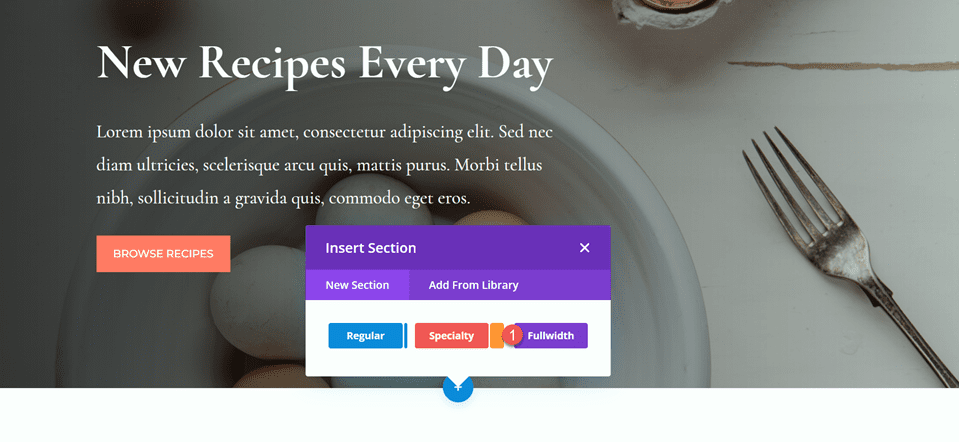
    First, we are going to start by recreating the hero section at the top of this layout using a Fullwidth Header Module. Add a new fullwidth section to the page, right below the current hero section.

    Divi Fullwidth Header Gradient Background Layout 1 Add Fullwidth Section

    Next, add a Fullwidth Header Module to the fullwidth section.

    Divi Fullwidth Header Gradient Background Layout 1 Fullwidth Header Module

    Now that our header module is in place, let’s update the header content in the Text section of the Content tab.

    • Title: New Recipes Every Day
    • Button #1: Browse Recipes
    • Button #2: Download the Cookbook

    Divi Fullwidth Header Gradient Background Layout 1 Content

    • Text: Lorem ipsum dolor sit amet, consectetur adipiscing elit. Sed nec diam ultricies, scelerisque arcu quis, mattis purus. Morbi tellus nibh, sollicitudin a gravida quis, commodo eget eros.

    Divi Fullwidth Header Gradient Background Layout 1 Body

    Under Background, remove the default background color and add the background image.

    Divi Fullwidth Header Gradient Background Layout 1 Background Image

    Move to the design tab and open the title text settings. Customize the settings as follows:

    • Title Font: Cormorant Garamond
    • Title Weight: Bold

    Divi Fullwidth Header Gradient Background Layout 1 Title Font

    Next, set the title text size and line height.

    • Title Text Size: 64px
    • Title Line Height on Desktop: 1.5em

    Divi Fullwidth Header Gradient Background Layout 1 Title Size

    To optimize the design for mobile devices, we need to decrease the size of the title line height on mobile. Select the responsive settings, then set the mobile line height.

    • Title Line Height on Mobile: 1em

    Divi Fullwidth Header Gradient Background Layout 1 Mobile Line Height

    Now let’s customize the body font options. Here are the settings:

    • Body Font: Cormorant Garamond
    • Body Font Weight: Medium

    Divi Fullwidth Header Gradient Background Layout 1 Body Font

    • Body Text Size: 24px
    • Body Line Height: 1.8em

    Divi Fullwidth Header Gradient Background Layout 1 Line Height

    Customize Button Styles

    Next, open the button one settings. Enable custom styles, then set the text size.

    • Use Custom Styles for Button One: Yes
    • Button One Text Size: 14px

    Divi Fullwidth Header Gradient Background Layout 1 Button Styles

    Add a background color to the button.

    • Button One Background: #FF7864

    Divi Fullwidth Header Gradient Background Layout 1 Button Background

    Customize the button border settings:

    • Button One Border Width: 8px
    • Button One Border Color: #FF7864
    • Button One Border Radius: 0px

    Divi Fullwidth Header Gradient Background Layout 1 Button Border

    Next, customize the font and disable the button icon.

    • Button One Font: Montserrat
    • Button One Font Weight: Medium
    • Button One Font Style: TT (Capitalized)
    • Show Button One Icon: No

    Divi Fullwidth Header Gradient Background Layout 1 Button Font

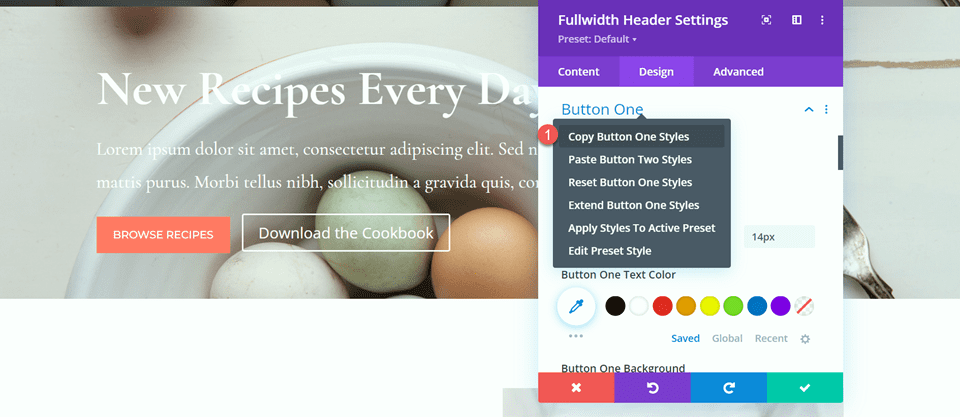
    Next, we will customize button two. The design is mostly the same as button one but with different colors. To skip some repetitive steps, let’s copy the button one styles to button two, then customize the design from there.

    First, right-click on the button one settings and copy the button one styles.

    Divi Fullwidth Header Gradient Background Layout 1 Button Styles

    Next, right-click on the button two settings and paste the button one styles.

    Divi Fullwidth Header Gradient Background Layout 1 Paste Styles

    Change the text color and background color for button two.

    • Button Two Text Color: #726D64
    • Button Two Background: #CBDBD2

    Divi Fullwidth Header Gradient Background Layout 1 Button 2 Background

    Change the button two border color as well.

    • Button Two Border Color: #CBDBD2

    Divi Fullwidth Header Gradient Background Layout 1 Button 2 Border Color

    Now that our buttons are complete, open the spacing settings and set the top and bottom padding.

    • Padding-Top: 10%
    • Padding-Bottom: 10%

    Divi Fullwidth Header Gradient Background Layout 1 Padding

    Finally, open the Custom CSS settings under the advanced tab. Select the responsive settings because we will only add the custom CSS for the desktop design. Add custom CSS to the Body CSS section.

    padding-right: 40%;

    Divi Fullwidth Header Gradient Background Layout 1 Body CSS

    Add the Gradient to the Fullwidth Header Module

    Now our fullwidth header design is complete and we can add the gradient. Navigate back to the content tab and open the background settings. Select the gradient tab and add the gradient as follows:

    • 0%: rgba(116,170,159,0.42)
    • 1%: rgba(79,127,108,0.35)

    Divi Fullwidth Header Gradient Background Layout 1 Background Gradient

    Next, customize the gradient settings:

    • Gradient Type: Elliptical
    • Gradient Position: Bottom Right
    • Repeat Gradient: Yes
    • Place Gradient Above Background Image: Yes

    Divi Fullwidth Header Gradient Background Layout 1 Gradient Settings

    Finally, delete the old header section from the original layout.

    Divi Fullwidth Header Gradient Background Layout 1 Delete Section

    Final Design

    Here is the final design for our first gradient header. As you can see, the repeated gradient with the subtle transparent colors creates an interesting background for this header section without overpowering the background image.

    Divi Fullwidth Header Gradient Background Layout 1 Full Design

    Divi Fullwidth Header Gradient Background Layout 1 Final Design Mobile

    Gradient 2

    Create a New Page with a Premade Layout

    For our next design, we will use the Nutritionist Landing Page from the Nutritionist Layout Pack.

    Add a new page to your website and give it a title, then select the option to Use Divi Builder.

    Divi Fullwidth Header Gradient Background Layout 2 Use Builder

    Since we are using a premade layout from the Divi Library, select Browse Layouts.

    Divi Fullwidth Header Gradient Background Layout 2 Browse Layouts

    Search for and select the Nutritionist Landing Page layout.

    Divi Fullwidth Header Gradient Background Layout 2 Find Layout

    Select Use This Layout to add the layout to your page.

    Divi Fullwidth Header Gradient Background Layout 2 Use Layout

    Now we are ready to build our design.

    Recreate the Hero Section Using the Fullwidth Header Module

    We are going to be recreating the existing hero section using the Fullwidth Header Module. Start by adding a fullwidth section to the page, below the existing hero section.

    Divi Fullwidth Header Gradient Background Layout 2 Fullwidth

    Next, add the Fullwidth Header Module to the section.

    Divi Fullwidth Header Gradient Background Layout 2 Add Module

    Under the content tab, add the text for the module as follows:

    • Title: Nutritionist
    • Subtitle: Specialized Food Coaching
    • Button #1: Get Started For Free
    • Button #2: Contact Me

    You can also remove the body text at this step, although we remove it later on in the tutorial.

    Divi Fullwidth Header Gradient Background Layout 2 Content

    Open the image settings. Set the logo image to the “Established 1990” image and set the header image to the graphic of the leaves.

    Divi Fullwidth Header Gradient Background Layout 2 Header Images

    Next, move to the Design tab. Set the text and logo alignment to center.

    • Text & Logo Alignment: Center

    Divi Fullwidth Header Gradient Background Layout 2 Alignment

    Customize the Title font as follows:

    • Title Font: Merriweather
    • Title Font Style: TT (Capitalized)

    Divi Fullwidth Header Gradient Background Layout 2 Title Font

    To optimize the design for tablet and mobile, we will use the responsive settings to add different title text sizes.

    • Title Text Size – Desktop: 70px
    • Title Text Size – Tablet: 50px
    • Title Text Size – Mobile: 30px

    Divi Fullwidth Header Gradient Background Layout 2 Title Text Size

    Next, set the title letter spacing and line height.

    • Title Letter Spacing: 5px
    • Title Line Height: 1.4em

    Divi Fullwidth Header Gradient Background Layout 2 Spacing Line Height

    Open the subtitle settings and customize the font.

    • Subtitle Font: Montserrat
    • Subtitle Font Weight: Medium
    • Subtitle Font Style: TT (Capitalized)

    Divi Fullwidth Header Gradient Background Layout 2 Subtitle Settings

    We will also set responsive text sizes for the subtitle. The sizes are as follows:

    • Subtitle Text Size – Desktop and Tablet: 18px
    • Subtitle Text Size – Mobile: 12px

    Additionally, set the subtitle letter spacing and line height.

    • Subtitle Letter Spacing; 5px
    • Subtitle Line Height: 1.5em

    Divi Fullwidth Header Gradient Background Layout 2 Subtitle Sizing

    Customize Button Styles

    Move on to the Button One settings. Enable custom styles and set the text size.

    • Use Custom Styles for Button One: Yes
    • Button One Text Size: 13px

    Divi Fullwidth Header Gradient Background Layout 2 Button One

    Add a background color.

    • Color 1 Background: #15C39A

    Divi Fullwidth Header Gradient Background Layout 2 Button Background

    Next, set the border width and radius, and the letter spacing.

    • Button One Border Width: 0px
    • Button One Border Radius: 100px
    • Button One Letter Spacing: 2px

    Divi Fullwidth Header Gradient Background Layout 2 Button Border

    Modify the font settings as follows:

    • Button One Font: Montserrat
    • Button One Font Weight: Medium
    • Button One Font Style: TT (Capitalized)
    • Show Button One Icon: No

    Divi Fullwidth Header Gradient Background Layout 2 Button Font

    Finally, add padding to the button.

    • Button One Padding–Top: 16px
    • Button One Padding–Bottom: 16px
    • Button One Padding–Left: 30px
    • Button One Padding–Right: 30px

    Divi Fullwidth Header Gradient Background Layout 2 Button Padding

    The styles for Button Two are largely the same as Button One, so we will copy the Button One Styles to Button Two and then make a small change to the colors.

    First, right-click on the Button One settings and copy the styles.

    Divi Fullwidth Header Gradient Background Layout 2 Copy Styles

    Then, right-click on the Button Two settings and paste the Button One styles.

    Divi Fullwidth Header Gradient Background Layout 2 Paste Styles

    Change the Button Two background.

    • Button Two Background: #BAB66F

    Divi Fullwidth Header Gradient Background Layout 2 Button 2 Background

    Next, navigate to the Spacing settings and set the padding as follows:

    • Padding-Top: 10%
    • Padding-Bottom: 0px

    Divi Fullwidth Header Gradient Background Layout 2 Spacing

    open the Animation section under the Design tab and set the module to fade.

    • Animation Style: Fade

    Divi Fullwidth Header Gradient Background Layout 2 Animation

    Add the Gradient to the Fullwidth Header Module

    Move to the content tab and open the background settings. First, remove the existing background color.

    Divi Fullwidth Header Gradient Background Layout 2 Remove Background Color

    Next, add the background image.

    Divi Fullwidth Header Gradient Background Layout 2 Background Image

    Move to the gradient tab and add the background gradient.

    • 35%: #FFC77F
    • 56%: #F2D57D
    • 90%: rgba(247,242,145,0.88)

    Divi Fullwidth Header Gradient Background Layout 2 Gradient

    Set the Gradient Type and Gradient Position.

    • Gradient Type: Circular
    • Gradient Position: Top

    Divi Fullwidth Header Gradient Background Layout 2 Gradient Type Position

    Remove the body text if you haven’t already.

    Divi Fullwidth Header Gradient Background Layout 2 Remove Body

    Finally, delete the original hero section above.

    Divi Fullwidth Header Gradient Background Layout 2 Delete Layout

    Custom CSS

    Now all of our basic settings are in place, but we need to go in with some custom CSS to complete the design and modify some of the header images. Move over to the Advanced tab and open the Custom CSS section.

    First, let’s customize the header image CSS. We will use responsive options to set different CSS for different device sizes. These settings will move the center leaf image up and behind the header text and also adjusts the size and margins. Add the following custom CSS to the desktop settings.

    transform: translateY(-22em);
    width: 25%;
    z-index: -1;
    position: relative;
    margin-bottom: -8em;
    

    Divi Fullwidth Header Gradient Background Layout 2 Header Image CSS

    Next, add the following custom CSS to the tablet settings of the header image section.

    transform: translateY(-22em);
    width: 40%;
    z-index: -1;
    position: relative;
    margin-bottom: -8em;
    

    Divi Fullwidth Header Gradient Background Layout 2 Custom CSS Tablet

    Finally, add the following custom CSS to the mobile settings of the header image section.

    transform: translateY(-24em);
    width: 75%;
    z-index: -1;
    position: relative;
    margin-bottom: -8em;
    

    Divi Fullwidth Header Gradient Background Layout 2 Header Image Mobile CSS

    We will also add custom CSS to the logo section. These settings will be responsive as well.

    First, add the following custom CSS to the desktop settings of the logo section.

    width: 40%;

    Divi Fullwidth Header Gradient Background Layout 2 Logo CSS

    Next, add the following custom CSS to the tablet settings of the logo section.

    width: 60%;

    Divi Fullwidth Header Gradient Background Layout 2 Logo Tablet CSS

    Then add the following custom CSS to the mobile settings of the logo section.

    width: 60%;

    Divi Fullwidth Header Gradient Background Layout 2 Logo Mobile CSS

    Finally, add the following custom CSS to the subtitle section.

    padding-bottom: 30px;

    Divi Fullwidth Header Gradient Background Layout 2 Subtitle CSS

    For the last step in this design, we need to add the rounded bottom divider. Open the fullwidth section settings and navigate to the design tab. Open the Dividers settings and add a bottom divider.

    • Dividers: Bottom
    • Divider Style: Curved
    • Divider Color: #FFFFFF

    Divi Fullwidth Header Gradient Background Layout 2 Divider Style

    Final Design

    And here is the final design for this header section.

    Divi Fullwidth Header Gradient Background Layout 2 Full Design

    Divi Fullwidth Header Gradient Background Layout 2 Final Design Mobile

    Gradient 3

    Create a New Page with a Premade Layout

    For our final gradient header design, we will use the SaaS Landing Page layout from the SaaS Layout Pack.

    Add a new page to your website and give it a title, then select the option to Use Divi Builder.

    Divi Fullwidth Header Gradient Background Layout 3 Use Builder

    We are using a premade layout from the Divi library, so select Browse Layouts.

    Divi Fullwidth Header Gradient Background Layout 3 Browse Layouts

    Search for and select the SaaS Landing Page layout.

    Divi Fullwidth Header Gradient Background Layout 3 Find Layout

    Select Use This Layout to add the layout to your page.

    Divi Fullwidth Header Gradient Background Layout 3 Use layout

    Now we are ready to build our design.

    Recreate the Hero Section Using the Fullwidth Header Module

    First, add a fullwidth section below the existing header section.

    Divi Fullwidth Header Gradient Background Layout 3 Fullwidth Section

    Select and add the Fullwidth Header Module to the section.

    Divi Fullwidth Header Gradient Background Layout 3 Add Module

    Open the module settings and add the following text:

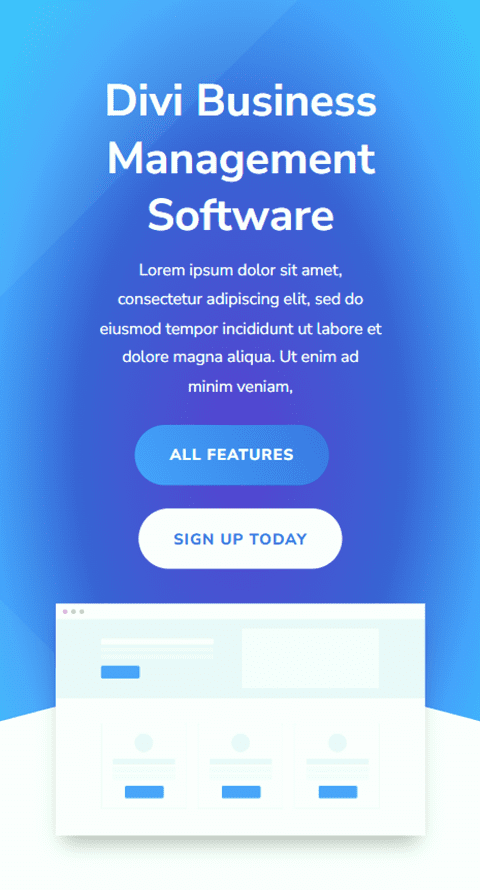
    • Title: Divi Business Management Software
    • Button #1: All Features
    • Button #2: Sign Up Today
    • Body: Lorem ipsum dolor sit amet, consectetur adipiscing elit, sed do eiusmod tempor incididunt ut labore et dolore magna aliqua. Ut enim ad minim veniam,

    Divi Fullwidth Header Gradient Background Layout 3 Content Settings

    Under the images section, add the header image.

    Divi Fullwidth Header Gradient Background Layout 3 Header Image

    We will come back to the content tab to add our background later. For now, delete the original header section above.

    Divi Fullwidth Header Gradient Background Layout 3 Delete Section

    Open the fullwidth header settings and navigate to the design tab. First, center the text and logo alignment.

    • Text & Logo Alignment: Center

    Divi Fullwidth Header Gradient Background Layout 3 Text Logo Alignment

    Open the image settings and add a box shadow to the header image.

    • Image Box Shadow: Bottom

    Divi Fullwidth Header Gradient Background Layout 3 Box Shadow

    Next, open the title text settings and customize the font.

    • Title Font: Nunito Sans
    • Title Font Weight: Bold
    • Title Text Alignment: Center

    Divi Fullwidth Header Gradient Background Layout 3 Title Font

    Change the color, size, and line height as well.

    • Title Text Color: #FFFFFF
    • Title Text Size: 45px
    • Title Line Height: 1.3em

    Divi Fullwidth Header Gradient Background Layout 3 Title Text Settings

    We want a smaller font size on mobile devices, so select the responsive settings for the Title Text Size option and add a different font size.

    • Title Text Size – Mobile: 38px

    Divi Fullwidth Header Gradient Background Layout 3 Mobile Text Size

    Move on to the Body Text section and customize the font as follows:

    • Body Font: Nunito Sans
    • Body Text Color: #FFFFFF

    Divi Fullwidth Header Gradient Background Layout 3 Body Font Color

    Set the Body Line Height.

    • Body Line Height: 1.8em

    Divi Fullwidth Header Gradient Background Layout 3 Line Height

    Customize Button Styles

    Next, let’s customize Button One. Enable custom styles then change the text size and color.

    • Use Custom Styles for Button One: Yes
    • Button One Text Size: 13px
    • Button One Text Color: #FFFFFF

    Divi Fullwidth Header Gradient Background Layout 3 Button Styles

    This button will have a gradient background. Add the gradient as follows:

    • 0%: #3d72e7
    • 100%: #53a0fe
    • Gradient Direction: 243deg

    Divi Fullwidth Header Gradient Background Layout 3 Button Gradient

    Next, change the button border settings.

    • Button One Border Width: 0px
    • Button One Border Radius: 26px
    • Button One Letter Spacing: 1px

    Divi Fullwidth Header Gradient Background Layout 3 Button Border

    Change the button font settings.

    • Button One Font: Nunito Sans
    • Button One Font Weight: Ultra Bold
    • Button One Font Style: TT (Capitalized)
    • Show Button Icon: No

    Divi Fullwidth Header Gradient Background Layout 3 Button Font

    Finally, add button padding.

    • Button One Padding-Top: 15px
    • Button One Padding-Bottom: 15px
    • Button One Padding-Left: 30px
    • Button One Padding-Right: 30px

    Divi Fullwidth Header Gradient Background Layout 3 Button Padding

    Once again, the Button Two design is very similar to the Button One design, just with different colors. We’ll skip the repetitive design steps by copying the Button One styles. To do so, simply right-click on the Button One setting and copy the Button One styles.

    Divi Fullwidth Header Gradient Background Layout 3 Copy Button

    Then, right-click on the Button Two settings and paste the Button One styles.

    Divi Fullwidth Header Gradient Background Layout 3 Paste Button Styles

    Now change the Button Two Text Color and background color.

    • Button Two Text Color: #4078ea
    • Background Color: #FFFFFF

    Divi Fullwidth Header Gradient Background Layout 3 Button Color Background

    Move to the Spacing section and add some top padding.

    • Padding-Top: 8%

    Divi Fullwidth Header Gradient Background Layout 3 Padding Top

    Next, navigate to the Animation settings and set the animation style as follows:

    • Animation Style: Zoom
    • Animation Direction: Up

    Divi Fullwidth Header Gradient Background Layout 3 Animation

    Finally, change the animation intensity and starting opacity.

    • Animation Intensity: 8%
    • Animation Starting Opacity: 100%

    Divi Fullwidth Header Gradient Background Layout 3 Animation Settings

    Add the Gradient to the Fullwidth Header Module

    Now that the basic design is complete, we can add our background gradient. Move over to the Content tab and open the Background settings. Our background will consist of a combination of a gradient, an image, and a mask. First, add the background gradient.

    • 22%: #5b40d1
    • 50%: #4161d4
    • 73%: #53a0fd
    • 100%: #4bc4fc
    • Gradient Type: Elliptical
    • Gradient Position: Center

    Divi Fullwidth Header Gradient Background Layout 3 Gradient Settings

    Next, add the background image. We will use the same background image that was used for the original header design. You should see this in your media library with the title geometric-bg-overlay-01.jpg. Use the overlay setting to blend the image with the gradient background.

    • Background Image Blend: Overlay

    Divi Fullwidth Header Gradient Background Layout 3 Background Image

    Now add the background mask.

    • Mask: Caret
    • Mask Color: #FFFFFF
    • Mask Transform: Horizontal
    • Mask Transform: Rotate
    • Mask Transform: Invert
    • Mask Aspect Ratio: Landscape
    • Mask Size: Stretch to Fill

    Divi Fullwidth Header Gradient Background Layout 3 Background Mask

    Next, use the responsive settings to customize the background mask for tablet and mobile devices. Let’s start with the tablet design.

    • Mask Aspect Ratio: Portrait
    • Mask Size: Custom Size
    • Mask Width: 100%
    • Mask Height: 60%
    • Mask Position: Bottom Center
    • Mask Vertical Offset: 140%

    Divi Fullwidth Header Gradient Background Layout 3 Tablet Mask

    Finally, modify the mobile design.

    • Mask Aspect Ratio: Portrait
    • Mask Size: Custom Size
    • Mask Width: 100%
    • Mask Height: 60%
    • Mask Position: Bottom Center
    • Mask Vertical Offset: 110%

    Divi Fullwidth Header Gradient Background Layout 3 Tablet Mobile

    Final Design

    Here is the final design for this section.

    Divi Fullwidth Header Gradient Background Layout 3 Final Design Full

    Divi Fullwidth Header Gradient Background Layout 3 Final Design Mobile

    Final Result

    Now let’s take a look at all three of our gradient header modules.

    Gradient 1

    Divi Fullwidth Header Gradient Background Layout 1 Final Design

    Divi Fullwidth Header Gradient Background Layout 1 Final Design Mobile

    Gradient 2

    Divi Fullwidth Header Gradient Background Layout 2 Final Design

    Divi Fullwidth Header Gradient Background Layout 2 Final Design Mobile

    Gradient 3

    Divi Fullwidth Header Gradient Background Layout 3 Final Design

    Divi Fullwidth Header Gradient Background Layout 3 Final Design Mobile

    Final Thoughts

    The Fullwidth Header Module is easy to customize and offers a lot of flexibility when it comes to the look and layout of your header design. When combined with unique design elements like gradients, you can create a truly stand-out design to bring your website visitors’ attention to the services that you offer. For 5 more creative Fullwidth Header tutorials, check out this article. Do you utilize the Fullwidth Header Module on your Divi website? Let us know in the comments!

    The post 3 Eye-Catching Gradients You Can Apply to Your Fullwidth Header Module with Divi’s Gradient Builder appeared first on Elegant Themes Blog.

  • Get a Free Tattoo Shop Layout Pack for Divi

    Hey Divi Nation! Thanks for joining us for the next installment of our weekly Divi Design Initiative; where each week, we give away a brand new Layout Pack for Divi.

    This time around, the design team has created a beautiful Tattoo Shop Layout Pack that’ll help you get your next Tattoo Shop website up and running in no time!

    This layout pack includes:

    7 Premade page layouts strategically designed for any Tattoo Shop website (including a footer design)
    – Original, royalty-free photos and graphics + customizable source file (see below)
    – Plus, a large collection of pre-designed website elements that are customizable and reusable anywhere.

    This layout pack is available right inside Divi for all Divi customers for FREE as the latest addition to our growing Divi library of hundreds of premade layout packs, thousands of page designs, and countless web design elements and resources.

    divi layout

    Check Out The Divi Tattoo Shop
    Layout Pack Below

    Get it for free today!

    Tattoo Shop Divi Layout Pack

    Landing Page Design

    Tattoo Shop Pack for Divi

    View The Live Layout Demo

    Home Page Design

    Tattoo Shop Layout Pack for Divi

    View The Live Layout Demo

    About Page Design

    Tattoo Shop Layout Pack for Divi

    View The Live Layout Demo

    Gallery Page Design

    Tattoo Shop Layout Pack for Divi

    View The Live Layout Demo

    Artists Page Design

    Tattoo Shop Layout Pack for Divi

    View The Live Layout Demo

    Resources Page Design

    Tattoo Shop Layout Pack for Divi

    View The Live Layout Demo

    Contact Page Design

    Tattoo Shop Layout Pack for Divi

    View The Live Layout Demo

    Key Features

    If you’re looking to get a new Tattoo Shop website, you don’t want to miss out on the Tattoo Shop Layout Pack for Divi! Each page layout is built to impress your visitors with world-class web design. And it has everything you need to promote Tattoo Shop services, and much more. Use it to get your next Tattoo Shop website up and running today!

    Live Demos

    Click the links below to see a live demo for each of the layouts included in the pack.

    1. Tattoo Shop Landing Page (live demo)
    2. Tattoo Shop Homepage (live demo)
    3. Tattoo Shop About Page (live demo)
    4. Tattoo Shop Gallery Page (live demo)
    5. Tattoo Shop Artists Page (live demo)
    6. Tattoo Shop Resources Page (live demo)
    7. Tattoo Shop Contact Page (live demo)

    Access This Layout Right Now
    Directly from Your Divi Builder

    Since Version 3.0.99 of Divi, you can find and import any of the layouts included in this pack (along with ALL of Divi’s Premade Layout packs) directly from the Divi Builder. They are already waiting for you.

    To access your new layout, simply activate the Visual Builder when editing a page and look for the “Load From Library” icon in the page settings bar (it looks like a plus symbol). Click this icon to launch the Load From Library popup. Under the Premade Layouts tab, you can easily find the new layout by scrolling through the list of layout packs. Once you find the Tattoo Shop Layout Pack, click on it. You will see all the individual layouts included in the pack. Select the layout you want to use and then click the “Use This Layout” button.

    Tattoo Shop Layout Pack for Divi

    For more, check out this video to learn how you can get this layout pack up and running today.

    Subscribe To Our Youtube Channel

    Authentication Required

    Before you can download Premade Layouts from the Divi Library you must authenticate your Elegant Themes Subscription. You can do this by navigating to Divi > Theme Options > Updates. There you can enter your username and API key and save changes.

    Tattoo Shop Layout Pack for Divi

    You can find your API Key under your members area on the Elegant Themes site. After you enter the Username and API Key, you will gain immediate access to our library of hundreds of free layouts (including this one). If you haven’t done this, when you click to import a layout to your page, you will be prompted to enter your Elegant Themes Membership Username and API Key.

    Use Layout Images for FREE with No Licensing Restrictions

    Divi Tattoo Shop Layout Pack for Divi

    The image assets included with these layouts (icons, illustrations, photos, etc.) have no licensing restrictions. This means you can use them in all of your commercial projects without having to worry about paying licensing fees or attributing the photographer. Use them in your commercial websites, sell them within your Divi child themes, include them in your own Divi layout packs or just use them on your blog. We know how challenging it can be to find good photos and how confusing and scary the licensing that governs those photos can be. We want to fix that problem for our users.

    Download the Full Res Image Assets

    New Layout Pack Every Week!

    We hope you enjoy this layout pack. We look forward to hearing your opinions in the comment section below. Make sure you check out next week’s layout pack as well!

    The post Get a Free Tattoo Shop Layout Pack for Divi appeared first on Elegant Themes Blog.

  • How to Set up WordPress Projects for Divi’s Filterable Portfolio Module

    The Filterable Portfolio Module for Divi is a great module to display your WordPress projects. Projects are easy to create and manage within WordPress. Once you’ve created them, Divi’s Filterable Portfolio Module displays any number of projects based on your selections. Your website’s visitors can easily sort them by category to see the work that interests them.

    In this post, we’ll see how to set up WordPress projects for Divi’s Filterable Portfolio module.

    Let’s get started!

    Filterable Portfoliio Module Preview

    First, let’s see what we’ll build in this tutorial.

    Desktop

    Portfoliio Preview

    Phone

    Portfoliio Preview

    Setting Up WordPress Projects

    Projects is a custom post type that’s built into WordPress. It works like any post type, but it has its own editor, list, categories, tags, etc. The Projects post type is great for creating portfolios to showcase your work. To use them properly, it’s important to know how to set them up with proper categories and tags.

    To view or create projects, go to Projects in the WordPress dashboard. You’ll see a menu with All Project, Add New, Categories, and Tags. Let’s look at each one.

    All Projects

    The Projects menu includes several options. All Projects opens when you select the Projects link. This screen lists all your projects with the title, author, categories, tags, comments, and date. You can perform edits on each project individually, do bulk edits, and create a new project.

    Setting Up WordPress Projects

    Add New

    To create a new project, select Add New in either the All Projects screen or the Projects dashboard menu. This opens the project editor. It works the same as a regular post type and includes the title, body content, categories, tags, featured image, excerpt, and the discussion options.

    Setting Up WordPress Projects

    Categories

    Categories work the same as regular post categories, except they are specific to projects. The Projects post type is the only post type that will use these categories. Existing categories for other post types are not available to the project post type. You’ll need to create them specifically for the Projects post type.

    When creating categories, be sure to use categories that are relevant to the project and provide a good overall description. Think of them as the broad topic the project would fall under. Don’t go too broad, though.

    For example, if you were creating categories for home repair, you might have separate categories for electrical, plumbing, construction, etc. Home Repair wouldn’t be the category in this case, since it’s the topic of the website. Home Repair might be a topic for a larger company that did new construction, repaired old construction, worked with both industrial and residential construction, etc. So, the categories need to fit the website.

    For my examples, I’ve created the categories to describe the types of photography this website would offer. They answer the question “what type of photography?”

    For my examples, I’ve created the categories:

    • Weddings
    • Proposals
    • Anniversary
    • Proms
    • Graduation

    Each of these categories describes the specific type of photography the client might look for. Ideally, each project would fit into one category.

    To create a category, simply fill in the fields and click Add New Category. Category fields include the name, slug, parent category, and description. You can also view and edit categories from the list.

    Setting Up WordPress Projects

    Tags

    Like categories, tags work the same way as regular post categories, but they’re created specifically for the Projects post type. Create tags that help describe the item within the category. They can help narrow down the topic.

    For our Home Repair example, you might use Appliances as a category and Gas and Electric as the tags. Use as many tags as you need.

    For my examples, I created six tags:

    • Inside
    • Outside
    • High School
    • Company
    • Church
    • Family

    These tell the client a little more about each photo shoot. We could go even further if we wanted to describe the type of crowd as large or small, the type of photos as color or black and white, and lots more.

    The tag editor includes the name, slug, and description. You can edit them from the list.

    Setting Up WordPress Projects

    Projects Example

    In this example, I’ve added a title, some body content including a description and photos, a category, a tag, and a featured image. I’ve selected Weddings as the category and Outside as the tag. I’m using the tag as a description of the wedding. I could add more tags if needed.

    Setting Up WordPress Projects

    Divi’s Filterable Portfolio Module

    Once you’ve created your projects, Divi’s Filterable Portfolio Module can display them. Users can filter the projects by categories to see the specific projects they’re interested in. You can select the categories, the number to display, and lots more. The module displays projects in fullwidth and grid layouts, so there are several designs to choose from.

    For this example, I’ve selected the grid layout, so all the projects are visible at once. It displays the filter with categories. Each project shows the featured image, title, and category.

    Divi’s Filterable Portfolio Module

    The Filterable Portfolio Module displays the filter at the top. The filter displays the categories and they’re clickable. Your visitors can view all categories or select a specific category. This example shows the Wedding category.

    Divi’s Filterable Portfolio Module

    Styling Divi’s Filterable Portfolio Module

    Next, let’s see how to style the Filterable Portfolio Module. For my examples, I’m adding a projects section to the landing page in the free Photography Studio Layout Pack that’s available within Divi.

    Alternatively, you could style your project pages as a Divi Theme Builder template that you could assign to any project you wanted. For more information, see the post How to Create a Dynamic Portfolio Project Template with Divi & ACF.

    Here are the first few sections of the layout. I’ll add the portfolio after the hero section. I’ll use design cues from the layout itself.

    Divi’s Filterable Portfolio Module

    Add a Section

    First, add a new Section under the hero section.

    Divi’s Filterable Portfolio Module

    Open the Section’s settings, scroll down to Background, and change the Background Color to black. Close the Section’s settings.

    • Background Color: #000000

    Divi’s Filterable Portfolio Module

    Add a Row

    Next, add a single-column Row.

    Divi’s Filterable Portfolio Module

    Add a Filterable Portfolio Module

    Finally, add the Filterable Portfolio Module from the list of modules.

    Divi’s Filterable Portfolio Module

    Filterable Portfolio Module Content

    For the Post Count, enter 4 into the field. Next, select the Categories you want to display in the Filterable Portfolio Module. By default, the module shows the Title, Categories, and Pagination. I’m leaving these at their default settings.

    • Post Count: 4
    • Categories: desired categories

    Divi’s Filterable Portfolio Module

    Filterable Portfolio Module Layout

    Next, go to the Design tab. The first section is Layout. The module displays in fullwidth by default, but I want to show the projects in a grid. Change the Layout to Grid. We’ll leave the image and overlay at their defaults.

    • Layout: Grid

    Divi’s Filterable Portfolio Module

    Filterable Portfolio Module Title Text

    Scroll down to Title Text. Use H2 for the Heading Level and change the Font to Inter, the Style to Bold, and the Color to #ff5a17.

    • Heading Level: H2
    • Font: Inter
    • Style: Bold
    • Color: #ff5a17

    Divi’s Filterable Portfolio Module

    Change the Size to 14px, the Letter Spacing to 1px, and the Line Height to 1.4em.

    • Size: 14px
    • Letter Spacing 1px
    • Line Height: 1.4em

    Divi’s Filterable Portfolio Module

    Filterable Portfolio Module Filter Criteria Text

    Next, scroll down to Filter Criteria Text. Change the Font to Inter, the Style to bold, and change the Color to black. This gives the filter a style that matches the layout and stands out from the portfolio.

    • Font: Inter
    • Style: Bold
    • Color: #000000

    Divi’s Filterable Portfolio Module

    Leave the Font Size at 14, which is the default setting. Change the Line Height to 1.4em.

    • Size: 14px
    • Line Height: 1.4em

    Divi’s Filterable Portfolio Module

    Filterable Portfolio Module Meta Text

    Next, scroll down to Meta Text. Change the Font to Inter and change the Color to white.

    • Font: Inter
    • Color: #ffffff

    Divi’s Filterable Portfolio Module

    Change the Line Height to 1.4em.

    • Line Height: 1.4em

    Divi’s Filterable Portfolio Module

    Filterable Portfolio Module Pagination

    Finally, scroll down to Pagination. Change the Font to Inter and the Color to white. Close the module and save your settings.

    • Font: Inter
    • Color: #ffffff

    Divi’s Filterable Portfolio Module

    Filterable Portfolio Module Results

    We now have a filterable portfolio that looks great within the layout. Here’s a look at how it looks filtered to show one category. Following this, we’ll see how it looks within the larger image of the layout.
    Divi’s Filterable Portfolio Module

    Desktop

    Portfoliio Preview

    Phone

    Portfoliio Preview

    Ending Thoughts on Setting up Divi’s Filterable Portfolio Module

    That’s our look at how to set up WordPress projects for Divi’s Filterable Portfolio Module. Creating projects is as simple as creating any content in WordPress. Once you’ve created your projects, add Divi’s Filterable Portfolio Module to any page or template to showcase your work anywhere on your website. The filter provides an extra layer of usability for your visitors as they can quickly see the types of work they’re looking for.

    We want to hear from you. Have you set up WordPress projects for your Divi Filterable Portfolio? Let us know about it in the comments.

    The post How to Set up WordPress Projects for Divi’s Filterable Portfolio Module appeared first on Elegant Themes Blog.

  • Divi Meetup Community Update: Q3 2022

    Hey, Divi Fam! It’s time for a community update!

    Oh my goodness, have we got some catching up to do! 😅
    It’s been busy! In-person events and conferences are back and reacclimating has taken some time. I forgot what three years ago was like! It’s been amazing getting back to in-person conferences! WordCamp Europe and WordCamp US finally came back to us this year and it was long expected. We loved having a presence, especially at WordCamp US. Did you get to attend either event? Comment below because we’d love to hear about your experience.

    But first, check out our current stats and community updates below. ⬇️

    The Divi Community Meetup Network by the Numbers

    • Total Members: 12,515
    • Total Groups: 54
    • Total Events Hosted: 1,630
    • Total RSVPs: 13,167
    • New Members (Last 90 Days): 601

    If you have a passion to build your local Divi community, locate a group near you here or use the button below to apply to become a local organizer.

    APPLY TO BECOME A DIVI MEETUP ORGANIZER TODAY

    Let’s Welcome Our Newest Meetup Host!

    Please give a warm welcome to our new host! We just onboarded a new Divi host for Divi Phoneix (my hometown) and we’re thrilled to introduce you to him!

    Divi Phoenix, Arizona, USA

    professional headshot of Dennis Dinsmore in suit

    Dennis Dinsmore – Divi PHX

    Meet the host, Dennis Dinsmore:

    Dennis Dinsmore is a WordPress developer originally from Salem, Oregon. He got his start in the creative field over 20 years ago as a screen-printer. Dennis moved to Tempe, Arizona to attend Collins College in 1999 where he graduated with a degree in Visual Communications with a focus on multimedia.
    A Flash developer in the 2000s, Dennis transitioned to building WordPress sites in 2010 and never looked back. He has worked as a developer for small and large agencies in the Valley of the Sun but now works for his freelance venture, Lights Out Interactive.
    When he’s not building WordPress websites, Dennis enjoys golfing, playing FIFA, riding his beach cruiser, or just chilling at his condo with his cats, Gracie and Tiger.

    Dennis desires to lead the Phoenix Divi meetup because he has the heart and mind of a teacher. Dennis recently acquired his teaching certificate in Career and Technical Education and hopes to share his professional Divi knowledge and experience with the Phoenix WordPress community.

    Dennis is leading the charge with me as an assistant (I can’t do it all 😅). I’m sooooo glad you stepped up, Dennis! 😍

    Go to Divi Phoenix

    Updates from Existing Groups

    Our Divi meetup groups have been faithful and we’re excited to share some of their community updates with you below. Read on!

    Divi Cape Town in South Africa

    Divi Cape Town September 2022

    From the Host, Dirk Tolken:

    Attendees: 5

    We discussed how to set up WooCommerce on a DIVI site. Attendees enjoyed it very much!

    There it is, Divi Cape Town! 💥

    Go to Divi Cape Town

    Divi Chicago, Illinois, USA

    screenshot of Divi Chicago virtual attendees

    Divi Chicago September 2022

    From the Hosts, Joan Margau & Scott Winterroth:

    Attendees: July-9, August-9, September-24

    July 2022
    Divi-Chicago Monthly Mastermind Meetup was a lively roundtable discussion about the workflow and Divi. The recent built-in, gradient, masks, and pattern background options increases the need for quality images. Finding and compressing images is time-consuming. Consider including the time factor for images in the cost of the website build.
    August 2022
    The Divi Chicago Mastermind Meetup was the masterminds of Divi users. We shared new ideas, made suggestions, and solved problems. Had a lively discussion on the workflow and how to give clients extra care with Divi’s built-in features. We didn’t get ’round to the union of SEO with Divi, but this is our next month’s mastermind.
    September 2022
    One of our very own Divi Chicago loyal members, Dhruv Pandya, gave a knowledge-packed presentation on ways to make your website search engine friendly, a/k/a SEO. How to do search engine optimization, and how to describe website content using Schema Structured data. Structured data is a system of pairing a name with a value to help search engines categorize and index your content. All of this helps search engines understand the content in a website. Dhruv will be giving more presentations in the future. Be sure to check the Divi-Chicago Meetup Schedule for details.

    Join Divi Chicago give them your input. 🔥

    Go to Divi Chicago

    Divi Dallas/Fort Worth, Texas, USA

    zoom screenshot Divi Dallas attendees' heads

    Divi DFW July meetup

    screenshot of Divi DFW virtual attendees

    Divi Dallas/Fort Worth August 2022

    From the Host, Tommy Lee & Kent Pilkington:

    Attendees: July-18 & August-13

    July 2022
    In July, we covered custom fields, custom post types, and how to use the Divi Theme Builder to apply styling to them. We demonstrated how this can be used to build websites multiple types of users can easily edit without worrying about messing up the code or design. We hope to see you next month as we host an open Q&A session.
    August 2022Last month at Divi DFW, we had our annual open meeting, which is a live Q&A between our members and the organizers. Members posed their questions to our experts, and we looked into the answers together. It also helped us generate topics for future meet-ups (like this month, where we’re looking into using global presets).

    Yee, Divi DFW!

    Go to Divi Dallas/Fort Worth

    Divi Washington DC, USA

    Divi Washington DC August 2022

    From the Host, John Browning:

    Attendees: 5

    During our meetup, we utilized Divi’s built-in gradient, pattern, and masking tools to add punch to our designs without knocking out the message. We had a great time experimenting with different combinations and learned a few shortcuts for other Divi tools along the way.

    Thank you for your dedication, Divi DC! We love it! 💥

    Go to Divi Washington DC

    Divi Dhaka, Bangladesh

    6 men & boys standing outside at the Divi Dhaka meetup

    Divi Dhaka September 2022

    group of men sitting and listening to one standing man at the Divi Dhaka meetup

    Divi Dhaka September 2022

    From the Host, Md Kamal Hossain:

    Attendees: 15

    It was a great meeting in person where we had quality time in Ramna Park, Dhaka for two days. Participants were very happy. We discussed the features and building materials that are common and extra from other page builders around the web developers. We have found some matched and unmatched answers regarding web development steps related to the theme and modules.

    Yesss, Divi Dhaka! 🤸🏻‍♀️

    Go to Divi Dhaka

    Divi Houston, Texas, USA

    City of Houston in background overlayed with a transparent purple

    Divi Houston

    From the new Host, Jube Dankworth:

    Divi Houston is refiring. Jube Dankworth, the found[er] of the Divi DFW group, moved to Houston, and has stepped up to refire the Houston Group. We look forward to meeting all the folks who make this community great!

    Divi Houston is back at it! Check them out.

    Go to Divi Houston, Texas

    Divi Kolkata, India

    screenshot of Divi Kolkata virtual attendees

    Divi Kolkata August 2022

    From the Host, Rajesh Ravidas:

    Attendees: 4

    Hi Divians,
    This month we talked about how we can use Divi to build an effective landing page with some [great examples]. We also had [a] QA session which covered some of the CSS/JS-related questions.

    So, glad to see Divi Kolkata always on it! 🔥

    Go to Divi Kolkata

    Divi Los Angeles, California, USA

    screenshot of Divi LA virtual attendees

    Divi Los Angeles August 2022

    From the Host, Julius Lopez:

    Attendees: 5

    So this is the one about Divi website hosting. A small gaggle of Divi enthusiasts got together online to share insights about hosting Divi websites. From great experiences to horror stories and everything in between. We even got into tools to manage multiple sites.
    There’s something to learn no matter what your experience is with Divi. Our next event is in the works so keep your eyes peeled to Meetup.com for it!

    Are you a resident of the Greater Los Angeles Area? Do you love Divi? Would like to present, or become a co-host of Divi Los Angeles Meetup? Contact Julius via email at: julius@trivessa.com. 🙌🏼

    Go to Divi Los Angeles

    Divi Milwaukee, Wisconsin, USA

    Divi Milwaukee August 2022

    From the Hosts, Tracy Champagne & Phil Reinhardt:

    Attendees: 8

    We had a pretty good meeting. It was a small group this time but we discussed a lot of Divi theme ideas.

    Get it, Divi Milwaukee! 💥

    Go to Divi Milwaukee

    Divi New York City, USA

    screenshot of Divi NYC virtual attendees

    Divi New York City September 2022

    From the Hosts, Patty, Jeanine, & Mickey:

    Attendees: 10

    Our September Meetup was “Back to Business – A Community Planning Discussion.” The meetup was attended by 10 members and we talked about our work and successes over the summer, what we are working on for the fall, and any issues or roadblocks with our businesses or Divi itself that we needed advice about. We also had the opportunity to view the efforts of one of our members in developing a new look for gallery display. It was a lively and informative discussion in which we had members attending from the US, Australia, and England.

    Yee, Divi NYC!! 🙌🏼

    Go to Divi NYC

    Divi Phoenix, Arizona, USA

    People taking an "usie" at the Divi PHX meetup

    Divi Phoenix September 2022

    From the Host, Dennis Dinsmore:

    Attendees: 6

    Yaaaaaaay! We’re back! Long-time community member, Dennis, was ready to take the baton and lead our group. 💯 We kicked off our rebooted meetup in September at a local coworking space in midtown Phoenix. This is the first meetup post-pandemic and we’re excited to continue them! Do join!

    Finally! 🥲

    Go to Divi Phoenix

    Divi Rio de Janiero, Brazil

    screenshot of Divi Rio de Janeiro virtual attendees

    Divi Rio de Janeiro August 2022

    From the Host, Daniel Peres Lins:

    Attendees: 5

    After months of not getting together, we’re back with the meetup in August covering all the recent Divi updates, talking about Divi Cloud and how to get the most out of Divi in ​​Woocommerce.

    Divi Rio just had their first meetup and they’d love for you to join the magic! Check it out!

    Go to Divi Rio

    Divi Sacramento, California, USA

    screenshot of Divi Sacramento virtual attendees

    Divi Sacramento August 2022

    From the Hosts, Rosalinda Huck & Elizabeth Hahn:

    Attendees: 4

    Divi Sacramento took a slight break over the summer, but did enjoy a Divi “Staycation”-themed meeting in August! We discussed creating travel blogs, reviewed existing travel blogs built in Divi, and then enjoyed some fun socializing through a travel-themed poll. We’re gearing up for a strong finish in the remaining months of 2022, starting with an overview of Google Analytics 4 in September. Come join us!

    Join Divi Sacramento for some continued Divi learning opportunities! ♥️

    Go to Divi Sacramento

    Divi Salt Lake City, Utah, USA

    screenshot of SLC meetup virtual attendees

    Divi Salt Lake City July 2022

    screenshot of Divi SLC virtual attendees

    Divi Salt Lake City August 2022

    screenshot of Divi SLC virtual attendees

    Divi Salt Lake City September 2022

    From the Host, Dustin Olsen:

    Attendees: July-12, August-8, September-5

    July 2022
    For July we had a guest speaker, Chris Settle, join us to discuss the basics of branding and how if we are able to humanize our approach, we will find success in being able to connect with our target audience. There’s a lot that goes into building a brand before one arrives at the website-building phase. Avoid common pitfalls in branding by doing due diligence in defining “who you are” and “what you stand for” and live by those attributes.
    August 2022
    For August, we did a demo of Divi Presets and went through some best practices and common use cases where you might want to leverage the power of Presets to streamline and ultimately simplify your design process (in other words, avoid the frustration of going page-by-page to update button styles). We also had questions that lead to discuss Global Modules, how they are different from Presets, and a use case for that as well.
    September 2022
    This month we had a guest speaker, Grady Kelly, join us to talk about the importance of UX in not just the websites we build, but in many areas of life and work where processes can be improved for even greater efficiency. We learned that one of the best things you can do to improve the UX of just anything is to talk to those who are using the tool and understand what their pain points are. Create a product that accommodates the end user.

    We love what Dustin’s cultivating with the Divi SlC community! 💯

    Go to Divi Salt Lake City

    Divi Satkhira, Bangladesh

    group of men around a table

    Divi Satkhira August 2022

    9 men standing outside at the Divi Satkhira meetup

    Divi Satkhira September 2022

    From the Host, Delower Hossain:

    Attendees: August-8 & September-9

    August 2022
    After a long time finally, We’re back. Our Divi Satkhira’s Co-organizer Delower Hossain provided us with an introduction to the Divi Marketplace.
    September 2022
    It was our regular monthly meetup. We covered What is Divi Marketplace and how we can get involved. There was a lot to cover! It was informative and some members shared some of the tools they use, too. All in all, a great meetup.

    Thank you for serving your community, Delower! 🙏🏼

    Go to Divi Satkhira

    Divi Warri, Nigeria

    Divi Warri July meetup

    Divi Warri people sitting at tables and learning.

    Divi Warri July meetup

    From the Host, Purity Ochuko:

    July Attendees: 18

    It went wonderful and expressive, we talked about tools, templates, and things that make Divi more unique. Topic: divi for beginners.

    Woot! 🤛🏼

    Go to Divi Warri

    Want to Host Your Own Local Divi Network Meetup?

    Great! We’re always on the lookout for people around the world who are passionate about Divi and building community and want to spread that enthusiasm to their local community. We take care of the monthly Meetup fees, and we provide all our hosts with tons of resources to help plan and promote their events, including help with finding a venue and coming up with topic ideas.

    Starting a new Divi Meetup group is simple. Just apply by filling out this form or email eventcoordinator@elegantthemes.com. Once the form is complete, we will work together to get your group launched and linked to our Meetup Network. Easy as that!

    Not sure if there’s already a Divi Meetup Group in your area? Just head to our Meetup Network page to see a map of our current locations.

    Global Divi Meetup Network

    The post Divi Meetup Community Update: Q3 2022 appeared first on Elegant Themes Blog.

  • Get a Free Plumbing Layout Pack for Divi

    Hey Divi Nation! Thanks for joining us for the next installment of our weekly Divi Design Initiative; where each week, we give away a brand new Layout Pack for Divi.

    This time around, the design team has created a beautiful Plumbing Layout Pack that’ll help you get your next Plumbing website up and running in no time!

    This layout pack includes:

    7 Premade page layouts strategically designed for any Plumbing website (including a footer design)
    – Original, royalty-free photos and graphics + customizable source file (see below)
    – Plus, a large collection of pre-designed website elements that are customizable and reusable anywhere.

    This layout pack is available right inside Divi for all Divi customers for FREE as the latest addition to our growing Divi library of hundreds of premade layout packs, thousands of page designs, and countless web design elements and resources.

    divi layout

    Check Out The Divi Plumbing
    Layout Pack Below

    Get it for free today!

    Plumbing layout pack for Divi

    Landing Page Design

    Plumbing Pack for Divi

    View The Live Layout Demo

    Home Page Design

    Plumbing Layout Pack for Divi

    View The Live Layout Demo

    About Page Design

    Plumbing Layout Pack for Divi

    View The Live Layout Demo

    Service Page Design

    Plumbing Layout Pack for Divi

    View The Live Layout Demo

    Services Page Design

    Plumbing Layout Pack for Divi

    View The Live Layout Demo

    Blog Page Design

    Plumbing Layout Pack for Divi

    View The Live Layout Demo

    Contact Page Design

    Plumbing Layout Pack for Divi

    View The Live Layout Demo

    Key Features

    If you’re looking to get a new Plumbing website, you don’t want to miss out on the Plumbing Layout Pack for Divi! Each page layout is built to impress your visitors with world-class web design. And it has everything you need to promote Plumbing services, and much more. Use it to get your next Plumbing website up and running today!

    Live Demos

    Click the links below to see a live demo for each of the layouts included in the pack.

    1. Plumbing Landing Page (live demo)
    2. Plumbing Homepage (live demo)
    3. Plumbing About Page (live demo)
    4. Plumbing Service Page (live demo)
    5. Plumbing Services Page (live demo)
    6. Plumbing Blog Page (live demo)
    7. Plumbing Contact Page (live demo)

    Access This Layout Right Now
    Directly from Your Divi Builder

    Since Version 3.0.99 of Divi, you can find and import any of the layouts included in this pack (along with ALL of Divi’s Premade Layout packs) directly from the Divi Builder. They are already waiting for you.

    To access your new layout, simply activate the Visual Builder when editing a page and look for the “Load From Library” icon in the page settings bar (it looks like a plus symbol). Click this icon to launch the Load From Library popup. Under the Premade Layouts tab, you can easily find the new layout by scrolling through the list of layout packs. Once you find the Plumbing Layout Pack, click on it. You will see all the individual layouts included in the pack. Select the layout you want to use and then click the “Use This Layout” button.

    Plumbing Layout Pack for Divi

    For more, check out this video to learn how you can get this layout pack up and running today.

    Subscribe To Our Youtube Channel

    Authentication Required

    Before you can download Premade Layouts from the Divi Library you must authenticate your Elegant Themes Subscription. You can do this by navigating to Divi > Theme Options > Updates. There you can enter your username and API key and save changes.

    Plumbing Layout Pack for Divi

    You can find your API Key under your members area on the Elegant Themes site. After you enter the Username and API Key, you will gain immediate access to our library of hundreds of free layouts (including this one). If you haven’t done this, when you click to import a layout to your page, you will be prompted to enter your Elegant Themes Membership Username and API Key.

    Use Layout Images for FREE with No Licensing Restrictions

    Divi Plumbing Layout Pack for Divi

    The image assets included with these layouts (icons, illustrations, photos, etc.) have no licensing restrictions. This means you can use them in all of your commercial projects without having to worry about paying licensing fees or attributing the photographer. Use them in your commercial websites, sell them within your Divi child themes, include them in your own Divi layout packs or just use them on your blog. We know how challenging it can be to find good photos and how confusing and scary the licensing that governs those photos can be. We want to fix that problem for our users.

    Download the Full Res Image Assets

    New Layout Pack Every Week!

    We hope you enjoy this layout pack. We look forward to hearing your opinions in the comment section below. Make sure you check out next week’s layout pack as well!

    The post Get a Free Plumbing Layout Pack for Divi appeared first on Elegant Themes Blog.

  • 5 Best WordPress Job Board Plugins (for 2023)

    Turning your website into a job board platform can be complicated without the right tools; you’ll need a way to track responses, easily remove and add listings, and reviews applicant profiles. Luckily, there are a ton of great WordPress Job Board Plugins that are available so that you can make a beautiful and functional job board in no time.

    What is a WordPress Job Board Plugin?

    A WordPress job board plugin is a way for employers to advertise their vacant positions to job seekers via their WordPress website. It’s an awesome tool to implement because with the right plugin you don’t need to be reliant on external platforms for job listings.

    Plus, adding a functional job board to your website can help gain more traffic and even get additional revenue, if you list positions from other employers on your site. Let’s take a look at some of the best job board plugins available!

    5 Best WordPress Job Board Plugins

    1. WP Job Manager

    WP job manager logo

    WP Job Manager is an incredibly user-friendly WordPress plugin brought to you by people from Automattic. With just a few clicks, you can have a live job portal up and running by adding new pages and shortcodes. It enables recruiters to post their job postings by registering on your website. Job seekers can also manage the jobs they are interested in from a straightforward dashboard.

    Through premium add-ons, you can also use the plugin to publish paid jobs online and earn money from them. Additionally, it features add-ons for managing a resume, monetizing your job board with WooCommerce, sending email alerts, and more.

    Key Features of WP Job Manager:

    • Job listing filters.
    • A user-friendly admin UI.
    • Frontend form submissions.
    • Searchable and filterable job listings via shortcode.
    • Shortcodes work with most themes, including Divi

    You can manage all of your job listings from the WordPress dashboard, and your users can also control their applications from their dashboard.

    WP Job Manager is for you if…

    • You want to create filterable jobs for different categories.
    • You want to monetize your job board.
    • You want to use shortcodes to output jobs in different formats.

    See our complete guide on how to create a job board in WordPress using this plugin.

    WP Job Manager Pricing: Free. Premium features start at $19 / year. | More Information

    2. WP Job Openings

    WP Job Openings logi

    WP Job Openings is another stellar freemium job board plugin. It provides various features for developers to alter the appearance and feel of your customized job board, such as versatile filter choices, two layouts for showing job listings, and two filtering options.

    It’s best used to build and add to your business’s career page. Applications are automatically formatted for readability, and you can see PDF copies of resumes and CVs without downloading each separately. It does, however, compile all applications into a single tab, which can be challenging if you’re posting positions from multiple businesses.

    Key Features of WP Job Openings:

    • Easy setup.
    • Clean grid layout.
    • Unlimited Job Specifications.

    Job board made with WP Job Openings

    The clean grid design makes looking for a specific job super easy for your users.

    Settings menu

    In addition, since WP Job Openings already includes a default form for applicants to submit their applications, building a form requires little to no busy work.

    WP Job Openings is for you if…

    • You want to display open positions using grid or list layouts.
    • You are focused on getting applicants for your site rather than multiple companies.
    • You want unlimited job specifications and filtering options.

    WP Job Openings Pricing: Free. Premium add-ons for $34/yr. | More Information

    3. WPJobBoard

    WPJobBoard is another premium WordPress job board plugin with everything you need to add a powerful career search engine to your webpage. In addition, it has a ton of tools that make it simple to make, manage, and display job listings, resumes, forms, and other materials.

    The ability to customize WPJobBoard is what really makes it stand out. With this plugin, you can modify the plugin’s functionality and customize templates for email notifications and job application forms. The plugin’s PHP Templating Engine allows you to overhaul your job board completely, so it’s tailor-made for your site. Additionally, it has a resume database and an employer interface where users can look for the ideal individual.

    Key Features of WPJobBoard:

    • SEO and social media feautures.
    • Works with any WordPress theme.
    • Drag and drop editor.
    • Great support team

    JBBoard Admin creation page

    The plugin comes with its own free theme and is compatible with all WordPress themes. Additionally, it enables you to receive payments and gives employers membership packages, coupons, and discounts.

    WPJobBoard is for you if…

    • You want a solution with multiple monetization options. (Works with PayPal, Stripe, etc.)
    • You want a solution compatible with any theme.
    • You want access to a simple drag-and-drop editor.

    WPJobBoard: $97/yr | More Information

    4. Simple Job Board

    Simple Job Board banner logo

    Simple Job Board is a short-code-based job board plugin. It allows you to create a system for a highly extensible online job board. Add the [jobpost] shortcode wherever you like on your website to start using the plugin.

    The ability to customize is where this plugin excels. You can design unique application forms for each job opening, and you can create multiple-choice options, designate mandatory fields, and much more. Available in 14 languages, Simple Job Board is ideal if you’re running a multilingual site.

    Key Features of Simple Job Board:

    • Uses a shortcode for complete control.
    • Include unique specifications and requirements for each job post.
    • Categorize reviewed applications for easy management.
    • Review applications and categorize them using multiple statuses.

    Simple Job Board UI

    Simple Job Board provides customers forms, although these options are limited. However, the pro version offers more possibilities.

    Simple Job Board is for you if…

    • You have a website using multiple languages.
    • You want a shortcode solution.
    • You want to be able to short out unsuitable applicants quickly.

    Simple Job Board Pricing: Free. Premium add-ons are available. | More Information

    5. WP Job Portal

    WP Job Portal logo

    WP Job Portal is another great option for a job board plugin. It’s intended to make it simpler and quicker for job seekers to identify the positions that best fit them and for companies to find the most qualified applicants.

    You can quickly narrow down your job postings by filtering results by application title, country, category, and more using a simple auto-fill option. Users can also save jobs they are interested in and go back to apply, and you can check how your listing is doing with a sleek-looking dashboard.

    Key Features of WP Job Portal:

    • Filter system.
    • Custom fields on registration forms.
    • Resume Parsing.
    • Save jobs to refer to them later.

    WP Job Portal dashboard

    WP Job Portal is essentially plug-and-play. It’s compatible with any theme for WordPress, so you know it’ll look great on your site, you can customize various options for both employers and job seekers from the dashboard.

    WP Job Portal is for you if…

    • You want to be able to parse through candidate resumés.
    • You want a high-quality UI.
    • You want a solution that’s setup without needing to make an account on an external platform.

    WP Job Portal Pricing: Free. Basic Add-on is $49/yr. | More Information

    Final Thoughts on WordPress Job Board Plugins

    You can quickly and easily post open opportunities using a WordPress job posting plugin. You can do so with the intention of internal hiring or use your website as a hub for job seekers and finders. This is a fantastic method to increase the number of people that visit your WordPress website, broaden your applicant pool, and perhaps even generate some extra revenue.

    Hopefully, one of the plugins listed above has features you’re looking to use on your site.

    Did we miss anything? Leave a comment telling us below!

    Article featured image by Viktoria Kurpas / shutterstock.com

    The post 5 Best WordPress Job Board Plugins (for 2023) appeared first on Elegant Themes Blog.

  • How to Duplicate a Page in WordPress (3 Simple Ways)

    As we all know, WordPress is a powerful tool that allows users to build websites. You can create articles (more commonly known as blogs or blog posts), upload documents, manage images and so much more. What started out as a blogging platform, has grown over the years into the content management system (CMS) of choice for more than one-third of the internet.

    However, amidst the many features that WordPress can boast of (like full-site editing), you aren’t able to duplicate a post or page out of the box. It seems like a slight oversight, but not one that we can’t fix ourselves. In this article, we’ll go over three easy ways that you can use to duplicate a page in WordPress.

    Reasons to Duplicate a Page

    There are many reasons why one may want to duplicate a page or post in WordPress. An example might be that you’ve built a really awesome landing page for a new product that you’re launching. However, you may want to do some A/B testing for some Facebook ads that you’re running to promote this product. As opposed to redoing all your hard work again, you can simply duplicate said page, make some slight tweaks and cut your design time all the way down.

    Another reason to duplicate a page is to help with your design process. If you have a really large site, you may need to duplicate a number of pages to add additional content for other members of your team. If you had to re-create each page repeatedly, you could slow down your design process which could lead to timelines being missed. Not to mention that you might leave some of your teammates a tad bit upset. As such, having a quick and easy way to duplicate pages is something that can come in handy in your day-to-day while working on your WordPress website. This is one of the reasons we added the Divi Cloud feature in Divi. With it, you can store all kinds of page layouts and more to speed up the design process.

    Watch Out for Duplicate Content

    Duplicating a page in WordPress should always be a means to an end. You don’t want to have two pages with the same content live on your site. This is bad practice and will have a negative effect on SEO. To learn more, check out our ultimate guide on duplicate content and SEO.

    How to Duplicate a WordPress Page (Step-by-Step)

    Now that we know why one would want to duplicate a page, let’s get into the three different ways that you can duplicate a page on your latest WordPress project.

    1. Duplicating a Page Using a WordPress Plugin

    There are a number of WordPress plugins that can be used to duplicate pages on WordPress. Always bear in mind what features you are looking for as well as the ratings and reviews of a plugin before installing it onto your WordPress website. Bearing all these things in mind, for this tutorial, we’ll be using the free version of the Duplicate Page plugin.

    To install the plugin, follow these steps:

    1. In the left-hand menu, click Plugins, and then click Add New
    2. In the search field that appears at the top right of the screen, type duplicate page
    3. Look for the Duplicate Page plugin, and then click Install Now

    Steps to duplicate a page in WordPress using a plugin

    Once the plugin is installed and activated, navigate to the Pages section of your website. To navigate there, click Pages and then click All Pages from the left-hand menu. Now, you will notice that when you hover over the name of a page, an additional menu item has been added titled Duplicate This.

    Using the newly added Duplicate This button from the plugin just installed

    Once you are ready to duplicate your page, simply click the Duplicate This link under the page listing that you would like to duplicate. That’s it!

    After that, you can edit the new duplicate page as needed. Make sure to edit the permalink for the new page. As it’s a duplicate, the permalink URL will also be copied over so ensure to edit it to match your new content.

    Remember to change your permalinks after duplicating a page!

    It is a good idea to visit the Duplicate Page plugin’s settings to make sure it is functioning the way you need it to.

    Duplicate Page Plugin - Settings Page

    The options allow you to control how you want pages to be duplicated and where you want the duplicate page link to be displayed.

    2. Duplicating a Page in WordPress with Divi

    For Divi users, you can easily duplicate pages (or templates) in WordPress. When using the Divi Builder, you have a built-in option to duplicate (or clone) existing pages in WordPress whenever you create a new page.

    Cloning an Existing Page Using the Divi Builder

    To duplicate a WordPress page in Divi, simply click to use the Divi Builder when editing a new page.

    When you click to use the Divi Builder to edit a page, you will see a popup that gives you three options as to how to proceed with your new page. The option we’re interested in is the third and last option, Clone Existing Page.

    Duplicating a page in WordPress using the Divi new page popup

    Once you select the clone existing page option, you will see all the existing pages within your site that you can choose to clone.

    select duplicate page in Divi Library

    Simply select the page from the list and the page will be duplicated and ready to edit. You won’t need to change the permalink as you’ll be working from a brand new page.

    Using Divi Layouts

    One of the great features of Divi is easy it is to add, create, and manage page layouts. A page layout contains the entire page design and content. Divi comes with over a thousand pre-made page layouts to jumpstart your page design and content. Plus, you can save your custom page layouts in your Divi Library for later use. Or you can save them to your Divi Cloud and duplicate cloud items all in one place. This takes the process of duplicating pages to a whole new level!

    3. Duplicating a Page in WordPress Manually: Copy and Paste

    To duplicate a page in WordPress manually, you can simply go into your page and copy the content within that page. Then paste the content into a newly created page.

    Copy and pasting content also allows you to duplicate the contents of a page in WordPress

    Here’s how to do it. First, navigate to All Pages.

    Navigate to All Pages

    Once you have your list of pages, here’s what happens next:

    1. From the list of pages, hover over the page that you’d like to edit.
    2. Then, select Edit under the page that you would like to duplicate

    Edit all pages

    After you have entered the page editor, do the following steps:

    1. Next, highlight all the content within the main content area.
    2. Using your mouse, move over to the highlighted content and right-click. Then, select Copy from your system menu.
    3. Towards the top of the page, click on the WordPress icon. This will take you back to the All Pages screen.

    Right Click Copy and Go Back to the All Pages screen

    You will now need to create your new page by clicking on the Add New button from this screen.

    Add new page

    Once you have a new, blank page in front of you, using your mouse, right-click, then press Paste. This will bring the content from the former page into this new page. Make any necessary edits that you need to make, and then click Publish from the Publish box at the top right-hand side of the page.

    TIP: If you used any special code within the page, it would be ideal to switch to the text/HTML tab editor to ensure that you are copying the code used on the page, in addition to the written content.

    In Conclusion

    While WordPress doesn’t have an out-of-the-box solution to duplicate pages, it is not something that is out of the question. With handy tools like Duplicate Page plugin and the Divi Builder, plugins and maybe even a bit of code here and there, you’ll be able to speed up your process, create content faster and copy pages across your WordPress install with ease.

    Do you have a favorite method for duplicating pages in WordPress? Let us know in the comments below!

    The post How to Duplicate a Page in WordPress (3 Simple Ways) appeared first on Elegant Themes Blog.