EDITS.WS

Category: elegantthemes.com

  • How to Create a Scroll Container for Your Divi Comments Module

    The comments section of a blog post allows readers to engage with others. It also allows users to be able to create conversations with people who are ingesting your comment. For those special posts that drum up a lot of noise, the comments section can get pretty hectic! You may want to find a way to make a long comments section easier to navigate. Consider creating scrollable comments in Divi!

    By creating a scroll container for your Divi Comments Module, you can minimize the amount of scrolling readers of your blog need to undergo. Thus, they have a better experience with your site. It’s important to consider factors of user experience when you are building your site, and by adding a scrollable comment in Divi you’re making your readers have an easier time enjoying your site which is always a good thing.

    Why Comments Are a Good Thing

    Before we head into the tutorial, let’s take a quick look at comments in general. In Divi, we have a Comments Module. This module allows users of your site to leave a comment on a page or post. The module also allows people to read past comments that have been left behind on a post by other readers of your site. When a post is engaging, it can encourage people to want to leave their thoughts, opinions, and questions with the author (a.k.a you) under the post. This is an example of what that looks like from the Elegant Themes blog:

    A sample of the Elegant Themes comments section

    This is the comments section on the 3 Best Voice Search Plugins for WordPress post on our blog. In it, you can see that several readers have left feedback, thanks, and more. The post’s author has also taken the time to respond to readers. This kind of engagement is good for your blog and website because it shows that you are providing value to you readers. In addition, it helps you build a stronger bond with those who use and visit your site. Now that we’ve seen comments in the wild, let’s see how we can manage the comments section in our own blog posts using Divi’s Comments Module.

    Scrollable Comments in Divi: An Overview

    For this tutorial, we’ll be using the Blog Post Template from Divi’s Software Layout Pack. Here’s a quick overview of the template:

    The Software Blog Post Template... Very long!

    Notice how there are a few comments on this post? We can make this part of our blog page easier to navigate by adding a vertical scrollbar. For this tutorial, we’ll be adding a vertical scrollbar to the row that is holding the Comment Module. Then, we’ll use a little bit of CSS to style said scrollbar so it looks different than the main scrollbar for the page. Ready? Let’s get into it!

    Scrollable Comments in Divi: The Tutorial

    Before we get started on creating scrollable comments in Divi with the Comments Module, you’re going to need to install the Software Blog Post Template. Follow the instructions within that blog post to install your Blog Post Template.

    Enter the Comments Row Settings

    Once your template is installed and edited to your satisfaction, we’re going to enter into the row that is holding the Comments Module. Scroll down to the section that contains the Comments Module. Hover over the row (green outline), and click on the gear icon. This will open up the settings module for the row.

    Enter the row settings

    Set Row Max Height

    Before we begin styling or activating the scrolling, we need to adjust the max height for the row. To do this, we click on the Design tab. Next, we click on the Sizing tab. We then enter a Max Height of 550px to the Max Height option.

    Adding max height to row

    Enter Row Advanced Settings

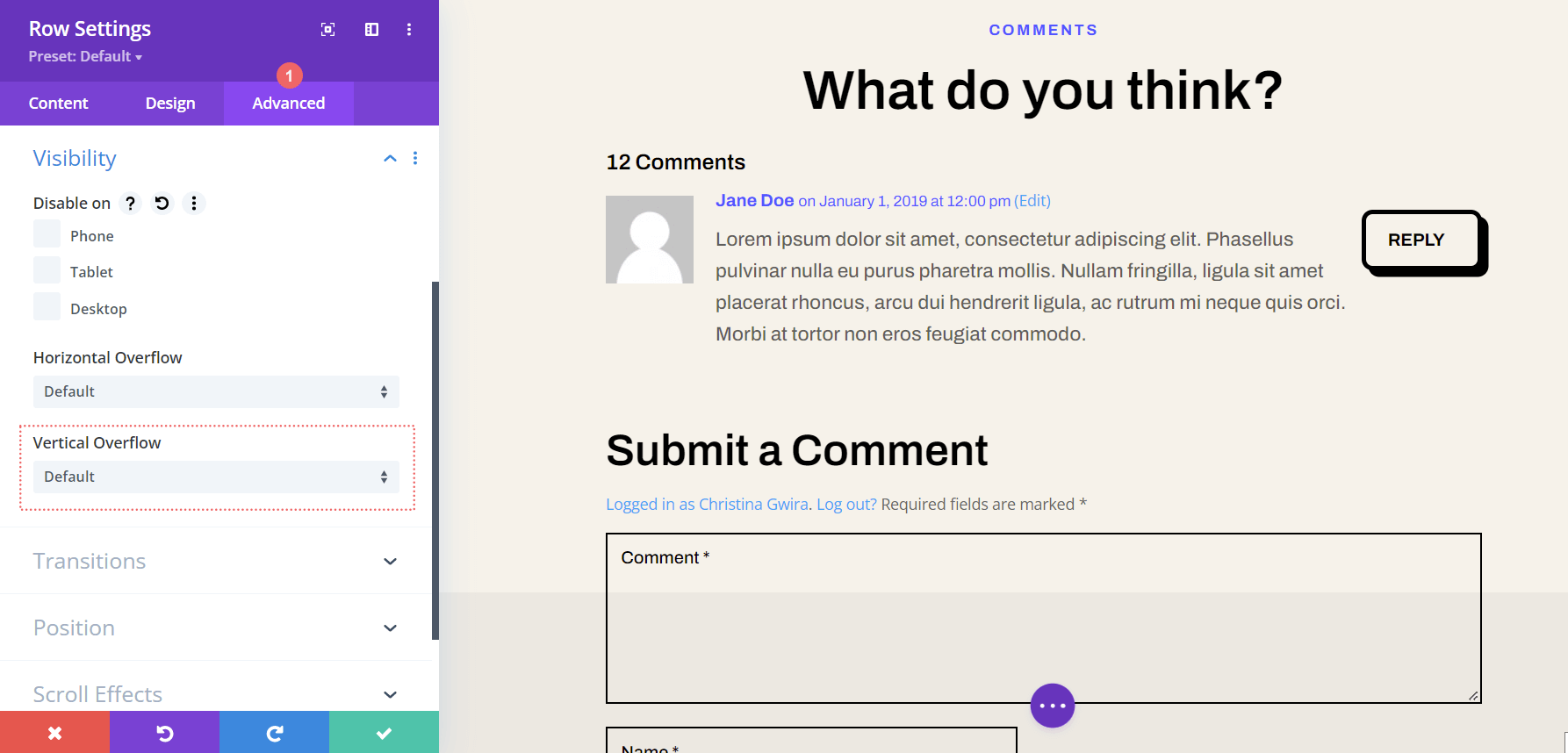
    After setting the max height of the row, we’re going to click on the Advanced tab within the modal box. It is here that the scrolling magic happens! Take note of the Vertical Overflow option which is further down the Advanced tab. We’ll be coming back to that soon.

    Enter the Advanced tab within the row settings modal box

    Activate the Vertical Scrollbar with Vertical Overflow

    Scroll down util you arrive at Vertical Overflow. Click on the dropdown and select Scroll.

    Activate vertical scrollbars by setting the Vertical Overflow to Scroll

    While we have our vertical scrollbar, we can spruce it up a bit with some almighty CSS and padding.

    Adding Padding to Prevent Overlap

    To prevent our newly added scrollbar from overlapping with our buttons within our comments section, we’re going to add some padding to the right and left-hand sides of our row. To do this, navigate to the Design tab of the Row Settings modal. Next, scroll down to Spacing. Click the link icon between the Left and Right Padding text boxes. We’re going to add a padding of 55px to each side of the row.

    Adding padding to row to prevent scrollbar from overlapping over Comments Module

    Since we’ve added some breathing space to our scrollbar, let’s now make it pretty with some custom CSS.

    Add a CSS ID to the Row

    Moving back to the Advanced tab of the row, scroll to the top. Add your CSS ID – for this tutorial, we’ll be using scrollie – that we’ll be calling within the Custom CSS section in the Body Template Settings.

    Add CSS ID to row to prepare for styling scrollable comments in Divi

    Add Custom CSS to Style Scrollbars

    Now, we’ll be entering into the Custom CSS for our Blog Post Template. This will ensure that our CSS will be active on each blog post within our website as this template is applied to All Blog Posts within the Divi Theme Builder. To enter the Custom CSS setting for our body template, click on the three dots within the purple button in the bottom center of the builder. Next, select the gear icon.

    Entering page settings for Custom CSS

    Add Custom CSS to Style Scrollable Comments in Divi

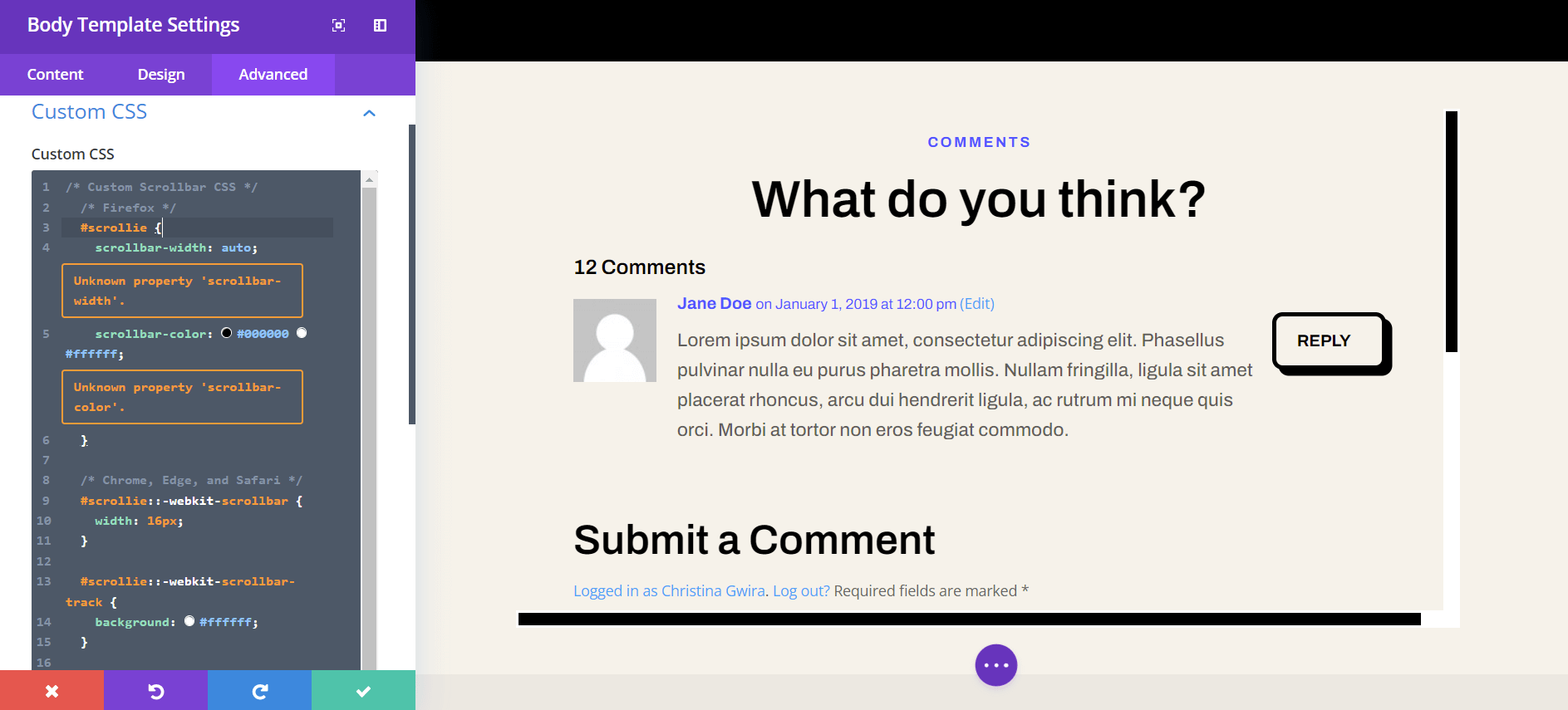
    We want to style the scrollbar for our scroll container to differentiate it’s use from the main scrollbars of our browsers window. To do this, we’ll be using some CSS. Once you are within the Body Template Settings, select the Advanced Tab. Next, scroll down to the Custom CSS tab.

    Entering the Advanced section of the Body Page Template

    Once we’re in the Custom CSS section of the Body Page Template, copy and paste the following CSS code:

    /* Custom Scrollbar CSS */
    /* Firefox */
    #scrollie {
    scrollbar-width: auto;
    scrollbar-color: #000000 #ffffff;
    }
    
    /* Chrome, Edge, and Safari */
    #scrollie::-webkit-scrollbar {
    width: 16px;
    }
    
    #scrollie::-webkit-scrollbar-track {
    background: #ffffff;
    }
    
    #scrollie::-webkit-scrollbar-thumb {
    background-color: #000000;
    border-radius: 0px;
    border: 3px solid #ffffff;
    }
    

    Custom CSS for scrollable comments in Divi

    If you used a different CSS ID, ensure that you’ve updated the code snippet within your website to reflect this. You can edit the CSS or add to it to style your borders in a way that matches your brand and website. In our case, we went with a flat design to match the styling of the Divi Software Layout Pack.

    Save Your Blog Post Template

    Once you’re happy with your CSS edits, remember to save your Blog Page Template. Click on the green Save button on the bottom right-hand side of the bottom menu within the Divi Theme Builder.

    Save your work!

    Once your settings are saved, visit your newly updated comments section on your blog!

    Styled scrollable comments in Divi

    Scrollable Comments in Divi: The Conclusion

    Creating a scroll container for Your Divi Comments Module helps your users to have a better experience with your comments section. User engagement is an important factor to nurture within your blog. By making your Comments Module scrollable, you are providing ease of use for your readers when they come to enjoy your various blog posts.

    The post How to Create a Scroll Container for Your Divi Comments Module appeared first on Elegant Themes Blog.

  • Rank Math SEO Plugin for WordPress: An Introduction

    Choosing the right SEO plugin for your WordPress site is one of the most important choices you will make. And with so many solutions out there, the best ones can often be overlooked. The Rank Math SEO plugin for WordPress is definitely in the ranking as one of the top SEO plugins for a lot of reasons. In this post, we’ll give a helpful overview of Rank Math SEO and cover the key features, ease of use, pricing, and more, so you can see if it is a right fit for your site.

    What is Rank Math SEO?

    Search engine optimization (SEO) is a way to ensure that your website appears to as many people as possible via search engines like Google. Rank Math SEO is a powerful SEO plugin for WordPress that makes it simple for anyone to improve the SEO of their content, regardless of their level of expertise. Founded in 2018 and headquartered in India, Rank Math has quickly taken the WordPress plugin world by storm, now boasting over 1 million active users.

    Rank Math (self-proclaimed as the “swiss army knife of WordPress SEO”) comes with ostensibly everything you need to make sure your content is optimized to hit the keywords you’re targeting and has a ton of other features that can take your SEO to the next level. It’s easy to use and has a lot of powerful features in the free version (especially for on-page SEO) that make it a plugin worth looking into.

    How to Install the Rank Math SEO Plugin

    Installing Rank Math from your website’s WordPress account is the simplest method. To begin, choose the Add New option after hovering over the Plugins option in the WordPress menu.

    Screenshot of WordPress.

    Search for Rank Math in the search bar and select Install.

    Search for Rank Math

    After a few seconds, Rank Math Plugin will be installed and activated. You can confirm this by checking if it’s listed on your plugin page.

    List of WordPress Plugins

    Key Features of Rank Math SEO

    Rank Math SEO comes with a free and premium version for those willing to pay $59 per year. Let’s take a closer look at some of the best features of Rank Math SEO.

    Easy-to-Use Dashboard

    The first feature that stands out for Rank Math is its clean and simple user interface. The dashboard provides you with a ton of great analytics that you can use to improve the content on your site, along with awesome visualization features, the dashboard is a breeze to navigate through and settings are easy to change.

    Rank Math Dashboard

    Visual Interface for On-Page SEO Optimization

    The UI is straightforward but effective. The plugin showcases critical details about your SEO content alongside the post itself in real time, This allows you to boost the on-page SEO of your content by using readily available information, all while still in the text editor. It offers a ranking from 0 to 100, with a green number indicating that you have surpassed the 80-point threshold.

    Blog example

    Advanced Keyword Optimization

    Along side the awesome in-editor SEO optimization, you can take a deeper look into keyword research from the Rank Math dashboard. You can see how many times your site has been shown in search results, see the total number of keywords your ranking for, see how many clicks your site is getting, and more.

    Keyword research dashboard

    The ability to visualise this information is always welcome, and it let’s you wrap your mind around your website’s trends and how your strategies are performing in practice. Keyword analysis and strategy is paramount to good SEO, so these features are incredibly welcome from Rank Math.

    Link Building Recommendations

    If you enable the Link Suggestions option, which is a really awesome feature, Rank Math will offer you link suggestions as you write your posts to help your link building strategy.

    You must navigate to Titles & Meta > Posts in the Advanced Mode to enable the Link recommendations meta box. You can find the Link Suggestions option near the bottom. Activate the switch by turning it on.

    Link suggestions toggle

    Link suggestions give you the option to link to other relevant posts that you or your team have previously authored. This can be incredibly useful, especially if you’ve written a lot of content in the past, as you can link to relevant content automatically without having to search for specific posts.

    Advanced Divi Integration

    We are proud to say that the powerful SEO elements of Rank Math are fully integrated with our own Divi WordPress theme’s visual builder! You can check out our in depth guide on to how to optimize your Divi site with Rank Math here. 

    Rank Math general settings in Divi

    Rank Math’s integration with Divi makes improving the SEO on your website even easier because it’s built right into the Divi visual editor. The controls are easy to use for any skill level and there is plenty of built-in support available if any questions arise. You can review your content’s SEO with ease right as you build your content.

    Title SEO for Rank Math


    Other Features of Free Version for Rank Math SEO

    Some other key features of the accessible version of Rank Math are:

    • XML sitemap – Using a separate plugin for your Sitemap is no longer necessary. The XML Sitemap component of Rank Math is ideal for letting search engines know which page you want them to index.
    • Analytic integration – You can connect to Google search console and other SEO tools and see all the stats directly on your WordPress dashboard.
    • Knowledge graph and local SEO – You can enhance your site to appear more prominently in local businesses’ search results.
    • Image SEO – Automatically add alt text and titles to images to rank higher.
    • Internal link suggestions – Automatically add SEO links to relevant internal pages.
    • AMP (Accelerated Mobile Pages) – Automatically adds required meta tags to AMP pages.
    • Content AI – First-of-its-kind AI automatically suggests related keywords, links, heading tags to help you write SEO content.
    • Social media descriptions – Control how your content is presented on social media.
    • Redirects – Manage and establish 301 and 302 redirects.
    • 404 monitor – This function will keep track of the URLs where users and search engines encounter 404 errors.
    • Focus keyword analysis – Content optimization for focus keywords.
    • Google Analytics – You can see traffic information from your WordPress dashboard after adding the Google Analytics tracking code.
    • Meta descriptions and titles –For each post or page, you can either manually edit the SEO titles and descriptions or use templates.
    • WooCommerce – If you have an online store, then you can optimize your WooCommerce pages with Rank Math, although there are additional features with the pro version.
    • Divi SEO Integration– Integration with the Divi page builder and theme from the page editor.

    Premium Features for Rank Math SEO

    • Keyword rank tracking – You can view your keywords’ search engine ranks for the previous twelve months using the keyword rank tracking feature. You’ll know more about the effectiveness of your keywords. A convenient on-page solution to similar to more robust keyword tracking tools.
    • Google Trend Integration – Rank Math offers Google analytics 4 integration along with a keyword rank tracker.
    • Multiple Platform Linking – You can use Rank Math for numerous different websites.
    • Schema Generator – Access to an advanced schema maker with over twenty different kinds of presets. This might be more convenient than other schema tools.
    • Content AI – More advanced features for the AI and gives you extra credits to use the AI.
    • More WooCommerce SEO features – Dedicated content analysis for pages, custom branding options, etc. It’s always a good idea optimize WooCommerce for SEO.
    • Podcast Module – Everything you need to start your podcast.

    Rank Math Setup Process

    Once the plugin has been installed and activated, you will be automatically redirected to the Rank Math registration window; if you haven’t been redirected,  you can select Rank Math from the WordPress sidebar. Next, you will be directed to the setup wizard and prompted to create a free account. This is recommended because it comes with some added features.

    Screenshot of Rank Math

    Rank Math installation and configuration is a breeze because the step-by-step installation and configuration wizard is automatic for most steps. In addition, the settings on your site are verified by Rank Math after installation, and it makes recommendations for the best configurations.

    The steps and SEO settings for your site, social networks, and webmaster profiles are configured via the wizard.

    Rank math installer

    You can link Rank Math with Google Analytics in order to get up-to-date site maps.

    Install Wizard

    Configure your required sitemap settings here.

    Sitemap

    Once you finish your setup you can delve deeper into advanced settings or just leave them in their the default position.

    Wizard ending

    Rank Math User Interface

    The Rank Math UI undoubtedly sets it apart from other SEO tools; it’s simple and sleek while still having advanced tools at your fingertips. From the dashboard, you can toggle the features you want to use.

    Screenshot of Rank Math UI

    The analytics tab offers a handful of helpful graphs and charts to easily track your website’s SEO growth and pinpoint what areas you need to work on.

    Screenshot of Rank Math Analytics UI

    An excellent user experience was the focus of this plugin’s design. The pages and tools you require are simple to traverse, and getting familiar with them is easier than you think. But, if you need assistance, you can select the “Help and Support” option from the sidebar.

    Screenshot of Rank Math UI

    Using Rank Math to Optimize a Page or Post

    This guide will show you how to use Rank Math to ensure your post is optimized and hits all the keywords your looking for. As soon as you begin writing the content, the optimization process starts. For this example, we’ll use the WordPress Menu > Posts > Add New option to create a new article.

    Screenshot of adding new post on WordPress

    Rank Math is fully integrated into the block editor; you can see it by selecting the red SEO score button on the top-right corner of the editor.

    Screenshot of "How to Throw an Awesome Dinner Party" Blog

    You can see all the suggestions and tools to make adjustments as you write. For example, we’re writing about how to throw an awesome dinner party, so we set our keyword to “dinner party,” and RankMath gives us suggestions on improving our SEO.

    Screenshot of Rank Math Word Editor UI

    Now, we simply follow the guidelines and suggestions from Rank Math until we have as close to a 100/100 SEO score as possible.

    Screenshot of Rank Math Word Editor UI

    Be sure to look at each tab in the Rank Math editor, so you don’t miss any tips for SEO optimization.

    Screenshot of Rank Math Word Editor UI

    Using Rank Math with Divi

    We are proud to offer an in-depth and intuitive integration with Rank Math SEO. You can seamlessly use Divi Builder alongside Rank Math; read the guide here.

    Pricing for Rank Math SEO Plugin

    Currently, Rank Math offers four different tiers for their pricing. The free Version of Rank Math Pro is $59, Rank Math Business $199, and Rank Math Agency $499.

    Screenshot of Rank Math Pricing

    The critical difference between the different price points is primarily an issue of volume. If you’re looking to manage SEO on a single site, the pro version will most likely meet all your needs.

    Rank Math SEO vs. Yoast SEO

    Yoast SEO has been at the top of the SEO mountain for WordPress plugins, but Rank Math is a worthy new challenger. Both plugins have a lot to offer when it comes to boosting SEO. Yoast SEO and Rank Math share many of the same free features, such as sitemaps, internal link counters, and SEO templates for content and titles.

    However, Rank Math also comes with Google Analytics integration and keyword analysis for five free keywords. While similar here, we can compare the two on five critical factors in deciding which tool to use.

    • Setup – Both offer a simple design that’s essentially plug-in-play. Rank Math can distinguish users with toggleable “Easy” and “Advanced” settings, whereas Yoast includes tutorial videos and demos.
    • Keywords – Rank Math comes with more keyword tools and a more comprehensive ranking system.
    • Features – Rank Math offers more free capabilities than Yoast SEO.
    • User-Friendliness – This depends on personal preference. Yoast SEO does provide extra editing options with the meta box and sidebar options.
    • Pricing: Rank Math Pro costs $59, which is cheaper than Yoast SEO’s $89.

    Rank Math FAQs

    Here we’ll answer some frequently asked questions regarding Rank Math SEO.

    Is Rank Math Secure?

    Yes, the WordPress team carefully examines plugins before adding them to the repository on WordPress.org, where Rank Math is included.

    Will Rank Math work with my WordPress Theme?

    While any theme using WordPress’s Codex should be compatible, here is a list of themes and plugins that Rank Math has currently validated as being fully compatible with the plugin.

    • Betheme
    • Deep Theme
    • Polite
    • Attesa Multi-Purpose Theme
    • Blocksy
    • Divi
    • Flothemes
    • Astra
    • MyThemeShop

    Does Rank Math Integrate with Divi?

    Yes! You can read about our integration with RankMath here.

    Is Rank Math Better than Yoast?

    Yoast has been the best in the business in terms of SEO for a long time. However, Rank Math may be a better fit for some users, it has a ton of great features and an easy-to-use UI. However, it comes down to taste. If you’re happy using Yoast and already accustomed to its UI, it may be a better option for you to stick with it.

    Does Rank Math have Good Reviews?

    Rank Math has fantastic reviews, with well over 4,000 5-star ratings.

    Should I buy the Premium Version of Rank Math?

    We recommend starting with the free version of Rank Math and seeing if that version fulfills your SEO needs before upgrading to the Pro version.

    Can I use Rank Math with other SEO plugins?

    You can import data from your previous SEO plugins using the Rank Math wizard. After you import, we recommend only using one SEO plugin at a time. This is to avoid duplicate meta tags and negative SEO consequences.

    Closing Thoughts on Rank Math SEO

    It’s safe to say that Rank Math SEO deserves to be considered as a viable WordPress SEO plugin. The free version of Rank Math provides lots of tools that other SEO plugins simply don’t have, and their pro version provides even more. When it comes to on-page technical SEO, this plugin is uniquely intuitive and effective. So, if you’re looking to improve your website’s SEO, Rank Math can certainly help you do it.

    We want to hear from you. Do you use Rank Math? Let us know what you think of it in the comments.

    Featured Image via Rank Math / RankMath.com

    The post Rank Math SEO Plugin for WordPress: An Introduction appeared first on Elegant Themes Blog.

  • Divi Plugin Highlight: Divi Mega Pro

    Divi Mega Pro is a third-party plugin for Divi that adds the ability to create mega menus and tooltips with the Divi Builder. Since the mega menus and tooltips are created with the Divi Builder, you can use any modules you want, including third-party modules, shortcodes, and code, and style them with Divi’s tools. In this post, we’ll take a look at Divi Mega Pro to help you decide if Divi Mega Pro is the right product for your needs.

    Divi Mega Pro Builder

    Rather than adding modules to the Divi Builder, Divi Mega Pro adds a new post type created with Divi layouts that WordPress menus and Divi Modules can display. Create and add as many as you want to any page and menu. A new menu item is added to the WordPress dashboard called Divi Mega Pro. This includes the Divi Mega Pro list, editor, and settings. Here, you can create and manage your mega menus and tooltips. We’ll look at each menu item in reverse order.

    Divi Mega Pro Settings

    The settings allow you to add a slide transition to the header, content, and footer. You can enable them independently. They’re disabled by default. The transition will change the content within the menu or tooltip while keeping its container visible. This forces the mega menu and tooltips into hover mode. I recommend enabling them unless you need to use the click mode.

    Divi Mega Pro Builder

    Add New

    To create a mega menu item or a tooltip, click Add New. This opens an editor where you can create the menu or tooltip. It includes the TinyMCE editor, and you can enable the Divi Builder to create it with Divi Modules. You’ll need to create a new item for every mega menu element you want to display. For example, if you want four different links in your header to show a different mega menu layout, you’ll need to create four different items.

    The editor includes lots of tools in the right sidebar and at the bottom including the standard publishing tools and custom fields options. Let’s take a close look at each of the custom tools.

    Divi Mega Pro Builder

    Display Locations

    Choose where the mega menu can display. Select between all posts and pages, all posts, all pages, or specific pages. You can add exceptions for all posts or pages to the field. If you choose specific locations, then you can enter them into the field. You can also select to show the menu on author pages and archive pages, and force render.

    Divi Mega Pro Builder

    Mega Pro Animation

    Choose the animation the menu or tooltip will use when it’s opened. Choose Shift Away, Shift Toward, Perspective, Fade, or Scale. These give the mega menus an elegant look and feel when they’re opening and closing.

    Divi Mega Pro Builder

    Mega Pro Triggers

    Enter the CSS selector trigger into the field. It also shows the Mega Pro Unique Class that you’d enter into the CSS Class fields to display the layouts.

    Divi Mega Pro Builder

    Mega Pro Display Settings

    The settings include a lot of options. Choose the display direction, add top and bottom margin, choose the width, enter the maximum height, choose the CSS position from absolute or fixed, and enable an arrow.

    Divi Mega Pro Builder

    If you enable the arrow, you’ll see some styling tools to choose the type, color, width, and height. It shows a preview, so you’ll know how it looks on the front end.

    Divi Mega Pro Builder

    Custom Close Button Customizations

    The close button customizations allow you to enable the close button on desktops and phones independently.

    Divi Mega Pro Builder

    If you choose to customize the close button, you’ll see another set of options to adjust the colors, font size, border radius, and padding. It also includes a preview so you can see how it will look on the front end.

    Divi Mega Pro Builder

    Mega Pro Additional Settings

    The additional settings allow you to disable the menu on phones, tablets, and desktops individually. Chose the trigger type between hover and click, the exit type between hover and click, and enter the exit delay in the field.

    Divi Mega Pro Builder

    Mega Pro Background

    This one is placed under the editor. It has a color picker where you can specify the background color of the menu.

    Divi Mega Pro Builder

    Divi Mega Pro List

    This shows the list of Divi Mega Pro items that you’ve created. Each one includes the Unique Mega Pro Class. This is what you’ll copy to paste where you want the mega menu or tooltip to display. You’ll need to create and copy each menu item individually to build your mega menu.

    Divi Mega Pro Builder

    Adding the Mega Menu

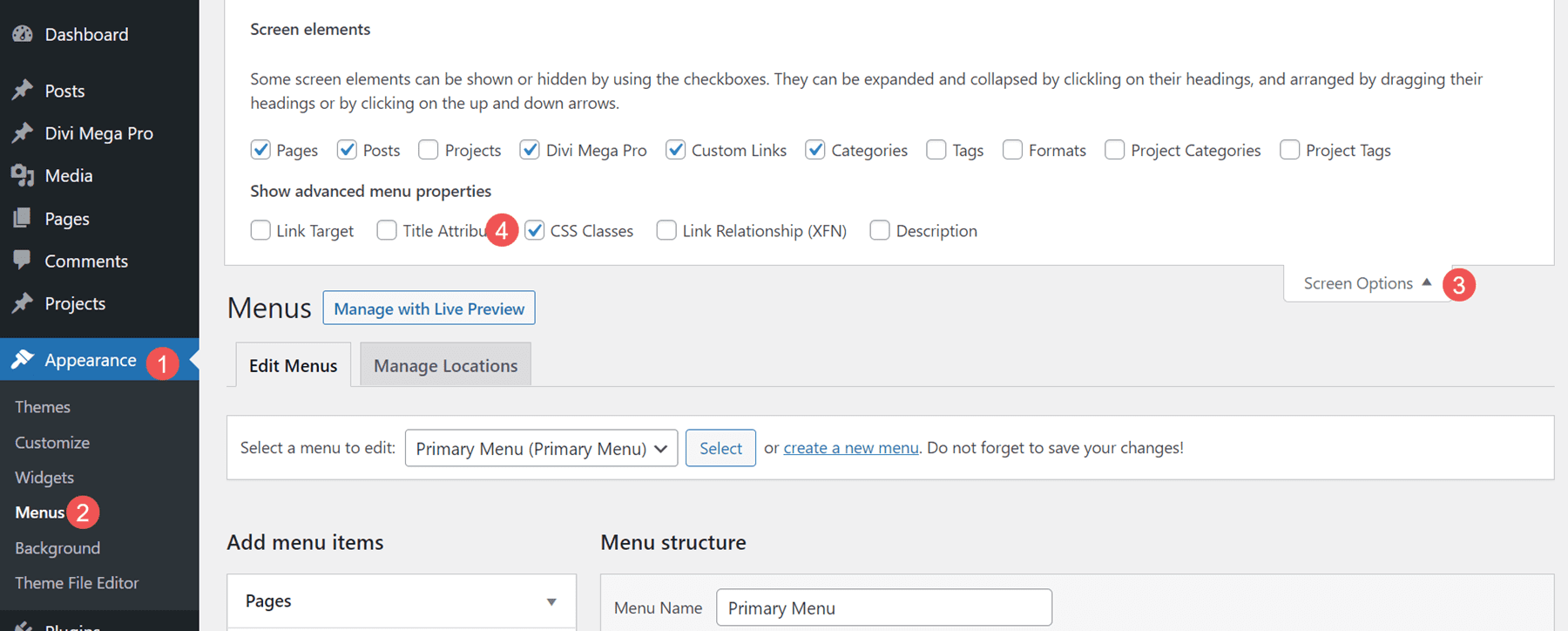
    To add the mega menu to your WordPress header and footer menus, you’ll need to have CSS Classes enabled. First, go to Appearance > Menus in the WordPress dashboard. Select Screen Options in the upper right corner of the screen and make sure CSS Classes is checked.

    Adding the Mega Menu

    Next, open the menu item that you want to display the mega menu item. Paste the Unique Mega Pro Class for the mega menu into the CSS Classes field.

    Adding the Mega Menu

    Repeat this process for every mega menu item you want to display.

    Adding the Mega Menu

    Here’s a look at this mega menu on the front end. I’ve used one of the demos that’s included, as we’ll see later.

    Adding the Mega Menu

    Adding Tooltips

    You can also use Divi Mega Pro to create mega tooltips. Simply add the CSS class to the element you want to show the tooltip. You can set the tooltip to open on hover or click. Any Divi Module can show a tooltip. Style the module as normal with the Divi tools.

    To add the tooltip, open the Divi Module you want to show the tooltip. Go to the Advanced tab and paste the Unique Mega Pro Class into the CSS Class field. Save your settings and you’re ready to display tooltips.

    Adding Tooltips

    Now when someone hovers over the element you’ve added the class to, the tooltip appears.

    Adding Tooltips

    The tooltips also work to create mega menus for headers in the Divi Theme Builder. Create the menu items with Divi Modules such as Text Modules, Button Modules, Image Modules, etc. I only recommend using Menu Modules to display standard menus as each link will either open a submenu or the page the menu points to.

    Add the Unique Mega Pro Class to the CSS Class field in each element you want to have a mega menu item. You can use this method to create custom headers and footers. In the example below, I’ve created a menu using standard Text Modules as the menu links. I’ll add a mega menu layout to each one.

    Adding Tooltips

    The menu items will work as a normal menu and display the mega menu items on hover or click, depending on your settings. In the example below, I’ve hovered over the first menu link and the mega menu for that Text Module has opened.

    Adding Tooltips

    Divi Mega Pro Templates

    Divi Mega Pro includes 15 templates to get you started. They’re provided as JSON files. Upload them to your Divi Mega Pro editor and use them to create your Divi Mega Pro layouts. They include eCommerce banners, tabs, CTA’s, contact information, a login form, blog posts, and lots more. The layouts are well-designed and work great with any style of the website.

    Divi Mega Pro Templates

    The templates are fully customizable, so you can adjust them to include your branded fonts and colors. This is template number 9, which creates eCommerce menus for featured brands. This shows the wireframe view within the back-end editor. You can also view the layouts on the front end. Mine displayed the layout with the sidebar by default, although I’m sure that can easily be disabled to show the layout in full width.

    Divi Mega Pro Templates

    Here’s how it would look on the front end. This is the back-end editor showing the desktop view.

    Divi Mega Pro Templates

    Where to Purchase Divi Mega Pro

    Divi Mega Pro is available in the Divi Marketplace for $79. It includes unlimited website usage, one year of support and updates, and a 30-day money-back guarantee.

    Where to Purchase Divi Mega Pro

    Ending Thoughts

    That’s our look at Divi Mega Pro. I found creating and using the mega menus to be intuitive. Since it uses any Divi Builder module, creating the menus and tooltips works the same as building any Divi layout. The extra features, such as animations, buttons, etc., provide even more control over the design and specify how the menus and tooltips work. It works well with pages, posts, WooCommerce products, and more. The added templates are a great way to get started. If you’re interested in creating mega menus and tooltips for your Divi websites, Divi Mega Pro is worth a look.

    We want to hear from you. Have you tried Divi Mega Pro? Let us know what you think about it in the comments.

    The post Divi Plugin Highlight: Divi Mega Pro appeared first on Elegant Themes Blog.

  • 6 Best Amazon Affiliate WordPress Plugins in 2023

    As an Amazon Affiliate (or Amazon Associate), you can monetize your traffic and promote recommended Amazon products directly from your WordPress website. So, when visitors click on your affiliate links (or ads) and buy those products, you earn a commission from each sale. However, to maintain a successful Amazon affiliate site, it helps to have the best Amazon affiliate WordPress plugin to do the heavy lifting.

    Not only can Amazon affiliate plugins simplify your workflow, but some can also provide valuable analytics to help grow your business. In this article, we’ll share the top WordPress plugins for Amazon affiliates.

    What is an Amazon Affiliate Plugin?

    An Amazon affiliate plugin is essentially a WordPress affiliate marketing plugin that makes it easy to manage, promote and sell your Amazon affiliate products on your WordPress blog or website, so you don’t have to worry about any technical issues getting in the way of your income.

    If you don’t already know, Amazon is stringent with its guidelines for its associates. For instance, you must use the Amazon Associates API to continue being a part of their program. You’ll also need to make sure you’re linking to the correct product, regardless of the country your user is visiting. For example, you’ll have to make sure that a UK user gets a link to their corresponding store, not to an Amazon in the United States. These issues, among others, are greatly simplified using an Amazon Affiliate WordPress plugin.

    5 Best Amazon Affiliate WordPress Plugins

    To help you avoid some common issues of being an Amazon affiliate. We have compiled a comprehensive list of the best Amazon affiliate WordPress plugins that will give you everything you need to start making more passive income.

    1. AAWP

    AAWP logo

    One of the most used plugins for Amazon Associates is the Amazon Affiliate WordPress Plugin (AAWP). This plugin lets you connect the Amazon Associates API to your page and add affiliate links to your WordPress articles simply and effectively.

    You don’t have to worry about violating Amazon’s affiliate policies by including prices or inserting images because all the data displayed comes via the API. The plugin also has various alternatives available to display Amazon products or affiliate links, all of which look fantastic on the front end of your website.

    Key Features of AAWP:

    • Product comparison tables (pictured below)
    • Automatic pricing updates
    • Easily implementable bestseller lists

    AAWP demo

    The appearance of any display element can be changed and is fully mobile-responsive; they look great and are sure to attract your users.

    AAWP is for you if…

    • You are an advanced user looking to maximize revenue on multiple websites.
    • Free plugins aren’t cutting it.
    • You want to display products in unique ways.

    AAWP Pricing: Starts at $49 for single-site usage

    Get AAWP

    2. AzonPress

    Azon Press logo

    AzonPress is a similar plugin to AAWP in that it easily allows you to insert affiliate links to texts and a variety of unique tables and displays as well.

    The plugin allows you to receive automatic product updates, customizable tables, and automatic geolocation, so you won’t have to worry about missing out on sales because of technical issues with the API. You’ll also be able to track your link performances via their dashboard.

    While it comes with many of the same features as AAWP, it’s a bit cheaper, so it may be the solution you’re looking for if you want to save a couple of bucks.

    Key Features of AzonPress:

    • Comparison tables
    • Automatic geotargeting
    • Customizable product display (example below)

    AzonPress Demo

    One of the plugin’s standout features includes the ability to display affiliate links, product details, photos, ratings, and reviews in a beautiful product showcase box.

    AzonPress is for you if…

    • You want a light and fast solution.
    • You want a way to track the conversions of your links.

    AzonPress Pricing: $31 for single-site usage

    Get AzonPress

    3. Pretty Links

    Pretty links logo

    All links on your website, including affiliate links, can be hidden and tracked using the freemium plugin Pretty Links. The plugin switches out affiliate links with ones that feature your domain name to make your link look cleaner and more trustworthy. In addition, it may generate random shortened slugs for any connection, or you can select your custom slug.

    Similarly to the other alternatives, Pretty Links tracks the clicks on your links and reports them to you through your WordPress admin panel. Link monitoring can be filtered based on the average number of clicks per link or the average number of unique clicks per link.

    Pretty Links provides all the above features without cost, but you can get some pretty neat features with the pro version, albeit for a hefty price. These include auto-linking keywords, multiple WordPress Site licenses, and priority tech support.

    Key Features of Pretty Links:

    • Link analytic tracking
    • Free version
    • Cloaks affiliate links

    Pretty Links dashboard

    This plugin is the best for cloaking and redirecting affiliate links into short and presentable links.

    Pretty Links is for you if…

    • You want a free solution.
    • You want to create SEO-friendly short links.

    Pretty Links Pricing: Free. Beginner $99.50/yr

    Get Pretty Links

    4. ThirstyAffiliates

    ThirstyAffiliates logo

    ThirstyAffiliates is a popular affiliate link management plugin for WordPress that helps you manage and cloak your affiliate links. It makes your links look clean and professional and provides a range of features for tracking clicks and conversions, organizing links into categories, and more.

    The free version of ThirstyAffiliates has many features that allow you to configure your basic links and customize them with additional details like product categories. The plugin also provides monitoring features to ensure your links are functioning properly and generates valuable user data to improve conversion strategies.

    Key Features for ThirstyAffiliates:

    • Link cloaking and management
    • Click and conversion tracking
    • Link categorization and organization
    • Link scheduling and expiration
    • Link redirection options

    ThirstyAffiliates offers a comprehensive solution for affiliate marketers using WordPress, providing a range of features for managing and optimizing affiliate links. This plugin is ideal for those looking for a complete solution to insert affiliate links on their website, keep track of links, cloak and localize links, and improve conversion strategies.

    ThirstyAffiliates is for you if…

    • You are looking for a good all-around solution to inserting affiliate links
    • You want to manage and optimize your affiliate links
    • You need to track clicks and conversions on your affiliate links

    ThirstyAffiliates Pricing: Free| Pro Version starts at $79.50

    Get ThirstyAffiliates

    5. Auto Amazon Links

    Auto Amazon Links logo

    Amazon Auto Links is a great free Amazon affiliate solution for website owners on a limited budget. Like the other solutions listed, this program automatically adds Amazon’s Amazon’sfeeds and affiliate links to your website.

    The displays frequently update product listings and update them as product details and pricing change. Additionally, you can filter out undesirable items from your links based on their description, title, and ID number. Products that are no longer available will be automatically removed, and tables with the products will be updated accordingly.

    In general, this product provides you with everything you need to quickly implement affiliate links without spending time managing them manually.

    Key Features of Amazon Auto Links:

    • Free.
    • Geotargeting support
    • Four ways to display products (category, product search, item look-up, URL)

    Amazon auto links example

    This plugin also gives you the tools to change the image size, description length, and product titles for your Amazon products.

    Amazon Auto Links is for you if…

    • You want a cheap and easy solution.
    • You are just starting and don’t need super advanced features.
    • You don’t mind coding custom templates for new layout designs.

    Amazon Auto Links Pricing: Free

    Get Auto Amazon Links

    6. WooZone (WZone)

    Woozone logo

    Also known as WooCommerce Amazon Affiliates, WooZone (WZone), assists you in linking your WooCommerce-based store with Amazon.

    In essence, WooZone enables you to choose items from Amazon.com and display them as if they were WooCommerce items. Then, when ready to buy, customers who visit your website can examine these items as they would on a conventional WooCommerce site before being redirected to Amazon (via your affiliate link.)

    Key Features of WooZone:

    • Automatically updates WooCommerce listings
    • Designed specifically for WooCommerce

    WooZone Dashboard

    In short, WooZone is an ideal solution if you’re familiar with working with WooCommerce products.

    WooZone is for you if…

    • You are using WooCommerce.
    • You want to sync and import products without needing an API key

    WooZone Pricing: $49 for single-site usage

    Get WooZone

    NOTE: We have a tutorial on their lite version of the plugin, which doesn’t seem to be supported currently.

    Which Amazon Affiliate WordPress Plugin Should You Pick?

    First, let’s recap all of the plugins we covered in this post. We ranked them in order of our favorites, with the top three amazon affiliate plugins at the top of the list. Of course, you might also want to consider the price associated with each. The price has been added to the following table for easy comparison. 👇

    Plugin Price Free Option
    🥇 AAWP $49 ❌ Learn More
    🥈 AzonPress $31 ❌ Learn More
    🥉 Pretty Links $99.50 ✔️ Learn More
    4 ThirstyAffiliates $79.50 ✔️ Learn More
    5 Auto Amazon Links / ✔️ Learn More
    6 WooZone $49 ❌ Learn More

    WordPress offers a lot of excellent plugins to help foster a profitable Amazon affiliate marketing program for your website. However, if you’re looking for a solution that will give you everything you need for an advanced campaign and you’re willing to spend some money, we recommend AAWP, which has everything you need and is known as the industry standard.

    As an affordable solution that gives you the basics, Pretty Links is a fantastic option without some of the frills. Regardless of your choice, a WordPress plugin will significantly enhance your site’s ability to monetize and present relevant products to your visitors.

    If you are interested in adding an affiliate program to WordPress, check out the Easy Affiliate plugin. Or, if you are looking to branch out into other affiliate programs, here’s a list of some great affiliate programs.

    Know any other plugins that can help Amazon affiliates? Leave a comment telling us below!

    Article featured image by ya_blue_ko/ shutterstock.com

    The post 6 Best Amazon Affiliate WordPress Plugins in 2023 appeared first on Elegant Themes Blog.

  • How to Add a Button to Your Divi Map Location’s Info Box

    The Divi Map module integrates with Google Maps seamlessly and is an easy way to add an interactive map to your Divi website. This is great for showing your business’s location or creating a local guide of your favorite boutiques and businesses.

    In this post, we’re going to show you how to add a button to the location info box for one of your pinned addresses.

    Design Preview

    First, let’s take a look at what we’re trying to accomplish. With some simple HTML, we’ll be able to accomplish adding a button inside the location info box for a pinned address.

    Let’s dive in!

    What You Need to Get Started

    To get started, you will need to do the following:

    1. Install Divi on your WordPress website.
    2. Add a Page, give it a title, and publish it.
    3. Enable the Visual Builder.
    4. Create your Google API Key.

    Select Build From Scratch

    Once you click the “Use Divi Builder” button the page will reload using Divi’s drag and drop builder interface. Three options will pop up – Build From Scratch, Choose A Premade Layout, and Clone Existing Page. For today’s purposes, select “Build From Scratch”. This will give us a blank slate where we can build our designs.

    Add Your Google API Key

    Before we’ll be able to fully use the map module and its functionalities, you’ll need to add your Google API Key to your Theme Options.

    1. From your WordPress dashboard, go to Divi > Theme Options and paste your Google API Key.
    2. Click “Save Changes”.

    Method 1: How to Add a Button to Your Divi Map Location’s Info Box

    Let’s get into the tutorial! Here’s how to add a button to the location info box.

    Add a Section and Row and the Map Module

    Navigate back to the page you just created and add a section and a one-column row to your page. Then load the module library and click Map. Once added, the module window will pop up with all the settings and functionalities available within the map module.

    Add  a Pin

    Click “Add New Pin” to add a pin to your map. This will bring up that pin’s settings where you can type in a title and add a description text. To add a button in the text area, add the following HTML:

    <a class="et_pb_button" href="#">Get Directions</a>

    The key here is to add the class of et_pb_button that turns a regular text link into a button. Don’t forget to replace the # sign with the URL you want this button to link to.

    Then add your pin’s location in the Map tab in the Map Pin Address field and click find.

    And there you have it! A button appears in the pin’s location info box.

    Method 2: Styling the Button with a Unique CSS Class

    There’s also another way to achieve this and it’s to add a unique CSS class to the HTML to style the button. Here is the HTML you’ll need:

    <a class="get-directions-btn" href="#">Get Directions</a>

    The unique CSS class we added was get-directions-btn. We can use this CSS class to apply unique styles to the button. You can do this by pasting on-page CSS or by using your child theme’s style sheet. In today’s example, we’re going the paste the CSS in our Page Settings.

    To achieve the button style below, copy and paste this CSS in to your Page Settings:

    .get-directions-btn {
      background-color: #1d1d1d!important;
      color: #f9f9f9;
      border-radius: 100px!important; 
      padding: 5px;}

    Final Thoughts

    Adding a button to your pin’s location box offers a clean direction button link that makes it easy for your visitors to get directions fast. You can also style the button using CSS added to your page! With that, the styling options are endless. Have fun customizing!

    The post How to Add a Button to Your Divi Map Location’s Info Box appeared first on Elegant Themes Blog.

  • WordPress Full Site Editing: A Beginner’s Guide

    Full site editing (FSE) is the newest buzz in WordPress. Although there have been premium themes utilizing this up-and-coming technology for several years now, it’s finally made it’s way into the mainstream thanks to the adoption of Gutenberg back in 2018. In this post, we’ll give you the low down on what WordPress full site editing is, what it’s built on, and how to use it. Let’s get to it.

    What is WordPress Full Site Editing?

    Full site editing header

    In years past, WordPress has had a very distinct structure. You would use the WordPress Editor to add content to posts and pages, then install plugins for extra functionality. WordPress core files were responsible for headers, footers, content areas, sidebars, and other elements. In recent years, WordPress full site editing has changed all of that. Based on blocks, full site editing makes it much more possible to edit every aspect of your WordPress site. You can create custom headers, footers, and build custom content just about anywhere. Full site editing also extends beyond the core of WordPress with page builders like Divi that take it to a whole new level of design capabilities.

    Benefits of Full Site Editing in WordPress?

    One of the greatest benefits of full site editing is the ability to customize your site any way you want from top to bottom. For example, you can now create and edit post and page templates, headers, and footers all on the front end. Plus you can add global styles to your site and blocks and create your own color palettes, fonts, spacing, and more. It allows WordPress users to create custom sites easier than in the past because of minimal coding requirements. As previously mentioned, full site editing themes use blocks, so you can utilize them throughout all areas of your site to create a custom site tailered specifically to you.

    Easy to Use

    Another benefit of full site editing in WordPress is the ease of use for your clients. If you’re a freelancer or web agency professional who wants to be able to hand off a website after completion, FSE themes are the way to go. There’s no need for them to dig down into the theme’s code to make design changes. You see, full site editing themes utilize a theme.json file which allows developers to add styles and functionalities easily. Creating a global color palette, assigning fonts, and other styles can be set globally, making it easy for end users to add and edit content.

    Optimized For Speed

    Lastly, FSE’s are typically faster. They generally have less bloat, are optimally configured, and process requests much faster than traditional WordPress themes. That being said, hosting is a factor, so you should choose a reputable hosting provider that utilizes caching, is compatible with the latest version of PHP, and preferably provides cloud hosting options. For more, check out how to optimize page speed for SEO.

    WordPress Full Site Editing Is Only Available on Block Themes

    It’s important to note that not every theme supports full site editing. Built on Gutenberg blocks, which launched back in 2018, is the foundation for FSE. When first introduced, blocks were only supported in the content area of websites – such as posts and pages. With FSE themes, that functionality expands to literally every aspect of the theme. As previously mentioned, the theme.json file controls all of the site’s global settings and styles. In previuos generations, the theme customizer controlled site settings. Now the WordPress Site Editor controls all global styles and settings, plus give users the ability to add blocks throughout the theme.

    WordPress full site editor

    That being said, there still aren’t a ton of options for full site editing themes out there. There are thousands of WordPress themes out there, with only a smidge over 160 FSE themes currently available. While full-site editing is growing in popularity, the technology is just now starting to take hold.

    What is a Block Theme?

    To put it plainly, a block theme is a WordPress theme that contains templates completely built on blocks. This not only includes posts and pages, but literally everything else. Sidebars, footers, headers, post templates, and every other aspect of the content on the theme.

    In the past, WordPress websites consisted of a series of traditional PHP files. Now, block themes are all built on block templates. As previously mentioned, all block themes have a theme.json file that allows for developers and users to add additional functionalities, set global styles, and more.

    Default themes such as Twenty Twenty-Two are considered block themes. Instead of using the old WordPress customizer to add your site’s taglines, choose colors, or select fonts, you use the WordPress Site Editor to control those things. Additionally, you use blocks to add content to templates to personalize it.

    What is the Difference Between Static and Dynamic(Theme) Blocks

    Before we start showing you how to use full site editing in WordPress, there are a couple of basics to understand in regards to WordPress blocks. There are two types of blocks in WordPress FSE – static blocks and dynamic Theme Blocks. Static blocks are made up of content that is known at the time you create and publish a post. Some examples of static blocks are paragraph, heading, image (although those can be dynamic too), quote, page breaks, buttons, and more.

    On the other hand, the new FSE dynamic blocks (called Theme Blocks or Site Blocks) are designed to be used when building templates and can pull content from the backend of your site dynamically to display it on your site. These dynamic Theme Blocks can generate for blog post feeds (with a query loop block), post titles, post content, featured images, and many more. The post content block is a great example because any changes to the post content on the backend will automatically update each instance of that post content block throughout your site.

    Static and Dynamic blocks

    Getting Started with Full Site Editing in WordPress

    Now that you have a basic understanding of what full site editing is, let’s talk about how to use it. In this section, we’ll help you understand how to choose a block theme, how to customize templates contained within the theme, set global styles, use dynamic theme blocks, and introduce you to block patterns.

    Choosing a Theme that Supports Full Site Editing

    Full Site Editing themes WordPress

    Currently, there are 150+ full site editing themes available in the WordPress repository. There are two ways to choose a FSE theme. You can choose a free one from the WordPress repository, or purchase one from a premium vendor. For this post, we’ll choose a FSE in the WordPress repository.

    First, log in to your WordPress dashboard and click Appearance > Themes. Next, click the Add New button.

    Add a new theme

    Next, click the Feature Filter link to set filtering options.

    WordPress feature filter

    There are three options to sort by including subject, features, and layout. You can choose the subject of the theme if you desire, otherwise you only need to tick the Site Editor box. Once you make your selections, click Apply Filters.

    site editor

    Your screen will refresh and reveal the choices available to you. You can choose a theme to follow along with this tutorial, or simply choose the Twenty Twenty-Two theme, which is what we’ll be using for this post. Once you make your choice, activate your theme to get started.

    Customizing a Template

    With your new theme active, the next step is to start customizing. For this tutorial, we won’t go into editing theme.json. We’re going to stick to the basics of Twenty Twenty-Two to get you acclimated to how full site editing themes work. That being said, head over to Appearance > Editor.

    WordPress Site Editor

    Once the site editor loads, you’ll be defaulted to the home page template.

    Edit home page template

    To edit other templates within your theme, simply click the WordPress logo in the upper left corner of the site editor, then click Templates. In Twenty Twenty-Two, there are a number of templates you can edit including single post, page, 404, blank, search arhive, and more. To select a different template to edit, click on it to activate the site editor for that page. Additionally, you can create a new template for your site by clicking the Add New button on the top right hand corner in the dashboard.

    Edit templates

    There are several options for new templates in Twenty Twenty-Two including front page, author, category, date, tag, and taxonomy pages. That being said, these options will differ depending on which theme you chose in the previous section.

    Add new template

    Template Parts

    The next area you can edit in a page template are template parts. In Twenty Twenty-Two, you can edit the header and footer template parts on each template. However, each template has different template parts that are editable. For example, the home page template offers a blog template part as well.

    WordPress template parts

    For this example, let’s edit the header template part. Here you can edit the existing blocks or add new ones to the template. To add more blocks, toggle the block inserter by clicking the blue + button in the top left corner of the editor.

    Add new blocks

    This will reveal all of the blocks available to you. You can add a block in one of two ways. Either click and drag your chosen block into the template part, or click the + icon to add one.

    Customize template part

    Additionally, you can edit existing blocks within a template. Simply click on the block you wish to edit to bring up its options. For example, if you want to edit the site logo, click on it to add a new image.

    edit existing block

    How to Set Global Styles

    Another great feature of a full site editing theme is the ability to set global styles. You can choose fonts, colors, color themes, and adjust spacing. You can opt to set styles across your entire site, or only on certain blocks. This is a huge timesaver compared to themes of the past.

    To access the styles for your site, click the styles icon at the top right of the site editor.

    Access site styles

    Once activated, you can browse the available styles in the Twenty Twenty-Two theme by clicking the browse styles link to choose a color scheme for your site.

    Browse styles

    The next option, typography, allows you to choose the font options for your text and links. This includes font family, size, line height, and font weight (appearance).

    Site editor font options

    Under colors, you can edit the colors used in your global color palette. You can assign colors to the background, text, and links. In Twenty Twenty-Two there are 17 solid colors and 20 gradients. Additionally, you can add custom colors and gradients to your site, which is great for branding purposes.

    Full Site Editing WordPress global colors

    Lastly, you can adjust the padding to your layout. Padding can be set for top, left, right, and bottom as a whole, or set individually.

    WordPress layout settings

    Using Dynamic Theme Blocks

    The block editor contains more than 90 blocks that can be utilized to build page templates in the site editor. Among those, there are some dynamic theme blocks that will populate dynamic content shown on the front end of your site. For example, when clicking into the single post template, you’ll see a few that are used including the post title, post featured image, and post content blocks. These are useful for building a dynamic template to display your blog posts dynamically.

    Dynamic theme blocks

    When editing themes, you can utilize theme blocks to build headers, footers, and more. In all, there are 27 theme blocks. We won’t go through all of them here, but we’ll go over a few so that you get a good understanding of what you can do.

    Full site editing theme blocks WordPress

    Building a New Header for Your Templates

    Let’s demonstrate how to use a few theme blocks to build a new header template part for your site. Start by navigating to the Templates menu. Next, click Blank template to start.

    new blank template

    If you want to be able to see which blocks are utilized in your page, you can use the layers view. It’s accessbile by clicking the layers icon in the top left part of your site edtior screen.

    full site editing layers menu

    Click the blue + icon to reveal the blocks, then scroll down to the theme block options. The first theme block we’ll select is the template part block. This is very useful for creating global sections for your site. We’re going to use a template part to create a custom header for your site that can be assigned to certain pages.

    Drag the template part block into your site editor’s blank page. Select start blank to build a new template part.

    full site editing template part

    Assign a name for your template part, then click create.

    name template part

    First, bring up the blocks and search for spacer, then add it to your pasteboard. Give it a height of 20px. This will add 20px of space at the very top of your template.

    Next, find the columns block. Drag it into the pasteboard. Select the 33/33/33 column variation. This will put three columns in your row. The each column will occupy 33% of the available site space.

    Your template part should now look like this:

    Three column layout

    Add Blocks to Your Header Template

    Bring up the blocks menu by clicking the blue + icon. Scroll down to the theme blocks and drag the site logo block into the first column. Upload an image or assign one from your media gallery.

    site logo full site editing theme block

    Next, drag the navigation block into the second column. For the navigation block, you can add pages from your website to the menu, or create custom links. Adding menus in full site editing themes is a bit different than in other themes. You no longer use Appearance > Menus to add them. Now, all menus are created and added in the site editor. Click start empty to create links for your site or select pages. To add them, hit the enter key on your keyboard.

    navigation theme block

    Finally, add the social links block to your third column. Add the social media icons you wish to feature by clicking the + at the right site of the social icons block.

    social icons block

    NOTE: You are not limited to adding Theme Blocks to your templates. You can use any WordPress Block. In this example, the social links block isn’t a dynamic theme block but is still a useful element to add to a header.

    With your blocks all added, your header should now look like this.

    header with blocks added

    Adjusting the Layout of the Template

    Now that you have all of the blocks in your new header, you’ll notice that the spacing seems a bit off. No worries, as is with every aspect of full site editing, you can adjust that too. First, click on the first column in the layers view. In the settings panel under Column Settings > Width, click the dropdown to reveal the different sizing options. Choose %. Type in 20 for the width of the first column.

    full site editing column width

    Repeat the steps to adjust the second column to 60%, then the third column to 20%. You header should now have better spacing. Save your template by clicking the Publish button in the top right hand corner.

    Your template should now look like this.

    published blank page template

    Using Block Patterns to Jumpstart Your Designs

    When building templates, there is an easy way to drop in a series of blocks to make the design process easier. These groups of blocks are called block patterns. WordPress comes standard with a few block patterns you can use, or you can build your own to reuse them throughout your site. To access block patterns, click the blue + icon at the top left in the site editor, then click the patterns tab. There are several categories of block patterns to choose from including footers, headers, buttons, galleries, columns, and more.

    full site editing block patterns

    Each block pattern can be edited to suit your design choices. Color, font, and padding styles can be adjusted within individual blocks in the pattern. If you want to save a block pattern you’ve created, simply click the ellipsis menu in the list view, then click Add to Reusable Blocks. Alternatively, you can also save it as a Template Part.

    Save a reusable block pattern

    Divi: The Ultimate Full Site Editing Theme for WordPress

    Divi by Elegant Themes

    If you are looking for a versatile, feature-packed full site editing theme for WordPress, look no further than Divi. Take full site editing to a completely different level by utilizing the most advanced Visual Builder in the world. Users can apply hover effects, add shape dividers, apply animations, edit elements in bulk, and apply global styles and color palettes, to name a few features. Plus, Divi has over 200 elements in its arsenal to help you create a stunning, highly functional website. With elements such as blogs, sliders, call to actions, pricing, testimonials, and more, users can create a truly unique website.

    Divi modules

    Divi Theme Builder

    Divi template builder

    In addition to the unlimited design capabilities of Divi, users can also expand customizations to their entire website. You can design headers, footers, product templates, category and archive pages, 404 templates, post templates and more. Plus, you can do all of this with Divi’s proprietary Visual Builder, which allows you to see design changes in real time. There’s no limit to the number of templates you can create. Additionally, Theme Builder templates can be assigned as global elements, or to individual pages if desired.

    Divi Dynamic Content

    Divi dynamic content

    Divi also has the built-in capability to create dynamic content for your website. Using the Template Builder and/or Visual Builder, users can assign dynamic content to posts, pages, products, and templates. You can use dynamic content in all Divi elements, which allows you to build dynamic modules to display information pulled directly from your database.

    Dynamic Modules in Divi

    Dynamic modules are great for use in all types of websites. They can be used to build modules for travel websites, recipes, rental services, and more. Using Divi’s Visual Builder, you can assign dynamic content based on the type of template you wish to build. For example, when building post or category templates, the dynamic content available for a text module has options that differ from those of an image module. For modules with text, you can choose things like post/archive title, post excerpt, publish date, comment count, tags, category description, and more. On the other hand, image modules are used to set dynamic content such as featured image, author profile picture, and site logo image.

    Dynamic WooCommerce Modules

    Divi product template

    Ecommerce website owners get an added bonus with Divi. When WooCommerce is installed, Divi adds a series of dynamic WooCommerce modules that offer the ability to add dynamic content when building product, cart, and checkout page templates. It’s no longer necessary to utilize CSS when using WooCommerce in order to make your site’s product and cart pages match your branding. Plus, WooCommerce modules can be used anywhere within Divi to highlight products, create product galleries, and much more.

    FAQs About WordPress Full Site Editing

    After all of the information that we’ve handed you, we’re sure you have some questions. Not to worry, we have answers for you.

    If I Swap To a Full Site Editing Theme, What Will Happen To My Website?

    Thankfully, full site editing themes are built on blocks. So, if you are swapping from another theme based on blocks, you should only have to do a few things to get your site looking good. The first thing is to set a site logo and navigation by creating a header template part. Chances are, your old theme used the Customizer. With FSE themes, the site editor is used to create your site’s header.

    Where Can I Find a Full Site Editing Theme?

    There are two ways to find a full site editing theme. The first way is to conduct a filtered search in the WordPress theme section of your admin dashboard. There are more than 160 themes to choose from. The second way is to purchase a premium full site editing theme such as Divi.

    My Old Site Uses Widgets. Will They Stay in Place if I Swap to a Full Site Editing Theme?

    Since a FSE theme is built entirely on blocks, it doesn’t utilize widgets the same as in the past. However, there are widget blocks that are available. You’ll probably need to replace old widgets with new widget blocks or add new block patterns to help speed up the process.

    What Version of WordPress Do I Need to Use a Full Site Editing Theme?

    Full site editing is compatible with versions of WordPress since the release of 5.8 and more Theme blocks have been added in recent versions. If your install doesn’t have 5.8, you’ll need to upgrade it in order to use a FSE theme. The good news is that you need to upgrade anyway, as using outdated versions of WordPress leaves your site vulnerable to security hacks and all sorts of other nasty issues.

    I’m Not Very Tech Savvy. Can I Use a FSE?

    Yes! It’s easy for nearly everyone to learn how to build a website using Full site editing. Because FSE themes utilize drag-and-drop visual editing, it’s easy to build beautiful layouts with ease.

    Will Using a Full Site Editing Theme Speed Up My Site?

    Yes, it can, but there’s more to it than that. First, full site editing themes can give you a performance boost because they are built in a way that requires fewer plugins for added functionality. So, you shouldn’t need to install many to get the site where you want it. That being said, FSE themes aren’t automatically designed to be faster out of the box. There are other considerations such as hosting providers. A good hosting provider such as SiteGround, will run the latest version of PHP, and provide a CDN and other speed enhancements that will make websites run faster.

    Full Site Editing is the Future of WordPress

    Full Site Editing is gaining ground in the WordPress community. With the ability to edit every aspect of websites, developers and creatives are beginning to see the value in it. Premium themes such as Divi have been using this technology since 2021, and have stayed ahead of the curve. That being said, with the release of WordPress Twenty Twenty-Two theme at the beginning of this year, we can expect full site editing themes to become the norm shortly. Knowing how to utilize full site editing in WordPress development is an essential step to keep you set up for the future.

    Do you use full site editing in WordPress? Give us your thoughts on it below.

    The post WordPress Full Site Editing: A Beginner’s Guide appeared first on Elegant Themes Blog.

  • Get a FREE Webinar Layout Pack for Divi

    Hey Divi Nation! Thanks for joining us for the next installment of our weekly Divi Design Initiative; where each week, we give away a brand new Layout Pack for Divi.

    This time around, the design team has created a beautiful Webinar Layout Pack that’ll help you get your next website up and running in no time!

    This layout pack includes:

    8 Premade page layouts strategically designed for any webinar website (including a footer design)
    – Original, royalty-free photos and graphics + customizable source file (see below)
    – Plus, a large collection of pre-designed website elements that are customizable and reusable anywhere.

    This layout pack is available right inside Divi for all Divi customers for FREE as the latest addition to our growing Divi library of hundreds of premade layout packs, thousands of page designs, and countless web design elements and resources.

    divi layout

    Check Out The Divi Webinar
    Layout Pack Below

    Get it for free today!

    webinar website

    Landing Page Design

    View The Live Layout Demo

    Home Page Design

    View The Live Layout Demo

    About Page Design

    View The Live Layout Demo

    Blog Page Design

    View The Live Layout Demo

    Contact Page Design

    View The Live Layout Demo

    Schedule Page Design

    View The Live Layout Demo

    Speakers Page Design

    View The Live Layout Demo

    Pricing Page Design

    View The Live Layout Demo

    Key Features

    If you’re looking to host webinars online, you’ll want to check out the Webinar Layout Pack for Divi. This layout pack provides beautiful layouts that focus on the essence of your webinars. Share your schedule, pricing, speakers, and more using the professionally-designed layouts in this layout pack!

    Live Demos

    Click the links below to see a live demo for each of the layouts included in the pack.

    1. Webinar Landing Page (live demo)
    2. Webinar Homepage (live demo)
    3. Webinar About Page (live demo)
    4. Webinar Blog Page (live demo)
    5. Webinar Contact Page (live demo)
    6. Webinar Schedule Page (live demo)
    7. Webinar Speakers Page (live demo)
    8. Webinar Pricing Page (live demo)

    Access This Layout Right Now
    Directly from Your Divi Builder

    Since Version 3.0.99 of Divi, you can find and import any of the layouts included in this pack (along with ALL of Divi’s Premade Layout packs) directly from the Divi Builder. They are already waiting for you.

    To access your new layout, simply activate the Visual Builder when editing a page and look for the “Load From Library” icon in the page settings bar (it looks like a plus symbol). Click this icon to launch the Load From Library popup. Under the Premade Layouts tab, you can easily find the new layout by scrolling through the list of layout packs. Once you find the Webinar Layout Pack, click on it. You will see all the individual layouts included in the pack. Select the layout you want to use and then click the “Use This Layout” button.

    webinar website

    For more, check out this video to learn how you can get this layout pack up and running today.

    Subscribe To Our Youtube Channel

    Authentication Required

    Before you can download Premade Layouts from the Divi Library you must authenticate your Elegant Themes Subscription. You can do this by navigating to Divi > Theme Options > Updates. There you can enter your username and API key and save changes.

    webinar website

    You can find your API Key under your members area on the Elegant Themes site. After you enter the Username and API Key, you will gain immediate access to our library of hundreds of free layouts (including this one). If you haven’t done this, when you click to import a layout to your page, you will be prompted to enter your Elegant Themes Membership Username and API Key.

    Use Layout Images for FREE with No Licensing Restrictions

    The image assets included with these layouts (icons, illustrations, photos, etc.) have no licensing restrictions. This means you can use them in all of your commercial projects without having to worry about paying licensing fees or attributing the photographer. Use them in your commercial websites, sell them within your Divi child themes, include them in your own Divi layout packs or just use them on your blog. We know how challenging it can be to find good photos and how confusing and scary the licensing that governs those photos can be. We want to fix that problem for our users.

    Download the Full Res Image Assets

    New Layout Pack Every Week!

    We hope you enjoy this layout pack. We look forward to hearing your opinions in the comment section below. Make sure you check out next week’s layout pack as well!

    The post Get a FREE Webinar Layout Pack for Divi appeared first on Elegant Themes Blog.

  • How to Use Bitrix24 CRM with WordPress

    Bitrix24 is an all-in-one business software (or Saas) with a suite of tools to help grow your company and manage customer relationships. Using Bitrix24 with WordPress could be an effective combination for streamlining your business. Your WordPress site can help capture sales and leads while Bitrix24’s Customer Relationship Management (CRM) handles the rest. This article will discuss the features of Bitrix24 and how to use the Bitrix24 CRM with your WordPress website.

    What is Bitrix24 CRM?

    Bitrix24 is an enterprise collaboration and CRM platform that helps businesses improve communication and performance while lowering business costs. It consists of a number of integrated applications that cover every aspect of running and managing a company including project management, CRM, task management, document management, file sharing, and more.

    Bitrix24 is available in both cloud-based and self-hosted versions. It offers a wide range of features and pricing options to meet the needs of businesses of all sizes. The best part is that many of its features integrate with WordPress websites, especially form and WooCommerce, to make your business operate smoothly.

    Bitrix24 CRM Homepage View

    Who Uses Bitrix24?

    Bitrix24 has a CRM and collaboration platform used by millions of companies worldwide. The platform helps sales, marketing, and support teams work together more efficiently and improve customer relationships. So, both small businesses (SMBs) and large enterprises are able to find success with it.

    Customer service, marketing, and sales organizations use Bitrix24 by using a single source of truth for tracking and managing customer interactions alongside corresponding tasks and internal communications. Plus, the platform is robust and flexible allowing organizations to completely customize how it is used to fit the operations and strategy of each company.

    Why Connect Bitrix24 CRM with WordPress?

    WordPress enables business owners to create any type of website they need. And it is a popular CMS because it is flexible and easy to use, especially with front-end no-code page builders like Divi.

    Your website oftentimes acts as the frontline of service to your customers. Therefore, integrating your WordPress site with Bitrix24 can help improve your customer relationships and grow your business. A WordPress site connected to Bitrix24 can send customer data collected on the site straight to your Bitrix24 CRM. This allows you to connect sales and support organization tools and automation to increase the efficiency and quality of each function. When the technology is accessible and connected with helpful employees, businesses are able to deliver on their promises and improve customer value.

    Bitrix24’s Features

    Bitrix24 offers a full suite of applications that are interconnected to keep disparate parts of a company running in sync. There are quite a few features under the hood that are worth considering.

    Some of Bitrix24’s best features for WordPress website owners are:

    Bitrix24 CRM

    Bitrix24 is a powerful CRM tool that offers a variety of features and capabilities to help businesses streamline their customer relationships. Custom fields, records, reports, workflows, and kanban boards are just some of the ways that Bitrix24 can help businesses manage their customer data. There are also different user types that can be assigned to specific tasks. This ensures the right people have access to the right information.

    Kanban Workflows

    Bitrix24 Open Deals Kanban View

    The CRM can display customers, leads, and active deals in a Kanban view which lets you visualize where each is within your workflows. Users can click on any one of them to see your complete record for that object.

    You can view:

    • Contact Information
    • Background Information including previous notes
    • Previous Interactions including phone calls, web chat, and email

    Teams can stay on top of a full pipeline of new sales leads or customers who’ve reached out for a support inquiry. With collaboration tools built into the workflow views, entire teams can work together to move the needle. This makes Bitrix24 one of the most effective company communication applications.

    Business Process Automation

    Online Workflows for Business Processes

    Every business needs a good automation platform to make internal processes more efficient. With Bitrix24, you can customize internal automation to create tasks based on certain actions or move leads along a sale journey.

    Bitrix24 CRM for Customer Quotes and Invoicing

    Bitrix24 is a powerful platform for sending customer quotes and invoices and offers a wide range of features and capabilities. This allows businesses to create custom quotes and branded invoices for their customers, offer discounts and taxes, and email or print them in PDF format.

    Quotes and Invoices

    Businesses can also use Bitrix24 for creating custom quotes at scale to help sales teams and service providers. You can create, customize, and send quotes and track actions that potential customers take — keeping you in the know at each step.

    Bitrix24 Create Quote View

    Craft custom invoices for customers that are fully branded, accurately calculate taxes, and offer discounts.

    Bitrix24 Create Invoice

    Bitrix24 for Customer Support Call Centers

    The Bitrix24 call center solution provides a comprehensive set of features to help businesses manage their customer support ops. It includes a powerful workforce management system, an integrated softphone for making and receiving calls, and conversation recording for extended record keeping.

    Bitrix24 Instagram Messaging View

    Call center technology is fully integrated with website live chat functionality that you can add to your website. Along with that, connect social accounts like Instagram and Whatsapp to serve customers where they are ready and willing. Bitrix24 offers an omnichannel support experience that scales into marketing opportunities with CRM and Email Marketing capabilities built in.

    How to Integrate Bitrix24 CRM Forms with WordPress

    If you’re a WordPress user, you might be wondering how to integrate your site with Bitrix24 CRM. There are a couple of ways to do this using forms to collect and update customer/lead information. And you can also make deeper connections if you use WooCommerce or a WordPress plugin that supports Zapier integrations.

    In the rest of this article, we’ll run through how to complete each of these integrations and why each may be helpful.

    Note: Fully integrating any CRM with a website (and the operations of your business) is a tall order. There is no one-size-fits-all approach as each CRM configuration and website configuration is different. Your business needs will demand different levels of integration and software solutions. The following are basic solutions for you to explore.

    Using Bitrix24 CRM Embeddable Forms

    Bitrix24 comes with a feature full web form creator. Web forms are the engine of a growing and flowing CRM. New leads, updated contacts, and new business can all start out as a simple web form fill.

    Bitrix24 Build Custom Web Forms

    The web form creator allows you to create forms with custom fields that populate vital information necessary for your sales, support, and marketing teams. Collecting accurate and timely information on customers and prospects is imperative to increase business and customer satisfaction. These forms are built into the Bitrix24 CRM and are embeddable on your website or landing pages.

    To create an embeddable form in Bitrix 24, navigate to the “CRM” pane of the online platform. Then visit the “Add ons” tab and select “CRM Forms”.

    Bitrix24 Embed CRM Form - Steps 1-3

    Once there, you will have two options you can use. The first option allows you to use (and customize) premade contact forms that have basic settings that work well for most businesses.

    Bitrix24 Embed CRM Form - Step 4

    In addition to using premade forms, the second option allows you to create a new form from scratch. To do so, click the “Add” button near the top.

    Bitrix24 Embed CRM Form - Step 5

    There are multiple options that you can use to create a custom-tailored form. These options changes both how the form operates and how it can be designed to match your brand.

    Once your form is fully configured, click “Save”. Then, in the top right, click “Form Features” then “Share”.

    Bitrix24 Embed CRM Form - Steps 6-7

    This will open up a window with all of Bitrix24’s Form sharing options. For a simple embed code, select the “Webpage” sharing option. You’ll see a drop-down section to view the form’s code.

    Bitrix24 Embed CRM Form - Steps 8-9

    Copy this code and paste it into a Custom Code block or Divi’s Code Module on your WordPress website.

    Using Contact Form 7 Plugin to Capture Leads for Bitrix CRM

    Flamix has created a premium WordPress plugin for connecting Contact Form 7 forms with Bitrix24. If you are a power user of CF7 and are comfortable with the subscription pricing of the Flamix solution, this might just be for you.

    Connect Bitrix24 CRM to CF7 with Flamix

    This Bitrix24 Contact Form 7 premium plugin integration is a great way to get more from your contact forms. With custom fields, duplicate control, and UTM catching, you can make sure that your forms are as effective as possible. Use a form builder that you are comfortable using while still channeling lucrative customer data into your CRM.

    For full installation steps (both on WordPress and in Bitrix24) see Flamix’s installation documentation.

    You many also like our guides on how to customize your CF7 Form to match your site and how to connect Contact Form 7 with Zoho CRM.

    Other Ways to Integrate Bitrix24 with WordPress

    Non-form integrations are also vital for business websites. They can collect user interactions and gather that information to populate your CRM with accurate and actionable information. Here are few integrations to consider.

    WooCommerce

    If you’re running a WooCommerce store on WordPress, then you know how important it is to have a CRM system in place to manage your customer relationships. But what if you could integrate your WooCommerce store with a CRM system like Bitrix24? With the premium WooCommerce plugin by Flamix for Bitrix24, you can do just that.

    Connect Bitrix24 to WooCommerce with Flamix

    Note that this premium plugin has low installs and reviews so do what research you can before using it.

    For full instructions for Flamix’s WooCommerce and Bitrix24 plugin, see the installation documentation and help video.

    Zapier

    If you’re using Bitrix24 for your CRM needs, you can now integrate it with WordPress using Zapier. Zapier uses WordPress triggers to perform actions within Bitrix24, making it easy to keep your data synchronized between the two platforms. This integration is especially useful if you use WordPress for your website and want to keep your customer data centralized in Bitrix24.

    Connect Bitrix24 to WordPress with Zapier

    To see what’s possible with Zapier automations, visit the Bitrix24 and WordPress landing page.

    Bitrix24 to WordPress with Zapier - Actions and Triggers

    Example Actions and Triggers available between platfoms

    In order to set up the automation, allow Zapier access to both your Bitrix24 account and your WordPress installation. Then pick the combination of triggers/actions that are helpful for your CRM workflow in Bitrix24. Zapier gives you a lot of customization options. You may need a paid plan to achieve the level of automation that you are hoping for but a simple, lone automation may be doable on their free plan. Find out more if we piqued your interest in what’s possible with Zapier and WordPress.

    Conclusion

    In conclusion, Bitrix24 CRM is a great tool for WordPress users. The software is easy to use and has a wide range of features. And, when combined with your WordPress site, it can help you manage your customers, sales, and marketing. If you are looking for a CRM for your WordPress site, Bitrix24 should be at the top of your list.

    Have you tried to integrate a CRM like Bitrix24 with WordPress? Let us know you experience in the comments below!

    The post How to Use Bitrix24 CRM with WordPress appeared first on Elegant Themes Blog.

  • 5 Cyber Monday Sleeper Deals in the Divi Marketplace

    With the Divi Cyber Monday Sale in full swing you’ve likely already heard about a lot of deals. We’ve got literally hundreds of deals to choose from, but because of that, some really good ones might be flying under the radar. That’s why in this post we’ve tried to find and highlight five products in the Divi Marketplace that have been significantly marked down and are just waiting to be discovered. So if you’ve yet to pick something up or if you’ve already got Divi or a Divi Account Upgrade for 25% Off, Divi Cloud and Divi Teams for 44% Off, and one or more of our Divi Cyber Monday Bundles for 60% Off–then these deals are for you!

    Avanti Divi Child Theme for 80% Off

    Where to Purchase Avanti

    This multi-purpose Divi Child Theme is packed with 60+ pages, targeted towards 9 niches, and includes 30+ design elements. Avanti is touted as the fastest way to build a website with Divi. It comes with one-click demo content import, all colors can be changed, it’s fully responsive, SEO friendly, and a lot more.

    Normally this child theme is $35. A great price! But during our Cyber Monday Sale it’s just $7!

    GET AVANTI FOR $35 $7!

    Divi Torque Pro for 50% Off

    Divi Torque is a new product so a lot of folks may not even know it exists yet. However, WPPaw has heavily marked it down during our Cyber Monday Sale and we have taken notice! This collection of 30+ modules and 100+ wireframe kits is just what Divi Pros need to keep things interesting from project to project.

    Normally this product is $75, but during our Cyber Monday Sale it’s just $37.50!

    GET DIVI TORQUE PRO FOR $75 $37.50!

    Divi Design Notes for 50% Off

    Divi Design Notes is another new product with a huge discount for Cyber Monday. This innovative product makes it easy for design teams and clients to provide and collect feedback on designs directly in Divi. Pin notes anywhere on your Divi website and take your collaborations to the next level.

    Normally this plugin is $29, but during our Cyber Monday Sale it’s just $14.50!

    GET DIVI DESIGN NOTES FOR $29 $14.50!

    Divi Headers Layout Pack for 80% Off

    Divi Awesome has created 45 Divi Headers and put them in this beautiful layout pack. All of these headers are responsive, look great on mobile, and can be made to fit any design niche.

    Normally this layout pack would cost $15, but during our Cyber Monday Sale it’s just $3! If you don’t get this one you’re crazy 🤪

    GET THIS DIVI HEADERS PACK FOR $15 $3!

    Divi WooCommerce Extended for up to 50% Off

    Divi WooCommerce Extended brings 7 new WooCommerce features to Divi. A mini cart, quick view, carousel, categories, ajax search, tab manager, and checkout manager. Add a whole new level of interactivity to your WooCommerce shop with this half-off Divi Extension.

    Normally this extension is $59, but if you unlock our hidden Cyber Monday discount perk, you can get it for just $29.50!

    How can you unlock this hidden discount? All you have to do is make any other purchase in our Cyber Monday Sale first. Once that purchase is complete, go to the Divi WooCommerce Extended listing and refresh the page. The new discount will be 50% off!

    GET DIVI WOOCOMMERCE EXTENDED FOR $59 $29.50!

    Grab Any Deal Above and Unlock Even More (Plus 50+ Free Divi Layouts and Templates)

    One of the best aspects of our Cyber Monday Sale is the added Perks that everyone who participates gets to have. When you make any purchase during the sale you’ll also get over 50 professionally designed Divi Layouts and Templates as well as a whole slate of additional deals–all located in the “Perks” tab of your Divi Members Area. So if you’ve been meaning to try out a Divi Extension, Divi Child Theme, or Divi Layout Pack from the Marketplace, now is the perfect time! Don’t let these deals expire before you take advantage of them!

    The post 5 Cyber Monday Sleeper Deals in the Divi Marketplace appeared first on Elegant Themes Blog.

  • Introducing the NEW Divi Cyber Monday Blog Booster Bundle

    The Divi Cyber Monday Sale is going on right now! We’ve got a slew of new bundles, prizes, and discounts for you to take advantage of! 25% off Divi, 44% off Divi Cloud and Divi Teams, and up to 60% off individual Marketplace items. We’ve also put together three new bundles just for Cyber Monday. So even if you bought all of our Black Friday Marketplace Bundles you can still save big. In this post we’ll explore our third and final Divi Cyber Monday Bundle–The Divi Blog Booster!

    TAKE ME TO THE SALE!

    The Massive Cyber Monday Blog Booster!

    Elevate your Divi Blog with this Blog Booster Bundle! This bundle is packed with brand-new blog modules, blog-centered child themes, completely new blog page templates, and the latest in blog post template designs. Everything you need to start–or supercharge–your blog in 2022 and beyond is in this bundle!

    Buy this bundle before the time runs out! When you purchase today, you receive 60% off 15 of the Divi Marketplace’s best-selling, blog-boosting extensions, layouts, and child themes. We only make bundles like this during our Black Friday and Cyber Monday sales once a year. When the sale is over, you won’t see these deals again! Now you have the chance to stock up on thousands of pre-made designs while saving hundreds of dollars!

    TAKE ME TO THE SALE!

    Divi Blog Extras

    Divi Blog Extras

    Say goodbye to boring blog post layouts! With Divi Blog Extras, you can build feature-rich, beautiful, and eye-catching blog designs for your website. Boosting more than 35,000 active installs across the web, this mainstay of the Divi Marketplace provides you with more than 10 different layouts for your blog. In addition to that, with custom post type support, you don’t just need to use this plugin on your blog posts. Your custom post types can get a feature boost as well!

    Blog 45 – Divi Blog Module Bundle

    Blog 45 – Divi Blog Module Bundle

    As the name implies, this pack comes with 45 different ways to style Divi’s Blog Module. Bringing clean and modern design, a deep library of hover effects, and full mobile responsiveness, branch out your blog post designs with this toolkit. A breeze to set up and supported with good documentation, you never have to worry about creating boring blog pages again, you’ll be in good hands with Blog 45 in your design arsenal.

    Divi Blog Pro

    Divi Blog Pro

    Touted as the most powerful Divi Blog plugin on the Divi Marketplace, Divi Blog Pro helps you build beautiful, responsive blog posts for your sites–no coding experience required! Packed with more than 8 different layouts, 4 unique grids and 3 pagination types. With Divi Blog Pro you have the power to build thoroughly custom blog pages for your next website project. In addition to its beautiful designs, it comes built-in with advanced filter options and comes translation ready for your multilingual website builds. Divi Blog Pro will add both beauty and brains to your blog pages in 2022 and beyond.

    Blogy – Blog and Post Layouts

    Blogy – Blog and Post Layouts

    With more than 60 blog page designs and 20 blog post designs, Blogy boasts 80 blog-related design templates for Divi. It also comes packed with 2 search result page templates. All of these items can be deeply customized and also include subtle animations with hover effects that can be customized to your needs. Blogy’s layouts work tightly with the Divi Theme Builder, meaning you can use them on any blog page, archive post or posts on your site. You won’t run out of blog page and post ideas when you use Blogy on your Divi website today.

    Divi Social Plus

    Divi Social Plus

    Divi Social Plus brings you 5 social media modules to your Divi website. Embed Twitter feeds, showcase Instagram grids and add social sharing websites to your Divi website with ease. Items like the social media icon color, shape, size and more are customizable, allowing you to fully integrate this plugin into your website’s current branding. Divi Social Plus gives your Divi website an Instagram carousel, an Instagram grid, social share buttons, a Twitter feed plus a Twitter carousel.

    DiviSwift Ajax Search

    DiviSwift Ajax Search

    A good companion to any Divi online store, DiviSwift Ajax Search empowers your search with real-time search results. This plugin comes with an easy installation process and simple–yet powerful–customizations for your Divi shop. Optimize your eCommerce website to increase website traffic and conversions. Here is a modern-day, Divi-centric tool that factors in the importance of conversion rate optimization for your online shop.

    Divi Post Extended

    Divi Post Extended

    Improve your blog layouts and designs with Divi Post Extended. Experiment with Divi’s default blog look with a myriad of post templates, and other customization options. Divi Post Extended comes packed with 5 Divi blog post layouts: Stellar, Prime, Classic, Valliant, and Lush. It also supports Standard, Gallery, Audio, Video, Link, and Quote post formats for your Divi WordPress website.

    Blog Layouts

    Blog Layouts

    53 blog post and blog page layouts are at your fingertips with the Blog Layouts kit! A deep library of blog layouts, post layouts, and more. The Blog Layouts design kit will become an essential part of your Divi design process. Overflowing with 20 blog page layouts, 20 blog post layouts, 7 blog layouts and 6 blog carousels complement the power of Divi’s Theme Builder with these layouts.

    The Complete Divi Blog Kit!

    The Complete Divi Blog Kit!

    Jumpstart your Divi blog with The Complete Divi Blog Kit. If you’re looking to start a blog in the new year, this kit is for you. With all the essential pages that you need to start a blog covered, you can be confident that you’re starting your blogging journey on the right foot. The Complete Divi Blog Kit comes with 3 homepage layouts, 3 blog page layouts and 14 blog post templates, all ready for you to use on your or your client’s blog websites. In addition to more than 20 blog design elements, The Complete Divi Blog Kit also has 4 custom header designs in both light and dark themes.

    Blogs and Posts layouts for Divi

    Blogs and Posts layouts for Divi

    Loaded with over 65 blog designs this product allows you to mix and match post headers, post templates, and sidebars to create your perfect blog post design. Blogs and Posts Layouts for Divi gives you elegant, minimal, and mobile responsive designs for your latest blog website. From grids to sliders, carousels to list templates, you won’t have to worry about styling your next blog website with this pack in your back pocket.

    Divi Table Of Contents Maker

    Divi Table Of Contents Maker

    Enhance the user experience of your website with a table of contents. Use Divi Table of Contents Maker to make it easier to add this valuable piece of UX. Improve your website usability, readability, and SEO with Divi Marketplace’s premier-rated table of contents plugin. Customize and style this module with your own branding, thanks to easy-to-understand documentation.

    Divi Blog Module Pack

    Divi Blog Module Pack

    50 grid styles and 50 list styles for your blog await you with the Divi Blog Module Pack. Made with Divi in mind, there is no need for external XML or JS files when using the layouts within this pack. Each layout also comes with its own hover effects that can be tailored to your site design as you see fit! Add to this the fact that you can use the designs with this site on an unlimited number of Divi sites, you’ll never lack inspiration when building your blog sites moving forward!

    iJOO – Advanced Blog/Magazine Module

    iJOO – Advanced Blog/Magazine Module

    The iJOO blog module gives you a number of options, tools, and styles to build your perfect magazine or blog site with Divi. You can also use this plugin with custom post types, further expanding the level of transformation that you can bring to grid and list-based elements on your Divi website.

    Neoblogger-Blog Child Theme

    Neoblogger-Blog Child Theme

    The Neoblogger-Blog Child Theme is a multipurpose theme for Divi that can help you build your very own blog, news, or magazine website with all the tools and features necessary to make an impact. You won’t need to start building your blog completely from scratch when you use this child theme. In fact, with this easy-to-use child theme, you can even import the demo data to your website, saving yourself a lot of time in constructing your Divi blog.

    Divi Breadcrumbs Ultimate

    Divi Breadcrumbs Ultimate

    Proclaimed as Divi’s most powerful Divi Breadcrumbs module, Divi Breadcrumbs Ultimate not only helps your Divi site with SEO, it also provides a better user experience for users of your website. There are over 380 separator options available for your breadcrumbs, which are also fully supported by the Divi Visual Builder. Any page that has the Divi Builder activated can use the Divi Breadcrumbs Ultimate module, amping up your hierarchy signals, which is always a good thing when it comes to ranking well with Google!

    Get the Divi Module Booster Bundle for 60% Off Right Now! $435.96 $174.40 🤯

    You don’t want to miss out on your chance to save 60% on these amazing Divi Blog Boosting tools. And to sweeten the deal even more, when you purchase any of our bundles during the Cyber Monday Sale you will get an additional FREE prize from the marketplace! In some cases adding an additional $100 or more to the total value of your purchase. But time is running out on our Cyber Monday Sale so head over to elegantthemes.com/cybermonday right now!

    TAKE ME TO THE SALE!

    The post Introducing the NEW Divi Cyber Monday Blog Booster Bundle appeared first on Elegant Themes Blog.