EDITS.WS

Category: elegantthemes.com

  • Divi Plugin Highlight: Divi ConKit Pro

    Divi ConKit Pro is a plugin that brings 36 new modules to the Divi Builder and 4 other extensions that add new functionality and customizability to your website. If you’re looking for a feature-packed plugin that completely integrates with Divi and brings you modules such as Instagram feed, timeline, animated text, and flipbox, and gives you design control over popups, your login page, and much more, this might be the plugin for you. In this plugin highlight, we’ll take a look at all of the features that come with Divi ConKit Pro and help you decide if this plugin is right for you.

    Let’s get started!

    Installing Divi ConKit Pro

    Install Divi ConKit Pro just like you would any other plugin. Go to the plugins page and click Add Plugins, then select Upload Plugin and choose the plugin file. Click Install Now to install the plugin, then Activate the plugin once it has loaded.

    Divi Plugin Highlight Divi ConKit Pro Install

    Once the plugin is activated you will see a DiviConKit tab in your WordPress dashboard menu, where you can control what features are enabled for your site.

    Divi Plugin Highlight Divi ConKit Pro Settings

    Divi ConKit Pro

    Divi ConKit Pro Modules

    First, let’s take a look at each of the modules that come with Divi ConKit Pro. These modules all integrate with the Divi Builder and you add them to your website just like you would any other Divi module.

    DP Advanced Heading

    This module allows you to add a heading to your page and offers some advanced options beyond what Divi’s default module has. You can add prefix text, center text, suffix text, and background text, and the design of each text type can be completely customized as well. With this module, you can create more complex headers with different styles of text.

    Divi Plugin Highlight Divi ConKit Pro Header

    DP Animated Text

    This module allows you to add animated text to your page. You can add multiple sections of animated text to each module, and you can also add prefix and suffix text that doesn’t move. There are three animation modes, text typing, text tilt, and animated slide. The animation can be customized with various animation settings such as speed and timing, and the animated text can be customized with the default design options.

    Divi Plugin Highlight Divi ConKit Pro Animated Text

    DP Blog Plus

    The blog plus module displays recent posts from your blog. It has four different skin styles, I am using the Creative style in this example. Like the other modules in this kit, you can use the design options to completely customize the styling of the module to fit your website design.

    Divi Plugin Highlight Divi ConKit Pro Blog Plus

    DP Business Hour

    The business hour module allows you to easily add your business hours to the website. Just input each date and the business hours for that day, and you can customize the design options to change any of the fonts or colors to go with your design.

    Divi Plugin Highlight Divi ConKit Pro Business Hours

    DP Card

    This module is a card module, which creates a simple card containing an image or icon and some text. You can choose to add a badge or a button to the card, and again the design of the card is completely customizable.

    Divi Plugin Highlight Divi ConKit Pro Card

    DP CF7 Styler

    This next module is a styler module for Contact Form 7. You can use this module to edit your contact form styling within the visual builder.

    Divi Plugin Highlight Divi ConKit Pro CF7 Styler

    DP Content Toggle

    The content toggle module adds a toggle icon that allows you to switch between two sets of body content. The body content can be custom content that is set up within the content editor in the module, or you can import a layout from your library.

    Divi Plugin Highlight Divi ConKit Pro Content Toggle

    DP Divider

    The divider module allows you to add an icon, image, or text in between the divider line and also comes with some bottom divider shape layouts (Shape 3 is selected in this example) to divide the text on your page.

    Divi Plugin Highlight Divi ConKit Pro Divider

    DP Dual Button

    The dual button option adds two buttons as a single module. You can even add a connector (text or icon) between the two buttons, as I did in the example above. By using the various design options available in this module, you can create unique two-button layouts for your site.

    Divi Plugin Highlight Divi ConKit Pro Dual Button

    DP Flip Box

    This module creates a box with content on the front and on the back. When you hover over the box, the back content is revealed with flip animation. This could be useful to demonstrate before and after effects or to reveal content in an engaging way.

    Divi Plugin Highlight Divi ConKit Pro Flip Box

    DP Floating Image

    The floating image module allows you to add an image that floats up and down on the page. It adds some subtle movement to the design of the page to elevate the design.

    Divi Plugin Highlight Divi ConKit Pro Floating Image

    DP Horizontal Timeline

    With the horizontal timeline module, you can create a timeline containing text, images, and an icon for each step. It also has looping and automatic scroll options so that you can have the timeline scrolling through the page automatically. Again the design options can be used to totally customize the appearance.

    Divi Plugin Highlight Divi ConKit Pro Horizontal Timeline

    DP Hotspots

    With this module, you can add tooltips to any image that contain text, images, or icons. You can specify exactly where you want the tooltips to appear over the image, and of course, can customize the design of all of the elements with the design settings.

    Divi Plugin Highlight Divi ConKit Pro Hotspots

    DP Hover Box

    The hover box allows you to reveal text and other elements like a border as you hover over the image. As you can see in the example above, the box on the left is being hovered over and you can see that the subtitle and description have been revealed, as well as the border. On the right is the box that is not being hovered on, and it only displays the title. There are many different hover settings for this module as well.

    Divi Plugin Highlight Divi ConKit Pro Hover Box

    DP Icon Box

    This module is a simple module that allows you to display an icon and optional text in a box.

    Divi Plugin Highlight Divi ConKit Pro Icon Box

    DP Image Accordion

    The image accordion module displays multiple images next to each other. When you hover over one of the images it enlarges and minimizes the others so that you can see the whole photo. In the example above, I am hovering over the photo on the right.

    Divi Plugin Highlight Divi ConKit Pro Image Accordion

    DP Image Compare

    With the image compare module, you can compare two images with a slider you can drag to see each side. You can also add a label to each side, such as “before” and “after”.

    Divi Plugin Highlight Divi ConKit Pro Image Compare

    DP Image Magnifier

    The image magnifier module asks you to upload a large and small version of an image. When you hover over the image a magnifier appears and you can see a larger version of the hovered area.

    Divi Plugin Highlight Divi ConKit Pro Image Magnifier

    DP Image Masking

    In this module, you can add an image with a mask shape. There are many different shapes for you to choose from within the module, and you can further customize the design by adding colors to the mask or the image.

    Divi Plugin Highlight Divi ConKit Pro Image Masking

    DP Info Box

    This module simply allows you to add a box with text content and an optional image or icon.

    Divi Plugin Highlight Divi ConKit Pro Info Box

    DP Inline SVG

    This module allows you to directly upload SVG files and view them within the Divi Builder.

    Divi Plugin Highlight Divi ConKit Pro Inline SVG

    DP Instagram Feed

    With the Instagram feed module, you can display your recent Instagram posts elegantly on your website. There are 3 layouts to choose from: grid, highlight (used in the example above), and masonry. You can use the design options to customize the spacing, the overlay, the caption, and much more.

    Divi Plugin Highlight Divi ConKit Pro Instagram

    DP List

    This module can be used to organize information in a list with an icon or image.

    Divi Plugin Highlight Divi ConKit Pro List Group

    DP Logo Grid

    The logo grid module could be useful for displaying client logos or “featured in…” logos. You can also add hover effects to the logo. In this example, I am using a zoom-out hover effect, which you can see applied on the second logo in the screenshot.

    Divi Plugin Highlight Divi ConKit Pro Logo

    DP Lottie

    With this module, you can add a Lottie animation directly to your page in the Divi Builder. You can add the Lottie Animation by uploading the Lottie JSON file or by URL.

    Divi Plugin Highlight Divi ConKit Pro Lottie

    DP Number

    The number module simply displays a number. You can enable the counter option and the number will count up as it is revealed. Again, you can use the design settings to fully customize the appearance.

    Divi Plugin Highlight Divi ConKit Pro Number

    DP Price Menu

    With the price menu module, you can easily create a menu on your website with prices, a title and description, and many options to customize the appearance.

    Divi Plugin Highlight Divi ConKit Pro Price Menu

    DP Review

    This module allows you to add reviews to your site with star ratings, an image, and of course the review text content.

    Divi Plugin Highlight Divi ConKit Pro Review

    DP Scroll Image

    With the scroll image module, your image is only partially displayed at a set height. When you hover over the image (or scroll, depending on the option you pick), the image scrolls so you can see the rest of the image.

    Divi Plugin Highlight Divi ConKit Pro Scroll Image

    DP Skill Bars

    This module can be used to demonstrate skill levels or anything else that can be represented by progress bars. You can choose what labels are displayed, and of course, all of the design elements can be customized.

    Divi Plugin Highlight Divi ConKit Pro Skill Bars

    DP Social Share

    This module has many social media platforms to choose from and you can easily change the button text, styles, layout, placement, and many other settings.

    Divi Plugin Highlight Divi ConKit Pro Social Share

    DP Team

    The team module makes it easy to display your team members on your website. You can add a photo, the name, job title, and bio, and even links to a personal website, email address, and social media sites. There are a couple of different options where the content is displayed over the image on hover as well.

    Divi Plugin Highlight Divi ConKit Pro Team

    DP Testimonial

    The testimonial module allows you to add customer testimonials to your site. It gives you the option to include a star rating, and you can choose to use a quote icon or upload your own. There are several positioning and layout options to choose from as well, allowing you to create a fully custom design.

    Divi Plugin Highlight Divi ConKit Pro Testimonial

    DP Twitter Feed

    This module allows you to display a Twitter feed on your website. This module has many options for you to choose exactly what is displayed, and of course, the design is completely customizable with Divi’s many design options.

    Divi Plugin Highlight Divi ConKit Pro Twitter Feed

    DP Vertical Timeline

    The vertical timeline module allows you to create a timeline with text and image content. There are several layout options available, and you can choose to add a scrolling line that adds some dynamic movement to the timeline. Additionally, you can fully customize the styling of the timeline and even add different colors for the active and inactive states.

    Divi Plugin Highlight Divi ConKit Pro Vertical Timeline

    DP Video Popup

    With this module, you can add a video that pops up in the same page on a dark overlay background. You can upload a cover image and customize the overall design, overlay icon, and other design elements. You can link a video from YouTube or Vimeo, or upload your own.

    Divi Plugin Highlight Divi ConKit Pro Video

    Divi ConKit Pro Extensions

    In addition to the modules that come with DiviConKit, there are a few extensions that come with the plugin that adds additional functionality to your website. Let’s take a look at each one.

    Blog Designer

    The blog designer gives you additional options to customize the way your blog and post pages are designed. You can find the blog designer settings within the Customize menu under Appearance, or by clicking the link in the Divi ConKit settings.

    Divi Plugin Highlight Divi ConKit Pro Blog Designer SEttings

    Within the blog/archive settings you can change the layout, the background, the post items that are displayed, the featured image sizing, and other sizing and spacing options.

    Divi Plugin Highlight Divi ConKit Pro Blog Archive Settings

    Next, in the single post settings, you can customize the sizing and spacing of the content, change the background, choose what elements are displayed, add a post author box, post navigation, related posts, and more.

    Divi Plugin Highlight Divi ConKit Pro Blog Post Settings

    Popup Maker

    The popup maker allows you to design a custom popup using the Divi visual builder. You can find the popups setting under the DiviConKit settings section in the WordPress dashboard. You can designate specific pages where you want each popup to appear.

    Divi Plugin Highlight Divi ConKit Pro Popup Builder

    Within the settings for the popup, you can designate the open event and animation style, change the background and overlay, adjust the positioning and sizing, and more.

    Divi Plugin Highlight Divi ConKit Pro Popup Settings

    And here is the popup in action.

    Divi Plugin Highlight Divi ConKit Pro Popup

    Login Designer

    The login designer allows you to customize the WordPress login page for your website. You can find the login designer settings within the Customize menu under Appearance, or by clicking the link in the Divi ConKit settings. You can customize the background, the logo, the login form and the fields, all of the text and labels, and the button.

    Divi Plugin Highlight Divi ConKit Pro Login Designer Settings

    Unfortunately, you can’t see the login page as you make these changes because you need to be signed out to see the login page. To get around this, I opened the login page using an incognito window in my browser so I could see both at the same time and see the changes I was making.

    Divi Plugin Highlight Divi ConKit Pro Login Designer

    Here is a customized version of the login page, with a new background, logo, field background, and text color.

    Divi Plugin Highlight Divi ConKit Pro Login Page

    Divi Library Shortcodes

    DiviConKit Pro also enables you to use shortcodes to display any Divi library template inside a Divi module or inside a .php file. When you access the Divi Library you will see the shortcode for each library item listed. Simply copy the shortcode and use it in the code module within the Divi builder or add it to a .php file, then the Divi Library item will appear. In this example, I added a pricing table from my Divi Library to my page using the shortcode.

    Divi Plugin Highlight Divi ConKit Pro Shortcode

    Purchase Divi ConKit Pro

    Divi ConKit Pro is available in the Divi Marketplace. It costs $59 for unlimited website usage and 1 year of support and updates. The price also includes a 30-day money-back guarantee.

    Final Thoughts

    Divi ConKit Pro is a feature-packed plugin that adds a lot of great modules to extend the functionality of the Divi Builder. Every module is packed with options and fully customizable, making it easy to create beautiful modules for your website. Finally, we would love to hear from you! Have you tried Divi ConKit Pro? Let us know what you think about it in the comments!

    The post Divi Plugin Highlight: Divi ConKit Pro appeared first on Elegant Themes Blog.

  • WordCamp US 2022 Recap

    Three weeks ago, Elegant Themes attended WordCamp US. This WordCamp was highly anticipated as it’s been almost three years since its last inception (thank you, pandemic). WCUS finally went west and was held in San Diego proper at the Town & Country resort in Hotel Circle. At roughly 650+ attendees, this was the smallest WordCamp US to date. But, that did not stop it from delivering a much-needed boost of community connection.

    town and country resort with lots of palm trees

    The WCUS 2022 venue – Town and Country Resort

    The team

    Our team looked a bit different this year as we had only a few seasoned folks. Half of our team was brand new to Elegant Themes and brand new to WordCamps. Our Elegant Themes WordCamp US team was as follows:
    Nathan B. Weller – Content Manager
    Raquel Landefeld – Community Manager
    Jason Champagne – Blog Category Editor
    Chris Morris – Blog Author
    Christina Gwira – Blog Author
    Deanna McLean – Blog Author
    Ethan Mills – Video Creator

    We had a blast getting to know each other and getting to know the WordPress community.

    Four Elegant Themes employees meeting at the airport

    Deanna, Chris, Ethan, and Jason meet at the airport for the first time

    team members having brunch on a restaurant patio

    Some of the team at brunch

    Chris sitting on a sidewalk curb at night

    Noice Chris

    Sponsoring WordCamp


    Elegant Themes sponsored WCUS at the Bronze level. As a sponsor, one of our favorite ways to meet and connect with our community is to host a morning meet-and-greet. This usually takes place over coffee, of course. We were ecstatic to partner with our favorite San Diegan coffee shop James Coffee Co. They came with it on the coffee and pastry front. But, the best part was our community of Divi users and supporters! Many attended including our friends at Siteground and BlogVault.

    Jason & Chris of Elegant Themes hosting the WCUS Divi meet-and-greet

    Hosting our Divi WCUS morning meet-and-greet

    group of people gathering for coffee at the Divi WCUS coffee meet & greet

    WCUS Divi morning coffee meet-and-greet

    Attending WordCamp US 2022


    WordCamp US 2022 was a 3-day event with sessions and workshops on Friday and Saturday followed by a Contributor Day on Sunday. We held our sponsored meet-and-greet on Friday morning before WCUS opening remarks which worked out perfectly. The team divided and conquered both days by attending sessions, visiting the sponsor hall, having valuable conversations, and meeting new and pseudo-old faces. I mean, some of us created online friendships and connections but had yet to meet! It was so wonderful finally meeting those connections IRL!

    Three men taking an usie in the WCUS Sponsor Hall

    Jason and Nexcess in the WCUS Sponsor Hall

    man and woman taking usie as WCUS

    Nathan and Divi Fam

    Raquel emcee on stage at WCUS

    Raquel reppin’ ET as an emcee

    It was such a delight finally having some IRL facetime with the WordPress community. As always, this is the best part of attending WordCamps. Honestly, I think most of us forgot what it was like. Thankfully, WordCamp US 2022 gave us a healthy reminder. We cannot wait to see the community again! Next stop; WordCamp Phoenix. See you there!

    Elegant Themes WCUS Content Team standing on steps in front of their airbnb

    Your WCUS 2022 Elegant Themes Content Team

    Elegant Themes WCUS Content Team acting silly standing on steps in front of their airbnb

    Your silly WCUS 2022 Elegant Themes Content Team

    The post WordCamp US 2022 Recap appeared first on Elegant Themes Blog.

  • Download a FREE Header & Footer for Divi’s Jewelry Designer Layout Pack

    Hey Divi Nation! Thanks for joining us for the next installment of our weekly Divi Design Initiative where each week, we give away brand new freebies. We recently shared a brand new Jewelry Designer Layout Pack. To help you get your website up and running as soon as possible, we’re sharing a global header & footer template that matches this layout pack perfectly as well! Hope you enjoy it.

    divi layout

    Check Out The Jewelry Designer
    Global Header & Footer Template Below

    Get it for free today!

    Header Design

    Desktop View

    Divi Jewelry Header Design for Desktop

    Tablet and Mobile View

    Divi Jewelry Header Design for Tablet and Mobile

    Footer Design

    Desktop View

    Divi Jewelry footer design for desktop

    Tablet and Mobile View

    Divi Jewelry footer design for tablet and mobile

    Download The Global Header & Footer Template For The Jewelry Designer Layout Pack

    To lay your hands on the free global header & footer template, you will first need to download it using the button below. To gain access to the download you will need to subscribe to our newsletter by using the form below. As a new subscriber, you will receive even more Divi goodness and a free Divi Layout pack every Monday! If you’re already on the list, simply enter your email address below and click download. You will not be “resubscribed” or receive extra emails.

    How to Upload The Jewelry Designer Layout Template

    Go to Divi Theme Builder

    To upload the template, navigate to the Divi Theme Builder in the backend of your WordPress website.

    Getting started with the Divi Conference Layout Pack

    Upload Global Default Website Template

    Then, in the top right corner, you’ll see an icon with two arrows. Click on the icon.

    Importing the Header and Footer Layout into the Divi Theme Buidler

    Navigate to the import tab, upload the JSON file which you were able to download in this post, and click on ‘Import Divi Theme Builder Templates’.

    Import settings for the header and footer layout pack

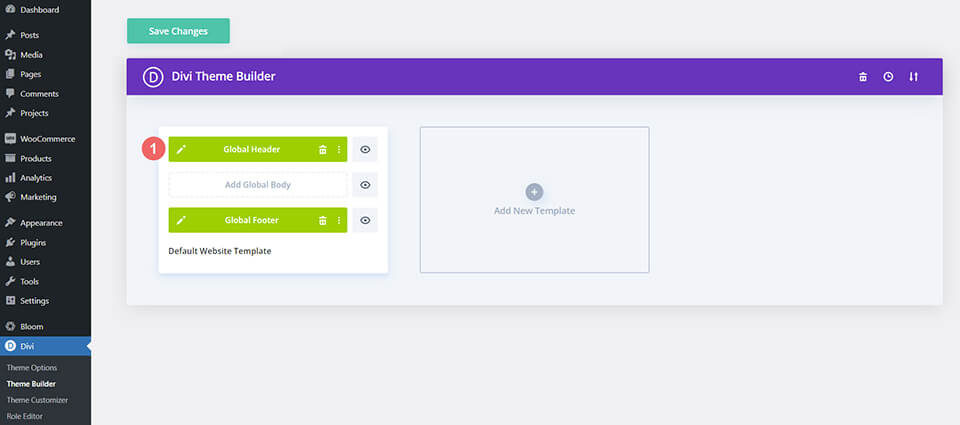
    Save Divi Theme Builder Changes

    Once you’ve uploaded the file, you’ll notice a new global header and footer in your default website template. Save the Divi Theme Builder changes as soon as you want the template to be activated.

    Save global header theme builder

    How to Modify The Template

    Open Jewelry Designer Layout Header Template

    To modify the global header template’s elements, start by opening the template.

    Editing the global header within the Divi Theme Builder

    Select Menu of Choice for Desktop, Tablet and Mobile

    Select a menu of your choice in the Menu Module.

    Selecting your menu for desktop

    We use two menu modules: one for desktop, and one for tablet/mobile. Ensure that the menus for both are the same as to not confuse your website users.

    Select your menu for use on tablet and mobile

    Update Logo with Menus

    You will need to upload your own logo into the Menu Modules within this header. Logos that are horizontal/landscape work best.

    Update header logo within the header Menu Module

    Update Text Call-to-Actions

    This header has three text areas that can be used as call-to-actions. Edit the text to match your brand. You can even go as far as to add links to them if you’d like, get creative!

    Update the text CTAs to match your brand and business goals

    Open Footer Template

    Continue by opening the global footer inside the default website template.

    Editing the footer template within the Divi Theme Builder

    Select Menu of Choice for Desktop, Tablet and Mobile

    Similar to the Header Template, you will need to add your menu to the footer menu.

    Select menu for footer menu module

    This will need to be done for both desktop and tablet/mobile view.

    Select menu for footer Menu Module for use in tablet and mobile

    Update Footer Menu Logo

    Just like the header’s Menu Module, you will need to update the logo included with our template with your own logo.

    Update footer Menu Module's logo

    Connect Your Email Marketing Solution

    Our footer has an Email Optin Module that needs to be activated. Connect your email marketing solution of choice to the module so that you can gather email addresses for your business.

    Connect your email marketing solution

    Update Static Footer Content

    You will need to go through and update the static content of the footer. This can include adding your own text, updating link URLs, and connecting your social media networks. Don’t forget about the copyright text at the bottom of the footer as well.

    Update static footer modules

    New Freebies Every Week!

    We hope you’ve enjoyed the Jewelry Designer Layout Pack and the Header & Footer freebie that goes along with it. We look forward to hearing your opinions in the comment section below. Make sure you check back next week for more freebies!

    The post Download a FREE Header & Footer for Divi’s Jewelry Designer Layout Pack appeared first on Elegant Themes Blog.

  • 15+ Best Free WordPress Plugins for Business Websites

    WordPress is undoubtedly impressive, but where it shines is as a content management system. For websites that have to go beyond being blog-centric, you may find that out-of-the-box WordPress is lacking. But, there’s no need to switch site builders. With the best free WordPress plugins for business websites, you can create a full-blown business website that caters to your customers exactly the way you need it to.

    What Are Free WordPress Plugins for Business Websites?

    Free WordPress plugins for business websites help you grow your website without spending more money than necessary. They cover various branches of business, from creating editorial calendars and talking in real-time with customers to making sure your website runs fast and is SEO-optimized. The purpose of business plugins is twofold. First, they automate some of your workload so you barely have to think about it. Second, they make it easier to carry out the work that still needs your focused attention.

    15+ Best Free WordPress Plugins for Business Websites

    There’s an almost endless amount of plugins for business websites, many free, some paid, and plenty with free versions that you can give a try before you upgrade for more features. In this article, we’ve rounded up the top free WordPress plugins for business websites so that you can upgrade your site without having to budget for it.

    1. Easy Appointments

    If booking and managing appointments is integral to your business, there’s no reason to rely on someone who has to answer the phone all day long. Instead, use a plugin so that visitors can book their appointments themselves at any time, even if your business is closed for the night.

    Key Features of Easy Appointments

    • Show your available time slots.
    • Send automated email confirmations and appointment reminders.
    • Set up booking for multiple locations, services and workers.

    Easy Appointments is for you if…

    • Your business relies on scheduled appointments.
    • You want to offer customers self-service for booking appointments.

    Easy Appointments Pricing: Free | Learn More About Easy Appointments

    Check out our best WordPress Booking Plugins for more free (and premium) options.

    2. Easy Digital Downloads

    Best Free WordPress Plugins for Business Websites

    If you’re only selling digital products, not physical ones, consider using Easy Digital Downloads (as opposed to WooCommerce, which we’ll talk about in a bit). This shopping cart plugin offers different options for customers to download files they’ve purchased. You can also create discount codes for products you’re trying to push.

    Key Features of Easy Digital Downloads

    • Create “Add To Cart” or “Buy Now” buttons.
    • Protect files so they can’t be shared after being purchased.
    • Process one-off payments or set up subscriptions.

    Easy Digital Downloads is for you if…

    • You’re only selling digital products, not physical ones.
    • You want to let customers sign up for a subscription.

    Easy Digital Downloads Pricing: Free with paid add-ons | Learn More About Easy Digital Downloads

    We also have more shopping cart plugins to check out.

    3. Editorial Calendar

    If your business website has a lot of content going up all the time, you need an editorial calendar to keep track of it all. This plugin lets you customize an overview of your publishing calendar, and it integrates with your WordPress dashboard so you can see it right when you log in.

    Key Features of Editorial Calendar

    • Reorganize posts with drag-and-drop functionality.
    • Quick-edit to update content and scheduling details.
    • Create multiple calendars to keep post types or topics separate.

    Editorial Calendar is for you if…

    • You have a lot of content across segmented topics to schedule.
    • You’ll benefit from quick access to the blog post tools you use a lot.

    Editorial Calendar Pricing: Free | Learn More About Editorial Calendar

    For more, check out these best editorial calendar plugins.

    4. Envira Gallery

    If your business website relies on a lot of images – maybe you run a photography studio or a retail shop – you’ll need a way to juggle all that media without sacrificing website performance. Envira Gallery lets you create galleries that are optimized for speed.

    Key Features of Envira Gallery

    • Responsive photo and video galleries.
    • Drag-and-drop photo gallery builder.
    • Add deep links, metadata and pagination to your galleries.

    Envira Gallery is for you if…

    • You have a media-forward business and need to showcase that on your site.
    • You want to share your media to social platforms.

    Envira Gallery Pricing: Free or Pro starting at $26 per year | Learn More About Envira Gallery

    We also suggest Soliloquy if you need to create image and video sliders – this plugin has pre-designed themes and templates, too.

    5. HubSpot

    Best Free WordPress Plugins for Business Websites

    HubSpot is a one-stop shop for a lot of the tools you need to run a business (and a business-oriented website) including a CMS like WordPress. You can manage your contacts, see how they’ve engaged with your company, connect via forms and live chat, monitor marketing performance – basically, you can do everything you need to stay in sync with your audience.

    Key Features of HubSpot

    • Must-have marketing tools, including email marketing, forms and live chat.
    • Forms and chat submissions auto-sync with the CRM so you can see details in the contact’s page.
    • Dashboards showcase marketing performance analytics.

    HubSpot is for you if…

    • You have a small business that you’re scaling.
    • You need a way to monitor traffic for your whole site or page by page.

    We’ve written an article on how to integrate HubSpot with WordPress.

    HubSpot Pricing: Free | Learn More About HubSpot

    6. myCred

    The myCred plugin is a points management system that lets you gamify your website. Gamification keeps visitor attention for longer and incentivizes certain actions. You create a points and rewards system for visitors, doling out digital prizes like badges and ranks – and also letting people use what they’ve earned toward real purchases.

    Key Features of myCred

    • Auto-deposit points on a preset schedule.
    • Points can be exchanged between members, which encourages engagement.
    • Website owner can add or deduct points from users.

    myCred is for you if…

    • You’re looking to increase the amount of time visitors spend on your site.
    • You want to encourage visitors to go to different pages or take specific actions.

    myCred Pricing: Free; membership starts at $149 per year | Learn More About myCred

    The myCred plugin is also listed as one of the best gamification plugins for WordPress.

    7. Print-O-Matic

    Best Free WordPress Plugins for Business Websites

    Some business websites have the need for print-friendly pages. For example, if you want customers to be able to print out directions for using your products or services, having a print-ready page is a must.

    Key Features of Print-O-Matic

    • Choose from five print icons.
    • Add custom text to printable pages.
    • Let users print an entire page or one HTML element.

    Print-O-Matic is for you if…

    • You want to offer visitors an easy way to print a page.
    • You have content that will be useful offline.

    Print-O-Matic Pricing: Free | Learn More About Print-O-Matic

    If Print-O-Matic doesn’t have the features you’re after, we have a few more options in this article.

    8. Quick and Easy FAQs

    Answering the same questions about your business over and over can eat up a lot of time. Creating a frequently-asked-questions page means that visitors can find answers to pressing questions themselves, leaving you free to handle more intensive troubleshooting.

    Key Features of Quick and Easy FAQs

    • Group FAQs by topic for better organization.
    • Edit backgrounds, border and text to create a customized FAQ page.
    • Choose from various styles to display the questions and answers.

    Quick and Easy FAQs is for you if…

    • You get a lot of the same questions over and over.
    • You have complex goods or services that require explainers.

    Quick and Easy FAQs Pricing: Free | Learn More About Quick and Easy FAQs

    9. Really Simple SSL

    Best Free WordPress Plugins for Business Websites

    Really Simple SSL is a super lightweight plugin that detects your website’s settings and configures it to be safer. (Learn more about HTTPS and SSL) Business websites that don’t have the basics of security covered won’t be trusted by visitors, and that can have a major impact on traffic and conversions.

    Key Features of Really Simple SSL

    • One-click solution.
    • Migrates your website to HTTPS.
    • Immediately redirects and updates all URLs to show that your site is secure.

    Really Simple SSL is for you if…

    • Have a website – all sites should have this basic protection.
    • You’re doing everything and anything to boost SEO.

    Really Simple SSL Pricing: Free or Pro starting at $29 | Learn More About Really Simple SSL

    These days you may not need a plugin at all. Learn more about how to get a free SSL certificate.

    10. RegistrationMagic

    Some business websites function as a business in themselves, allowing users to pay for VIP access to upgraded content and access. RegistrationMagic lets you onboard new members and decide which content they can see versus what non-members can see.

    Key Features of RegistrationMagic

    • Customize signup and registration forms.
    • Choose the payment methods you want to accept.
    • Block content from non-paying visitors.

    RegistrationMagic is for you if…

    • Your site has a members-only section for paying customers.
    • You want to ensure that non-members can’t access certain content.

    RegistrationMagic Pricing: Free | Learn More About RegistrationMagic

    We also like the WP-Members Membership Plugin if you’re looking for an alternative.

    11. SiteReviews

    Best Free WordPress Plugins for Business Websites

    If you have products or services that you want customers to review – or anything that you want reviews for, actually – consider installing this plugin. You have a lot of control over who can leave reviews, and when a new one comes through, you’ll get a notification. (We have a lot of other ratings and reviews plugins rounded up here, too.)

    Key Features of SiteReviews

    • Opt to require users to log in before leaving a review.
    • Prioritize reviews with high ratings.
    • Ban specific words, names, email addresses or IP addresses from leaving a review.

    SiteReviews is for you if…

    • You want control over who’s allowed to leave reviews.
    • You want a lot of choices when it comes to where reviews are displayed.

    SiteReviews Pricing: Free with paid add-ons | Learn More About SiteReviews

    12. WP Go Maps

    If you have a brick-and-mortar location (or several), integrating maps with your website is key for helping people get there. Markers show exact locations, and polygons give a broader view of the general area where your stores are located.

    Key Features of WP Go Maps

    • Choose from different themes or create your own.
    • Show different routes to your store.
    • Set map type (roadmap, satellite, terrain, hybrid).

    WP Go Maps is for you if…

    • You have one or more brick-and-mortar locations.
    • You want to show customers the areas where you deliver.

    WP Go Maps Pricing: Free; Pro starts at $39.99 | Learn More About WP Go Maps

    Check out these other Google Maps plugins, too.

    13. WooCommerce

    Best Free WordPress Plugins for Business Websites

    If you want to sell products online, WooCommerce is among the best (or the best) e-commerce platforms for WordPress sites. You have total control over how your store looks and functions, and you can sell pretty much anything you want, physical or digital, setting product variations as needed.

    Key Features of WooCommerce

    • Accept all major cards, cash on delivery and other payment methods.
    • Multiple shipping options, including shipping that’s calculated in real time and free shipping.
    • Add functionality with extensions and themes from the library.

    WooCommerce is for you if…

    • You need an e-commerce plugin that does it all.
    • You’ve never set up a shop before and will find the guided wizard useful.

    WooCommerce Pricing: Free | Learn More About WooCommerce

    You may also want to check out the Customer Reviews for WooCommerce plugin.

    14. WP Legal Pages

    To make your business website legit and legal, you need different types of text to protect your company – and to let visitors know how you’re protecting them, too. The WP Legal Pages plugin generates this text for you using your specific business information.

    Key Features of WP Legal Pages

    • Generate different policies, including a privacy policy, terms and conditions, affiliate disclaimers, etc.
    • Get geography-based copy that complies with local requirements.
    • Edit and update the pages however you need to.

    WP Legal Pages is for you if…

    • You have a business website, period – everybody needs this!
    • You run an e-commerce shop and need to clarify a returns-and-refunds policy.

    WP Legal Pages Pricing: Free or $39 per year for Pro | Learn More About WP Legal Pages

    15. Counter Number

    Best Free WordPress Plugins for Business Websites

    This plugin lets you add any counters to your website that you want, both serious and silly. Your visitors can see important stats about your business, like how many sales you’ve made, products you’ve created, clients you have, newsletter subscribers are signed up, cups of coffee you’ve consumed, etc. The fun stat(s) will communicate that you run a lighthearted and/or modern brand, but the real stats will instill a bit of FOMO and get potential customers to act.

    Key Features of Counter Number

    • Customize each entry’s icon, title and number.
    • Choose the font family and size, as well as colors.
    • Easy drag-and-drop builder.

    Counter Number is for you if…

    • Your stats are impressive enough to encourage visitors to take the next step.
    • You like to keep track of (and show off) your business’ successes.

    Counter Number Pricing: Free; Pro is $12 | Learn More About Counter Number

    Check out more fun and weird WordPress plugins here.

    Other Free Plugins and Tools for Business Websites

    There are a lot of other great free plugins out there for Business websites we’ve featured on our blog. Here are a some other important plugins and tools to check out:

    • Best SEO Plugins – Every business website needs a good SEO plugin. And there are some great free options that offer crucial SEO tools with their free versions including Rank Math and Yoast SEO.
    • Free SEO Tools – In addition to a good SEO plugin, businesses can take their SEO to the next level with some free options.
    • Testimonial Plugins – This list of testimonial plugins will give businesses a free option for showcasing testimonials in style.
    • Free WooCommerce Plugins – For WooCommerce stores, these free plugins give you additional WooCommerce features and functionality without the extra cost.
    • Lead Generation Platforms and Apps – Lead generation is crucial to any growing business. These options include free tools out of the box.

    Final Thoughts on the Best Free WordPress Plugins for Business Websites

    If you are just getting started, small businesses might benefit from a no-code solution by building a business website with Divi which has a lot of built-in features already. But for those looking to expand their existing business website with additional functionality, the free plugins covered in this article are a great start. Our best advice is to pick and choose the plugins you need based on what you’re missing, not what’s out there. You could end up adding bloat with plugins and features you don’t actually have a use for. WordPress can do a lot out of the box, so make sure you’re only installing plugins that will add to your experience or the user experience. And whenever possible, choose plugins that roll multiple features you want into one solution.

    Do you have a business plugin that you can’t live without? Tell us about it in the comments!

    The post 15+ Best Free WordPress Plugins for Business Websites appeared first on Elegant Themes Blog.

  • How to Use Bootstrap in WordPress: A Beginner’s Guide

    WordPress and Bootstrap are both popular platforms for web design that aren’t often considered as compatible. Bootstrap has grown to be a favorite CSS platform for developers because it makes it easy to build responsive websites. In fact, more than 70% of websites on the internet are designed with it. You can code anything you’d like into its responsive framework to create a unique website that’s mobile friendly, right out of the box. With more than half of all users accessing the internet via a mobile device, it’s crucial to have a responsive site.

    What if we told you that you can use Bootstrap and WordPress together? Well, you can. There are a few ways to use Bootstrap in WordPress, including WordPress Bootstrap plugins which can add Bootstraps blocks to the WordPress Editor. We’re going to cover all the ways to use Bootstrap in WordPress and show you how.

    What is Bootstrap?

    Bootstrap was created by two Twitter experts, Marc Otto and Jacob Thornton. With so many people accessing the internet by phone, they wanted to design a framework that would put mobile users first. Because of this, Bootstrap is widely popular with web developers. To accomplish mobile-first design, Bootstrap uses a grid system, or column structure, that adjusts page designs at certain breakpoints or screen resolution.

    WordPress Bootstrap

    Bootstrap is made up of HTML, CSS & Javascript. It’s a free and open source framework, which allows users to add in any HTML or Javascript component that they wish. In fact, there are many Bootstrap developers who create components and sell them in several marketplaces to assist beginners in developing their own websites. Like WordPress, Bootstrap is very popular and allows for some beautiful designs.

    The Advantages of Using Bootstrap

    In addition to being geared towards mobile devices, Bootstrap is fast. It is a CSS Framework which is different from a CMS. So there isn’t any bloat like you will find on some CMS’s to slow your site down. Another advantage is browser capability. It works right out of the gate with Chrome, Safari, Firefox, and others. There isn’t any need to use webkit CSS rules to make Bootstrap work — making it a excellent choice for cross-browser compatibility. Also, the framework is easy to use. Anyone who has knowledge of CSS and HTML can work with Bootstrap. Lastly, there is a large community surrounding Bootstrap. Users are quick to share knowledge about features, coding, or any other related issue a new developer may need help with.

    Ways to Use Bootstrap in WordPress

    There are a few options if you want to use Bootstrap in your WordPress site. You can install the script manually, but you’ll need to do most of the coding on your own to bring it to life. Secondly, you can use a pre-made Bootstrap theme for WordPress. There are several out there to choose from, but by choosing this option, you are stuck with your site looking exactly like the theme. There won’t be many options to make it look less cookie-cutter unless you code your own page templates to change things up. And, lastly, you can use a WordPress plugin to build your site using Boostrap.

    In recent years, WordPress developers have started releasing Bootstrap plugins that can be used within WordPress. These plugins are beginning to take hold, especially since the release of Gutenberg Blocks. By using a WordPress Bootstrap plugin, you can bring the best of both platforms together. Before we delve deeper into what you can do with these plugins, let’s expand a bit on the other option available to you to bring your Bootstrap project to life in WordPress.

    Installing Bootstrap Manually

    If you don’t want to use a plugin, you can always build your site with Boostrap manually. To do this, you’ll need to add a link reference to Bootstrap in the head of your WordPress site. You may need to add a code snippets plugin to do this depending on what theme you are running.

    A CDN link to Bootstrap’s external stylesheet in your site’s header will look something like this:

    <link href="https://cdn.jsdelivr.net/npm/bootstrap@5.1.3/dist/css/bootstrap.min.css" rel="stylesheet">
    

    Make sure to check Bootstrap’s website to ensure you are using the latest script so that you can benefit from the latest release available to you. Keep in mind that you can build your own WordPress theme that incorporates Bootstrap, but it will take quite a bit of work on your part. This would involve modifying core pages — index.php, wp-admin.php, and others. For this tutorial, we’re going to use a Bootstap plugin since it is a much easier approach for most.

    Using a Bootstrap WordPress Theme

    There are quite a few free Bootstrap WordPress themes available in the WordPress repository. Each one is fully responsive, and built completely using Bootstrap. Let’s take a look at some of the more popular choices.

    Shapely

    Shapely Bootstrap theme

    Shapely is the most popular Boostrap WordPress theme available. It’s a one page design that comes with Bootsrap fully integrated. There are several homepage widgets, and support for major WordPress plugins such as WooCommerce, Jetpack, Gravity Forms, Yoast SEO, and more. Thanks to the Boostrap integration, Shapely is 100% responsive.

    Illdy

    Illdy Bootstrap theme

    Illdy is a multi-purpose Bootstrap WordPress theme that utilizes a front-end visual editor. Like all Bootstrap based themes, Illdy is fully responsive. It’s suited for creative businesses because of it’s built-in portfolio functionality.

    Activello

    Activello Boostrap theme

    Activello features a full-screen slider on the homepage, which provides a stunning look when you first click on the page. It’s well-suited for bloggers and comes with support for most popular WordPress plugins. Additionally, Activello is compatible with Schema, which makes this theme very SEO friendly.

    Using a WordPress Bootstrap Plugin

    For the purpose of this tutorial, we’ll be using a plugin to build our Bootstrap page in WordPress. Both the plugins we’ll talk about enable the use of Bootstrap with Gutenberg blocks, but one offers an easier path than the other.

    Bootstrap Blocks

    bootstrap blocks plugin

    Bootstrap Blocks is a WordPress plugin that add Boostrap Gutenberg blocks to the WordPress editor. The plugin requires quite a bit of customization to fully integrate with WordPress. It doesn’t include the Bootstrap library into the plugin. If you want to have that functionality, you’ll need to manually add code to your functions.php file. This plugin is suited more for the WordPress developer with a good amount of programming knowledge. If you already have familiarity with how core WordPress files work, and have a good concept of Bootstrap, this might be the way to go. However, there’s one thing you should keep in mind about this plugin. You’ll only gain access to a few components — containers, rows, columns, and buttons. If you want a more robust option without a lot of hassle, you’ll likely want to consider a different approach.

    All Bootstrap Blocks

    all bootstrap blocks plugin

    The All Bootstrap Blocks plugin has some really nice features. Not only does it incorporate the Bootstrap framework into WordPress for you, it gives you 37 very cool blocks to use alongside Gutenberg blocks. You’ll get features like columns and rows — which are the foundation blocks of Bootstrap. Additionally, there are modals, accordions, content cards, icons, and so much more. It’s almost like having a fully functional theme just by installing a plugin. There is a bit of a learning curve to get things to look just right, especially if you are used to a drag and drop visual builder. However, if you’ve been coding by hand with divs and columns, this will be a breath of fresh air.

    How to Use Bootstrap in WordPress to Design a Page (Step by Step)

    For this tutorial, we’re going to build a page in WordPress using the Twenty Seventeen theme and All Boostrap Blocks. We’re going to model our page after the camera product page available with an Elegant Themes subscription.

    1. Modify the Twenty Seventeen Theme CSS for Bootstrap

    Now, if you know anything about Twenty Seventeen, you’ll see that by default, there is a big header image, followed by a two column layout. For our page layout, this simply won’t do. We’re going to need to make some changes in order to get our page to look like the camera product page.

    Twenty Seventeen Theme Layout

    The first thing we’ll need to do is remove the header image that comes standard on the theme. To do this, navigate to customizer in the black admin bar.

    Customize the WordPress Bootstrap site

    When the screen refreshes, click on the additional css section.

    boostrap Additional CSS

    Finally, add in the following css:

    /*Make page full width */
    @media screen and (min-width: 1200px) {
        .wrap {
            max-width:100%!important;
            padding:0;
        }
    }
    
    @media screen and (min-width: 1200px) {
    #primary .entry-content {
      width: 100% !important;
    		}
    }
    
    .site-content {
    	margin:0!important;
    	padding:0!important;
    }
    
    /* Hide Menu Bar */
    
    .site-branding {
        display:none;
    }
    
    /* Hide Page Title */
    .page .panel-content .entry-title, .page-title, body.page .entry-title {
        display:none;
    }
    
    /*Hide Site Footer */
        .site-footer {
            display: none;
        }
    }


    This will do a few things. First, it will make the width of the content fill the full width of the page. Secondly, it will remove any margin and padding on the page. Don’t worry, Bootstrap will control those. Additionally, it will remove the header and footer area of your site. Lastly, it will remove the page name from our soon-to-be masterpiece.

    Note: If you want to create footer for your page, you can omit the site-footer css rule above.

    Once you click publish, your page should look like this:

    Blank Page Template

    2. Install and Setup the Plugin

    Now that we have our theme’s page all ready to go, you’ll need to install the All Bootstrap Blocks plugin. Once installed and activated, there are quite a bit of customization options to choose from. You can adjust colors, typography, links, and a lot more. To get started, head over to Boostrap > Customize. You’ll find tabs for customizing your layout, content, creating forms, and components.

    Customizing WordPress Bootstrap Plugin

    3. Create a Page Layout With All Bootstrap Blocks

    To get started, create a new page. Once your page is created, start with a strip block for the first block on the page. This will create a section that adds a container, row, and column.

    Click on the + and click browse all. This will bring up a sidebar with the available modules.
    Under bootstrap layout, choose strip.

    Add Strip

    When the content is added, you’ll see that a container, row, and column are visible inside the strip. Next, you’ll choose a heading and set it to H4.

    Add a Heading

    Click the + to add another heading under the h4 tag. Set it to H1, then set the size to 7em.

    Set the H1 Tag

    Next, add a Bootstrap button by clicking the +. Type button in the search bar. Set the button’s text. Next, set the style to dark, the size to medium, and leave text wrap as default.

    Add a WordPress Bootstrap Button

    For the last item in the section, choose an image by clicking +. Add any image you like, but you can also right click on the Divi layout example and save the large camera image to use in your layout. Click upload to insert the image.

    Add an Image

    You’ll see that the image is directly underneath the button, but there’s not enough space between the two. To fix this, add a spacer. Click into the column underneath the image to bring up the +. Search for spacer. Add the spacer and give it 30px height. Next, click the up arrow to move it above the image.

    Add a Spacer

    4. Making Adjustments to the Container

    After saving the page, open it in a new tab. You’ll notice that we still need to set the background color for the section and give it a bit of padding to bump it down from the top of the page.

    Head back over to the back end and click inside the container. You can either do this by selecting the menu near the top of the page, or by clicking inside the container itself on the page builder. Next, slide the display background toggle on. Set the horizontal align to center, then set the color to #c6e8ff.

    Set the Background Color

    Next, set the container to container-fluid. This will make the container span the full width of the page.

    WordPress Bootstrap Fluid Container

    Finally, we’ll need to add some padding to the row. Click the dropdown menu on display. Set the padding to 50px top and bottom.

    Add Padding

    5. Create the Next Section

    Next, we’ll create a section with icons and text. To get started, add another strip beneath the first one by clicking the +. The next step is to insert an icon into the layout. Click the +, then type icon into the search bar.

    Insert an icon

    Select the icon module. Click the settings dropdown menu to reveal the icon choices. Choose dark as the style, then set the size to medium. Leave the default icon bi-activity as the icon selection.

    WordPress Bootstrap Icon Settings

    Under the icon settings, set the horizontal align to start. This will align the icon to the left to match the rest of the column.

    Icon Alignment

    Add an H4 and type your headline. Next, set the text alignment to left, color to dark, and leave the size at default. Finally, choose medium for the appearance.

    Icon Headline Settings

    Click + to add paragraph text. Set the alignment to left, color to dark, and leave the size at default. Use the text of your choice.

    Set the Icon Text

    Save the page and view it in a new tab. You’ll notice that there isn’t any spacing above the icon. To fix this, click into the row settings to add 50px padding to the top and bottom.

    WordPress Bootstrap padding

    Lastly, under settings XXL, set the horizontal align to center. This will center the content to the middle of the page in all screen sizes.

    Center Content

    The next step is to duplicate the columns. This is a big time saver. You’ll only need to swap out the icon and text. To do this, click the settings of the columns, then click duplicate. Repeat this step once more to have a total of three columns.

    Duplicate columns

    Now there are three columns that are centered in the page with a left alignment on the icon and text. Next, change the icon in the middle column. Click into the icon and choose bi-lightbulb-fill. For the icon in the third row, choose bi-zoom-in.

    Choosing a Different Icon

    Next, change the headlines in the second and third columns.

    Change Column Headings

    Duplicate the First Row

    Now the first row of icons is complete, duplicate the row to create the second row of icon boxes.

    Duplicate the Icon Box Row

    Repeat the steps above to change the headlines in all three columns, as well as the icons. For the icon in the first column, use bi-wind. The icon for the second column is bi-brightness-lo-fill, and the third icon to bi-person-fill. The last step of this row is to change the headlines.

    Second Row Icons

    6. Create the Last Section

    Start with adding a new strip. Under the settings, change the background color to #f0f0f0.

    Add the Last Strip

    In the container settings, set the width to container-fluid. Also, add 50px top and bottom padding to the row.

    Container Fluid

    Duplicate the single column to make one more column. Next, adjust the column width on each column to adjust for the size requirements of the layout. For the first column, make it a width of 5.

    Adjusting column widths

    For the second column, leave the column width as is. Next, add a H2 heading, followed by an H4 heading. Set both to align left.

    Add the Headings

    Add an image to the right column. Refer to our Divi layout to snag the image to import. Set the image to align to the center.

    Add the Image

    For the next step, insert two columns under the headings in the left column. Add the row module.

    Add the Row Module

    Duplicate the column within the newly created row.

    Duplicate the Columns

    Click into the first column on the left and set the size to 3.

    Set the Column Width

    Now that we have our column structure in place, we can add an icon. Choose the bi-arrows-fullscreen icon and set the size to large. Set the style to dark. Be sure to align the icon to the left by setting the horizontal align to start.

    Large Icon Settings

    For the right column, we’ll add a H4 heading, followed by a paragraph. Make sure to set the color to dark, then left align each. Add a spacer underneath the H4 heading and give it a height of 30px.

    Add the right column content

    Next, we’ll duplicate the interior row we created two times.

    Duplicate the Rows

    The final step is to change the icons in the second and third rows. For the first, choose the bi-card-image icon. The second icon will be bi-camera-fill.

    7. Optimize Page for Mobile Devices

    One of the best things about Bootstrap is the ability to make your design responsive with ease. The page is complete, but there are a few steps left to to make it ready for mobile devices. First, we’ll need to tell Bootstrap how many columns our sections should take up on smaller screens.

    The first strip is already set to one column, so we don’t need to worry about that one. For the second strip, there are a small adjustment to make.

    WordPress Bootstrap 2nd strip

    Scroll down to the settings (XS) section and set the columns to 1.

    XS Settings

    Next, switch over to XXL and set the columns to 3. This will tell Bootstrap to place all content in the row to display in one column on mobile, and three columns on larger screens.

    XXL Settings

    You can tweak the other screen sizes to your liking, but these settings will make your layout look good on both larger and smaller screens.

    Final Result

    Bootstrap responsive view

    What About Using Bootstrap with Divi?

    Divi by Elegant Themes

    While Bootstrap is a good option when working in generic WordPress themes, it’s generally not the best option if you plan to use Divi. With Divi, you have the ability to design fully responsive, beautiful websites without the need for any Bootstrap integration. Divi comes standard with more than 40 modules, which allows for endless design possibilities. Additionally, Divi includes more than 200 full website packs with over 2,000 pre-made website layouts available to you.

    If you plan to create your own look, Divi’s built-in Visual Builder makes it easy. You can see changes in real time as you design your site on the front end. You can create and customize your pages effortlessly using modules, then edit colors, text, add background effects, and more. Divi allows you to save and manage your designs, as well as set global elements and styles.

    WordPress Bootstrap Plugins Make it Easy to Use Bootstrap

    While WordPress isn’t made to work with Bootstrap natively, they do work well together with a little help. If you are the hands-on type, you can bring Bootstrap into your WordPress site by creating custom page templates, but you’ll need to do a lot of coding. That being said, with the plugins available in the WordPress repository, integrating the two is a less daunting task. With the All Bootstrap Blocks plugin, you can take an ordinary plain Jane theme and create a WordPress site without all the time needed to code things manually. If you are looking for an easy way to integrate Bootstrap with WordPress, you should definitely look into using a WordPress Bootstrap plugin.

    Have you incorporated Bootstrap into your WordPress builds? If so, sound off in the comment section below.

    The post How to Use Bootstrap in WordPress: A Beginner’s Guide appeared first on Elegant Themes Blog.

  • How to Style Your Fullwidth Header Module’s Background

    Divi’s Fullwidth Header module makes it easy to design a stunning hero section for your website in just minutes. A hero section is the very first section of your website that your visitors will see, so you’ll want it to be branded, informative, and compelling. Thankfully, the Divi Fullwidth Header comes packed with content options: header text, subtitle text, body text, two images, and two buttons. We’ll be utilizing all of these elements in our fullwidth headers today.

    In this post, we’re going to demonstrate 3 ways to design your fullwidth header’s background with eye-catching designs. Ready to get started? Let’s dive in!

    Design Preview

    Let’s take a look at the 3 fullwidth headers we’ll be designing today.

    Divi Bushcraft Community

    The first design uses Divi’s background image options to create a textured background that is unique and on-brand for the Bushcraft Community.

    Mrs. Nicole’s 2nd Grade

    This second design uses a background image and background gradient to create a clean, modern, and fresh welcome header for Mrs. Nicole’s 2nd-grade class.

    Realtor Header

    The third design utilizes a background image, background gradient, and background pattern, all combined to create an elevated yet subtle design for a realtor’s home page.

    Download the Layouts for FREE

    To lay your hands on the designs from this tutorial, you will first need to download it using the button below. To gain access to the download you will need to subscribe to our newsletter by using the form below. As a new subscriber, you will receive even more Divi goodness and a free Divi Layout pack every Monday! If you’re already on the list, simply enter your email address below and click download. You will not be “resubscribed” or receive extra emails.

    To import the header template to your Divi Library, do the following:

    1. Navigate to the Divi Theme Builder.
    2. Click the Import button at the top right of the page.
    3. In the portability popup, select the import tab
    4. Choose the download file from your computer (make sure to unzip the file first and use the JSON file).
    5. Then click the import button.

    Once done, the section layout will be available in the Divi Builder.

    Let’s get to the tutorial, shall we?

    What You Need to Get Started

    To get started, you will need to do the following:

    1. Install Divi on your WordPress website.
    2. Add a Page, give it a title, and publish it.
    3. Enable the Visual Builder.

    Setting Up Our Page

    Once you click the “Use Divi Builder” button the page will reload using Divi’s drag and drop builder interface. Three options will pop up and for today’s purposes select “Build From Scratch” so that we have a blank slate where we can build our fullwidth headers.

    How to Design the Divi Bushcraft Community Fullwidth Header

    Add a Fulldwith Section and Fullwidth Header

    First, we’ll need to add a fullwidth section to our page. Click on the “+” icon to bring up the section options and then click “Fullwidth”. This will load the fullwidth module library where you can select “Fullwidth Header” from the options. This will load the fullwidth header module to your page.

    Add The Content

    Now we’re going to add our module content in the Text tab. Configure the following settings:

    1. Header Text: Divi Bushcraft Community
    2. Subtitle Text: Divi Bushcraft
    3. Button #1: Join Today
    4. Button #2: Learn More
    5. Body Text: At vero eos et accusamus et iusto odio dignissimos ducimus qui blanditiis praesentium voluptatum deleniti atque corrupti quos dolores et quas molestias excepturi sint occaecati cupiditate non provident.

    Style the Background

    This design utilizes a background image from the free Divi Bushcraft pre-made layout pack. You can get all of the images from that layout pack in this post. Simply scroll all the way to the bottom of the post and click to download the high-res images.

    Add Background Image

    Once you have the photos, add a background image.

    1. Click the third icon, the image icon.
    2. Click “Add Background Image”. This will bring up the media library where you can upload a new photo or select a photo from your media library.
    3. The set the Background Image Blend Mode to Overlay.
    4. Click the first icon, the paint bucket icon, and set a background color of: rgba(10,10,10,0.3)

    Choose the Layout

    Underneath the Design settings, in the Layout tab, select center alignment. Toggle the “Make Fullscreen” option to “yes”.

    Style Title Text

    Style the Title Text by configuring these settings:

    1. Title Heading Level: H1
    2. Title Font: Josefin Sans
    3. Title Font Weight: Bold
    4. Title Font Style: Uppercase
    5. Title Text Size: 7rem

    Style Body Text

    Style the body text by configuring these settings:

    1. Body Font: Josefin Sans
    2. Body Text Size: 20px

    Style Subtitle Text

    Style the subtitle text by configuring these settings:

    1. Subtitle Font: Josefin Sans
    2. Subtitle Font Weight: Semi Bold
    3. Subtitle Font Style: Uppercase
    4. Subtitle Letter Spacing: 3px
    5. Subtitle Line Height: 5em

    Style Button #1

    Now let’s style the buttons! For button one, configure these settings:

    1. Use Custom Styles For Button One: Yes
    2. Button One Text Size: 14px
    3. Button One Text Color: #666b4a
    4. Button One Background: #ead5a4
    5. Button One Border Width: 0px
    6. Button One Border Radius: 0px
    7. Button One Letter Spacing: 3px
    8. Button One Font Style: Uppercase
    9. Button One Padding: 15px top and bottom; 25px left and right.

    Style Button #2

    To style button #2, configure the following settings:

    1. Use Custom Styles For Button One: Yes
    2. Button One Text Size: 14px
    3. Button One Text Color: #ead5a4
    4. Button One Background: #666b4a
    5. Button One Border Width: 0px
    6. Button One Border Radius: 0px
    7. Button One Letter Spacing: 3px
    8. Button One Font Style: Uppercase
    9. Button One Padding: 15px top and bottom; 25px left and right.

    And, voila!  You have a beautifully styled fullwidth header with a textured background image with an overlay for the Divi Bushcraft Community.

    How to Design Mrs. Nicole’s Fullwidth Header

    Now let’s design a fullwidth header for Mrs. Nicole’s 2nd-grade class! This header uses a background image and gradient to create a fun and fresh design. Let’s get started!

    Add a new page, then add a Fullwidth Section and Fullwidth Header

    First, we’ll need to add a fullwidth section to our page. Click on the “+” icon to bring up the section options and then click “Fullwidth”. This will load the fullwidth module library where you can select “Fullwidth Header” from the options. This will load the fullwidth header module to your page.

    Add The Content

    Now we’re going to add our module content in the Text tab. Configure the following settings:

    1. Header Text: Welcome To Mrs. Nicole’s 2nd Grade Class
    2. Subtitle Text: Welcome
    3. Button #1: View Assignments
    4. Button #2: Contact Mrs. Nicole
    5. Body Text: Donec sollicitudin molestie malesuada. Nulla quis lorem ut libero malesuada feugiat.

    Style the Background

    This design uses images from the free Classroom pre-made layout pack. You can download the full-res images by scrolling to the bottom of this post.

    Style the background by configuring these settings:

    1. Click the second tab, the gradient icon.
    2. Set the gradient stops to: #ffffff at 40%, and transparent at 18%.
    3. Set the gradient direction to 219 degrees.
    4. Toggle “yes” for the Place Gradient Above Background Image.
    5. Click on the third icon, the image icon, and click “Add Background Image”.

    Choose the Layout

    Here is where we’re going to align the module content to the center and make it fullscreen.

    1. Text & Logo Alignment: Center
    2. Make Fullscreen: Yes

    Style the Title Text

    Style the title text by configuring these settings:

    1. Title Font: Candal
    2. Title Text Size: 4rem

    Style the Body Text

    Style the body text by configuring these settings:

    1. Body Font: Montserrat
    2. Body Text Color: #6d6d6d
    3. Body Text Size: 20px

    Style the Subtitle Text

    Style the subtitle text by configuring these settings:

    1. Subtitle Font Weight: Ultra Bold
    2. Subtitle font Style: Uppercase
    3. Subtitle Text Color: rgba(28,10,10,0.6)
    4. Subtitle Letter Spacing: 3px
    5. Subtitle Line Height: 3em

    Style Button #1

    Style button #1 by configuring these settings:

    1. Use Custom Styles For Button One: Yes
    2. Button One Text Size: 15px
    3. Button One Text Color: #ffffff
    4. Button One Background: #000000
    5. Button One Border Width: 0px
    6. Button One Border Radius: 0px
    7. Button One Letter Spacing: 3px
    8. Button One Font Weight: Ultra Bold
    9. Button One Font Style: Uppercase
    10. Button One Padding: 15px top and bottom; 25px left and right.

    Style Button #2

    Style button #2 by configuring these settings:

    1. Use Custom Styles For Button Two: Yes
    2. Button Two Text Size: 15px
    3. Button Two Text Color: #ffd078
    4. Button Two Background: transparent
    5. Button Two Border Width: 0px
    6. Button Two Border Radius: 0px
    7. Button Two Letter Spacing: 3px
    8. Button Two Font Weight: Ultra Bold
    9. Button Two Font Style: Uppercase
    10. Button Two Icon Color: #ffd078
    11. Only Show Icon On Hover For Button Two: No
    12. Button Two Padding: 15px top and bottom; 25px left and right.

    Sizing

    Set the content width to 70%.

    Voila! You now have a fully designed fullwidth header for Mrs. Nicole’s 2nd grade class.

    How to Design a Realtor’s Fullwidth Header

    Let’s design this elegant and modern fullwidth header for a realtor’s website. This section utilizes a background image, background gradient, AND a background pattern. Let’s get to work!

    Add a new page, then add a Fullwidth Section and Fullwidth Header

    First, we’ll need to add a fullwidth section to our page. Click on the “+” icon to bring up the section options and then click “Fullwidth”. This will load the fullwidth module library where you can select “Fullwidth Header” from the options. This will load the fullwidth header module to your page.

    Add Content

    First, let’s add the content needed for this module in the Text tab:

    1. Title: Let’s Find Your Dream Home
    2. Subtitle: Dave Merrit – Realtor
    3. Button #1 – Book A Free Consult
    4. Button #2 – Email Me
    5. Body Text: Sed ut perspiciatis unde omnis iste natus error sit voluptatem accusantium doloremque laudantium, totam rem aperiam, eaque ipsa quae ab illo inventore veritatis et quasi architecto.

    Style the Background

    Add a Gradient

    In the background tab, click the second icon, the gradient icon, and configure these settings:

    1. Gradient Stops: rgba(56,65,58,0.74) at 100% and #38413a at 70%
    2. Gradient Direction: 88deg
    3. Place Gradient Above Background Image: Yes

    Add Image

    Click the third icon, the image icon, and then click “Add Background Image” to upload your image. This demonstration uses images from the free Realtor pre-made layout pack. You can download the full-resolution images by scrolling to the bottom of this post.

    Add a Background Pattern

    Add a background pattern by configuring these settings:

    1. Select Tufted from the dropdown.
    2. Pattern Color: rgba(0,0,0,0.2)

    Choose the Layout

    Here is where we’re going to align the module content to the center and make it fullscreen.

    1. Text & Logo Alignment: Center
    2. Make Fullscreen: Yes

    Style the Title Text

    Style the title text by configuring these settings:

    1. Title Font: Merriweather
    2. title Text Size: 5rem

    Style the Body Text

    Style the body text by configuring these settings:

    1. Body Font: Open Sans
    2. Body Text Size: 16px
    3. Body Line Height: 2em

    Style the Subtitle Text

    Style the subtitle text by configuring these settings:

    1. Subtitle Font: Open Sans
    2. Subtitle Font Weight: Bold
    3. Subtitle Font Style: Uppercase
    4. Subtitle Text Color: #b4926b
    5. Subtitle Letter Spacing: 3px

    Style Button #1

    Style button #1 by configuring these settings:

    1. Use Custom Styles For Button One: Yes
    2. Button One Text Size: 18px
    3. Button One Background: #b4926b
    4. Button One Border Width: 0px
    5. Button One Border Radius: 0px
    6. Button One Padding: 10px top and bottom; 25px left and right.

    Style Button #2

    Style button #2 by configuring these settings:

    1. Use Custom Styles For Button Two: Yes
    2. Button Two Text Size: 18px
    3. Button Two Border Width: 1px
    4. Button Two Border Color: rgba(255,255,255,0.19)
    5. Button Two Border Radius: 0x
    6. Button Two Padding: 10px top and bottom; 25px left and right

    Voila! Now you have a beautiful fullwidth header for a realtor website.

    Final Thoughts

    The Divi Fullwidth Header is a fast and easy way to build a stunning website hero section for your website. Since website hero sections are so essential in making a great first impression, it’s important that your design is branded, eye-catching, and informative. With the Fullwidth Header, it’s easy to build a header that hits all of those goals within one module. Now that you’ve seen what’s possible with the Fullwidth Header, how will you design yours?

    The post How to Style Your Fullwidth Header Module’s Background appeared first on Elegant Themes Blog.

  • Get a Free Whiskey Distillery Layout Pack for Divi

    Hey Divi Nation! Thanks for joining us for the next installment of our weekly Divi Design Initiative; where each week, we give away a brand new Layout Pack for Divi.

    This time around, the design team has created a beautiful Whiskey Distillery Layout Pack that’ll help you get your next Whiskey Distillery website up and running in no time!

    This layout pack includes:

    8 Premade page layouts strategically designed for any Whiskey Distillery website (including a footer design)
    – Original, royalty-free photos and graphics + customizable source file (see below)
    – Plus, a large collection of pre-designed website elements that are customizable and reusable anywhere.

    This layout pack is available right inside Divi for all Divi customers for FREE as the latest addition to our growing Divi library of hundreds of premade layout packs, thousands of page designs, and countless web design elements and resources.

    divi layout

    Check Out The Divi Whiskey Distillery
    Layout Pack Below

    Get it for free today!

    Landing Page Design

    Whiskey Distillery Layout Pack for Divi

    View The Live Layout Demo

    Home Page Design

    Whiskey Distillery Layout Pack for Divi

    View The Live Layout Demo

    Shop Page Design

    Whiskey Distillery Layout Pack for Divi

    View The Live Layout Demo

    Product Page Design

    Whiskey Distillery Layout Pack for Divi

    View The Live Layout Demo

    About Page Design

    Whiskey Distillery Layout Pack for Divi

    View The Live Layout Demo

    Visit Page Design

    Whiskey Distillery Layout Pack for Divi

    View The Live Layout Demo

    Blog Page Design

    Whiskey Distillery Layout Pack for Divi

    View The Live Layout Demo

    Contact Page Design

    Whiskey Distillery Layout Pack for Divi

    View The Live Layout Demo

    Key Features

    If you’re looking to get a new Whiskey Distillery website, you don’t want to miss out on the Whiskey Distillery Layout Pack for Divi! Each page layout is built to impress your visitors with world-class web design. And it has everything you need to promote Whiskey Distillery services, and much more. Use it to get your next Whiskey Distillery website up and running today!

    Live Demos

    Click the links below to see a live demo for each of the layouts included in the pack.

    1. Whiskey Distillery Landing Page (live demo)
    2. Whiskey Distillery Homepage (live demo)
    3. Whiskey Distillery Shop Page (live demo)
    4. Whiskey Distillery Product Page (live demo)
    5. Whiskey Distillery About Page (live demo)
    6. Whiskey Distillery Visit Page (live demo)
    7. Whiskey Distillery Blog Page (live demo)
    8. Whiskey Distillery Contact Page (live demo)

    Access This Layout Right Now
    Directly from Your Divi Builder

    Since Version 3.0.99 of Divi, you can find and import any of the layouts included in this pack (along with ALL of Divi’s Premade Layout packs) directly from the Divi Builder. They are already waiting for you.

    To access your new layout, simply activate the Visual Builder when editing a page and look for the “Load From Library” icon in the page settings bar (it looks like a plus symbol). Click this icon to launch the Load From Library popup. Under the Premade Layouts tab, you can easily find the new layout by scrolling through the list of layout packs. Once you find the Whiskey Distillery Layout Pack, click on it. You will see all the individual layouts included in the pack. Select the layout you want to use and then click the “Use This Layout” button.

    Whiskey Distillery Layout Pack for Divi

    For more, check out this video to learn how you can get this layout pack up and running today.

    Subscribe To Our Youtube Channel

    Authentication Required

    Before you can download Premade Layouts from the Divi Library you must authenticate your Elegant Themes Subscription. You can do this by navigating to Divi > Theme Options > Updates. There you can enter your username and API key and save changes.

    Whiskey Distillery Layout Pack for Divi

    You can find your API Key under your members area on the Elegant Themes site. After you enter the Username and API Key, you will gain immediate access to our library of hundreds of free layouts (including this one). If you haven’t done this, when you click to import a layout to your page, you will be prompted to enter your Elegant Themes Membership Username and API Key.

    Use Layout Images for FREE with No Licensing Restrictions

    Whiskey Distillery Layout Pack for Divi

    The image assets included with these layouts (icons, illustrations, photos, etc.) have no licensing restrictions. This means you can use them in all of your commercial projects without having to worry about paying licensing fees or attributing the photographer. Use them in your commercial websites, sell them within your Divi child themes, include them in your own Divi layout packs or just use them on your blog. We know how challenging it can be to find good photos and how confusing and scary the licensing that governs those photos can be. We want to fix that problem for our users.

    Download the Full Res Image Assets

    New Layout Pack Every Week!

    We hope you enjoy this layout pack. We look forward to hearing your opinions in the comment section below. Make sure you check out next week’s layout pack as well!

    The post Get a Free Whiskey Distillery Layout Pack for Divi appeared first on Elegant Themes Blog.

  • How to Use a Dynamic Logo in Divi’s Fullwidth Menu Module

    Changing website logos can be a time-consuming process. This is especially true if the website uses different headers for different templates. If you use an image for each one of those headers, you’ll have to manually get in there and change each one of them. Fortunately, Divi can display your website’s logo dynamically, saving you time! In this post, we’ll see how to use a dynamic logo inside Divi’s Fullwidth Menu Module.

    Let’s get started!

    Why Use a Dynamic Logo?

    The dynamic logo option lets Divi users change their website logos in a single location. That change is then reflected in every module that uses the dynamic logo. This simplifies the process.

    It’s especially helpful in headers, and even more helpful when there are several menu modules in use since it reduces the time it takes to make the changes. It also keeps the Divi user from making a mistake by forgetting to change one of the headers.

    Why would Divi users need more than one menu module? The Divi Theme Builder allows Divi users to create multiple headers to use on various pages across their websites. This opens up lots of design possibilities for headers across the Divi website.

    It’s not uncommon to have a header for the homepage, one for the blog, one for a services page, one for a CTA landing page, and lots more. It’s also not uncommon for these headers to use the same logo. This would require the Divi user to open every header template and change the logo in every menu module. Even using the copy and paste features requires the Divi user to open each template.

    Theme Builder Example

    In my example below, I’ve built 10 custom headers and assigned them to various pages on my website. Each header has a custom design, with different colors, CTAs, and layouts, but they all use the same logo. If I want to change the logo for my website, and I wasn’t using a dynamic logo, I’d have to open each Divi Fullwidth Menu Module and make the change manually.

    Theme Builder Example

    If I had the dynamic logo option set up in each module, the logo would change in every module automatically. Let’s see how to select the logo dynamically.

    How to Use a Dynamic Logo in the Fullwidth Menu Module

    To get started, open the Fullwidth Menu Module that you want to use a dynamic logo. I’m adjusting the header template in the Divi Theme Builder. For this example, I’ll assume you have a Fullwidth Menu Module already set up with a logo selected.

    Open the Divi Theme Builder

    To use a dynamic logo, go to Divi > Theme Builder in the WordPress dashboard.

    • Divi
    • Theme Builder

    Open the Divi Theme Builder

    Select the edit icon for the header you want to modify. Wait for the editor to open.

    • Edit

    Open the Divi Theme Builder

    Change the Logo to Dynamic Content

    Next, open the settings for the Fullwidth Menu Module by selecting its gear icon.

    • Fullwidth Menu Module settings

    Change the Logo to Dynamic Content

    In the Content tab, scroll down to the section called Logo. Hover over the logo image and click the trash can icon. You can also click the circular reset icon if you prefer.

    • Trash can

    Change the Logo to Dynamic Content

    Next, hover over the image area to reveal the Dynamic Content icon. Click the icon to open the Dynamic Content choices.

    • Dynamic Content

    Change the Logo to Dynamic Content

    A modal opens with lots of options to choose from. Select Site Logo in the top section.

    • Site Logo

    Change the Logo to Dynamic Content

    You’ll see the new logo appear in your header’s menu that’s specified in the Divi Theme Options (more on that in a minute). Under the logo in the Logo selection settings, you’ll see the message “Site Logo”. This indicates that the module is now displaying the dynamic logo. Click the green button to close the module.

    • Close

    Change the Logo to Dynamic Content

    Next, save the layout by clicking the green Save button in the lower right corner and clicking the X in the upper right corner to close the editor.

    • Save
    • Exit

    Change the Logo to Dynamic Content

    Finally, click Save Changes in the upper left corner of the Theme Builder screen.

    • Save Changes

    Change the Logo to Dynamic Content

    The new logo automatically changes on the front end for every Fullwidth Menu Module that you’ve set up to use a dynamic logo. We don’t have to change it on this page because it’s pulling the logo dynamically. For more information about using dynamic content with Divi, search the Elegant Themes blog for “dynamic content“.  

    Perform this set of steps for every Fullwidth Menu Module you want to use the dynamic logo. We recommend performing this task as you copy or create the headers.

    Now, let’s see how to edit the Divi logo so that it changes in the Fullwidth Menu Module.

    How to Change the Logo in Divi

    Next, let’s see how to tell Divi which logo to use. Every time you want to change the logo, perform the following set of steps. The logo changes dynamically, so Divi users never need to open the Fullwidth Menu Module to change the logo.

    Divi Logo Before

    To help understand what’s happening, let’s look at the logo on the front end of the site before and after the change. First, here’s a look at the current logo on my test site. This is set up in the Divi Theme Options.

    Divi Logo Before

    Change the Divi Logo

    To change the Divi logo, go to Divi > Theme Options in the WordPress dashboard. The first tab, General, has a field called Logo. It includes a field with the logo’s URL, a button to reset the logo to the default, and a button to upload a logo to the Media Library. I currently have a logo set, which is the logo seen in the Before image above. Upload or select the image you want to use. Select the Upload button.

    • Divi
    • Theme Options
    • 1st General tab
    • 2nd General tab
    • Upload

    Change the Divi Logo

    This opens the media folder where you can choose an image from the Media Library or upload a new image. Choose your logo and click Set As Logo in the lower right corner of the Media Library screen.

    • Select image
    • Set As Logo

    Change the Divi Logo

    Click Save Changes in the upper left corner of the screen above the Divi Theme Options. Now, every template that includes the Fullwidth Menu Module with the dynamic logo setting has automatically changed the logo to show your new logo.

    • Save Changes

    Change the Divi Logo

    Divi Logo After

    The front end of my site now shows the new logo, even though I didn’t open the Theme Builder and make changes there. This change was automatically reflected in every Fullwidth Menu Module that uses the dynamic logo.

    Divi Logo After

    As another example, when we open any of the templates in the Theme Builder, we’ll see the new logo. This example shows the Homepage Header Layout with the logo already updated with no further input from me.

    Divi Logo After

    Ending Thoughts

    That’s our look at how to use a dynamic logo in Divi’s Fullwidth Menu Module. The dynamic logo is easy to set up in the module. Using a dynamic logo can save a lot of time when changing the logo on a Divi website. Even if you only use one Fullwidth Menu Module, the dynamic logo simplifies the process. When using multiple modules, dynamic logos make an even larger impact on time savings and reduce mistakes.

    We want to hear from you. Do you use dynamic logos with your Fullwidth Menu Module? Let us know in the comments.

    The post How to Use a Dynamic Logo in Divi’s Fullwidth Menu Module appeared first on Elegant Themes Blog.

  • 5 Best IDX Plugins for WordPress in 2023

    If you’re in the real estate business, you’re probably familiar with Multiple Listing Service (MLS) portals and Internet Data Exchange (IDX) software. Furthermore, if you have a real estate website built on WordPress, being able to pull listings using IDX software will make your work a lot easier.

    In this article, we will talk about what IDX software is. Then we’ll introduce you to the best IDX plugins for WordPress and discuss their key features, pricing, and who should consider using them. Let’s get to it!

    What Are IDX Plugins?

    To understand what IDX plugins are, we need to talk about the software itself. IDX is software that enables users to look through real estate listings in a specific area. The software pulls those listings from MLS platforms.

    IDX homepage

    In turn, MLS platforms are local portals where realtors can share information about their listings. Realtors must keep that information up to date, making MLS listings much more comprehensive than what you might find on platforms such as Zillow or Redfin.

    However, MLS portals are for realtors only. IDX software enables you to pull information about listings from those portals and display it on your website. In other words, you can use IDX to start your own listing site.

    IDX plugins for WordPress allow you to display listings from MLS portals and manage them directly within WordPress. IDX plugins are similar to other popular real estate plugins for WordPress. However, this family of plugins focuses solely on IDX integration.

    5 Best IDX Plugins for WordPress

    In this section, we’re going to look at some of the best IDX plugins for WordPress that will allow IDX integration for your real estate website.

    1. Realtyna WPL

    Realtyna Organic IDX

    Realtyna WPL is developed by Realtyna and is one of the most popular and powerful real estate plugins for WordPress. With this tool, you get to use a listings system on your website and the ability to upload new properties manually. And the free version comes with many powerful features to add and customize listings to build a real estate website.

    Realtyna WPL can pull information that includes listing features, appliances, address maps, neighborhood details, images, videos, and more.

    If you pay for their pro version and their Organic MLS Integration add-on, you’ll be able to host all the MLS/IDX data on your own server. This is great for real estate agents or agencies that want an independent solution with complete ownership of MLS data on their websites. This type of control is also great for Search Engine Optimization (SEO).

    Divi Integration

    The plugin integrates with the Divi Builder making it easy to add listings using custom Divi Modules.

    realtyna wpl divi integration

    For more, check out how to add real estate listings with Divi.

    Key Features for WPL Real Estate:

    • Supports organic MLS/IDX integration for WordPress
    • Pull data from the MLS provider of your choice
    • Tons of add-ons for more flexibility
    • Publish imported listings or pull them organically
    • A property/listing management system within WordPress

    Adding IDX properties using Realtyna

    After importing properties using IDX, you can edit their information with the WPL property manager. This manager enables you to add any missing information and edit property descriptions using a simple interface.

    Realtyna WPL is for you if…

    • You want more control and ownership of property listings on your site.
    • You want Divi integration and custom modules to add and customize listings on your site.
    • You want to be able to customize the listings that you import using IDX
    • You want options for organic MLS/IDX integration
    • You are a real estate agent or agency that wants an independent listing website.

    Pricing: IDX integration is available with WPL Pro, starting at $199 | Learn More About WPL Real Estate

    2. Showcase IDX

    Showcase IDX

    Showcase IDX is a comprehensive solution for publishing listings, importing MLS data, and developing client relationships. On top of enabling you to use IDX, the plugin also doubles as a Customer Relationship Management (CRM) solution.

    With Showcase IDX, you can enable user registration (that supports social login) and encourage it using pop-ups. The plugin lets you keep track of what properties each user is looking at, and configure follow-up messages to encourage them to keep searching.

    Although Showcase IDX integrates with most real estate themes, the plugin enables you to configure the style of your listings and search using internal settings. Plus, its listings are responsive right out of the box.

    Key Features for Showcase IDX:

    • Set up a listings solution for your website
    • Import MLS listings
    • Enable and encourage user registration
    • Monitor user searches and configure follow-up messages
    • Configure the style of your listings

    Importing MLS properties using Showcase IDX

    When you import a batch of MLS properties, Showcase IDX enables you to create custom shortcodes to display them on your website. You get to configure unique styles for each batch of properties.

    Showcase IDX is for you if…

    • You want an all-in-one real estate and IDX solution
    • You want to get access to built-in CRM tools

    Pricing: There’s a free version of this plugin, while Showcase IDX plans start at $59.95 per month | Learn More About Showcase IDX

    3. Estatik Real Estate

    Estatik Real Estate

    Estatik Real Estate is a plugin that adds a listing system to WordPress. With this plugin, you can create listings manually, including a broad range of information about each property.

    Listings that you create can use over 50 unique shortcodes, and they can include image slideshows. That’s all available with the free version of the plugin. However, if you want IDX integration for Estatik, you’ll need to pay for a premium license.

    Key Features for Estatik Real Estate:

    • Add a property listings system to WordPress
    • Use shortcodes to customize the style of your listings
    • Include image slideshows alongside listings
    • Import MLS listings with the premium version of the plugin
    • A powerful fields builder for organizing your listings
    • 4+ Themes to jumpstart your listings website
    • Multi-lingual support

    Estatik property manager

    The Estatik property editor is fairly intuitive, and it integrates with the WordPress Classic Editor. You can also use the editor to update the information for any properties that you import using IDX.

    Estatik Real Estate is for you if…

    • You want a full-featured listing solution that includes IDX integration from multiple MLS providers
    • You want access to premade themes
    • You are a real estate agency that doesn’t want to spend extra money on web design

    Pricing: The Estatik Real Estate premium pack supports MLS/IDX imports for $489 | Learn More About Estatik Real Estate

    4. MLS Import

    MLS Import

    MLS Import integrates with the most popular real estate themes for WordPress. This plugin enables you to connect with an MLS platform and run batch imports for properties that fit the criteria you want.

    One standout aspect of this plugin is that it syncs properties automatically, and you can configure it to import new properties periodically. MLS Import also offers a custom Content Delivery Network (CDN) for serving images, which means that you save on server space.

    Key Features for MLS Import:

    • Connect to your MLS platform of choice
    • Import properties in batches and sync their information
    • Configure the plugin to import new property data periodically

    Configuring the MLS Import plugin

    MLS Import can pull data for large numbers of properties in a single batch as long as your server can handle it. If you’re using a not-so-capable hosting plan, we recommend importing properties in smaller batches.

    MLS Import is for you if…

    • You want to use a dedicated IDX plugin and not an extension to another tool
    • You don’t mind paying for a monthly or yearly license

    Pricing: MLS Import plans start at $49 per month | Learn More About MLS Import

    5. SimplyRETS

    SimplyRETS logo

    SimplyRETS is a powerful real estate platform that provides property listings, MLS data access, and other real estate information. The platform is designed to make the process of accessing real estate information easier, faster, and more efficient, giving real estate professionals a one-stop solution for all their data needs.

    In fact, it takes about five minutes to have an IDX search integration with your MLS set up. The plugin allows for the display of your real estate listings with a scalable catalog that adjusts to the device being used.

    Key Features for SimplyRETS:

    • Access to MLS data and property listings
    • Easy-to-use API and data access tools
    • Flexible and scalable pricing options

    SimplyRETS

    With SimplyRETS, you can access MLS data and property listings from multiple sources, making it easier to find the information you need. The search options for your users include filters so they can quickly find properties that meet their criteria. Plus, the interface is customizable to match the theme of your website.

    SimplyRETS is for you if…

    • You’re a real estate professional looking for a one-stop solution for your data needs
    • You need easy access to MLS data and property listings
    • You’re looking for a cost-effective and flexible solution

    Pricing: SimplyRETS plans start at $49 per month | Learn More About SimplyRETS

    Final Thoughts on IDX Plugins for WordPress

    There are a lot of amazing real estate plugins for WordPress. However, not all of them offer IDX support. Without this feature, you won’t be able to import MLS listings into your website, and you’ll need to add properties to it manually. If you have access to an MLS portal, not using an IDX plugin, it’s a missed opportunity.

    If you’re looking for real estate plugins that offer IDX support, here are our top two picks:

    1. Realtyna WPL: This is one of the most popular real estate plugins for WordPress and Divi, and its premium version offers IDX support.
    2. Showcase IDX: This IDX plugin also offers CRM functionality, and it can help you follow up with buyer leads.

    Do you have any questions about IDX plugins for WordPress? Let’s talk about them in the comments section below!

    The post 5 Best IDX Plugins for WordPress in 2023 appeared first on Elegant Themes Blog.

  • Download a FREE Category Page Template for Divi’s Home Baker Layout Pack

    Hey Divi Nation! Thanks for joining us for the next installment of our weekly Divi Design Initiative where each week, we give away brand new freebies. This time around we’re building upon the Home Baker Layout Pack with a brand new Category Page Template that matches the rest of the pack perfectly. Hope you enjoy it!

    divi layout

    Check Out The Home Baker
    Category Page Template Below

    Get it for free today!

    Desktop View

    Category Page Template for Divi's Home Baker Layout Pack Desktop View

    Tablet and Mobile View

    Category Page Template for Divi's Home Baker Layout Pack Tablet and Mobile View

    Download The Category Page Template For The Home Baker Layout Pack

    To lay your hands on the free Home Baker Category Page Template, you will first need to download it using the button below. To gain access to the download you will need to subscribe to our newsletter by using the form below. As a new subscriber, you will receive even more Divi goodness and a free Divi Layout pack every Monday! If you’re already on the list, simply enter your email address below and click download. You will not be “resubscribed” or receive extra emails.

    How to Upload The Template

    Go to Divi Theme Builder

    To upload the template, navigate to the Divi Theme Builder in the backend of your WordPress website.

    Getting started with the Divi Conference Layout Pack

    Upload Website Template

    Then, in the top right corner, you’ll see an icon with two arrows. Click on the icon.

    Importing the Header and Footer Layout into the Divi Theme Buidler

    Navigate to the import tab, upload the JSON file that you could download in this post, and click on ‘Import Divi Theme Builder Templates’.

    Import settings for the header and footer layout pack

    Save Divi Theme Builder Changes

    Once you’ve uploaded the file, you’ll notice a new template with a new body area that has been assigned to All Category Pages. Save the Divi Theme Builder changes as soon as you want the template to be activated.

    Save the imported category page layout within the Divi Theme Builder

    How to Modify The Template

    Open Category Page Template Body Layout

    To modify the template’s elements, start by opening the template’s body layout.

    Begin the process for editing the Category Page Layout

    Inside the Body Layout Editor, you can edit the design on the front end using the Divi Builder just like you would with a normal Divi page.

    About the Template

    This category page template has a few dynamic elements that will work automatically including:

    • Category Page Post/Archive Title: This will display the name of the category.
    • Blog Module 1: This displays the two most recent posts within the current category.
    • Blog Module 2: This module has a 2 post offset that displays the next 6 posts, following the first two. This module is display in a masonry grid format and has pagination.

    Here is a quick illustration that identifies the dynamic elements of the Home Baker Category Page Template.

    Illustration of Prepopulated Modules in the Category Page Template for Divi's Home Baker Layout Pack

    Updating the Template’s Dynamic Elements

    Blog Module(s)

    Posts for Current Page

    Since this is a template that has been assigned to all category pages for the site, there are going to be one or more blog modules that are set to display posts for the current page. This is how the template displays the posts dynamically for each category page.

    Showcasing the blog posts for the specific category chosen

    You can update the rest of the settings (like post count) to adjust the module elements and design. However, make sure to keep the option Posts for Current Page set to YES.

    Post Offsets

    If more than one blog module is used on the template, the post offset option is used in conjunction with the previous blog module to preserve the order of dynamic posts by picking up where the previous blog module left off. In our case, the previous blog module had a post count of 2, the next blog module will have a post offset of 2 to display posts starting at #3.

    Understanding the post offsets for the second Blog Module

    Keep this in mind when making updates to blog modules’ post count and offsets.

    Updating the Template’s Static Elements

    Some elements on a category page template will need your immediate attention before using it live on your own website. These elements are called static because they will not update dynamically.

    Email Optin

    To allow the Email Optin Module to show up in your design, you’ll need to link an email account.

    Connect email marketing platform of choice to Email Optin Module

    Update Other Category Page Static Content

    Other content that isn’t going to change dynamically should be updated as well. These include all modules displaying text, links, social media follow icons, etc.

    New Freebies Every Week!

    We hope you’ve enjoyed the Home Baker Layout Pack and the Category Page Template freebie that goes along with it. We look forward to hearing your opinions in the comment section below. Make sure you check back next week for more freebies!

    The post Download a FREE Category Page Template for Divi’s Home Baker Layout Pack appeared first on Elegant Themes Blog.