EDITS.WS

Category: hostinger.com

  • How to Restore WordPress From a Backup: 4 Effective Methods + Best Practices

    Creating a WordPress backup is essential for safeguarding your website from unforeseen circumstances like errors or malicious attacks. However, the crucial follow-up action you need to take is restoring it. Whether you’re facing data loss, a site crash, or want to revert to a previous version, knowing how to properly conduct a backup restoration will […]

    Read More…

    The post How to Restore WordPress From a Backup: 4 Effective Methods + Best Practices appeared first on Hostinger Tutorials.

  • Unveiling the Hostinger Sustainability Report: Journey Towards Gender Balance 

    In the era of corporate social responsibility and sustainability, we’re proud to take the lead and contribute to a more sustainable future. The first Hostinger Sustainability Report is out, showing our current state and journey toward sustainable development and commitments.  

    Why Is a Sustainability Report Needed? 

    We are eager to embrace sustainable practices and contribute more consistently in that direction, starting with our Sustainability Report. It outlines where we currently stand and how far we’ve come, identifies areas that need more attention, and reflects our plan to address them. 

    The Sustainability Report provides a broad set of information about the company that helps consumers make informed decisions. As for the company, it enables us to meet the growing expectations of our stakeholders, increases transparency, opens doors to new opportunities, and helps to attract and maintain talent. 

    Among various aspects of sustainability, one prominent thread in this report is gender balance, underlining our dedication to fostering an equitable workplace.

    Diversity and Inclusion 

    According to the latest data, only 18.9% of people working in the ICT sector in Europe are women. Meanwhile, we’re proud to say women make up 43.9% of our team, keeping us at the forefront of our industry. Let’s look at how it was achieved and what positive results it’s bringing to our company and its people.

    Many researchers agree that a diverse employee base allows companies to achieve better results. To empower our team members for success, we’re cultivating a diverse work environment where equal opportunities are accessible to all, regardless of location, gender, or cultural background. Currently, we have team members across 45 countries and counting. 

    RÅ«ta GrigaliÅ«naitÄ—, Sustainability Manager at Hostinger, explains that diversity at the company level is tracked in several ways: 

    • Recruitment type
    • Employment country
    • Age
    • Leadership position
    • Seniority
    • Salary distribution 

    Progress on inclusion and equal opportunities is also monitored through periodic internal evaluations and staff surveys. 

    “With monitoring, we aim to analyze the current situation and assess what action plans might be relevant to improve it. The latest available data shows that women hold 26.5% of executive, senior-level, and management positions in S&P 500 companies. According to our newest data, 56.4% of men and 43.6% of women are in management positions. We are happy to surpass the market standard and that our management positions reflect our overall staff pool,” shares GrigaliÅ«naitÄ—. 

    Rūta Grigaliūnaitė, Sustainabiity Manager at Hostinger.

    What Means Are Used? 

    According to Grigaliūnaitė, the management of equal opportunities is constantly strengthened, and there are several means to do that:

    • Equal Rights Policy – defines the principles, establishes monitoring procedures, provides measures for preventing violations, sets guidelines for investigating them, and outlines the consequences. 
    • Open-Door Policy – encourages communication and feedback. Furthermore, regular staff surveys and meetings allow employees to voice their thoughts and concerns. 
    • Whistleblower channel – prevents unethical and unfair behavior in the company. It allows all employees and third parties to share information about serious and unlawful wrongdoing.

    According to GrigaliÅ«naite, the company also acknowledges the importance of compensation and career opportunities in creating workplace equality. As the pay gap between women and men remains high in the IT field, our aim is to change this. 

    “Comprehensive Salary Philosophy guides all managers in evaluating their direct reports’ salaries based on various factors. Like how an employee’s behavior is aligned with 10 principles, the contribution the employee makes, and the professional competencies they have mastered”, explains she. 

    Going Beyond the Industry Average

    Rūta Katilauskaitė, CS People Partner at Hostinger, says that the most important part is eliminating the idea that women are inferior to men and focusing the conversation on people’s capabilities and cultural fit. She assures that Hostinger has a healthy gender balance in the organization, which exceeds the norm of our industry.

    “Two examples come to mind: the Bar Raiser Initiative, which helps to ensure candidates are evaluated through a non-biased opinion. And the Performance Evaluation Form, where the team members are evaluated through our principles instead of personal assessment. 

    Every team member should believe in equality, act immediately when equality is not factored into the decision-making process, and go the extra mile where possible. If we want to be ambassadors of diversity in the future, we need more public conversations about these topics,” identifies KatilauskaitÄ—. 

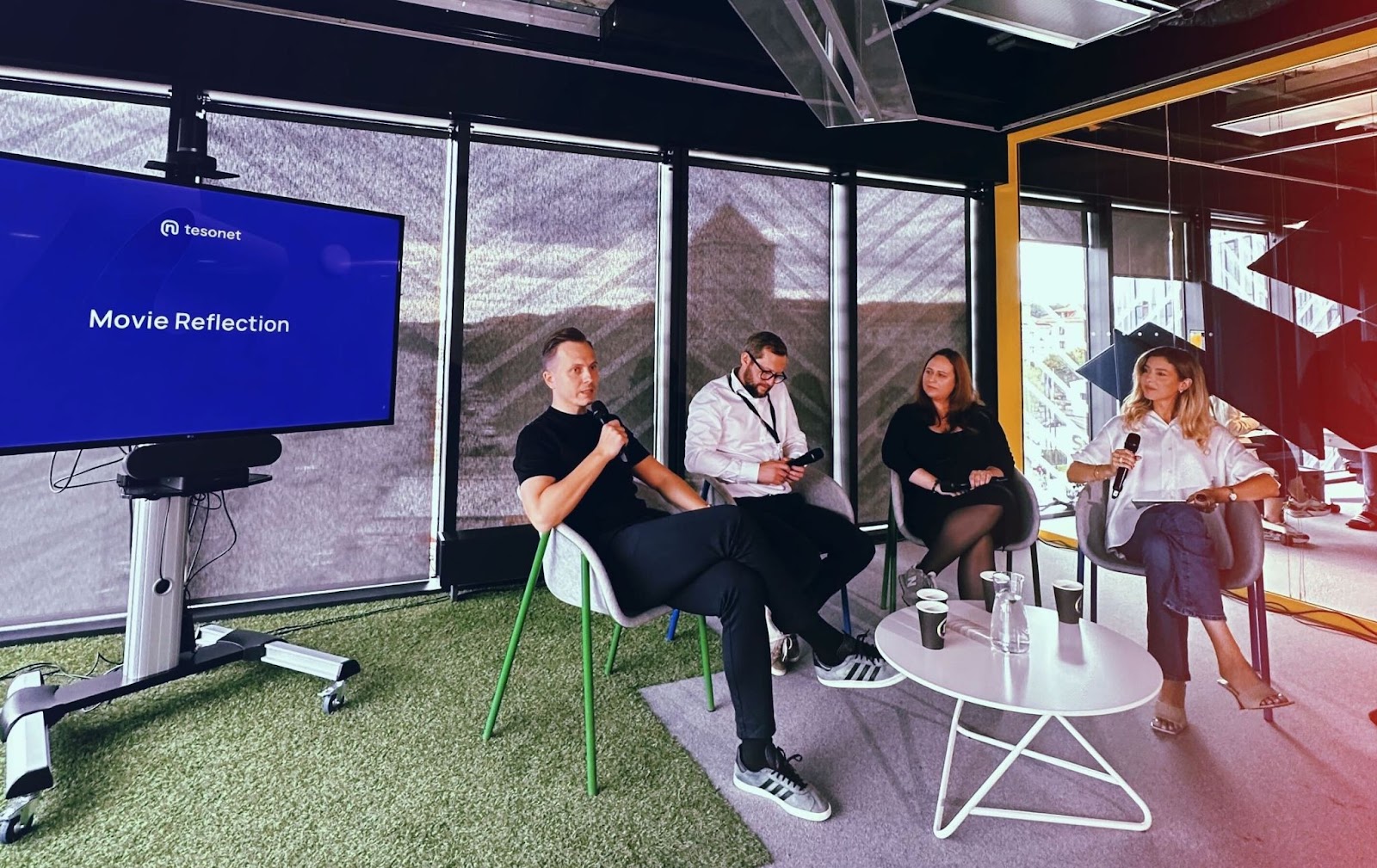
    RÅ«ta recently participated in the Diversity Talks panel discussion, where she proudly shared her insights, as well as personal and professional challenges that gender biases create. 

    Rūta Katiliauskaitė participating in Diversity Talks panel discussion.

    Just the Beginning

    Both GrigaliÅ«naitÄ— and KatilauskaitÄ— see many advantages in achieving gender equality, as it not only ensures the well-being of employees but also helps the company thrive in a competitive environment and achieve great results. This allows to harness the talents and perspectives of all employees, which encourages learning and innovation, enhances problem-solving skills, and creates a more dynamic working environment. 

    The Sustainability Report has given us valuable insights into our current state and progress toward sustainable development. It is essential to acknowledge that the journey toward sustainability and gender balance is an ongoing and evolving process that needs to be maintained and accelerated. As we move forward, may this step be an encouragement to keep taking action and setting an example in the industry. 

    If you’re ready to join our team, have a look at the open positions we are currently hiring for.

    The post Unveiling the Hostinger Sustainability Report: Journey Towards Gender Balance  appeared first on Hostinger Blog.

  • How to Update WordPress Theme In 4 Steps and Keep the Theme’s Customization

    Updating your theme regularly keeps your WordPress website fast and secure. Plus, it gives you access to useful new features and security patches. However, some users may be unsure how to update a WordPress theme, especially once it’s been modified with custom code snippets. Fortunately, it’s relatively straightforward to update your theme in WordPress. You’ll […]

    Read More…

    The post How to Update WordPress Theme In 4 Steps and Keep the Theme’s Customization appeared first on Hostinger Tutorials.

  • Top Web Design Trends for 2023 + AI Trends and Future Trend Predictions

    As web design and its best practices are ever-evolving, web designers need to constantly adapt to new challenges and opportunities. In 2023, several web design trends and AI developments have reshaped how websites are created and experienced. From typography to sustainability and artificial intelligence, this comprehensive guide will look at the biggest web design trends […]

    Read More…

    The post Top Web Design Trends for 2023 + AI Trends and Future Trend Predictions appeared first on Hostinger Tutorials.

  • Podcast With Hari Shanker: Nurturing Contributors for the Future of WordPress

    Our latest guest in the Hostinger Academy podcast is Hari Shanker, an open-source program manager at Automattic. We sat down with him to discuss his role in fostering community contributions, which is crucial for WordPress sustainability.

    The Background

    WordPress is open-source software developed and maintained by a vibrant community. This community comprises developers, agencies, and freelancers who leverage the WordPress content management system for their needs while contributing to its code, bug fixes, and release cycles.

    Given the critical role of community contributions to WordPress’s long-term success, we were keen to explore Hari Shanker’s efforts in nurturing this ecosystem.

    Hari’s WordPress journey began in college when he discovered the platform’s extensive customizability. By 2016, he was deeply involved in India’s local WordPress community and began organizing Meetups. 

    In 2020, Hari became a full-time WordPress contributor. Now, as an open-source program manager, he focuses on boosting community participation through initiatives like Five for the Future and the Contributor Mentorship Program.

    In this special episode recorded during WordCamp US 2023, Emma Young, Hostinger’s Head of Content, delves into the Five for the Future initiative, the Mentorship Program, and the potential benefits for companies contributing to WordPress.

    Watch the Full Podcast

    Watch the full podcast on the Hostinger Academy YouTube channel.

    Subscribe For more educational videos!
    Hostinger Academy

    How Five for the Future Was Started

    Matt Mullenweg wrote a simple blog post – that’s all it took to start the Five for the Future initiative. It was then formalized during the 2017 WordPress Community Summit. A few years later, its dedicated page was launched. 

    Currently, the page serves as a pledge platform, but Hari aims to evolve it into a more structured program offering clear guidance for contributors.

    WordPress Five for the Future page

    “It is a program where folks can sign up. But for new companies signing up, you may not have a ton of direction on what to contribute, where to contribute, and what areas WordPress teams need help with. So I’m trying to solve that problem.” says Hari.

    Luckily for Hari, he’s not working on this alone. The WordPress Community Team fully supports him, especially after this year’s Community Summit. “I think you’ll see some excellent changes coming up in the next couple of years,” promises Hari.

    For example, the Make WordPress project has just launched a new page, make.wordpress.org/contribute. It is a contributor orientation tool where users can get a list of teams that are suitable for their contributions.

    “We have 22 teams – again, you do not need to know how to code to start contributing. There are a bunch of no-code ways to contribute to WordPress as well. So this tool will help you identify some teams,” Hari explains.

    Inviting Organizations to Contribute Together

    WordPress is a significant economic force – a 2021 study estimated that the combined global economy for WordPress is worth half a trillion dollars. While the platform has enabled countless organizations to thrive, Hari envisions more companies actively supporting WordPress itself.

    “My ideal future is where all these companies work together, and all the needs of the project are met, and the project moves from maintaining to going to the next frontier,” explains Hari. 

    He acknowledges that there may be concerns when a company puts many resources into WordPress and takes control of the project. But he emphasizes that it’s not like that in an open-source environment. 

    “Everybody works together – that is the future that I envision. Even though they may be competitors in business, they all work together hand in hand. And it’s already happening.”

    But why should companies contribute in the first place? While not every business might benefit from it, Hari gives a few examples.

    Let’s say you are making money by developing plugins. You can try to join the WordPress Plugin Team, where you will learn plugin standards while contributing to the team. It can help you get up to speed with the coding standards and make a better plugin for the WordPress ecosystem.

    Another example is agencies that can join the Core Team and have their clients’ voices heard in the development environment, especially when it comes to bugs to fix or features to develop.

    In essence, contributing to WordPress provides a deeper understanding of what’s happening under the hood, allowing you to align your goals with the direction of WordPress development.

    The Birth of the Contributor Mentorship Program

    When working on the Five for the Future initiative, Hari did a lot of research to attract more contributors. One of his key findings was that WordPress has an onboarding issue for contributors. 

    “The problem is not the lack of resources. It’s like there’s too much information. When somebody wants to contribute to WordPress, and they go to the Make WordPress site and pick whatever teams they want, they cannot find their way,” he reveals.

    This led Hari to post a proposal about the Contributor Mentorship Program, which received positive feedback. Plus, a mentorship program is also one of the project’s main priorities for 2023.

    The project kicked off in March 2022 when the working group, consisting of contributors from the Americas, Europe, and Asia Pacific, had the first chat. 

    Long story short, the team decided to pick eight teams for the mentorship program. When the program was launched, it received a great response, with 50 people applying to be mentees. The first mentorship cohort started on July 12 with 13 mentees and 13 mentors – where they worked together closely for four weeks.

    The inaugural cohort was a success. “Of the 13 people that we joined that joined, 11 graduated. So that’s even more than we expected. And these people are making ongoing contributions. A couple of them are actually here in WordCamp US,” shares Hari.

    The success encouraged Hari and the working group to continue the program. The next cohort is planned for January 2024, although it’s not set in stone yet.

    Advice for Starters and New Contributors

    Despite how popular WordPress is, some beginners have just started their journey with it. If you’re one of those people, Hari has some advice for you.

    First of all, he suggests trying some easy ways to test the platform, such as WordPress Playground, to see how it works and how you can create a website in minutes. You can also sign up for a hosting service and learn to set up WordPress yourself.

    WordPress Playground interface

    “Try out one of those tools, see how it works, enjoy the beauty of WordPress, and slowly try learning it,“ recommends Hari.

    Once you’re diving deeper into WordPress, you might want to see how you can contribute to the software. Hari’s first advice is to use the tool in make.wordpress.org/contribute to find which team best suits you.

    There are easy ways to contribute, such as uploading photos to the WordPress photo directory and translating WordPress with the Polyglots Team. Whatever team and contribution you choose, consistency is the key.

    “Try making it a habit”, said Hari. “Find some time to do it on an ongoing basis, maybe 30 minutes a week. If you like it, consider doing this again. Make it a habit, explore more, and you will see that you learn through it. I think it’s one of the most underappreciated parts of our contribution.”

    The post Podcast With Hari Shanker: Nurturing Contributors for the Future of WordPress appeared first on Hostinger Blog.

  • WordPress 6.3 Release Leads: Experiences Behind the Scenes

    WordPress 6.3 was released in early August, introducing new improvements to make website creation even more enjoyable. But have you ever wondered what’s running behind the scenes every time WordPress releases a new version?

    To answer your curiosity, we’ve sat down with three WordPress 6.3 release co-leads – Ahmed Kabir Chaion, Leonardus Nugraha, and Pooja Derashri.

    We discussed how they started as a release co-lead, what they worked on for this release, the challenges, and the fun experiences they had. Let’s dive into the conversation!

    How It Started

    For Leonardus Nugraha – Leo, for short – this was his first time joining a WordPress release squad.

    Leo’s been active as a WordPress contributor for Documentation, Polyglots, and Community. When the WordPress 6.3 Call for Volunteers was announced, he decided to apply for Documentation because that’s where he’s most active.

    “I currently work as a content specialist. However, I started at Hostinger as a content writer for WordPress tutorials, so contributing to Documentation just feels natural. It suits my interest and skill set,” Leo explains.

    List of articles written by Leonardus Nugraha in Hostinger Tutorials website

    Leo also wanted to step up his contribution game by diving deeper into the world of open-source projects. “I want to understand the whole release process. When I’m contributing to the Documentation team, I only focus on one area of the project,” he says. “When I got involved in a WordPress release, I experienced more cross-functional workflows. I got to interact with contributors from various teams such as Core and Marketing.”

    It was also Pooja Derashri’s first time being part of a WordPress release squad. She has been contributing to the project since 2017, mainly in the Training team.

    Pooja Derashri with her fellow WordPress Training team contributors

    Even though it was her first time being a release co-lead, Pooja has been involved in moving the past few WordPress releases forward.

    “I have attended a few beta releases and release parties and contributed to testing some WordPress versions,” Pooja says. “I don’t want to limit my contribution. It has always been my aspiration to explore other contribution teams, like Core testing. So it fascinates me to become a part of the release.”

    To pursue her aspiration, Pooja followed the whole WordPress 6.2 release process. Then, when 6.3 was announced, she volunteered to be a part of it.

    Meanwhile, Ahmed Kabir Chaion has been a part of the release squad multiple times – from WordPress 5.9 to 6.1.

    “I wasn’t in the release squad for 6.2 because I was busy with WordCamp Asia. Now that the event’s over, I volunteered again as part of the Core Triage team,” says Ahmed.

    Coming from a language background with a sufficient understanding of programming, Ahmed started his journey in WordPress contribution by creating triage meeting summaries.

    During WordPress 5.6, Tammie Lister and Estela Rueda – both were Design team reps – noticed Ahmed’s consistent contribution to the WordPress project. They offered to train him to become a Core contributor and a release co-lead.

    Ahmed Kabir Chaion sharing his knowledge with audience

    For WordPress 5.8, Ahmed got an opportunity to work directly on the release, but he was not part of the release team. During version 5.9, he continued to express his interest in joining the release squad. He was then selected as one of the Triage co-leads.

    “Versions 5.9, 6.0, and 6.1 are the releases where I tried to constantly improve my role as a Triage lead. When I decided not to participate in the development of version 6.2, it was very important for me to learn that I don’t have to be involved all the time. There are times when I can take a break and come back stronger,” Ahmed admits.

    Working on a WordPress Release

    So, what were Leo, Pooja, and Ahmed assigned to in this release squad?

    “There were four Documentation co-leads for WordPress 6.3. We split the tasks – two of us worked on user documentation, and the other half took care of developer notes,” Leo recalls. “I was in charge of developer notes. While user documentation is like a knowledge base for end users, developer notes are the same but for developers. It was something new for me.”

    WordPress 6.3 developer notes

    All developer notes should be ready to publish during the first Release Candidate. Hence, Leo’s most intense working period was the two to three weeks before the first Release Candidate.

    “During the first Release Candidate, most of the features were almost ready. But changes are still possible at this stage,” Leo explains. “Developer notes should be written by those who own the ticket or the request, not by the Documentation team. Our job is to wrangle these tickets, contact the ones who should write the notes, categorize them to see if some can be merged, then review and publish them.”

    After the first Release Candidates went public, Leo occasionally helped update user documentation. “They include interface changes, screenshots, new features, and new Blocks. There were a lot of them,” says Leo.

    Pooja, as the Test co-lead, handled the Call for Testing publications. The posts offer an opportunity for anyone to test WordPress’ latest release and for developers to gather user insights. This promotes a culture of review and triage within the project.

    WordPress 6.3 Call for Testing post

    “It’s published on the same day as the Beta version of WordPress 6.3,” recounts Pooja. “My fellow Test co-leads and I closely monitored each feature enhancement scheduled for this release.”

    “We monitored Gutenberg versions from the previous releases, attended every bug scrub in the Core team’s Slack channel, read their notes, and explored 6.3’s GitHub project board,” Pooja continues. “Then, we also went to many code-related Slack channels to gather updates and information. We wanted to gather all the testing-related information in one place.”

    Pooja and her teammates went on to publish more Call for Testing publications based on the changes throughout the release cycle.

    Then we have Ahmed, who handled triaging. Since Ahmed already has experience in release development, he mentored the release squad’s first-timers.

    “My role as a Core Triage co-lead was to train and mentor the ones who haven’t done Triage lead before,” says Ahmed.

    “Since we have four Core Triage co-leads, we tried to cover two time zones. So, there were two co-leads from Asia Pacific (APAC) and two from Europe, the Middle East, and Africa (EMEA). This is so we can contribute and complement each other.” With this arrangement, Ahmed worked with Mukesh Panchal to cover the APAC time zone. Meanwhile, JB Audras and Olga Glecker covered the EMEA ones.

    “I helped JB articulate plans for the triage. This included deciding on the triage sessions, which must cover as many different time zones and days of the week as possible,” says Ahmed. He also points out the importance of having more than one triaging session per week, which encourages more people to come.

    “I have been a part of the release squad a few times, and JB is a release squad veteran. So, we prepared the draft plan, and Mukesh and Olga helped finalize it,” Ahmed continues. This helps newer co-leads hone their skills and prepare for upcoming releases.

    The Challenge

    For Ahmed, the biggest challenge was when a major bug was encountered during the Beta 1 phase, which caused a fatal error. “We had to push a few dates because the bug was severe,” he says. Fortunately, there were more squad members working on WordPress 6.3 than usual, making it faster to reach a solution.

    The list of WordPress 6.3 release team

    Meanwhile, Pooja faced the challenge of overcoming worry when starting something new. “At the start of the release cycle, I was so confused about what to do and how to start. Thankfully, my co-lead Brian Alexander guided me a lot throughout the release process and helped me navigate my duties and responsibilities.”

    Pooja has participated in tests for patch beta releases and Release Candidates of previous WordPress versions. Still, she was surprised that the process was different from what Test co-leads do.

    “That’s why I really appreciated how the WordPress release coordinators tried to balance the team composition this time. New people joined, but there were also more experienced team members. No one felt pressured when working on this release,” she explains.

    Leo also shares a concern similar to Pooja’s – starting something new can be scary sometimes. “Interacting with many new people can make you nervous. But it turned out everyone was very welcoming. After a couple of days, I started to get the hang of it,” Leo recounts.

    He also found the many sub-tasks of creating developer notes pretty complex. There were lots of back-and-forth communications throughout the development process.

    Fortunately, Leo also felt very supported during his first stint as a Documentation co-lead. He appreciated how Milana Cap, a Documentation team rep, held an Ask Me Anything session for all Documentation co-leads. Meanwhile, Abha Thakor shared some advice about Core team resources.

    “Many people helped me. Steven Lin, a fellow Documentation co-lead, showed me where to find the developer notes and how to identify tickets in Core or Gutenberg. I decided to focus on the Gutenberg ones,” Leo recalls.

    When Birgit Pauli-Haack noticed that Leo was doing the Gutenberg developer notes, she also offered her help, passing on her knowledge as a former Documentation co-lead. “I followed Birgit’s best practices to wrangle developer notes,” Leo says.

    The Fun Stuff

    Ahmed enjoys seeing people’s reactions when they find out he’s not a programmer.

    “Some people assume that I am a programmer who has the actual solution for the tickets. They’re surprised upon knowing I’m simply a documentation person who summarizes the issue, solution, or procedure,” Ahmed says. “I feel like it’s surprising for me as well, and at times overwhelming. But this learning experience is very worth it.”

    Leo finds it delightful to know the workflow behind a WordPress release – from Beta, Release Candidates, to the final release date. Working on developer notes, viewing tickets, and pulling requests for new features and bug fixes helped him learn more about the upcoming WordPress release.

    “Usually, it’s quite hard to find resources on technical stuff during the first days of a release cycle. It’s nice to understand what’s running under the hood,” Leo admits.

    Meanwhile, Pooja had a particularly funny memory during the 6.3 release. “It was the day of the 6.3 Beta release,” Pooja recalls. “I wasn’t well that day – I had a fever. I waited almost four hours until midnight in my time zone, expecting to kick off the Beta release party. But it was postponed for 24 hours due to technical issues.”

    “It was very exciting, but since I took medicine for my fever, I was unaware that I was falling asleep while holding my laptop. When I woke up in the morning, I was still holding it open in front of me in bed,” she laughs, “I was happy I didn’t miss anything.”

    When asked about their favorite improvement in this release, Ahmed, Leo, and Pooja had different opinions.

    For Ahmed, it’s about the improved workflow. “The WordPress 6.3 release had more people in the release squad, so the workload was less demanding. People worked more compassionately with each other,” he says.

    Meanwhile, Pooja and Leo are excited about the features they have been waiting for.

    “My favorites are the Distraction Free Mode, Command Palette, and Style Revisions. These features are so handy. Especially the last one, which lets users easily revise styles,” Pooja explains.

    “For me, it’s how users can directly create Patterns from the Site Editor. Previously, you’d have to use a plugin, code it from scratch, or create it via the Pattern Directory. Now it’s as easy as creating a Reusable Block,” says Leo.

    Onwards and Upwards

    So, what else do they want to see in future WordPress releases?

    “I’m definitely looking forward to the online collaboration features listed in Gutenberg phase 3‘s roadmap,” Leo says. This phase will be centered around streamlining content management flows to improve how WordPress users work, which often includes collaboration from various corners of the earth.

    On the other hand, Pooja thinks that basic SEO should be part of WordPress core in the future. “Right now, we still rely on third-party plugins to improve our SEO performance. It would be good to have basic SEO as a built-in feature. If we want more advanced functionality, we can use a third-party solution.”

    Ahmed’s wish is similar to Pooja’s, only he takes it a step further. “In the future, I want to see a world where having just WordPress would be enough to have a wonderful website.”

    The upcoming WordPress 6.4 release will be run entirely by a squad of female and nonbinary contributors, reprising the historic WordPress 5.6 release.

    a visual for WordPress 5.6, code named Simone, which named in honor of the legendary musician Nina Simone whose also pictured here

    Pooja will reprise her role as a Test Lead in the 6.4 release. “I’m so excited for the 6.4 release. In the past few years, we have been trying our best to promote and maintain Diversity, Equality, Inclusivity, and Belonging in our meetups and WordCamps. I’m sure it will set another benchmark of success in the open-source ecosystem. We want to share the message that women and non-binary folx are not lesser than.”

    For WordPress enthusiasts who want to be part of the release squad, Ahmed suggests being proactive in understanding the ins and outs of WordPress. “At least experience or witness one release cycle entirely. See how the squad was formed, why one person got selected, and what kind of work they delivered.”

    Ahmed continues, “Once you have the information, only then volunteer. That can make the whole process easier. Learning on the job is one thing, but it would create an additional workload for others if you cannot deliver your part. It’s a voluntary commitment, so it’s great if you can be reliable for the tasks.”

    Being a part of the release squad indeed requires a certain level of expertise and experience. But this should not discourage anyone from aiming for it in the future.

    “After contributing to this community for a while, you’ll start connecting with fellow WordPress enthusiasts. Here, everyone loves to lift each other up. When you encounter difficulties, there will be many people who are more than happy to help,” assures Leo, emphasizing the supportive nature of the WordPress community.

    Suggested Resource

    If you want to start contributing for the WordPress project, check the Make WordPress page.

    The post WordPress 6.3 Release Leads: Experiences Behind the Scenes appeared first on Hostinger Blog.

  • The Rise of the .ai Domain: From Anguilla to AI Powerhouse

    With artificial intelligence (AI)’s explosive growth, “ai domain” searches have skyrocketed 203% in just a year, fueled by game-changers like ChatGPT. Although .ai began as Anguilla’s country code, it’s now seen as the go-to domain extension for AI-centric endeavors. Its growth rate has overtaken the market leader .com, as well as .io and .tech – […]

    Read More…

    The post The Rise of the .ai Domain: From Anguilla to AI Powerhouse appeared first on Hostinger Tutorials.

  • How to Cancel a Bluehost Account and Migrate Your Services to a Better Platform

    Bluehost is a popular web hosting company that is known for its cheap hosting plans and easy new account creation process. However, cancelling Bluehost services can be quite complicated and time-intensive. Whether you’re dealing with poor performance, a confusing control panel, or other issues, you’re always able to take the necessary steps to improve your […]

    Read More…

    The post How to Cancel a Bluehost Account and Migrate Your Services to a Better Platform appeared first on Hostinger Tutorials.

  • 18 Tips to Write SEO-Friendly Content That Ranks in 2023

    Writing SEO-friendly content is crucial for ranking in search engines and attracting readers. However, it can be confusing to know where to start, especially if you’re a beginner. In this article, we guide you through the process of how to write SEO-friendly content that not only ranks well in search results, but also resonates with […]

    Read More…

    The post 18 Tips to Write SEO-Friendly Content That Ranks in 2023 appeared first on Hostinger Tutorials.

  • 6 About Us Page Examples for 2023 Built With Hostinger Website Builder

    When going over the steps on how to make a website, don’t forget to include an About Us page. It is more than simply saying hello to your clients. It’s a business card, a brand narrative, and a way for visitors to understand your company’s culture and core values. In this article, we’ll feature six […]

    Read More…

    The post 6 About Us Page Examples for 2023 Built With Hostinger Website Builder appeared first on Hostinger Tutorials.