EDITS.WS

Category: jetpack.com

  • How to Edit & Customize Your WooCommerce Checkout Page

    The default WooCommerce checkout page is streamlined for the average store and audience. However, there’s a good chance your store is anything but average and your audience has unique needs and preferences that challenge a basic checkout flow.

    If this sounds like your store, you probably want to customize the default WooCommerce Checkout page to make it more user-friendly for your specific customers and encourage them to complete purchases. 

    Fortunately, there are many ways to edit the WooCommerce Checkout page. You can use WooCommerce extensions or blocks, or edit the page manually using code. By optimizing this page, you can create a more seamless checkout experience. 

    Before you make changes, however, make sure you have a WordPress backup plugin installed and active, so you can quickly restore your site in case something goes wrong, or you simply want to undo your work. 

    In this post, we’ll take a closer look at why you might want to edit the Checkout page in WooCommerce. Then, we’ll guide you through three simple methods.

    Why build a custom WooCommerce Checkout page?

    Last year, almost half of U.S. consumers abandoned their online purchases during checkout. Some of the reasons for this include a long or complicated checkout procedure, and the customer not being able to calculate the total order cost upfront.

    Therefore, it’s important to remove all the barriers at checkout and provide an easy process. One way you can do this is by simplifying the checkout flow so that shoppers can complete their orders much faster.

    Additionally, WooCommerce Checkout page customization can be used as a marketing strategy. For instance, you could gather details from your customers so that you can improve your products.

    Alternatively, you can upsell and cross-sell items to increase the average order size. You might suggest related products, or offer add-ons like insurance and gift wrap. 

    Another reason to build a custom WooCommerce checkout page is to ensure that it fits in with the rest of your website. You might apply custom colors and fonts, or upload your logo. This can help you reinforce your branding and deliver a memorable checkout experience. 

    How to edit your WooCommerce checkout fields

    An effective way to customize your Checkout page is to edit the WooCommerce checkout fields. This way, you can provide a streamlined process for shoppers, making it easier for them to complete an order.

    By default, WooCommerce offers a set of useful fields for your Checkout page. These include First name, Last name, Email address, Phone, Company name, Town/City, and more.

    If you mainly sell to individuals, you’re unlikely to need the Company name field. Meanwhile, if you offer gifts or discounts to customers on their birthdays, it makes sense to add a Date of Birth field.

    There are other ways to customize the WooCommerce fields. You can apply new colors, adjust the size of fields, or change the placeholder text.

    It’s also a good idea to remove unnecessary fields and configure required fields that need to be completed before the customer can proceed with the order. You can go one step further and allow customers to verify a delivery preference, request a specific delivery date, or set up a preferred contact method. 

    Extensions for editing your WooCommerce checkout fields

    The simplest way to edit your WooCommerce checkout fields is to use an extension. Fortunately, there are many tools to choose from. 

    Checkout Field Editor is a premium WooCommerce extension that lets you optimize your checkout page by adding, removing, or editing fields.
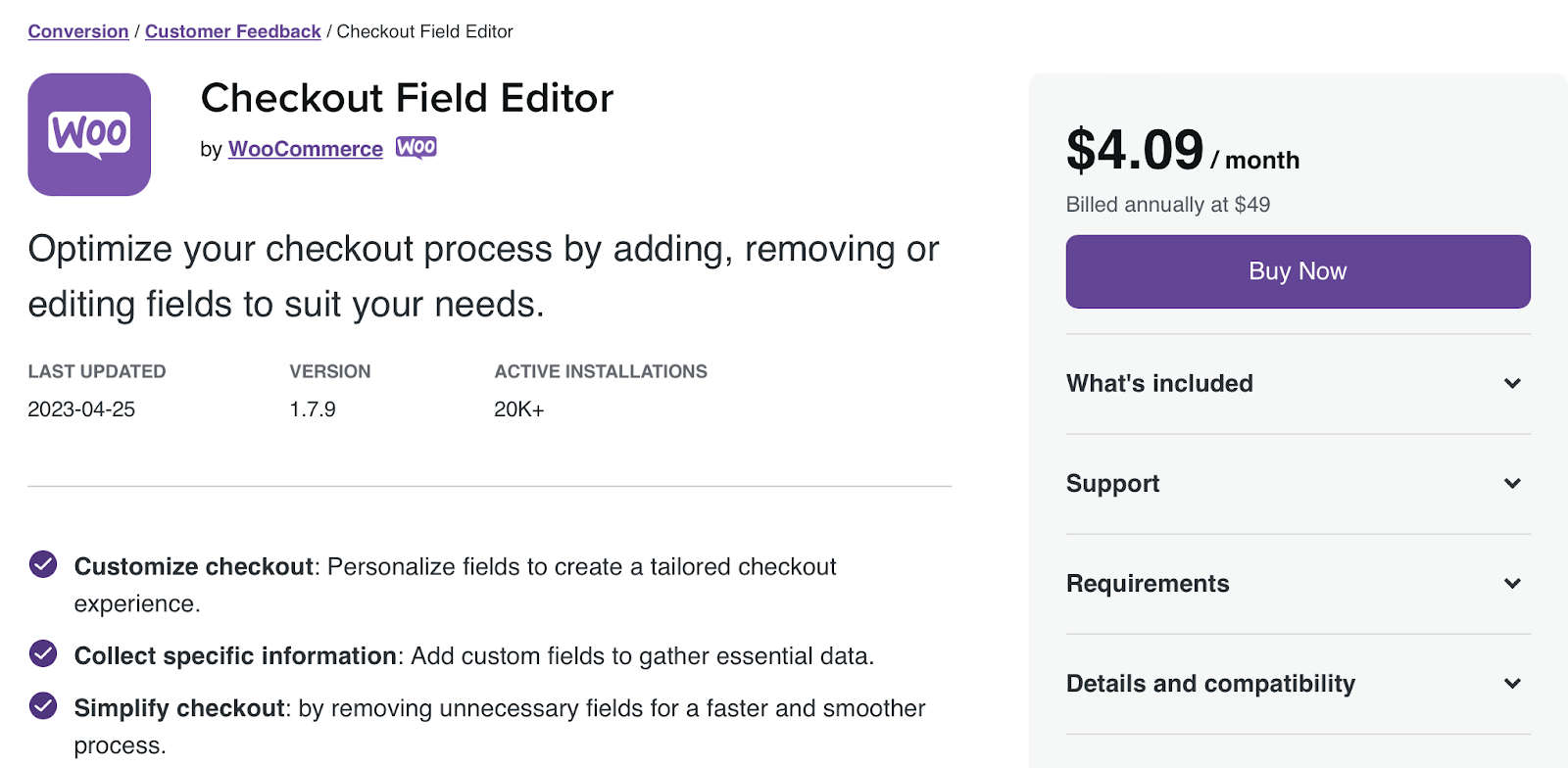
    Checkout Field Editor is a premium WooCommerce extension that lets you optimize your checkout page by adding, removing, or editing fields.

    Although you can’t take away the core fields, you can move them around. This gives you greater control over the flow of the checkout process. 

    If you run a large store, you might require a more sophisticated tool, like WooCommerce Checkout Add-Ons.
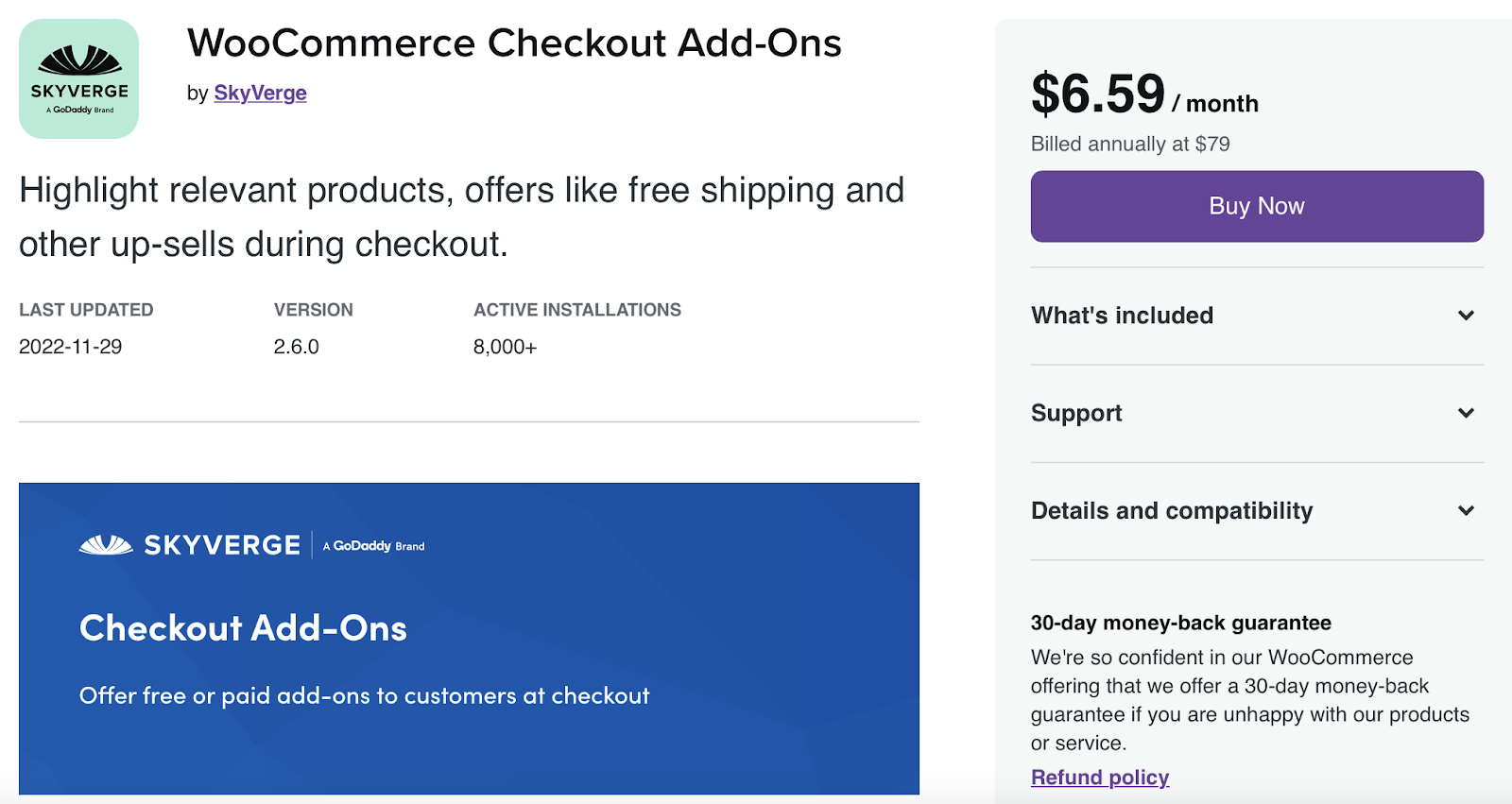
    If you run a large store, you might require a more sophisticated tool, like WooCommerce Checkout Add-Ons.

    With this tool, you can insert free (and paid) add-ons at the checkout stage. For instance, if you sell personalized products or gifts, you can allow customers to add a message to the order.

    It also enables you to offer gift wrapping services and insurance. You can even give customers the option to leave a tip. 

    The plugin gives you full flexibility over your WooCommerce fields. You can create conditional add-ons, add fixed or percentage-based costs, and dynamically update order totals. Plus, the tool supports WooCommerce Subscriptions and renewal orders. 

    How to customize your WooCommerce Checkout page

    Now that you know a bit more about WooCommerce checkout fields, let’s take a look at three ways to customize your Checkout page. 

    1. Use the WooCommerce Cart and Checkout blocks

    The first way to customize your WooCommerce Checkout page is to use the Woo Cart and Checkout Blocks extension. This tool is completely free.

    Find the WooCommerce Blocks page and click on Free Download.

    The first way to customize your WooCommerce Checkout page is to use the Woo Cart and Checkout Blocks free extension.

    You’ll then be guided through the checkout process (although you won’t be expected to pay anything). 

    There are different ways to customize your checkout experience with these blocks. You can configure product add-ons, accept multiple payment methods, offer express payment options, and more.

    Note that the Cart and Checkout blocks are only available on sites with WordPress 6.9 or higher. Additionally, you’ll need to replace the existing shortcodes on your Cart and Checkout pages. 

    First, navigate to Pages in your dashboard and open your Checkout page. Here, you can delete the checkout shortcode [woocommerce_checkout].

    Delete the checkout shortcode [woocommerce_checkout] in the page editor.

    Then, search for the Checkout Block and add it to your page. Now, you should see a preview of your block-based cart which you can customize using the settings in the sidebar.
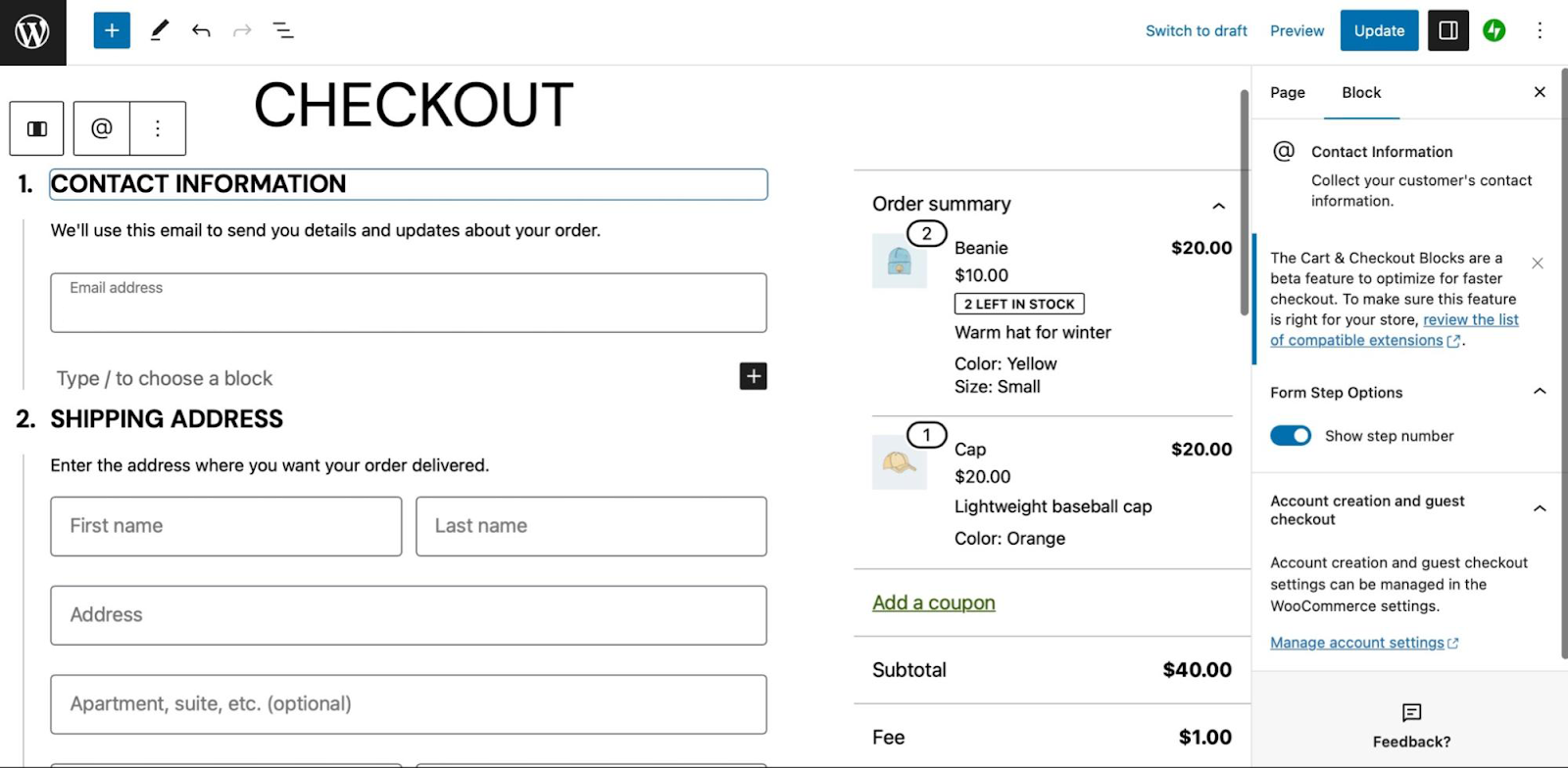
    Search for the Checkout Block and add it to your page.

    Now you’re all set to customize your Checkout page. You can show/hide the checkout step numbers, show/hide certain fields, and make the Phone field a required field using the block settings.

    You can show/hide the checkout step numbers, show/hide certain fields, and make the Phone field a required field using the block settings.

    Additionally, you can configure paid add-ons, allow shoppers to apply coupons or notes to their orders, enable multiple shipping options, and more. 

    2. Customize your Checkout page using WooCommerce extensions

    While WooCommerce Blocks offers an easy way to customize your checkout page, you can also get started with various WooCommerce extensions. Let’s look at a few options. 

    Make product recommendations

    One of the best ways to increase your average order size is to make product recommendations on the checkout page. Fortunately, the Product Recommendations extension makes this super simple.

    Increase your average order size with product recommendations on the checkout page with Recommendations extension.

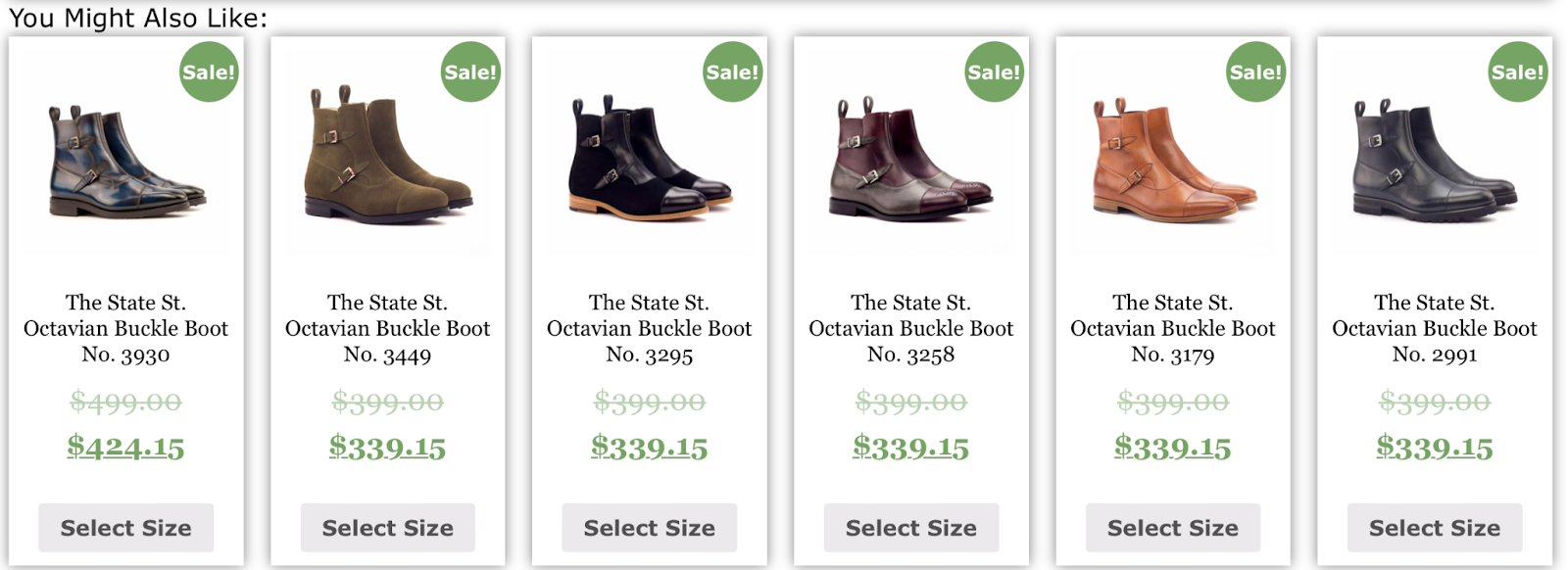
    You can present cross-sells under eye-catching titles like “Frequently bought together” or “You might also like”.

    Present cross-sells under eye-catching titles like “Frequently bought together” or “You might also like”.

    Alternatively, you can upsell products to increase order value. Plus, you can present your product recommendations across your entire store, including individual product pages and your order confirmation page. 

    Enable multiple shipping addresses

    Another way to customize your WooCommerce Checkout page is to enable multiple shipping addresses. Sometimes, customers make orders that consist of multiple products that need to be sent to different addresses (like home and work addresses).

    Additionally, some customers like to buy gifts and ship them straight to their friends and family. Without this option, customers are forced to make separate orders for each shipping address, which can be quite time-consuming.

    You can use the Shipping Multiple Addresses extension to offer this feature.

    Allow customers to buy gifts and ship them straight to their friends and family with the Shipping Multiple Addresses extension.

    Customers can request any quantity of products to be sent to any number of addresses. Plus, they can save all of these shipping addresses within their accounts. 

    Once you purchase this extension, all you need to do is install it on your WordPress site and enable multiple shipping methods. 

    Let customers choose a delivery date

    A great way to give your store a competitive edge is to allow customers to choose a delivery date to receive their orders. This can improve your overall customer satisfaction since it shows that you’re willing to go the extra mile.

    With the Order Delivery for WooCommerce extension, you can limit the number of orders per day to make sure you can process all orders within the specified timeframe.

    With the Order Delivery for WooCommerce extension, you can limit the number of orders per day.

    Plus, you can provide customers with a list of options for delivery dates based on bank holidays, shipping methods, and other factors. 

    Once you purchase and install the extension in WooCommerce, you can display a delivery date picker in your checkout form. Here, you can determine time slots, define a delivery range, and charge additional costs when customers choose a specific date/time. 

    Offer add-ons at checkout

    Another way to optimize the WooCommerce Checkout page is to add upsell options. For instance, you might offer shipping insurance, rush handling, company swag, or gift wrapping.

    You could also let customers choose from a range of paid add-ons at checkout, like gift messages or gift receipts. WooCommerce Checkout Add-Ons offers an easy way to do this.

    Let customers choose from a range of paid add-ons at checkout with WooCommerce Checkout Add-Ons.

    With this extension, you can add several types of fields to your checkout form, based on your add-on type. So, you might include additional text fields, radio buttons, checkboxes, or file uploads.

    You can configure fixed-amount or percentage-based costs. Meanwhile, you’re able to include conditional add-ons that change based on factors like the number of products in the cart and the cart subtotal. 

    Display messages to customers at checkout

    Your WooCommerce Checkout page customization can simply involve displaying a message. You can do this to engage customers, promote offers in your store, or point them toward related items.

    You can use the Cart Notices WooCommerce extension to do this.
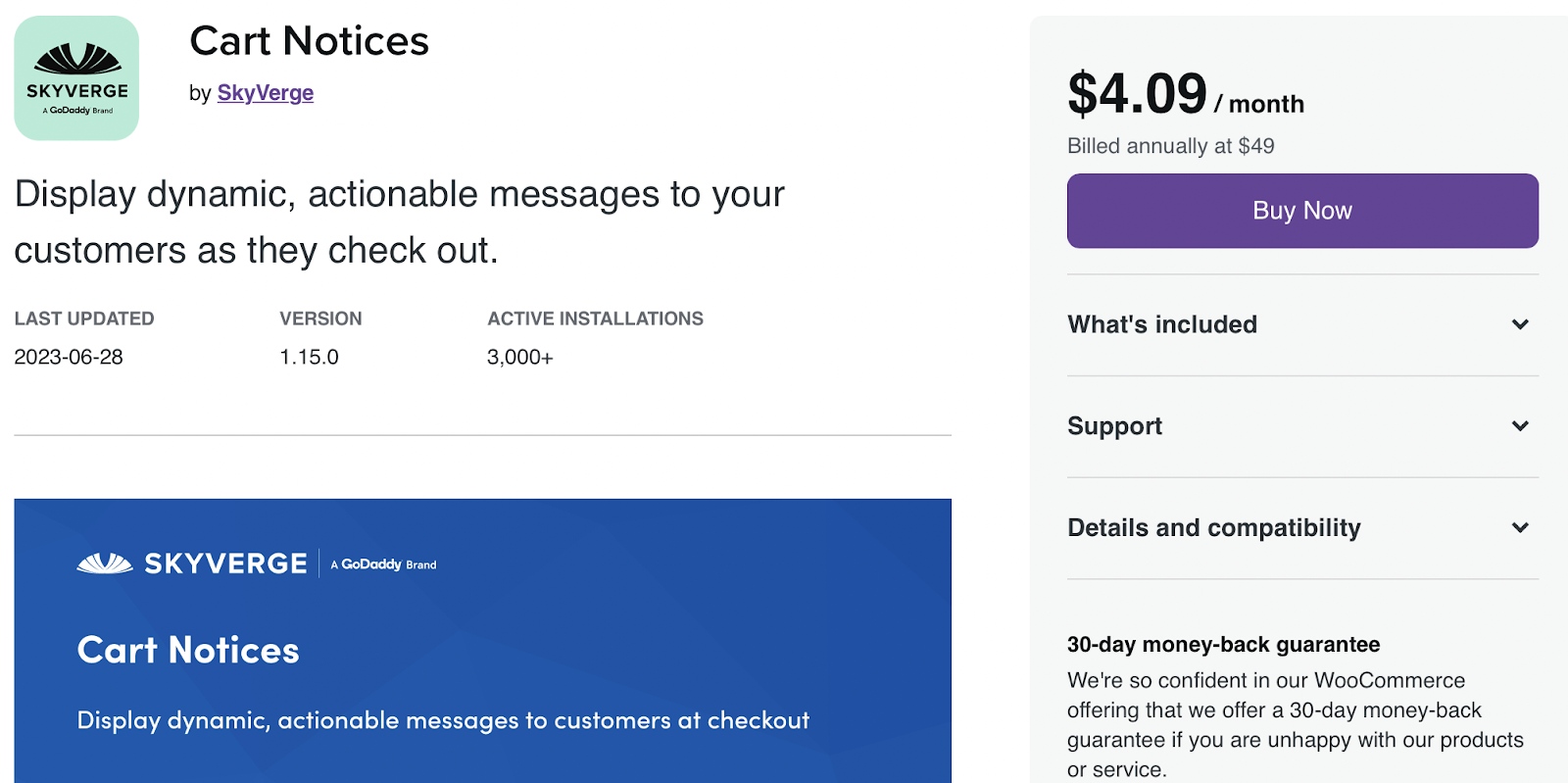
    Engage customers, promote offers in your store, or point them toward related items with Cart Notices WooCommerce extension.

    Once you’ve purchased and installed the extension, you’re able to display dynamic messages at checkout to encourage customers to buy more products. For example, you might want to present a notice that says, “Add one more item to qualify for free shipping.” 

    If you offer express shipping, you might motivate customers to place an order by displaying a message that says, “Order in the next ten minutes for next-day delivery.” 

    Provide a gift wrap option

    Although many of your customers are shopping for themselves, some are buying gifts for their loved ones. Therefore, it’s a great idea to offer a gift wrapping option on your WooCommerce Checkout page.

    The Gift Wrapper for WooCommerce extension lets you add this option to your store.

    Offer a gift wrapping option on your WooCommerce Checkout page with The Gift Wrapper for WooCommerce extension.

    This way, you can customize your Shop page by allowing customers to add gift wrapping to individual items. Shoppers can also apply gift wrapping to their entire order at checkout. Plus, you’re able to configure different pricing options for this service.

    This plugin supports both simple and variable WooCommerce products, and you can offer an unlimited number of gift wrap designs. Shoppers can even add a personalized message to their orders. 

    3. Customize your Checkout page manually

    You can also make changes to the Checkout page manually. This option is best if you’re comfortable working with code. 

    If you’re editing your site files directly, it’s best to create a child theme. Otherwise, when you switch themes or even update your current parent theme, you’ll lose any of the changes you’ve made. 

    Plus, it’s a good idea to make a fresh backup of your WooCommerce store since a single error can break your site. There are many high-quality backup plugins to choose from, but Jetpack VaultPress Backup is a powerful and reliable tool.

    There are many high-quality backup plugins to choose from, but Jetpack VaultPress Backup is a powerful and reliable option.

    The plugin works automatically, creating real-time backups that are stored securely in the Jetpack Cloud. Better yet, VaultPress Backup is designed specifically for WordPress and WooCommerce sites, which means it backs up your files, database, and customer data. 

    Edit the visual design of your WooCommerce Checkout page using CSS

    To edit your WooCommerce fields manually, you’ll first want to use the inspector tool in your browser to identify the exact area that you want to customize. Then, you’re ready to apply the changes to your theme.

    Here’s a list of primary tags (including classes and IDs) that enable you to edit the design of your Checkout page:

    <body class="woocommerce-checkout">
    <div class="woocommerce">
    <form class="woocommerce-checkout">
    <div id="customer_details" class="col2-set">
    <div class="woocommerce-billing-fields">
    <p class="form-row">
    <div class="woocommerce-shipping-fields">
    <p class="form-row">
    <div class="woocommerce-additional-fields">
    <div id="order_review" class="woocommerce-checkout-review-order">
    <table class="woocommerce-checkout-review-order-table">
    <div id="payment">
    <ul class="wc_payment_methods payment_methods methods">
    <div class="form-row place-order">

    To give you an example, you might want to change the background color of an input box. In this case, you can use the following code snippet:

    .woocommerce-checkout input[type="text"] {
         background-color: #222;
    }

    Alternatively, you might wish to remove a field from your Checkout page, like the Company name field in the Billing section. In this scenario, you’ll need to add the following code snippet to your functions.php file.

    function wc_remove_checkout_fields( $fields ) {
        unset( $fields['billing']['billing_company'] );
        return $fields;
    }
    
    add_filter( 'woocommerce_checkout_fields', 'wc_remove_checkout_fields' );

    Make sure to save your changes when you’re ready.

    How to create a one-page WooCommerce checkout 

    If you want to simplify the shopping experience, you might want to create a one-page checkout experience, using a plugin like WooCommerce One-Page Checkout. With this tool, you can add checkout fields to any of your landing pages.

    Simplify the shopping experience with a one-page checkout experience, using a plugin like WooCommerce One-Page Checkout.

    This extension offers three ways to create a one-page checkout. First, you can enable it on a product-by-product basis.

    Alternatively, you can configure a one-page checkout with a shortcode. All you need to do is add the following shortcode to any page or post on your site:

    [woocommerce_one_page_checkout]

    How to boost the speed of your Checkout page

    While it’s a good idea to customize your WooCommerce Checkout page, you’ll also want to make sure that it’s optimized for performance. Bounce rates increase by an average of 32 percent as page load time goes from one to three seconds. 

    To maximize conversions and sales, it’s important to improve your website speed. There are different ways to optimize your WooCommerce Checkout page, but Jetpack Boost offers an easy and convenient solution.

    There are different ways to optimize your WooCommerce Checkout page, but Jetpack Boost offers an easy and convenient solution.

    There’s a free version of the plugin, which is simple to set up. Go to Plugins → Add New and search for “Jetpack Boost”. Then, click on Install Now → Activate. 

    Now, you can head to Jetpack → Boost in your dashboard.

    There’s a free version of the plugin, which is simple to set up in the Plugin Repository.

    Here, you can enable any of the optimization settings that you want to apply to your website. For example, you might want to lazy load images to improve your loading times.

    It’s also a good idea to optimize critical CSS loading. This feature moves your styling information to the start of the page so that your content loads much faster. As such, it’s a great way to improve your overall user experience. 

    You can also upgrade to a premium Jetpack plan to access additional features. For instance, the plugin will automatically regenerate your site’s critical CSS (and performance scores) every time you make a change on your site.

    Frequently asked questions about customizing the Checkout page 

    This post has covered the basics of WooCommerce Checkout page customization, but you might still have some questions. Let’s answer some of them. 

    What is the WooCommerce Checkout page?

    When you install WooCommerce in WordPress, you’ll get a default Checkout page. This contains fields for customers to enter their name, address, email address, payment information, and more. Once they’ve entered these details, they can complete their order. 

    What is the best way to customize a WooCommerce Checkout page?

    There’s no best way to customize the WooCommerce Checkout page since it depends on your preferences, skill level, and experience. For beginners, it can be easiest to use WooCommerce Blocks or a WooCommerce extension since you won’t need to use code.

    More experienced users may like to edit the WooCommerce Checkout fields using code snippets. This involves adding CSS snippets in the WordPress Customizer or your child theme. 

    Should I back up my site before editing the checkout page template?

    The WooCommerce checkout page is one of the most important pages on your website. Therefore, it’s important to back up your WordPress site before you make any edits.

    This way, if you make a mistake or a change that you don’t like, it’s easy to restore your website to an earlier version. You won’t need to troubleshoot your site for errors or go through the hassle of undoing the change.

    The easiest way to back up your site is to use a plugin like Jetpack VaultPress Backup. Once installed, this handy tool makes real-time backups that are stored securely in the Jetpack Cloud. 

    Plus, you’ll get access to an activity log to tighten up security on your site. Meanwhile, the restoration process is super simple, enabling you to get your site up and running again in just a few clicks. 

    What else can I do to enhance my WooCommerce Checkout page?

    It’s a great idea to customize your WooCommerce Checkout page to increase sales and improve the customer experience, but there are other ways that you can enhance your Checkout page.

    It’s important to prioritize your site’s speed as this can reduce bounce rate and improve the shopping experience. You can install a plugin like Jetpack Boost to speed up your loading times. 

    Once activated, Jetpack Boost provides you with access to a clean interface where you can keep an eye on your performance score. Plus, the tool makes it easy to enable optimization features like lazy loading, critical CSS, and non-essential JavaScript deferral. 

    Optimize your WooCommerce checkout experience

    While WooCommerce provides a built-in Checkout page, there are tons of ways to enhance the page to boost sales and configure useful checkout options. For instance, you might enable multiple shipping addresses, make certain fields required, or offer gift wrapping.

    To recap, here are three ways to edit and customize your WooCommerce Checkout page:

    1. Use the WooCommerce Cart and Checkout blocks.
    2. Use WooCommerce extensions like Cart Notices and Product Recommendations.
    3. Use code to manually customize the Checkout page.

    You’ll also want to optimize your Checkout page for performance, using a beginner-friendly tool like Jetpack Boost. This way, you can speed up your site and improve the user experience, which can lead to more conversions.

  • Full WordPress Backups: A Complete Guide for Website Owners

    In life, we’re constantly reminded of the value of insurance — health insurance, car insurance, home insurance — but how often do we think about insurance for digital assets like websites? Not having insurance or a contingency plan is especially shocking when you consider that businesses, connections, and reputations depend so much on these online tools.

    A mistaken line of code, a software glitch, or an unforeseen cyberattack can bring operations and sales to a standstill. 

    But what if there were something even better than insurance? What if, instead of simply being compensated for the loss, you could actually repair the damage instantaneously? 

    That’s the purpose that backups serve. And the right WordPress backup solution can restore your online presence in minutes, even saving ecommerce sales that occurred between the time you restore and the time that the backup was taken (e.g. in the case of a malware injection). 

    Read on to learn about your digital safety net and how to find and implement the right solution for your site. 

    The importance of WordPress backups

    Every piece of content created, every update made, and every plugin installed on your WordPress site represents an investment — one of time, energy, and often money. Losing all of that in a blink of an eye is not only disruptive, but potentially catastrophic for a business, particularly for small to mid-sized companies. 

    Backups serve as a fallback, providing the assurance that even in the face of the unforeseen, you can rebound quickly, minimize downtime, and continue to serve your audience without disruption. They’re not just about recovering data, but about preserving the heart of your digital business.

    The different types of WordPress backups

    As with all good things, backup services range in functionality, catering to diverse needs and resources. Some of the differences include the frequency of backups (daily, weekly, real-time, etc.) and where the files are stored. 

    However, there are three major types of WordPress backups: full backups, incremental backups, and differential backups.

    1. Full backups

    Full backups are like they sound — they cover everything. All of your files, your settings, and your database are backed up entirely each time.

    2. Incremental backups

    Incremental backups, on the other hand, start with a full backup. But then, instead of creating a new, full backup every time, the tool saves just the files that are new or have changed since the last backup — whether that backup is full or incremental.

    The advantage here is that these small files can be saved quickly, using minimal resources. This means that they won’t impact the performance and speed of your site in the same way that full backups can.

    The disadvantage is that, to restore a complete backup, all the files must be merged to create a complete site. This can take a bit longer than with other backup types.

    3. Differential backups

    Differential backups strike a middle ground. Like incremental backups, they start with a full backup. But every time a new backup runs, it saves a file with all changes since the last full backup. So, backups taken after the initial full backup take very little space. However, as time goes by, each one increases in size. 

    This takes less storage space, overall, than storing a full backup each time. The main advantage over incremental backups is that, when a restore is needed, it only has to merge two backups to create a complete “set.” This process is much quicker than what’s required with incremental backups. 

    The disadvantage is that this strategy requires much more storage space than with incremental backups. 

    A detailed overview of full backups

    Full backups, as the name implies, are a complete backup of your entire WordPress site — every file, every folder, every line of data in your database. Nothing is left out. 

    It’s like making a mirror image of your site at a particular point in time. This includes all of your site’s core files, plugins, themes, uploads, and your database, which houses your posts, pages, and users. 

    Imagine having a complete clone of your website neatly packaged and ready to be deployed at a moment’s notice. That’s the peace of mind a full backup offers. However, as you may suspect, this thoroughness comes with a trade-off. Full backups can be resource-intensive, both in terms of storage space and server resources used while the backup runs.

    But, with the right tools and practices, these challenges can be effectively managed, making full backups an attractive proposition for WordPress site owners.

    Why most WordPress sites should use a combination of backups

    Incremental backups allow site owners to use the least amount of storage space while also reducing the number of server resources used at any given time. This is great for storing snapshots of a site’s history over a long period of time. You can keep lots of copies without much storage space, so if you want to revert to a time months in the past or simply restore an older version to check something, you can. 

    Differential backups can be used for a real-time backup strategy, so site owners can rest assured that every single action taken on the site is safe. Orders, comments, edits, post updates, and anything else you do between full backups will be saved if you need to restore the site. 

    And full backups, of course, ensure you have a complete picture of your site, its database, and all files in a single place. Restoring a full backup can be quicker than with other methods and, without a full backup to start, incremental and differential backups simply aren’t possible. 

    Top WordPress backup services like Jetpack VaultPress Backup employ each of these backup methods throughout your plan’s history. This allows for a fully secure site backup infrastructure that has all of your files in real time, but is quick to restore in an emergency.

    How often should you back up your site?

    To the extent that budget allows, you should back up your site every time a change is made or an update occurs. 

    So if someone places an order on your site? Back it up. Publish a new blog post? Back it up. Get a new comment? Back it up. 

    Real-time backups make this possible. While this term refers to the frequency of backups, it’s generally done through differential backups. 

    But if you rarely make changes to your site or your budget is very strapped, you may need to settle for more periodic updates. In a sense, there’s not a one-size-fits-all answer to this question other than you should back up your site as often as realistically possible given your resources and the importance of your site as a business asset. 

    Remember, the goal is not just to back up your files but to minimize potential data loss. If your last backup was a month ago, you stand to lose a month’s worth of data. And that can be a heavy blow for a business or blog.

    Limitations of traditional backup methods

    Let’s pause for a moment and consider the conventional ways of backing up WordPress sites. While they’ve served us well over the years, they have their limitations.

    1. Host backups 

    Many hosting providers offer backup services, often included in their plans. This might seem convenient and economical, but it’s not without drawbacks. 

    For one, host backups often lack the flexibility and control that a dedicated backup solution offers. You’re at the mercy of your host’s backup schedule and retention policy. 

    What’s more, if your host encounters issues, both your site and its backups could be at risk. For example, if a hacker gains access to your server, they could inject malware in your backup files as well as your live website. That would mean that you couldn’t safely restore a previous version of your site.

    2. Manual backups 

    For those who prefer a “do-it-yourself” approach, backing up your WordPress site manually through cPanel or an FTP client is a big temptation. 

    But while this provides full control over backups, it comes with a steep learning curve and a substantial time commitment. Backing up a site manually can be a complex process, one that includes the risk of human error. Miss a file or a database table, and your backup is incomplete. 

    Moreover, manual backups are a chore to automate and scale. As your site grows, so does the time and effort required to back it up manually.

    If you miss even a single day’s backups, for a decently-active site, you could suffer significant loss should disaster strike. 

    3. Third-party backup services 

    Third-party backup services offer more control and flexibility than host backups and are easier to manage than manual backups. However, not all backup services are created equal. Some lack real-time backup capabilities, saving your site only once a day, or worse, once a week.

    Others don’t offer easy-to-use restoration features, making the recovery process a nightmare. 

    The Jetpack VaultPress Backup advantage

    Jetpack VaultPress Backup, a feature-rich WordPress backup solution, addresses the shortcomings of traditional backup methods while offering a host of other benefits. 

    VaultPress Backup is more than just a backup tool; it’s a comprehensive backup and security solution for your WordPress site. It offers automatic, real-time backups that are securely stored separately from your server, along with easy-to-use restoration features, all in an intuitive, user-friendly interface. 

    How Jetpack VaultPress Backup works

    VaultPress Backup stands out in its approach, offering several features that make it a compelling choice for WordPress site owners, including:

    1. Real-time backups

    VaultPress Backup doesn’t make you wait for a scheduled backup to protect your latest updates. Its real-time backup feature automatically saves your site each time you make a change. Publish a new post, update a page, or earn a sale, and it’s backed up instantly. This reduces the risk of data loss to practically zero.

    2. One-click restores

    With VaultPress Backup, restoring your site is as easy as clicking a button. Whether you’re restoring your entire site or just a specific file or database table, VaultPress Backup guides you through the process in a few simple steps. No complex instructions, no technical jargon — just straightforward, simple steps.

    3. Off-site storage

    VaultPress Backup stores your backups off site, in separate infrastructure from your website. This means that your backups are safe even if your website or hosting provider encounters issues. 

    4. Ultra-secure storage infrastructure

    Your backups are not just offsite, but stored in a secure, reliable, and high-performance storage infrastructure. VaultPress Backup employs state-of-the-art security measures to protect your backups from unauthorized access and threats. 

    In fact, it’s the same infrastructure serving WordPress VIP clients, used by the world’s top organizations and run by elite WordPress experts. 

    The many advantages of VaultPress Backup

    VaultPress Backup offers benefits not just for businesses and site owners, but also for WordPress site builders and agencies, as well as WooCommerce stores.

    1. Benefits for businesses and site owners

    As a business owner, VaultPress Backup gives you peace of mind that your site’s data is safe and always accessible. Its real-time backup feature ensures you never lose a single update, while its easy-to-use restoration feature minimizes downtime during a site recovery.

    Plus, with VaultPress Backup, you’re not just getting a backup solution, but a dedicated support team ready to assist you 24/7.

    2. Benefits for WordPress site builders and agencies

    If you’re a WordPress site builder or run an agency, VaultPress Backup can be a game-changer for you. It’s an easy sell to your clients, offering comprehensive, real-time backups, one-click restores, and a secure off-site storage. Plus, it can save you countless hours in site management, with automatic backups and easy-to-use features.

    Learn more about Jetpack’s partner program for agencies and pros: https://jetpack.com/agencies-pros/

    3. Benefits for WooCommerce stores

    Running a WooCommerce store? VaultPress Backup is the perfect tool for you. It backs up not just your posts and pages, but your entire WooCommerce store — products, orders, customer information, and more. And with its real-time backup feature, every transaction is backed up instantly, ensuring you never lose a sale.

    Perhaps the coolest part? If you need to restore to a previous date, orders that occurred since that date will still be saved — even as the rest of your site reverts to a past version. 

    Setting up VaultPress Backup 

    Getting started with VaultPress Backup couldn’t be easier. To begin, go to Plugins → Add New in your WordPress dashboard. There, search for “VaultPress Backup.”

    Getting started with VaultPress Backup couldn't be easier from the WordPress Plugin Repository.

    Click on Install Now, then Activate. Then, click the Set up Jetpack button that appears.

    Click on Install Now, then Activate. Then, click the Set up Jetpack button that appears.

    Here, click Approve to connect your site to WordPress.com. There, you can create a new account or log into an existing one.

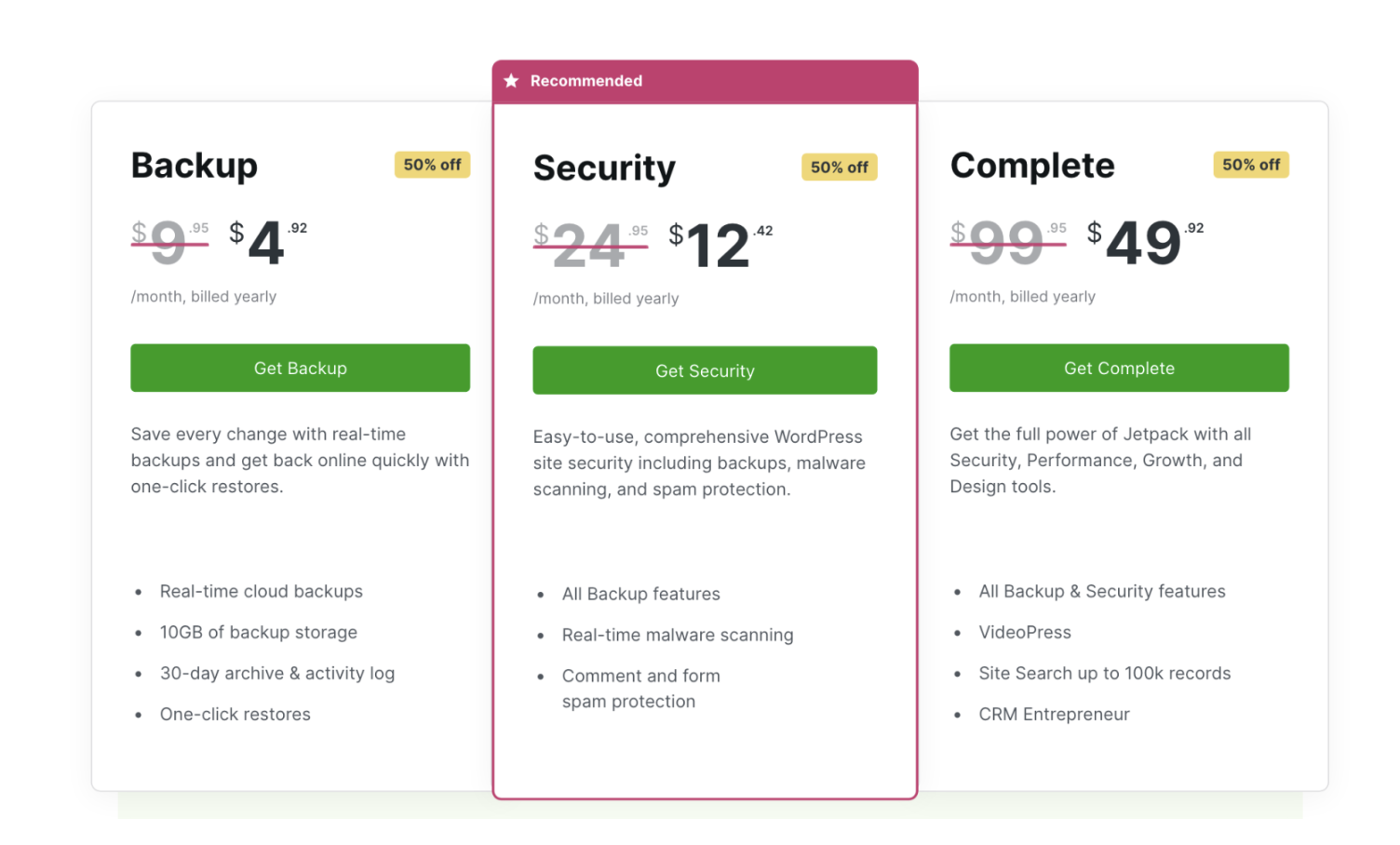
    You’ll now see a table with several options for plans. Choose the one that best fits your needs and finish the checkout process.

    Choose the option that best fits your needs and finish the checkout process.

    And you’re done! Your first backup will start immediately; no need to do anything else!

    Understanding the VaultPress Backup dashboard and settings

    The VaultPress Backup dashboard is your command center, giving you access to your backups, restoration features, settings, and more. It’s designed with simplicity in mind, making it easy for even non-technical users to manage their backups. 

    On your WordPress site, go to Jetpack → VaultPress Backup. This is where you’ll find your backup information and settings.

    First, you’ll see information about your latest backup, including the time it took place, and what was backed up. In this section, you can also:

    1. Click the See backups in the cloud button. This will take you to the Jetpack Cloud, where you can view all of your available backups, edit settings, and more.
    2. Click View your latest restore point. This will take you to your most recent backup in the Activity Log, with the ability to restore immediately.
    Click the See backups in the cloud button - you can view all of your available backups, edit settings, and more.

    In the next section, you’ll see a link to the Activity Log. This will allow you to see all the events that took place on your site, along with information about when they occurred and who was responsible. You can also restore backups based on each action.

    The Activity Log will allow you to see all the events that took place on your site, along with information about when they occurred and who was responsible.

    How to restore a backup created with VaultPress Backup

    Restoring a backup with VaultPress Backup is just as simple. In the VaultPress Backup dashboard, click See backups in the cloud. You can then choose which backup you want to restore, whether that’s the latest version, one from a previous time/date, or one based on an action taken on your site.

    Restoring a backup with VaultPress Backup is just as simple from the VaultPress Backup dashboard.

    Now, click Actions → Restore to this point.

    VaultPress Backup then guides you through the restoration process, letting you choose what to restore (entire site, files only, or database only) and how to restore (restore to the current site or download a ZIP file of the backup).

    VaultPress Backup then guides you through the restoration process, letting you choose what to restore and how to restore.

    Once you’ve made your selections, click on the Confirm restore button, and VaultPress Backup will begin restoring your site. That’s all there is to it.

    Frequently asked questions about full WordPress backups

    How frequently should I back up my WordPress website?

    Real-time backups are best for most WordPress sites. However, if your site is rarely updated, you could consider daily updates instead. 

    Does VaultPress Backup back up WordPress in real-time?

    VaultPress Backup offers real-time backups, using differential backups to automatically save your site each time you make a change. You can restore your website at any time with just a few clicks.

    See a full list of what is and is not included in the backups from VaultPress Backup.

    Why does VaultPress Backup store backups off-site? What are the benefits?

    Storing backups off-site, in a separate infrastructure from your website, offers several benefits. It protects your backups from issues affecting your website or hosting provider, reduces the load on your server, and provides additional security for your backups.

    What kind of support does VaultPress Backup offer?

    VaultPress Backup offers best-in-class support through email and live chat. They have a dedicated support team that’s ready to assist you with any issues or queries you may have.

    How do I get started with VaultPress Backup?

    Getting started with VaultPress Backup is easy. All you need is a WordPress.com account, a plan that includes VaultPress Backup, and a few minutes to set it up. Refer to our ‘Setting Up VaultPress Backup’ section earlier in this article for a detailed guide.

    VaultPress Backup: The gold standard in WordPress backups

    When it comes to WordPress backups, having a full backup available is important. This saves everything on your site, giving you the confidence that you can recover your site in its entirety, exactly as it was. 

    However, you don’t need to save an entire copy of your site each time to have a full copy available when you need to restore. Instead, consider a solution that’s nimble enough to save your site in-real time, so you never lose a thing, while also using minimal resources and preserving your site performance. 

    You also need to consider how backups are performed. Manual backups and backups from your hosting provider both have their shortcomings that can leave you in the lurch when you need them the most. They can be unreliable, cumbersome, expensive, or lack important features.

    That’s where VaultPress Backup shines. It’s a comprehensive, reliable, and easy-to-use backup solution that’s tailor-made for WordPress. It offers real-time backups with one-click restores, off-site storage, ultra-secure storage infrastructure, and more. It brings the many benefits of WordPress backups within reach of businesses, site owners, site builders, agencies, and WooCommerce stores.

    Getting started with VaultPress Backup is straightforward. The setup is simple, the dashboard and settings are easy to navigate, and creating and restoring backups is a walk in the park. With 24/7 support, VaultPress Backup is an excellent choice for all of your WordPress backup needs.So go ahead, give VaultPress Backup a try. It might just be the best investment you’ll ever make for your WordPress site.

  • The 10 Best AI Writing Tools for Content Creation

    When generative artificial intelligence (AI) technology was announced at the end of 2022, the world reacted with excitement, fear, concern, and many innovative ideas. While a lot of people have tinkered with this new technology, few have incorporated AI content writing tools into their daily work effectively and efficiently.

    In many ways, the technology is still in its infancy. Those professionals who are using AI tools for content writing are often relying on them only as a starting point, refining the output to sound more human and ensuring that all facts are correctly portrayed. That said, AI writing tools can certainly reduce the time it takes to conduct initial research and create a first draft.

    According to Forbes Advisor, 97 percent of business owners believe AI content writing tools will help their company, with one in three organizations planning to use such tools to create website content in the near future. 

    Many new AI writing tools have emerged in the market in recent months, and this guide reviews some of the best ones, along with their features, pros and cons, ease of use, and pricing details. 

    Essential features of AI writing tools

    AI writing tools for content creation are evolving at a rapid rate, so before you make a selection, take some time to consider the essential features you want. Here are a few things to look for:

    • A solid learning model. The best AI tools for content writing are trained on a specific set of data and language models. Be sure you select a tool that uses comprehensive training data to generate quality outputs.
    • Control over outputs. You’ll want to be able to specify the style, tone, voice, and language of the final output. For example, you may want to generate content with a very professional tone in English for one audience and deliver the same message in a casual style in Spanish.
    • Ease of access. To streamline your workflow, your AI content writing tool should ideally be integrated into the programs you’re already using. The last thing you want to do while you’re building a blog or website is to toggle between screens and applications, cutting and pasting AI-generated content.
    • A conversational interface. Be sure your AI content creation tool uses natural language processing so that your query stream becomes similar to a conversation with a colleague. This allows you to refine your prompts as the tool provides responses, helping you to get the best output for your needs.
    • Affordability. As this market develops, keep an eye out for pricing and feature changes. Most tools should be both powerful and affordable. 

    Top AI writing tools for content creation

    We’ve dug deep into the latest AI programs to find the best options for creators, entrepreneurs, content marketers, and anyone using WordPress to pursue their passion. Here are the top 10 AI writing tools for content creation on the market today:

    Jetpack AI Assistant homepage

    1. Jetpack AI Assistant

    If you’re a WordPress user, Jetpack AI Assistant fits perfectly into your workflow. Embedded directly into the WordPress editor, the intuitive interface invites you to engage with AI as if you were chatting with a colleague. The Jetpack AI Assistant lets you generate diverse content on command, reducing the time and effort you spend on content creation.

    Key features of AI Assistant:

    • Integrates seamlessly into the WordPress dashboard
    • Crafts high-quality, uniquely-tailored content
    • Creates text, lists, and tables
    • Adapts unique tone and brand voice
    • Integrates easily with other WordPress tools

    Pros of AI Assistant:

    • The Jetpack AI Assistant is integrated directly into WordPress, which means you don’t have to disrupt your workflow to use this tool.
    • The tool responds to your prompts with professional, customized content.
    • It’s easy to change the feeling of your writing by asking Jetpack AI Assistant to rewrite content in a casual, professional, or academic tone.
    • It’s built and maintained by Automattic, the team behind WordPress.com, for seamless and complete integration.
    • The tool not only generates text but can pull information to help you easily build lists and tables. 

    Cons of Jetpack AI Assistant:

    • While the AI writing tool offers excellent value and a 14-day money-back guarantee, the free plan is very limited and primarily acts as a test drive.
    • The Jetpack AI Assistant processes information based on only the context provided, so it may occasionally misinterpret requests.
    • If outdated training data is used, the tool may generate inaccurate responses.

    Ease of use:

    Since the Jetpack AI Assistant was built specifically to work with WordPress sites, it’s easy to use the tool while you’re writing or editing content. Simply create a prompt as needed, without needing to toggle back and forth between your site and outside tools. It’s best for anyone running a site on WordPress.

    Pricing:

    The Jetpack AI Assistant is available for $8.33 per month, billed annually, and offers a money-back guarantee. There’s a limited free plan that allows you to try the AI Assistant. 

    Rytr homepage

    2. Rytr

    Built on OpenAI’s GPT-3 API, Rytr is an AI content creation tool that was created specifically for content writers, SEO specialists, and others responsible for generating text-based materials for their organizations and clients.

    Key features of Rytr:

    • Built on an open-source platform
    • Offers multiple use cases as starting points
    • Creates unique, high-quality content
    • Allows storage of content in one location
    • Suggests optimal keywords for SEO

    Pros of Rytr:

    • Rytr offers content-generation in more than 30 languages, can generate text using more than 20 different styles and tones, and has more than 40 use cases for a quick start.
    • The tool can run plagiarism checks while the user is generating text.
    • Rytr not only delivers AI-generated written content, but can also create images from prompts.
    • The premium subscription level allows users to create custom use cases for content generation.
    • Since it’s designed specifically for content writers, it offers unique features like building a writing portfolio page.

    Cons of Rytr:

    • While Rytr works well for short-form content, it’s not as robust for longer-form pieces. It can generate outlines and ideas, but expanding on them usually results in repetitive, nonsensical content.
    • Although Rytr integrates with SERP tools for keyword optimization, this feature is weak compared with products that are geared specifically towards SEO.
    • The user interface is not as streamlined or intuitive as the best products on the market.

    Ease of use:

    Because Rytr offers dozens of pre-defined use cases, it can be very easy to work with for the most basic content-writing needs. It quickly and easily generates short-form content that can be expanded upon by writers to add a human element.

    Pricing:

    Rytr offers three pricing levels, which come with an increasing number of features: free, Saver at $9 per month, and Unlimited for $29 per month.

    Jasper homepage

    3. Jasper

    Jasper is an AI content writing tool designed specifically for marketers who want to create content for a wide variety of channels, including blog posts, advertisements, social media, product descriptions, and more.

    Key features of Jasper:

    • Generates both text and images
    • Integrates with Grammarly and Chrome
    • Provides a revision history feature
    • Allows sharing of documents with colleagues
    • Has a built-in plagiarism checker

    Pros of Jasper:

    • Jasper has a unique option entitled “explain it to me like a fifth grader” that can help simplify complex content.
    • The tool not only delivers AI-generated text but can also build images from prompts.
    • Jasper does an excellent job of generating natural-sounding content.
    • This AI writing tool can help create additional ideas for marketing promotions.

    Cons of Jasper:

    • Although Jasper does well when it’s asked to generate content on common topics, it may create incomplete, incorrect, or nonsensical content if the prompt is too niche.
    • While it can generate natural-sounding content, it has more difficulty creating a unique brand voice.
    • Like all AI content generation tools, Jasper can only generate output based on input and cannot reliably check facts.

    Ease of use:

    Jasper is easy to use, allowing businesses to mimic their own brand voice and style by training the tool on existing content, their own style guides, or other current marketing and product materials. It pulls from a cross-section of other AI tools, incorporates search results, and individual business information for a robust solution.

    Pricing:

    Jasper offers three pricing levels designed for the individual creator at $39 per month, the team at $99 per month, and the business, which requires a conversation and negotiation with the company. It does offer a free trial period.

    Frase homepage

    4. Frase

    Frase is marketed as an all-in-one AI content generator and SEO tool for both content writers and marketers. It can support individuals from research through writing and into the SEO analytics stage of their workflows.

    Key features of Frase:

    • Supports content generation at the research stage
    • Helps generate quality outlines and content briefs
    • Fleshes out longer-form content
    • Analyzes and optimizes for SEO

    Pros of Frase:

    • Frase has a very intuitive user interface, making it easy to get started without training.
    • The tool examines the top-ranking Google search results and automatically generates content briefs for users.
    • Frase can break down a website, delivering analytics that pinpoint which pages are ranking best and which need improvement.
    • The organization releases updates nearly every day for continuous improvement.

    Cons of Frase:

    • Frase is on the expensive side and offers no free trial or free version.
    • Since this tool really started in the SEO space, its AI writer is relatively new and requires a fair amount of improvement compared to others on the market.
    • The AI writing tool cannot be used on an ongoing, unlimited basis without purchasing the SEO component.

    Ease of use:

    While Frase has an intuitive, easy-to-use interface, it was originally designed for SEO-focused tasks. The company has recently added an AI content generation component but is still working on improving the entire package to meet market needs.

    Pricing:

    Frase offers three pricing levels designed for the solo creator at $14.99 per month, the basic level at $49.99 per month, and the team level at $114.99 per month. It offers a five-day trial for $1.

    Sudowrite homepage

    5. Sudowrite

    Although Sudowrite seems to be targeted toward fiction authors looking for creativity, plot twists, and fresh ideas, what company couldn’t benefit from a little better storytelling? By taking advantage of the features of this AI content tool, writers and marketers may be able to create more engaging blog posts, web content, and social media updates.

    Key features of Sudowrite:

    • Offers in-depth, creative descriptions based on a built-in thesaurus
    • Creates everything from initial outlines to long-form content
    • Delivers multiple options based on previously-set tone to help complete thoughts
    • Reads existing content and offers improvement ideas

    Pros of Sudowrite:

    • Sudowrite can generate content in several languages.
    • The tool “learns” as it interacts with the user, generating better content as the conversation continues.
    • Sudowrite can incorporate the creative, descriptive style found in fiction to liven up business copy and content.
    • The AI content generator can also review existing content and make suggestions for improvement to make copy more engaging.

    Cons of Sudowrite:

    • Since it’s designed for fiction authors and not specifically for business use, it’s not as familiar with formats such as blog posts, web content, and social media posts.
    • It has no plagiarism checker or any SEO capabilities that are more popular with business-focused tools.

    Ease of use:

    Sudowrite may be a great tool to help writers overcome writer’s block or generate creative, fresh ideas for boring corporate content. Its strength is in its creativity and storytelling ability; finding ways to use this to benefit the content writer or marketer may be a little challenging but worth the effort.

    Pricing:

    Sudowrite offers three pricing levels designed for the hobbyist or student at $10 per month, the professional at $25 per month, and the enterprise level at $100 per month. It also offers a free trial.

    Growthbar homepage

    6. GrowthBar

    Those content writers looking for an affordable tool that can help write blog posts and optimize them for SEO may want to consider GrowthBar. It quickly scans Google results to generate briefs that provide all the information needed to create high-ranking blog posts, including keywords, optimal length, both internal and external link suggestions, and more.

    Key features of GrowthBar:

    • Collaboration abilities so teams can work together to generate content
    • Builds complete blog posts quickly
    • Analyzes keyword options and delivers difficulty and revenue metrics
    • Creates content for a wide variety of channels

    Pros of GrowthBar:

    • GrowthBar is an affordable way to quickly generate SEO briefs and outlines.
    • The tool provides everything needed for a basic SEO campaign.
    • It offers unlimited domain queries and keyword research.
    • GrowthBar has a Chrome extension that allows easy SEO data access anywhere, anytime.

    Cons of GrowthBar:

    • The SEO features are basic and may not be sophisticated enough for some businesses.
    • Since GrowthBar’s strength is in generating briefs, actual AI-generated content must be closely fact checked.
    • Customer support information is difficult to access.
    • It can’t help identify or fix broken links.

    Ease of use:

    As long as individuals understand the basics of SEO, GrowthBar is a very intuitive and easy tool to use. Although SEO tools are not as robust as some, they are presented in a very easy-to-use and easy-to-access manner.

    Pricing:

    GrowthBar offers three pricing levels: standard at $29 per month, the pro at $79 per month, and the agency at $129 per month. It offers a free 14-day trial.

    Closerccopy homepage

    7. Closerscopy

    If you’re looking for a tool that can work with a lot of languages, Closerscopy supports more than 100. In addition, this AI content creation tool has a proprietary AI model that’s trained on real-world examples. It’s designed to help generate content for a wide variety of channels, including blog posts, social media updates, advertisements, customer correspondence, and more.

    Key features of Closerscopy:

    • Supports more than 100 different languages
    • Offers the ability to generate both freestyle and directed long-form content
    • Checks content for facts, emotions, and tone 
    • Downloads content in multiple formats

    Pros of Closerscopy:

    • Closerscopy offers unlimited content generation.
    • It’s good at long-form material creation, which is also unlimited.
    • The tool offers strong social media post creation tools.
    • Not only does it support the most popular languages, but it also offers translation into more than 100 different languages.
    • It has more than 800 marketing frameworks and workflows.
    • Closerscopy provides quality SEO auditing capabilities.

    Cons of Closerscopy:

    • Because it’s a more comprehensive tool, it’s harder to grasp, more complex, and somewhat slower than most AI tools.
    • Closerscopy does not offer the level of creativity, tones, and styles found in other tools.
    • Even with access to three AI platforms, the content quality is average.
    • The interface is difficult to use and still has glitches.

    Ease of use:

    Although Closerscopy’s interface is attractive to the eye, it’s more complex than other AI content generators and may be more difficult for a beginner to learn. A dashboard may help keep tasks organized for the user.

    Pricing:

    Although Closerscopy does not have a free version or trial, it does offer a 14-day money-back guarantee. Packages are the Power version at $49.99 per month, the Superpower at $79.99 per month, and the Superpower Squad at $99.99 per month. A 30 percent discount is offered if paid annually, and Closerscopy offers a lifetime package as well.

    Writesonic homepage

    8. Writesonic

    Writesonic is a powerful tool that’s particularly good for ad copy and short-form social media blog posts, although it offers long-form, blogging, and other content-generating capabilities as well. Like all AI content generation tools, it’s trained on both rules and existing content, learning to “write” human-like content in a fraction of the time.

    Key features of Writesonic:

    • Writes structured content with headlines and subheadlines
    • Paraphrases and rewrites content in seconds
    • Expands or summarizes content on demand
    • Creates SEO product descriptions

    Pros of Writesonic:

    • Writesonic has a clear, easy-to-use interface for a fast start.
    • It offers more than 50 advanced writing tools.
    • The tool generates plagiarism-free, search-optimized, grammatically-correct content in seconds.
    • Writesonic has a free trial period.
    • It offers many content types.

    Cons of Writesonic:

    • The content generated should be fact checked for accuracy and edited to ensure it meets the user’s intent.
    • The free trial only allows users to test a few features.
    • The ability to expand content to long-form articles has a maximum character limit.
    • The credit system used by Writesonic can be difficult if you require multiple versions of the same content.

    Ease of use:

    Writesonic has a straightforward interface that allows users to generate content quickly and easily.

    Pricing:

    Writesonic offers four levels of pricing and features: a free month-long trial, a business level at $12.67 per month per user, an unlimited level at $16 per month per user, and an enterprise package at a customized price starting at $1,000 per month.

    Article Forge homepage

    9. Article Forge

    Based on advanced AI and deep learning models, Article Forge was designed to generate more accurate, factually correct, SEO long-form content quickly. Its easy-to-use interface strives to let writers and marketers get started quickly and efficiently.

    Key features of Article Forge:

    • Generates long-form content of more than 1,500 words with minimal time and input
    • Uses research-augmented AI to assist with fact checking
    • It can be programmed to send new content to WordPress on a schedule
    • Adds images, videos, and custom links automatically

    Pros of Article Forge:

    • Article Forge will automatically add images and videos to text content.
    • Users can determine how frequently they want new content added to a WordPress site, which can be created and scheduled automatically.
    • The tool allows both a free trial and an unlimited number of articles.

    Cons of Article Forge:

    • Even though Article Forge uses research-augmented AI, final content should still be fact checked.
    • Generated content can vary in quality from strong to nonsensical, repetitive, and weak.
    • Sometimes, results are not related to the correct topic.
    • It’s not as good with shorter-form content, social media posts, ad copy, or other content generation.

    Ease of use:

    Article Forge is very easy to use and can spin long-form content in about one minute. It takes very little training to get started with this tool, and it has a simple interface.

    Pricing:

    Article Forge offers a free five-day trial. One user can pay $57 per month or save 51 percent by paying annually, dropping the price to $27 per month. Businesses need to contact the company for custom pricing depending on the number of users.

    WriterZen homepage

    10. Writer Zen

    Using a data-based approach and offering its “keyword golden score” metric, Writer Zen focuses on generating AI content that improves ranking on key search engines. Unlike other AI content tools, Writer Zen balances factors such as keyword competition, ranking difficulty, cost per click, and estimated traffic when generating content.

    Key features of Writer Zen:

    • Suggests keywords that have a high-traffic, low-competition ratio to improve results
    • Creates AI-generated briefs that are based on current top-ranking pages
    • Identifies keyword clusters through Google tools
    • Protects against plagiarism 

    Pros of Writer Zen:

    • Writer Zen was designed first with SEO in mind, so its keyword optimization tools are superior to others.
    • It provides above-average content that is relatively free from grammatical errors and sounds more human than some other tools.
    • The company behind Writer Zen has provided quality support and documentation to help customers maximize their use of this tool.
    • It has collaborative features that allow teams to work effectively together.

    Cons of Writer Zen:

    • The interface is a little confusing for new users, requiring some time to get up to speed.
    • With its emphasis on SEO, Writer Zen doesn’t offer an auditing feature to check existing web pages and suggest keyword improvements.
    • The plagiarism checker delivers only average results.

    Ease of use:

    The interface is not as clear-cut as some other AI-tools and may take some time to learn to use it effectively. It’s best for individuals seeking to improve SEO rankings of their content.

    Pricing:

    Writer Zen offers a free trial and four levels of features and pricing. The lite version for one user costs $19 per month, the plus version is for more dedicated solo users at $79 per month, the pro package is designed for small teams at $199 per month, and a scalable ultra package is $359 per month.

    Strong Short-form Strong Long-form Integrated with WordPress SEO Features Free version Free trial Money-Back Guarantee
    Jetpack AI Assistant Yes Yes Yes No No Yes Yes
    Rytr Yes No No Yes Yes No No
    Jasper Yes Yes No No No Yes No
    Frase No No No Yes No No No
    Sudowrite Yes Yes No No No Yes No
    GrowthBar Yes Yes No Yes No Yes No
    Closerscopy Yes Yes No No No No Yes
    Writesonic Yes No No Yes No Yes No
    Article Forge No Yes Yes Yes No Yes No
    Writer Zen No No No Yes No Yes No

    So, what is the best AI content writing tool?

    The answer to that question really depends on your individual business’ priorities and current needs. For example, companies that have an in-house writing or marketing staff may be looking for a tool that can assist their team with only idea generation and research support, but a start-up with a skeleton crew may lean on its AI content writing tool to help build out full website content and create a plethora of marketing materials.

    If you’re using WordPress to build or run your website, Jetpack AI Assistant is undeniably the clear choice, as it provides quality content, uses natural language processing, offers different styles and tones, and is completely integrated into the WordPress editor. 

    In addition, Jetpack AI Assistant joins a host of other powerful features offered by the plugin, giving you the opportunity to boost your all-around marketing, security, and performance efforts with a single tool. 

    Frequently asked questions about AI writing tools

    Still have questions? Let’s take a look at some common ones.

    What is an AI content writing tool, and how does it work?

    AI content writing tools use language rules, machine learning, and artificial intelligence to generate content. By asking a question or typing a prompt, an individual can quickly generate text, tables, or lists on a vast number of subjects.

    What makes a good AI content writing tool?

    The most important factors in a quality AI content writing tool are the datasets and models it’s trained on. This is the information it uses to generate content, so the broader and more current this information, the better.

    How much does a good AI writing tool typically cost? Are there any free options?

    Many AI writing tools are available on the market today. Some are available for free, while others range in price depending on features and access. The top tool in our review, Jetpack AI Assistant, is a cost-effective solution, especially for WordPress users, and comes with a free version.

    Can I use an AI writing tool directly in my WordPress editor?

    Jetpack AI Assistant is the only AI writing tool that can be used directly in the WordPress editor, making it the most efficient option if you regularly create content directly in WordPress.

    What are the main benefits of using AI content writing tools?

    The main benefits of using AI content writing tools are greater efficiency, broader idea generation, and easier research. Because these tools are automated, they can generate content based on much more information than a human can process in the same amount of time.

    Are there any limitations or drawbacks to using AI content writing tools?

    Yes, AI content writing tools can only respond to human-created prompts, which may vary in specificity or contextual direction. In addition, outputs are only based on the inputs provided to the tool, which may leave gaps or even generate misinformation in the outputs themselves.

    AI tools, because they can spin-up original outputs based on interpretations of the information they’ve digested, can experience hallucinations. This means that they quote factually inaccurate information in a very convincing way. It’s critical that humans fact check any articles created by AI.

    Which industries or types of content are best suited for AI-powered writing?

    If a great deal has already been written about a particular topic or industry, AI writing tools have more data to access and use to generate content. AI-powered tools would have more difficulty generating content about a brand new development, product, or idea.

    Can AI writing tools proofread content?

    AI writing tools can use spelling and grammar rules to proofread content. 

    Can AI writing tools generate content in multiple languages?

    Yes, some AI writing tools can generate content in different languages. It’s important to check and make sure the language you need is supported by the tool you select.

    Can AI writing tools translate content from one language to another?

    In some cases, AI writing tools can provide translation services. Be sure to explore the features of your chosen tool to see if they provide this capability.

    How do AI writing tools handle tone, style, and brand voice?

    Since AI tools can imitate existing content, they can “learn” common tones, styles, and voices. For example, if a user prompts an AI writing tool to generate content using a professional tone, it will use typical words, sentence structures, and phrases found in professional content in its output.

    Can I use an AI writing tool directly in my WordPress editor?

    Yes, Jetpack AI Assistant can be used directly in the WordPress editor, helping to streamline your workflow and improve efficiency.

    How fast can I start using an AI writing tool? What does the learning curve look like?

    Usually, most AI writing tools are easy to set up and learn to use. The most difficult part is to understand how to create the best prompts to generate the content you desire.

    If you’re a WordPress user and interested in setting up Jetpack AI Assistant, it’s easy to do so from your WP Admin page. Simply go to Plugins → Add New and search for Jetpack. The latest version will be in the search results, and you can click Install Now next to the AI Assistant offering.

  • CRM vs CMS: Exploring the Differences & How They Work Together

    Businesses — big and small — are constantly working to connect, engage, and build relationships with their audiences. To be effective, efforts have to span across various channels, mediums, and technologies. It’s a lot to manage!

    Amidst this flurry of activity, two tools have become indispensable: customer relationship management (CRM) software and a content management system (CMS).

    These might sound complex, but their essence is simple — they’re platforms designed to streamline specific aspects of your business operations. 

    The differences between the two, and how they can complement one another, often cause confusion. So we’re here to walk you through the world of CRMs and CMSs, exploring their definitions, benefits, and potential to drive your business forward. 

    What is a CRM? (customer relationship management system)

    A CRM is your key to customer-centric business operations. It’s a powerful tool designed to manage and analyze interactions and data throughout the customer lifecycle. The ultimate goal is to improve customer service relationships, aid in retention, and drive sales growth. With a CRM, you’re not just managing customers, you’re understanding them. 

    What are the benefits of a CRM?

    1. Centralized data. With a CRM, all your customer data — interactions, transactions, and preferences — are housed under one roof. No more rifling through spreadsheets or databases. Your customer data is organized, accessible, and ready to deliver insights. 

    2. Better customer service. CRM provides in-depth customer data, allowing you to personalize interactions and solve problems efficiently. All of your sales representatives can have access to information about each customer, allowing them to understand previous conversations instead of asking the same questions over and over.

    3. A streamlined sales process. With a clear view of the customer journey, you can identify opportunities and bottlenecks, thus refining your sales strategy and boosting conversions.

    4. Enhanced marketing efforts. CRM data can guide your marketing strategy, ensuring that your campaigns are tailored to customer behaviors, needs, and preferences. 

    Typical features of a CRM

    A CRM can pack a punch with a host of features designed to enhance your customer relationships, and Jetpack CRM is an excellent example. Features include:

    1. Contact management. A tool like Jetpack CRM allows you to capture, track, and manage customer data effectively. Everything from contact details to interaction history is neatly organized.

    2. Sales funnel visualization. A CRM provides a clear view of your sales funnel, highlighting opportunities and revealing choke points. 

    3. Task management. Assign tasks, set reminders, and follow up on pending work with a CRM. It’s about taking the right action, at the right time.

    4. Analytics and reporting. A CRM turns raw data into actionable insights with detailed analytics and reporting. 

    What is a CMS? (content management system)

    A CMS, on the other hand, is your digital publishing powerhouse. It’s a software application or set of related programs that allows you to create and manage online content. With a CMS, you can control and structure the content on your website without diving into the technical depths of web development.

    What are the benefits of a CMS?

    1. Easy content management. A CMS gives you the freedom to create, manage, and modify content on your website without any technical knowledge.

    2. A collaborative work environment. Multiple users can contribute and collaborate on the same content, ensuring smooth workflows and efficient content production.

    3. Improved search engine optimization. With built-in SEO tools, a CMS can help optimize your content for search engines, thus improving your visibility.

    4. Unlimited customization options. A CMS like WordPress provides you with numerous themes and plugins to customize your website’s look and feel, ensuring that it resonates with your brand.

    Typical features of a CMS

    A CMS comes equipped with a variety of features to streamline your content management efforts. WordPress, as the leading CMS, showcases these capabilities brilliantly, including:

    1. Content creation and management. WordPress allows you to easily create, edit, and organize your content with its powerful block editor.

    2. User management. With WordPress, you can manage user access, roles, and permissions, ensuring a safe and efficient work environment.

    3. Compatibility with additional tools. WordPress has an extensive range of plugins that enable you to add features and functionality to your website, customizing it according to your needs.

    4. A template system. A CMS like WordPress typically offers themes that can change the way your site looks without altering its underlying software. 

    The differences between a CRM and CMS

    In the simplest terms, a CRM manages your customers, while a CMS manages your content. 

    A CRM focuses on managing customer data, interactions, and relationships, driving customer satisfaction and sales growth. On the other hand, a CMS is all about creating, managing, and modifying digital content. It’s your tool for publishing and structuring the content on your website.

    In essence, a CRM works behind the scenes, shaping the way you interact with your customers, while a CMS is on the front lines, shaping the way your customers interact with you.

    Use cases of a CRM vs CMS

    Understanding the different use cases for a CRM and CMS can help you appreciate their individual strengths and collective potential.

    1. A CRM for sales and marketing

    A CRM can be your sales and marketing team’s best friend. It provides a wealth of customer data that can be used to personalize sales interactions, tailor marketing campaigns, identify sales opportunities, and evaluate marketing performance. 

    Jetpack CRM interface

    For instance, with Jetpack CRM, you can manage and track leads, nurture customer relationships, and glean insights from customer data to shape your marketing strategies.

    2. CMS for content and website management

    A CMS, like WordPress, on the other hand, is a boon for content creators and website managers. It empowers you to create and publish content, manage the look and feel of your website, and collaborate efficiently with your team. 

    the WordPress block editor in action

    CRM and CMS as standalone software

    Operating a CRM or CMS as a standalone system does come with benefits and drawbacks. 

    On the one hand, a standalone CRM, like Jetpack CRM, can provide a focused environment for managing and analyzing customer data, thereby improving customer relationships and driving sales. However, the lack of integration with your CMS could result in a disconnect between your customer data and your content strategy, potentially hampering its effectiveness.

    Similarly, a standalone CMS, like WordPress, gives you complete control over your digital content and website. Yet, without CRM integration, you’re missing out on valuable customer insights that could enhance your content’s relevance and impact.

    The need for integration: CMS and CRM together

    The real magic happens when you bring a CMS and CRM together, each amplifying the other’s strengths. 

    The right integration allows your CRM to access data from your CMS, providing a more comprehensive view of your customers. For example, it automatically pulls in information about the orders that an individual has placed, so that your customer service team can best answer their questions and so that you can segment shoppers to enhance your marketing strategy.

    contact page in Jetpack CRM

    But integration doesn’t mean just slapping the two systems together. It’s about creating a sum greater than its parts. That’s where Jetpack CRM comes into play, seamlessly integrating its powerful tools with your WordPress site.

    Jetpack CRM and WordPress: the perfect combination

    Jetpack CRM and WordPress aren’t just compatible — they’re symbiotic. Together, they marry the content and customer management, streamlining and enhancing business operations.

    Jetpack CRM was crafted specifically for WordPress. Its creators envisioned a CRM that would leverage the flexibility and power of WordPress and serve as a tool that’s easy to use, feature-packed, and capable of turning customer management into a breeze. 

    How Jetpack CRM leverages power of WordPress

    Jetpack CRM taps into the user management, content hierarchy, and plugin architecture of WordPress to streamline the customer journey. It packs a host of features that seamlessly blend with WordPress, including:

    1. WordPress user sync. Jetpack CRM allows you to automatically sync WordPress users and CRM contacts, ensuring that your data is always up-to-date.

    2. Invoices & transactions. With Jetpack CRM, you can manage invoices, quotes, and transactions right from your WordPress dashboard, providing a unified business management experience.

    3. Email and SMS marketing. Connect your CMS to your existing email service provider like MailPoet or use the Mail Campaigns extension to send unique marketing messages to specific customer segments. And add the Twilio extension to send text message marketing to your contacts. 

    4. Automated customer data sync. Sync all the data from your WooCommerce store. Gain more in-depth insights into customer information, preferences, and buying habits and market specifically to them.

    5. Online commerce without the ecommerce site. Creating your own ecommerce site is a great way for B2B and service-based businesses to streamline operations. But if all you want to do is send an invoice and collect payment, Jetpack CRM lets you do that easily and quickly.

    Pairing Jetpack CRM with WordPress isn’t just about integrating systems; it’s about creating a cohesive and effective customer-centric strategy. It’s about knowing your audience, delivering content they love, and forging relationships that endure.

    How to integrate Jetpack CRM with your WordPress site: a step-by-step guide

    Installing and setting up Jetpack CRM is simple. Just follow these steps:

    1. In your WordPress dashboard, go to Plugins → Add New. Search for “Jetpack CRM” and click Install Now → Activate.

    essential details field in Jetpack CRM

    2. You’ll now see a setup wizard that will walk you through the process of getting started. It will ask you details about your site, like the type of business you run and the currency you accept. Answer all of these questions, then click Next.

    importing contacts into Jetpack CRM

    3. On the next page, you’ll see options for importing contacts from other tools you may be using, such as Stripe, WooCommerce, and Twilio. If you want to do so, click the Connect your CRM to other services button. Otherwise, proceed on.

    optional features in Jetpack CRM

    4. Now, you’ll see options for enabling extensions and additional functionality, such as quotes, invoices, and WooSync. Turn on these as needed.

    5. Finally, you’ll have the option to subscribe to the Jetpack CRM newsletter. Click Finish and go to your CRM.

    Now, take the time to get to know your dashboard and configure your settings. For more information and detailed walkthroughs about everything Jetpack CRM, check out the documentation.

    Maximizing Jetpack CRM’s features

    Just integrating the two systems isn’t enough — you need to make them work for you.

    1. Managing contacts

    With Jetpack CRM, managing contacts is easy. You can add, edit, and categorize contacts, track customer interactions, and view all this information in a neat, user-friendly dashboard. The trick is to keep your contact data organized and updated, ensuring that you have accurate and actionable customer insights at your fingertips.

    2. Tracking customer interactions

    Jetpack CRM’s customer interaction tracking allows you to monitor activity on your WordPress site — pages visited, forms filled, downloads made, and more. You can then use this information to understand your customers better and tailor your sales and content strategy to match their needs and preferences.

    3. Optimizing marketing efforts

    Using the customer data gleaned from Jetpack CRM, you can refine your marketing campaigns, making them more personalized, targeted, and effective. Monitor campaign performance, identify what works, and tweak what doesn’t.

    4. Customizing the CRM to fit your business needs

    Every business is unique, and your CRM should adapt to meet your specific needs. Jetpack CRM allows you to customize your CRM experience with a range of extensions for email marketing, invoicing, webinars, and more. Choose the ones that suit your business needs and create a CRM that’s tailor-made for your business.

    Tips for getting the most out of your CRM-CMS integration

    1. Map your customer’s journey

    A fundamental part of successfully integrating your CRM and CMS lies in understanding the path your customers take from discovery to conversion. Map out this journey, using your CRM to capture key touchpoints and interactions. 

    This will help guide the content and messaging you develop through your CMS. Jetpack CRM, for instance, is excellent at recording customer data, while WordPress makes content publishing a breeze.

    2. Harness the power of data

    Every interaction a customer has with your website is a nugget of data that can be utilized. Your CRM system collects and organizes this data, allowing you to leverage it to tailor your content, marketing, and sales strategies. Make sure your CMS is designed to make full use of this information. For example, WordPress’s compatibility with Jetpack CRM ensures a seamless data flow, enhancing your data-driven marketing efforts.

    3. Personalize the experience

    Using the data you gather, deliver a personalized experience to each contact. While your CRM manages customer data, your CMS must be flexible and robust enough to deliver varied content. WordPress shines in this respect, with customization at its core, while a CRM like Jetpack CRM makes tailoring customer interactions effortless.

    4. Maintain CRM data quality

    Ensure the customer data stored in your CRM is regularly updated. This not only helps maintain the quality of your customer relationships, but it also guarantees that your CMS delivers relevant and engaging content.

    5. Use your CRM for content strategy

    Your CRM can provide invaluable insights for your content strategy. Use the data it provides to create content that resonates with your audience. As you feed these insights into your CMS, you’ll create more meaningful and impactful connections.

    6. Implement automation where possible

    Use automation features in your CRM to streamline tasks such as sending emails or updating customer data. This frees up your team’s time, allowing them to focus on other vital areas. Jetpack CRM, as an example, has a wealth of automation features that can save valuable time.

    7. Utilize integrations

    Make use of the integration features of your CRM and CMS to connect various aspects of your business. This helps streamline your processes and make your systems work in sync. With both WordPress and Jetpack CRM supporting a multitude of third-party integrations, the possibilities are endless.

    8. Customize your CRM to suit your needs

    Make the CRM truly yours by customizing it to align with your unique needs. Whether it’s adjusting terminologies or capturing additional information, a flexible CRM is an asset. Jetpack CRM, for instance, offers multiple customization options to fit your business model.

    9. Train your team

    Make sure your team is well-versed in how to use both the CRM and CMS. Understanding these systems and their integration can improve efficiency and make your strategies more effective.

    10. Review and optimize regularly

    Finally, keep a close eye on the performance of your CRM and CMS. Use the analytics and reporting capabilities of your CRM and the analytics of your CMS to continually review and optimize your strategies.

    By applying these strategies, you can truly harness the synergistic potential these technologies have to offer. As we’ve seen, systems like Jetpack CRM and WordPress exemplify the potential of such an integration, each bringing their unique features to the table. Remember, CRM-CMS integration isn’t about using two systems in tandem — it’s about creating a seamless system that drives business growth.

    Frequently asked questions

    Want to know more about content management systems and customer relationship management software? Let’s dive into some frequently asked questions.

    What is the primary difference between a CRM and a CMS?

    While both a CRM and CMS are pivotal tools for any business, they serve different primary functions. A CRM, or customer relationship management system, is a tool designed to manage a company’s interactions with current and potential customers. It keeps track of customer information, purchase history, interactions, and more, all in one centralized location. 

    A CMS, or content management system, is a tool that allows you to create, manage, and modify content on a website without needing any specialized technical knowledge. It handles all the basic infrastructure, allowing you to focus on the front-end parts of the website — content, design, etc.

    Can a business run efficiently using only a CRM or a CMS?

    While a business can indeed function with only a CRM or a CMS, integrating both can exponentially increase efficiency and productivity. Having both a CRM and a CMS ensures that not only is your website content managed effectively, but your customer relationships are also nurtured and improved over time. 

    For instance, you could run a blog on WordPress (CMS) to attract visitors and generate leads. Once these leads are captured into Jetpack CRM, you can then nurture these relationships, turning prospects into loyal customers.

    How does a CRM-CMS integrated system improve operational efficiency?

    When you integrate your CRM and CMS, the synergy between the two creates a unified system that boosts operational efficiency. With a CRM like Jetpack CRM integrated with a CMS like WordPress, you can ensure that your content strategies are informed by your customer insights and vice versa. 

    For instance, you can use the CRM data about your customers to personalize your CMS-driven content. Similarly, the behavior data of users interacting with your content can be captured by the CRM for further analysis and action. This circular data flow between CRM and CMS, when used correctly, can improve both the customer experience and business results.

    How does Jetpack CRM differ from other CRM systems?

    Jetpack CRM stands out from other CRM systems because of its deep integration with WordPress, ease of use, and incredible flexibility. It takes the power and scalability of WordPress and brings it to the CRM space. Furthermore, Jetpack CRM is also modular and customizable to fit your specific business needs. 

    Plus, the ability to manage everything from the same dashboard where you manage your content on WordPress provides unparalleled convenience and efficiency.

    What are some key features of Jetpack CRM that leverage the CMS capabilities of WordPress?

    Jetpack CRM comes with several features that leverage the CMS capabilities of WordPress. For instance, it allows you to manage your contacts right from your WordPress dashboard, eliminating the need to switch between platforms. It also provides features for tracking customer interactions on your WordPress site, allowing you to capture valuable behavioral data.

    Other key features include seamless integration with popular WordPress plugins, customization options to fit your business needs, and in-depth analytics and reporting capabilities to measure and improve your CRM strategies.

    How can I integrate Jetpack CRM with my existing WordPress site?

    Integrating Jetpack CRM with your existing WordPress site is a straightforward process. First, you need to install and activate the Jetpack CRM plugin from your WordPress dashboard. Once the plugin is activated, it automatically integrates with your WordPress site, adding a Jetpack CRM section to your dashboard. 

    From this section, you can manage all your CRM-related tasks — managing contacts, tracking customer interactions, optimizing marketing efforts, customizing the CRM to your needs, and much more — right from your WordPress dashboard.

    Can I customize Jetpack CRM to fit the specific needs of my business?

    Absolutely! One of the significant advantages of Jetpack CRM is its flexibility and customization options. You can customize the CRM to fit your specific business needs, whether it’s renaming fields to match your business terminology, adding custom fields to capture additional information, or customizing the layout and display of information.

    Jetpack CRM: the #1 CRM for sites using WordPress

    In the world of business, the right partnership can propel both organizations to the moon. When Jetpack CRM meets WordPress, it’s like witnessing a celestial alignment. The two don’t just coexist; they amplify each other. Together, they create a platform that’s more than just a CRM or a CMS — it’s a complete business solution. 

    Jetpack CRM was born in the WordPress universe and embodies some of the key traits of WordPress: simplicity, power, and flexibility. It takes the robustness of WordPress, infuses it with CRM functionalities, and delivers a tool that businesses of all sizes can use to drive customer relationships and business growth.

    No matter the size of your company, whether you’re a one-person show or a growing enterprise, Jetpack CRM has you covered. It’s scalable, customizable, and packed with features that make customer management seamless. From capturing leads to closing deals, Jetpack CRM turns every step into a streamlined process, right inside your WordPress dashboard.

    If your business relies on WordPress as its CMS, Jetpack CRM is the ideal choice. The two form a combination that can power your journey to the top. But don’t just take our word for it. Take it for a spin. See how the magic of CRM-CMS synergy can transform your business operations, customer experience, and bottom line.

    Get started with Jetpack CRM today: https://jetpackcrm.com/

  • ERP vs CRM Systems: Understanding the Key Differences

    Life is an assortment of choices, and the same thing goes for the business world. Every day, we’re faced with decisions that shape the trajectory of our businesses. And one of the biggest ones for a company — whether it’s a start-up or a multinational corporation — is the selection of software systems to manage operations.

    In the realm of business management software, two terms often float around: CRM (customer relationship management) and ERP (enterprise resource planning). Each of these has a role to play, and they can be as different as apples and oranges. So, let’s delve deep into these systems, understand their unique features and benefits, and most importantly, learn how to choose the right one for your business.

    Understanding CRM systems

    What is a CRM?

    A CRM, or customer relationship management system, is essentially a tool for managing all of your company’s relationships and interactions with customers and prospects. It pumps vital sales information where it needs to go, ensuring that every part of the company is on the same beat.

    Common features of CRM systems

    CRM systems are robust, with features that are as varied as the businesses they serve. However, most have a number of things in common.

    1. Customer data management

    CRM systems excel in their ability to manage customer data. They collate every piece of information about a customer, whether it’s their basic contact information, buying preferences, interaction history, or social media activity.

    2. Lead and opportunity management

    A lead is potential gold waiting to be mined. CRM systems help businesses manage these golden opportunities by tracking, scoring, and nurturing leads.

    3. Sales and pipeline tracking

    Sales can be seen as a journey. It’s the process of moving a potential customer from interest to purchase. CRM systems help map and monitor this journey, providing real-time visibility of the sales pipeline.

    4. Customer service and support

    CRM systems enable businesses to provide top-notch customer service. By maintaining a history of customer interactions, these systems allow representatives to personalize their approach and solve issues faster.

    5. Marketing automation

    Marketing automation streamlines repetitive marketing tasks, which not only frees up your time, but also ensures consistent and timely engagement with your audience.

    Key benefits of using CRM systems

    CRM systems aren’t just fancy pieces of technology. They bring tangible benefits to the table, including:

    1. Enhanced customer engagement and satisfaction

    A CRM system allows you to know your customers inside out, which in turn enables you to engage them effectively and boost satisfaction levels.

    2. More effective sales and marketing

    By providing visibility into sales processes and automating marketing tasks, CRM systems enhance the effectiveness of your sales and marketing teams.

    3. More personalized and targeted communication

    In today’s business world, personalization isn’t a luxury; it’s a necessity. CRM systems help businesses personalize their communication and target their audience more precisely.

    4. Increased customer retention and loyalty

    By helping you engage customers in meaningful ways, CRM systems play a pivotal role in increasing customer retention and loyalty.

    5. Improved cross-selling and upselling

    Since CRM systems provide insights into customer preferences and buying behavior, they enable businesses to cross-sell and upsell effectively.

    Key factors to consider when selecting a CRM

    Choosing a CRM isn’t a task that should be taken lightly. It’s an investment, both in terms of money and time. Below are some of the factors you should consider before taking the plunge.

    1. Sales and marketing features

    Since a CRM is instrumental in sales and marketing, you must ensure that the system you choose is equipped with all the necessary features for your business, like lead management, pipeline tracking, and marketing automation.

    2. Ease of use and user interface

    A tool is only as good as its usability. If your team finds it hard to navigate, your shiny new CRM will just end up gathering digital dust. So, pay attention to the ease of use and the quality of the user interface.

    3. Integration with existing tools

    Your CRM doesn’t exist in isolation. It needs to play well with other tools you use, whether it’s your email marketing software or customer service tools.

    4. Mobile accessibility and compatibility

    In the era of remote working, mobile accessibility is a must-have feature. Ensure that the CRM you choose offers mobile compatibility, so your team can access customer data on the go.

    Popular examples of CRM systems

    The CRM market is crowded, but a few names stand out, such as:

    Jetpack CRM homepage

    1. Jetpack CRM

    For businesses running their websites on WordPress, Jetpack CRM offers a seamless and robust CRM solution. More on this later.

    2. Salesforce

    Salesforce is a giant in the CRM landscape. It’s well-known for its wide array of features and cloud-based operations.

    3. HubSpot CRM

    HubSpot CRM is known for its user-friendly interface and integration capabilities. It’s especially popular among small to midsize businesses.

    4. Zoho CRM

    Zoho CRM is lauded for its affordability and the range of features it offers, making it a common choice for many small businesses.

    Understanding ERP systems

    What is an ERP?

    ERP (enterprise resource planning) is a type of software that integrates all aspects of a business into one comprehensive information system. Think of it as the brain of your business, analyzing data, making plans, and ensuring all parts of the business are working in harmony.

    Common features of ERP systems

    ERP systems are complex, and their features often span across all business operations. Below are some of the most common features you’ll find in an ERP system:

    1. Resource management

    ERP systems help businesses manage their resources more effectively. Whether it’s your employees’ time or office supplies, ERPs ensure optimal utilization.

    2. Supply chain management

    Managing your supply chain can be a tough nut to crack. ERP systems streamline this process by providing real-time visibility into inventory levels, order statuses, and demand forecasts.

    3. Inventory management

    Inventory management is a balancing act, and ERP systems help maintain this balance by tracking inventory levels and providing alerts when it’s time to restock.

    4. Financial management

    From maintaining a general ledger to managing payroll and taxes, ERP systems handle all financial aspects of a business.

    5. Human resources management

    Whether it’s recruiting new employees, managing payroll, or tracking employee performance, ERP systems help businesses manage their human resources.

    Key benefits of using ERP systems

    Just like a CRM, an ERP system brings a plethora of benefits to a business, including:

    1. Streamlined business processes

    An ERP system integrates all business operations into one single system, thereby eliminating data silos and streamlining processes.

    2. Improved operational efficiency

    By automating routine tasks and providing insights into business operations, ERP systems improve operational efficiency.

    3. Increased data visibility and accuracy

    ERP systems provide real-time visibility into business operations and ensure data accuracy, which is crucial for making informed decisions.

    4. Better decision-making capabilities

    By providing timely and accurate data, ERP systems enable businesses to make informed decisions.

    5. Enhanced scalability and growth

    ERP systems are scalable. They can handle increased workload without a significant decline in performance, making them ideal for growing businesses.

    Key factors to consider when selecting an ERP

    Choosing an ERP system is a monumental decision. Here are the factors you need to consider before making a choice:

    1. Functionality and modules

    Consider the functionalities and modules offered by the ERP system. Ensure that it meets your business needs. If your business deals with complex supply chain processes, ensure the ERP you choose excels in supply chain management.

    2. Scalability and customization options

    As your business grows, your needs increase. The ERP system you choose should be able to scale with you and offer customization options to adapt to your changing requirements.

    3. Integration capabilities

    Just like a CRM, your ERP system should seamlessly integrate with your existing tools and software to create a cohesive digital ecosystem.

    4. Vendor reputation and support

    Don’t forget to consider the reputation of the ERP vendor. Look at their track record, their customer support capabilities, and the regularity of their software updates.

    Popular examples of ERP systems

    1. SAP

    SAP is a big player in the ERP space, providing robust solutions for large enterprises.

    2. Oracle

    Oracle ERP is known for its strong financial management capabilities, making it a preferred choice for many businesses.

    3. Microsoft Dynamics

    Microsoft Dynamics provides comprehensive ERP functionalities and integrates well with other Microsoft products.

    4. NetSuite

    NetSuite, a cloud-based ERP solution, is popular among small to midsize businesses for its scalability and customization options.

    Comparing ERP and CRM systems

    What are the key differences between ERP and CRM systems?

    While CRM and ERP systems may seem similar on the surface, there are distinct differences.

    CRM systems focus on the customer. They are designed to manage customer relationships, boost customer satisfaction, and improve sales and marketing processes.

    ERP systems, on the other hand, are designed to manage business operations. They focus on streamlining processes, improving operational efficiency, and enhancing data visibility.

    In other words, while CRM systems aim to increase profitability by nurturing customer relationships, ERP systems aim to increase profitability by reducing operational costs and improving efficiency.

    Making the right choice: ERP, CRM, or both?

    Choosing between a CRM and an ERP system isn’t about picking the better one. It’s about understanding your business needs and choosing the system that best addresses those needs.

    If your business has a strong customer focus, a CRM system might be the best choice. If you’re struggling with managing business operations, an ERP system might be more suitable.

    However, many businesses can benefit from implementing both systems. CRM and ERP systems complement each other. While a CRM focuses on front-end operations (sales, customer service, marketing), an ERP takes care of back-end operations (inventory, finance, HR). When used together, they can create a powerful synergy that drives business growth.

    The role of business size and type in choosing between ERP and CRM

    The size and type of your business play a significant role in choosing between an ERP and a CRM system.

    Smaller businesses, especially those with a strong customer focus, might find more value in a CRM system. It can help them build strong customer relationships and improve sales and marketing efficiency.

    Large businesses that manage complex operations and supply chains might benefit more from an ERP system. It can help them streamline processes and improve operational efficiency.

    However, this doesn’t mean that small businesses can’t benefit from an ERP or large businesses from a CRM. It ultimately depends on your specific business needs.

    Spotlight: Jetpack CRM for WordPress

    An in-depth look at Jetpack CRM

    Jetpack CRM is a powerful CRM system specifically designed for WordPress. It offers a plethora of features, from customer data management to sales and pipeline tracking, and marketing automation.

    Jetpaack CRM list of customers

    One of the key benefits of Jetpack CRM is its seamless integration with WordPress. It allows you to manage your customer relationships right from your WordPress dashboard.

    How Jetpack CRM stands out from other CRM systems

    Jetpack CRM stands out from the crowd with its user-friendly interface and robust features. It’s designed with small to midsize businesses in mind, providing all the necessary CRM functionalities without overwhelming you with complex features that you may not need.

    Moreover, Jetpack CRM is incredibly affordable, making it an ideal choice for businesses on a tight budget.

    Steps to integrate Jetpack CRM into a WordPress site

    Integrating Jetpack CRM with your WordPress site is a piece of cake.

    1. Log into your WordPress dashboard and go to Plugins → Add New. Search for “Jetpack CRM” and click Install now → Activate.

    installing Jetpack CRM from the dashboard

    2. This will open a setup wizard that will help you get started. You’ll first answer a few questions about your site and business, such as your company name and industry. Answer these and click Next.

    details form for Jetpack CRM

    3. Now, you can import contacts from other tools, if appropriate. These include Stripe and WooCommerce. If you’d like to do so, toggle the ones you want to use, then click Connect your CRM to other services.

    importing contacts into Jetpack CRM

    4. You’ll now see a screen for turning on additional features and enabling extensions. This includes functionality like WooSync. Enable these as needed.

    optional features in Jetpack CRM

    5. Lastly, you’ll be able to subscribe to the Jetpack CRM newsletter if you’d like. Click Finish and go to your CRM.

    With the initial setup complete, you can get to know your dashboard and configure your settings. For more information and detailed walkthroughs, check out the Jetpack CRM documentation.

    How a CRM can work with an ERP system

    While a CRM system like Jetpack CRM excels in managing customer relationships, an ERP system shines in managing business operations. They complement each other and can be used together to drive business growth.

    For instance, data from certain CRMs can be fed into the right ERP systems to provide insights into customer behavior, which can help in demand forecasting and inventory management. Conversely, data from the ERP system can inform your customer service reps about product availability or delivery statuses.

    Frequently asked questions about ERPs and CRMs

    What is the main difference between an ERP and CRM?

    At the most fundamental level, the difference between ERP (enterprise resource planning) and CRM (customer relationship management) systems lie in their primary focus. ERP systems are designed to optimize and streamline internal business processes across an organization, providing a holistic view of operations from finance to human resources to supply chain management. They’re the engines that keep the business running smoothly, efficiently, and profitably.

    On the other hand, CRM systems put customers at the center. They help businesses understand and manage their relationships with customers, both potential and existing. CRM systems consolidate customer data, track interactions, and foster sales and marketing efforts, contributing to enhanced customer satisfaction and loyalty, and thus driving business growth.

    Can an organization benefit from implementing both ERP and CRM systems?

    Absolutely. While ERP and CRM systems have different focuses, together they provide a comprehensive solution for managing both internal processes and external relationships. 

    For instance, the sales department can use a CRM to track a potential deal, while the production department can use the ERP system to ensure that there’s sufficient inventory to fulfill the order. 

    So, both systems work in harmony, enabling different departments to work together seamlessly. Therefore, organizations can definitely reap substantial benefits by implementing both systems, given they have the resources and needs for both.

    How do ERP and CRM systems integrate with each other?

    The integration of ERP and CRM systems depends on the specific solutions in use. Most modern systems are designed to facilitate such integration, either natively, through third-party interfaces, or with custom-developed solutions.

    With integration, data can flow freely between the two systems, eliminating data silos and reducing the need for manual data entry. For example, customer orders captured in the CRM system can be automatically sent to the ERP system for fulfillment.

    Can ERP systems handle customer-related data and activities?

    ERP systems do have the capacity to handle some customer-related data and activities, but it’s not their primary function. Their key focus lies in the integration of all internal business operations. 

    While they can include a customer module that stores basic customer details and tracks sales orders, they lack the specialized features of a CRM system. Those features include the ability to manage customer relationships, like tracking interactions, managing leads and opportunities, and supporting targeted marketing campaigns. Therefore, for in-depth and comprehensive handling of customer data and customer-facing activities, a dedicated CRM system would be a better choice.

    Can CRM systems handle financial management and resource planning?

    While CRM systems excel at managing customer relationships, they aren’t typically designed for comprehensive financial management or resource planning. Some CRM systems might offer rudimentary features, like tracking sales revenue or basic project management, but for extensive capabilities like managing financial accounts, cash flow, supply chain, and human resources, ERP systems are the go-to choice.

    Are there industries or business sizes where one system is more suitable than the other?

    The choice of system depends more on the nature of operations rather than the size or industry of the business. A business with complex operational processes like manufacturing or distribution would likely benefit more from an ERP system.

    In contrast, a business where customer interactions are central, such as in the retail or service industry, might find a CRM system more valuable. That said, both ERP and CRM systems can be beneficial to businesses of all sizes.

    How long does it typically take to implement an ERP system? What about a CRM system?

    The implementation timeframe for both ERP and CRM systems can vary widely based on the specific system, the size and complexity of the business, and the level of customization required.

    Typically, ERP implementations are more time-intensive, often taking several months to over a year, given their extensive scope and the necessity for precise data migration. CRM implementations, being more focused, can often be completed in a few weeks to a few months. However, these timelines are general estimates and can differ from case to case.

    What are some common challenges faced during ERP or CRM system implementations?

    Implementing either of these systems can be a complex task. Common challenges include:

    • Resistance to change. Employees might resist the new system, making it crucial to manage change effectively and maintain clear, open communication about the benefits of the new system.
    • Inadequate training. Without proper training, users may not fully understand or utilize the system’s capabilities, diminishing its value.
    • Data migration issues. Moving data from old systems to the new one can be a complex and error-prone process, needing careful planning and execution.
    • Inaccurate resource allocation. Companies often underestimate the time, money, and personnel needed to implement the system, leading to overruns and frustration.

    Can ERP and CRM systems be customized to meet specific business needs?

    Yes, most modern ERP and CRM systems offer considerable flexibility and can be customized to align with the specific processes and needs of a business. However, customization should be approached judiciously. Over-customization can lead to increased complexity, longer implementation times, higher costs, and potential issues with system upgrades.

    Are there any notable differences in pricing structures between ERP and CRM systems?

    Pricing structures for both ERP and CRM systems can vary significantly based on factors such as the number of users, degree of customization, deployment model (on-premise vs. cloud), and vendor’s pricing model. However, given the more extensive scope of ERP systems, they often tend to be more costly than CRM systems.

    How do ERP and CRM systems contribute to business intelligence and analytics?

    Both ERP and CRM systems are rich sources of data that feed into business intelligence and analytics. ERP systems offer in-depth insights into operational efficiency, cost management, and resource utilization, while CRM systems reveal patterns in customer behavior, sales trends, and marketing campaign effectiveness. By analyzing this data, businesses can make informed strategic decisions to drive growth and profitability.

    Are there any best practices for successfully using ERP and CRM systems together?

    There are several best practices that can help businesses reap maximum benefits from their ERP and CRM systems:

    • Integration. Ensure that your ERP and CRM systems can communicate effectively with each other, allowing for a free flow of data and eliminating information silos.
    • Training. Invest in comprehensive user training to ensure your team can effectively utilize the systems.
    • Clean data practices. Maintain high data quality in both systems to ensure reliable insights and smooth operation.
    • Regular updates. Keep your systems up to date to benefit from the latest features and security enhancements.

    By following these best practices, businesses can ensure that their ERP and CRM systems provide the greatest possible value.

    Jetpack CRM: The #1 CRM for businesses using WordPress

    Jetpack CRM is a robust CRM system designed with WordPress users in mind. It provides all the necessary CRM functionalities right from the WordPress dashboard, allowing you to manage your customer relationships without leaving your website.

    Jetpack CRM offers powerful features such as customer data management, lead and opportunity management, sales and pipeline tracking, and marketing automation. Moreover, it’s incredibly user-friendly and affordable, making it an ideal choice for small to midsize businesses.

    With Jetpack CRM, you can enhance your customer engagement and satisfaction, improve your sales and marketing effectiveness, and increase your customer retention and loyalty. All of this, while also benefiting from the powerful capabilities of WordPress.

    In conclusion, the choice between an ERP and a CRM system depends on your specific business needs. Both systems offer valuable benefits and can drive your business growth when used properly. And if you’re a WordPress user looking for a CRM solution, look no further than Jetpack CRM.

    Learn more about Jetpack CRM and get started today: https://jetpackcrm.com/

  • Jetpack 12.6 – AI generated excerpts, paywalled content, and more

    This month, Jetpack 12.6 brings updates to AI Assistant, Newsletter, Social, and more. Read on to learn more.

    AI: Generate excerpts for your posts

    You can now ask AI to create a post excerpt for your posts to save you time in writing short summaries of your content. This is great if you’re producing a lot of content and want a consistent post summary on your blog page. Custom excerpts can give an overall summary of a post and increase the number of click-throughs to read the whole post.

    Add a paywall to your content

    If you’re using the Newsletter feature, you can now add a paywall divider, which lets you control how much of a post visitors see before subscribing to your site or becoming a paid subscriber to access the full content. It’s a great way to monetize your content and keep visitors coming back for more.

    Automatically optimize your social image sizes

    When adding images to your Social posts, we now automatically optimize them to ensure that they are the right size for each social network that you are sharing to.

    And More

    We’ve also improved the plugin by making important bug fixes, including improved escaping around attributes, hiding the subscriptions modal if a post is set to subscribers only, fixing an issue that caused the notice displayed when updating widgets to overlap the admin menu and showing two-year plans on the my plans page.

    A big thank you to everyone who contributed to this release!

    Addison Stavlo, Adnan Haque, Andrés Blanco, Antonio Sejas, bindlegirl, Bogdan Ungureanu, Brad Jorsch, Brandon Kraft, Brent Nef, Caroline Moore, Chris McCluskey, Christopher Smith, Clemen, daledupreez, Damián Suárez, Daniel Bachhuber, David Calhoun, Derek Smart, Douglas Henri, Dylan Munson, Erick Danzer, Gergely Márk Juhász, gogdzl, Harris Papazoglou, Ian Ramos, Igor Zinovyev, Jasper Kang, Jeremy Herve, Jeroen P, John Caruso, katinthehatsite, Kev, Kosta, Kuba Birecki, Luiz Kowalski, Miguel Lezama, Mikael Korpela, MILLER/F, Nauris Pūķis, Neil Roberts, Omar Alshaker, ouikhuan, Paulo Cruz, Peter Petrov, Rafael Agostini, Rahul Gavande, Richard Ortiz, robertf4, Sebastián Barbosa, Sérgio Gomes, Siddarthan Sarumathi Pandian, Steve D, tbradsha, Tim Broddin, valterlorran

  • Unveiling Granular Restores and Downloads: More Control at Your Fingertips

    Building on the innovative capabilities of our backup file browser, we’re excited to introduce granular restores and downloads in Jetpack VaultPress Backup. Now, not only can you access, preview, and download with ease, but you can also select specific files for download or restoration. Backup control has never been this simple and efficient!

    Select, Bundle, and Download

    Ever wished to download just a subset of your backup files? Now you can! Simply use the checkboxes next to each item—be it files, plugins, themes, or database tables—and create a tailored bundle. Once selected, you’ll receive a link to download an archive containing only those specific items.

    Restore with Precision

    Your peace of mind is our priority. With granular restores, you decide which elements to restore. After making your selections, you’ll be presented with a confirmation screen to double-check your choices. A single click later, your site starts restoring the selected items, ensuring you maintain control every step of the way.

    Simplified Backup Management

    Our goal remains clear—making your backup experience as easy and seamless as possible. With granular restores and downloads, you have enhanced power to pick, choose, and manage. Whether you want to download a specific set of plugins or restore a couple of database tables, we’ve got you covered.

    Dive into granular restores and downloads

    If you’re already using Jetpack VaultPress Backup, navigate your backups with added precision. Try out the new Granular Restores and Downloads feature today!

    Not yet a part of the Jetpack VaultPress Backup experience? Discover the depth of our backup capabilities. Get started here.

  • Jetpack Boost Image Analyzer: Optimize Your Website Images with Ease

    Are you aware that oversized images can slow down your website and impact the user experience? Jetpack Boost is proud to introduce the image size analyzer.

    Boost Your Website’s Performance

    Speed score chart showing 100 on desktop and mobile

    The speed and performance of your website are critical to keeping your visitors engaged and improving your search engine ranking. An often overlooked factor affecting site speed is the size of the images you’re using. Larger than necessary images can slow down your site, negatively impacting user experience.

    Meet the Image Analyzer

    Image Analysis results showing issues on the homepage and pages

    The image analyzer is a new addition to Jetpack Boost. It’s designed to enhance your website’s performance by automatically checking the size of images on your site. This feature ensures your images are properly sized for both desktop and mobile users, taking the guesswork out of image optimization.

    Detailed Reporting, Simplified

    Image recommendations showing size savings and how to fix

    After the image analyzer completes its scan, you’ll receive a comprehensive report. This report lists any image size issues, allowing you to easily see and address the most impactful problems first. It’s a straightforward way to enhance your website’s performance.

    Optimize Your Website Today

    Don’t let oversized images slow down your website. Upgrade your version of Jetpack Boost to include the image size analyzer today and effortlessly enhance your website’s performance.

    • Boost


      50% off *

      $9.95 instead of $19.95 per month for the first year, billed yearly


      Upgrade Boost

      Automatically regenerate critical CSS and hunt down image issues with ease.

      • All free features
      • Automated critical CSS
      • Image size analyzer
      • Priority support

    • * Discount is for the first year only, all renewals are at full price.
  • The 10 Best Social Media Management Tools for Businesses

    93% of internet users have at least one social media account, which makes social media an excellent opportunity to connect with your audience, no matter what type of business you run.

    But when you need to manage social media accounts while also writing content, marketing across other platforms, and running every other aspect of your company, it can be a bit like trying to juggle a dozen balls in the air. 

    Thankfully, there’s a wide range of social media management tools for business that can help you run your social media, so you can focus on what’s most important.

    In this helpful guide, we’ll help you decide on the best social media management tool for your business. We’ll explore ten of the best options, look at the key features you should keep in mind, and answer your burning questions about social media management software. 

    Jetpack Social homepage

    1. Jetpack Social

    Jetpack Social is one of the best social media management tools for WordPress website owners, allowing you to easily share your content on various channels. This social media management plugin is trusted by tens of thousands of WordPress site owners, who collectively share over one million posts a day.

    Jetpack Social has easy-to-use tools that allow you to schedule posts to publish at the date and time your audience is most engaged on a particular platform. Plus, it enhances your content strategy by making it easy to reshare posts for the perfect stream of evergreen media on your feed.

    Social media posts with images create up to 2.3x higher engagement than those without. Jetpack Social’s image generator enables you to always include the perfect graphics with your posts. It will automatically look at the images in the post and select the ones in the best dimensions for each social media platform. If your post includes a video, Jetpack Social will also allow you to share this directly on your social media post.

    Simply sharing links to a post on your site likely won’t get much attention. But when you upload a curated image and take the time to add a bit of written context, suddenly that post is much more alluring to followers. 

    Jetpack’s tools mimic this curated approach to social media while streamlining processes so social media managers (or small business owners) can work much more efficiently. 

    Jetpack Social also works perfectly alongside the social sharing tools in the Jetpack plugin, which automatically add buttons for visitors to share their favorite content on their own profiles with just a few clicks.

    settings for Jetpack Social

    Created by the team behind WordPress.com, Jetpack Social is a safe, robust, solution for WordPress sites. It integrates seamlessly with the latest version of WordPress and is supported by true WordPress experts.

    Key features of Jetpack Social:

    • The ability to post and share your WordPress site’s content to Facebook, Tumblr, LinkedIn, Instagram, and Mastodon
    • Tools to customize the content of your posts
    • Options to reshare existing content
    • A scheduler for auto-posting 24/7
    • Unlimited shares (paid plans)
    • An image generator (advanced plan)
    • Multi-image sharing (advanced plan)
    • Video sharing (advanced plan)
    example of images shared with Jetpack Social

    Pros of Jetpack Social:

    • Jetpack Social makes it easy to share your WordPress website’s content on social media, enabling you to expand the audience for your content beyond your site visitors.
    • You can manage your social media sharing from within your WordPress dashboard.
    • The plugin’s scheduling feature enables you to post your content at the time that’s best for your audience, without having to be online.
    • Jetpack Social allows you to share the best images or videos from your post along with custom text, which creates the illusion of manually-created social media posts. 

    Cons of Jetpack Social:

    • Jetpack Social is designed to make sharing your website’s content with followers simple, but it won’t share posts with content that’s not already on your site.  

    Ease of use

    Jetpack Social is user-friendly. It guides you through the process of connecting your social accounts, so you can begin using the plugin and sharing your posts within minutes of installation. You can also take advantage of documentation, along with email and live chat support from Jetpack’s Happiness Engineers.

    Pricing

    Jetpack Social’s free plan allows you to share up to 30 posts per month. The Basic plan allows unlimited sharing for just $3.99 a month, and the Advanced plan unlocks all features, including image sharing, for only $12.99 a month. 

    Hootsuite homepage

    2. Hootsuite

    Hootsuite is a popular social media management tool that helps you coordinate your social media profiles from one centralized dashboard. 

    It offers a wide range of features, including post scheduling, which helps ensure your content lands in your audience’s social media feeds at the most effective times. Hootsuite also provides tools to curate content from across the web, which you can then share on your social media profiles. 

    From your Hootsuite dashboard, you can edit and create images for your posts that follow the best practices and required sizes for each platform, and then preview how each one will appear. You can also use Hootsuite for social media monitoring through a centralized feed, and it enhances social media ‘listening’ by alerting you to mentions of your brand or chosen keywords.

    Key features of Hootsuite:

    • A tool to post and schedule content across multiple social media platforms
    • Previews of how your posts will look on each social media platform
    • Support for a range of platforms, including Facebook and LinkedIn
    • The ability to curate content from across the web to use in your posts
    • Built-in image editing
    • Video upload and sharing tools
    • Social media tracking and analysis

    Pros of Hootsuite:

    • Hootsuite provides detailed analytics on your social media activity, so you can see how your content is performing across different platforms, helping you make data-driven decisions and refine your social media strategy.
    • Hootsuite allows you to monitor and post to all of your social media accounts from one platform.

    Cons of Hootsuite:

    • While Hootsuite has a plugin that allows you to post to WordPress from your Hootsuite dashboard, you can’t auto-share your WordPress posts to your social media profiles, meaning you have to create a manual post in Hootsuite for each new piece of content you add to your site or use a limited third-party plugin.
    • You can’t manage your social media posts from within your WordPress website.

    Ease of use:

    Hootsuite has a large number of features that can be daunting at first. However, a comprehensive help center is provided, as well as email and live chat support so you, or your social media manager, can get up to speed quickly. 

    Pricing:

    The Hootsuite Professional plan allows you to manage up to ten social media accounts and costs $99 a month.

    Buffer homepage

    3. Buffer

    Buffer is a well-known social media management software tool that offers a range of features to help individuals and businesses manage their social media accounts.

    Buffer was initially created to allow users to write and schedule posts across various social media platforms, and this functionality remains at the platform’s core. Buffer’s paid accounts now also allow users to interact with their audiences from directly within the platform and analyze their posts and their followers’ engagement with them on social media. 

    Buffer has also recently launched a set of AI features that help you grow your social media audience across a range of platforms by repurposing your existing content. 

    Key features of Buffer:

    • Social media post scheduling
    • The ability to share the same posts across multiple platforms
    • Social media analytics (paid accounts)
    • Hashtag management (paid accounts)
    • Tool to view social media comments, engagements, and mentions (paid accounts)
    • AI features for post creation and repurposing 

    Pros of Buffer:

    • Buffer has a streamlined interface that makes creating and scheduling posts simple. 
    • Buffer’s AI features allow you to automatically repurpose high-performing posts to create new content.

    Cons of Buffer:

    • You aren’t able to automatically share your website’s posts from within Buffer, meaning you have to either use a third-party workaround or create separate posts to share your content. 

    Ease of use

    Buffer has a simple interface that’s easy to use. A detailed knowledge base is available, as well as email support for all users.

    Pricing

    Buffer has a limited free plan that allows you to plan and publish posts to 3 social media platforms. Its essential plan unlocks more features, including engagement tools and analytics, for $6 per month per social media account. 

    Tailwind homepage

    4. Tailwind 

    Tailwind is a unique social media management platform specializing in sharing visual content on Pinterest, Instagram, and Facebook. As well as support for manual scheduling, Tailwind can help take the guesswork out of posting by automatically scheduling your posts when your audience is most likely to be engaged.

    The platform also helps you create on-brand social media posts using its built-in editor — you can add text, images, and videos, and Tailwind will then automatically resize your content to fit the dimensions of each social media platform. 

    Tailwind also provides detailed analytics, allowing you to track impressions, clicks, saves, and other metrics to see how your visual content performs. 

    Key features of Tailwind:

    • Post planning and idea generation
    • Instagram, Pinterest, and Facebook post scheduling 
    • Auto-scheduling to engage your audience at peak times
    • Image and post-creation tools
    • Hashtag suggestions
    • Post analytics
    • AI tools to write copy that accompanies your images
    • Email marketing features 

    Pros of Tailwind:

    • Tailwind includes advanced post-creation tools that allow you to build optimized image-based posts for each platform by uploading images, videos, and text.
    • Tailwind features advanced analytics, which allows you to track your Pinterest, Facebook, and Instagram posts and discover which types of posts gain the highest level of engagement. 

    Cons of Tailwind:

    • As Tailwind focuses only on image-based posts on Pinterest, Instagram, and Facebook, it may not be suitable for those looking to share text-based posts and content from their website on their social media channels. 
    • Tailwind does not support automatic posting from WordPress websites, meaning you need to create a social media post in Tailwind for everything you want to share.    

    Ease of use

    Tailwind’s social media management platform is user-centric and intuitive, making creating and scheduling image-based posts simple. There’s also a comprehensive help center, and email support is offered to all users.

    Pricing

    Tailwind’s Pro plan, which allows you to connect one Pinterest, Instagram, and Facebook account, costs $12.99 per month. The Advanced Plan includes more resources and additional accounts for $19.99 a month.

    Revive Old Posts plugin

    5. Revive Old Posts

    Revive Old Posts is designed to help you automatically share your website content with social media followers.

    Revive Old Posts helps you share and bring visitors to your old content by automatically resharing posts at your chosen interval. The premium versions of the plugin can also help you automate the scheduling and sharing of posts from the WordPress dashboard. 

    Key features of Revive Old Posts:

    • Support for a range of social media accounts, like Facebook, LinkedIn, and more
    • Automatic sharing of posts, pages, and custom post types at set intervals
    • The ability to add categories or tags as hashtags
    • Custom post scheduling (premium)
    • A URL shortener with click tracking (premium)
    • Custom post variations (premium)

    Pros of Revive Old Posts:

    • Revive Old Posts allows you to drive traffic to your older blog content by automatically resharing links, which can help keep a consistent social media presence.

    Cons of Revive Old Posts:

    • Scheduling of social media posts is not available with the free or basic premium subscription, meaning you’re restricted to sharing posts when they’re published and then at a set interval.
    • Revive Old Posts does not allow you to customize your social media posts completely. While the premium plans allow you to create custom messages for your posts, these are always used in rotation with your default post structure.
    • Revive Old Posts does not automatically select the best image from your posts to share.

    Ease of use

    Revive Old Posts is simple to use. Once you have connected your social media accounts, the plugin will automatically start sharing your old posts. Some of the advanced features of the plugin require additional configuration, but a knowledge base is available. The plugin authors also offer email support to premium users.

    Pricing

    Revive Old Posts is a freemium plugin. The basic free version is available from the WordPress plugin directory. Premium plans start at $75 a year, and plans that incorporate custom scheduling start at $149 a year.

    Later homepage

    6. Later

    Later began life as an Instagram-only social media management tool for small businesses, but has evolved over time and now supports a wider range of social media platforms, including Facebook and TikTok. Later allows you to create, schedule, and publish social media posts through its mobile app and web platform using an intuitive visual content calendar to drag and drop images and posts to schedule them.

    Later also features a range of built-in content creation tools, which help you create compelling posts for each platform, as well as tools that allow you to source, repurpose and share relevant user-generated content for your brand.

    Key features of Later:

    • The ability to plan, schedule, and publish posts across a range of platforms, including Instagram, Facebook, and Pinterest
    • A visual social media content calendar
    • Content creation tools
    • User generated content (UGC) curation tools
    • Social media analytics
    • A ‘link in bio’ tool, which allows you to provide a collection of links or a shoppable Instagram feed in your social media account bios

     Pros of Later:

    • Later’s visual content calendar offers a clear view of your scheduled content and allows you to drag and drop posts to reschedule or re-use them.
    • Later’s content creation tools allow you to take an image and turn it into an effective Instagram, Facebook, or Pinterest post in a couple of clicks. 

    Cons of Later:

    • While Later now offers support for a wider range of platforms, its tools are still geared towards businesses who primarily want to share image-focused content with their followers.
    • Later limits the number of posts that you can publish per month to each platform.
    • Later doesn’t support auto-publishing of your WordPress website’s posts and pages, meaning you’ll need to manually create a post and upload your images in Later to share your website’s content.

    Ease of use

    Later offers an easy-to-navigate interface centered around a visual calendar, which makes fairly intuitive. Email support is offered to all users.

    Pricing

    Later’s Starter plan costs $18 a month and allows you to connect a single account per platform and allows for 30 posts a month for each one. Their advanced plan costs $40 a month for up to three accounts per platform and 150 posts a month.

    Social Engine branding illustration

    7. Social Engine

    Social Engine is a WordPress social media management tool that allows you to create, schedule, and manage your social media posts from within your WordPress website. 

    Social Engine allows you to automatically schedule and publish new posts and pages that you’ve created on your site, as well as re-post older content to help fill the gaps in your social media schedule. 

    The plugin also has a fully-featured social media calendar which allows you to create and schedule all of your social media posts — even those with content other than existing posts or pages on your site — in a single location.

    Key features of Social Engine:

    • Social media post creation and scheduling
    • Support for a range of social media networks, including Facebook and Instagram
    • The ability to automatically post your website content
    • Tools to customize your social media post content
    • The ability to automatically reshare old posts and pages (premium)
    • LinkedIn and Pinterest support (premium)
    • Social media statistics (premium)

    Pros of Social Engine:

    • Beyond support for promoting what’s already on your WordPress site, Social Engine also allows you to create, schedule, and publish separate content. So it can function as a complete social media management tool.
    • Social Engine enables the automatic resharing of old posts and pages to help you drive traffic to your site.

    Cons of Social Engine:

    • Social Engine requires you to create your own free developer accounts with each social media network, which it then uses to post on your behalf.
    • While Social Engine offers support for images, it won’t automatically select the best image from your WordPress posts or pages when sharing them.

    Ease of use

    Once configured, Social Engine is easy to use. However, some users may find the process of creating social network developer accounts and entering API keys into the plugin confusing. Email support is offered for paid plans, and the plugin developer is active on the WordPress support forum.

    Pricing

    There’s a free version of Social Engine available from the WordPress plugin directory. The premium plan costs $29 a year for a single site and offers support for additional social networks, as well as analytics and automatic post re-sharing.

    Blog2Social homepage

    8. Blog2Social

    Blog2Social is a popular WordPress social media management software tool that allows you to turn your website’s posts and pages into social media posts. Blog2Social lets you select individual posts or enable auto-posting, which will automatically share your posts once they’ve been published.

    Blog2Social also includes a scheduling tool that allows you to schedule posts in advance, and its ‘Best Time Manager’ will automatically analyze your social media accounts and select the optimum time for each one. 

    Social media managers can also easily cross-post content between different social media networks by creating customized templates that follow the best practices for each network.  

    Key features of Blog2Social:

    • The ability to share your WordPress posts and pages on social media
    • Automatic sharing of posts and pages when they’re published (premium)
    • Support for a range of networks, including Facebook and LinkedIn
    • The ability to automatically reshare posts (premium)
    • The option to create posts from any text, image, or link 
    • Auto-resharing of old posts (premium)
    • Post scheduling (premium)
    • Customizable post formats for each social media account (premium)

    Pros of Blog2Social:

    • Blog2Social allows you to schedule and share any text, link, or image, which means it can be used to manage all your posts from within your WordPress site.

    Cons of Blog2Social:

    • While Blog2Social supports the inclusion of images in your social media posts, it won’t automatically select the best image for each network. 
    • Sharing videos with Blog2Social requires an additional paid add-on, even for premium users.

    Ease of use

    Blog2Social guides you through the process of connecting your social media profiles, which makes getting started with the plugin easy. Some features, including setting customized post templates for different networks and automatically sharing old posts, require additional configuration that some users may find confusing. A knowledge base is provided for all users, along with email support for all premium plans.

    Pricing

    Blog2Social has a limited free version available from the WordPress plugin directory. Premium plans start at $11 a month for the ‘smart’ plan, which includes post-scheduling. The ‘Pro’ plan costs $16 a month and adds additional features, including sharing images and support for additional social media networks.

    Sprout Social homepage

    9. Sprout Social

    Sprout Social is a popular social media management platform that combines a range of post creation tools with powerful analytics.

    Sprout Social allows you to create a unified inbox that combines posts, comments, and interactions from all of your social media accounts. You can also schedule posts and re-use them across different accounts and Sprout Social will suggest the best time to post them on each one.

    Sprout Social’s analytics tools allow you to track engagement, conduct social media monitoring for brand mentions, analyze social media performance, and generate detailed reports about your social media strategy and engagement.

    Key features of Sprout Social:

    • Support for Facebook, Pinterest, LinkedIn, and other popular networks
    • A unified social media inbox
    • Social media post scheduling
    • WooCommerce integration
    • Post creation and optimization tools
    • AI-powered engagement tools
    • Advanced social media analytics

    Pros of Sprout Social:

    • Sprout Social offers a set of AI-powered engagement tools that help you automate tasks such as replying to followers and sharing user-generated content.
    • Sprout Social’s WooCommerce integration allows you to add product links, images, and information to your social media posts.
    • The analytics and reporting features within Sprout Social allow you to monitor the impact of your social media strategy. 

    Cons of Sprout Social:

    • Sprout Social is considerably more expensive than the other tools in this guide, making it only suitable for companies with large social media marketing budgets.
    • While Sprout Social allows you to share WooCommerce product information, it cannot automatically share your WordPress website’s posts and pages.

    Ease of use

    Sprout Social offers a range of advanced features that can make it overwhelming to simply share your website’s content and posts with your followers. To help users adjust to the platform, Sprout Social offers a comprehensive resource center, knowledge base guides, and email support to all users.

    Pricing

    Sprout Social’s standard plan, which allows you to connect to five social media accounts, starts at $249 a month. The professional plan starts at $349 a month and adds advanced analytics and an unlimited number of social accounts.

    CoSchedule homepage

    10. CoSchedule

    CoSchedule is a popular social media management platform that’s based around a marketing calendar that allows you to see all of your social media and website posts in one place. 

    Using the calendar, you can schedule content across multiple social media channels, as well as see when you have new posts scheduled to go live on your WordPress website.

    CoSchedule allows you to create social media content from within the WordPress editor, so you can schedule posts to share your website content on Facebook, LinkedIn, and other popular social media channels. CoSchedule also offers a ‘ReQueue’ feature which automatically fills any gaps in your social media schedule by republishing previous posts.

    Key features of CoSchedule:

    • A calendar overview of scheduled social media posts and website content
    • Unlimited posting to Facebook, LinkedIn, Pinterest, and other major social media platforms
    • Team collaboration tools (paid accounts only)
    • An AI writing assistant
    • Basic social analytics (paid accounts only)

    Pros of CoSchedule:

    • CoSchedule integrates with a range of content management systems, including WordPress, which allows you to see your scheduled website posts and create social media posts to share them with your followers.
    • CoSchedule will analyze your social media accounts to help you determine the best times to post your content.

    Cons of CoSchedule:

    • CoSchedule’s social media analytics features are limited compared to other similarly-priced options.
    • While CoSchedule’s ReQueue feature can help fill gaps in your social media schedule, it does this by re-posting previous posts without changing them, which could result in your social media accounts becoming stale and repetitive.

    Ease of use

    CoSchedule’s calendar-based approach makes it simple to schedule content, but some of the advanced features require a significant amount of configuration. CoSchedule offers a knowledge base and email support to all users.

    Pricing

    CoSchedule offers a limited free plan, which allows for the scheduling of five posts at a time. Unlimited posts and additional features are available in the ‘Pro’ plan, which starts at $29 per user per month.

    A comparison of the best social media management tools

      Jetpack Social Hootsuite Buffer Tailwind Revive Old Posts Later Social Engine Blog 2 Social Sprout Social CoSchedule
    Built for WordPress? Yes No No No Yes No Yes Yes No No
    Automatically share your website’s posts and pages? Yes No No No Yes No Yes Yes No Yes
    Schedule social media posts? Yes Yes Yes Yes Yes Yes Yes On some pro plans Yes Yes
    Re-share old posts with one click? Yes No No No Yes No Yes Yes No Yes
    Customize social media post content? Yes Yes Yes Yes Yes Yes Yes Limited Yes Yes
    Share your post’s images on social media? Yes – automatically when sharing Manually Manually Manually Yes Manually Manually Yes Manually Yes
    Cost Limited free version. Premium plans start at $3.99 a month. From $99 a month. Limited free version. Premium plans start at $6 a month per social media account From $12.99 a month Limited free version. Premium version starts from $75 a year. Premium plans start at $18 per month. Limited free version. Premium plan is $29 a year. Limited free version. Premium plans start from $11 a month From $249 a month. Limited free version. Premium plans start from $29 a month

    Frequently asked questions about social media management tools

    What features should I look for in a social media tool for my business? 

    When looking for a social media sharing tool for your WordPress website, it’s important to make sure that it’s affordable and easy to use. You should also consider if it was built specifically for WordPress and check out the options for support. Finally, and perhaps most importantly, compare it against a list of your most critical features and make sure it checks all the boxes.

    Affordability 

    Social media management tools have a wide range of price points, with some costing as much as $249 a month per user. Jetpack Social, on the other hand, offers a range of affordable plans starting at just $3.99 a month.

    Ease of use

    It’s important that your social media management tool is easy to use. Some services offer many different features that are only used by a small section of users but which can make the platforms more challenging to navigate and use. 

    However, other social media management services, such as Jetpack Social, offer all the features most businesses need to share their website content on social media with a user-friendly interface that takes the hassle out of the process.

    Built for WordPress

    If your website is built on WordPress, then you’ll want to ensure that your social media management tool is built specifically with the needs of WordPress site owners in mind. For example, Jetpack Social was created specifically for WordPress by Automattic, the team behind WordPress.com.

    Great support

    When choosing which social media management tool to use, it’s important to consider the level of support offered. For example, Jetpack Social users can connect to Jetpack’s team of expert Happiness Engineers by email or live chat for help with the plugin.

    Delivers the features you need

    With so many different features offered by social media management services, you must ensure the tool you choose delivers all the features you need to manage your social media without complicating your life with things you’ll never use. 

    For example, most WordPress website owners will find that Jetpack Social offers the perfect set of features to help them boost the reach of their posts on social media. 

    How do I choose the right social media management tool for my business?

    After reading through the popular options in this article, it’s probably clear that companies using WordPress for their website will want to choose Jetpack Social. It offers everything a business needs to share their website’s content on social media.

    If your business doesn’t use WordPress, the best social media management tool will depend on the features your business is looking for and what platform or content-management system your website is built on. 

    How do I integrate a social media management tool with my website or blog?

    Some social media management tools, such as Jetpack Social, are made specifically for WordPress and will integrate smoothly with your WordPress site. When you install Jetpack Social, you’re guided through connecting your social media profiles, and then the plugin will get to work automatically. 

    Can social media management tools help me manage multiple social media accounts?

    Yes, social media management services can help you manage multiple accounts. For example, the leading service in our review, Jetpack Social, will automatically share your website’s posts in the best formats for Facebook, LinkedIn, Tumbler, and Mastodon.

    Which social media platforms do social media management tools generally support?

    Each social media management tool supports its own set of social media software, but most integrate with Facebook. Some tools, such as Jetpack Social, also support other platforms, including LinkedIn, Tumblr, and Mastodon, whereas other tools focus primarily on visual platforms, such as Pinterest and Instagram. 

    Can a social media management tool help me automate my social media posting process?

    Yes, some social media management tools allow you to automate your social media posting process. For example, Jetpack Social can post new site content when it’s published or automatically post pre-scheduled posts at the time of your choosing. 

    Can I customize my messaging when using an automated social media management tool?

    Some social media sharing tools only allow you to share links to your content. However, other tools such as Jetpack Social allow you to customize content included within posts, so you can speak more directly to followers and boost engagement.  

    Jetpack Social: The leading social media management tool for WordPress

    With its perfect combination of affordability, ease of use, and seamless WordPress integration, Jetpack Social is the leading social media management tool for WordPress. It’s poised to become a powerful partner for your business.

    Jetpack Social provides all the important features your WordPress website needs to reach the world. Sign up for your Jetpack Social account today!

  • How to Switch from a Classic Theme to a Block Theme in WordPress

    If you’re a WordPress developer or site owner, you’ve undoubtedly heard a lot of praise surrounding the Site Editor. This powerful tool enables users to edit every single component of their site — from headers and footers to templates — using blocks. 

    To take advantage of the Site Editor, however, you’ll need to have a block theme installed and activated on your site. The process of switching from a classic theme to a block theme may seem complicated, but will be more than worthwhile, whether you’re working on your own site or improving a client’s.

    Let’s explore why you might want to switch to a block theme and how you can do so safely and efficiently.

    What are the different theme options in WordPress?

    There are several different types of themes that are available in WordPress, and understanding the difference will help you identify the best solution for your situation.

    1. Classic themes

    WordPress classic themes have been around the longest, and are built using PHP-based templates. They’re typically not as flexible as block themes, and site owners use the Customizer and widget areas to make design changes. Classic themes are typically more difficult to customize, especially for global site elements and templates.

    If you’ve been working in the WordPress community for very long, you’re certainly familiar with classic themes.

    WordPress theme repository within the WP Dashboard.

    2. Block themes

    Block themes are built with HTML templates that are entirely composed of blocks. Instead of using widgets and the Customizer, site owners employ the Site Editor to make changes. This allows for a lot more flexibility, enabling users to edit everything from headers and footers to templates with blocks. 

    WordPress has supported block themes since Version 5.9, and there are some excellent options to choose from.

    3. Hybrid themes

    A hybrid theme is exactly what it sounds like — a mix of classic and block themes. They provide some of the traditional editing experiences from classic themes, alongside more advanced tools from block themes.

    Essentially, hybrid WordPress themes are classic themes that have incorporated one or more aspects of block themes (e.g. the Site Editor or theme.json file). 

    4. Universal themes

    Universal themes allow users to take full advantage of the Site Editor, but can also be set up to use classic WordPress elements like the Customizer and widget areas. These are designed to essentially “bridge the gap” between block and classic themes.

    Why switch to a block theme?

    Now that we’ve touched on the different types of themes, we’ll look at why it’s worth switching from a classic to a block theme.

    1. Improved performance

    Performance is always top of mind when building a website since it impacts everything from user experience to conversions and search engine rankings. Block themes are typically faster than classic themes because they load styles just for the rendered blocks on the page. 

    In many cases, you can also avoid heavy plugins that weigh down your site, using built-in functionality from the WordPress block editor instead. 

    2. Ease of updating and making changes

    When you can edit absolutely everything with blocks, the design and updating process is simpler and faster. Developers can build WordPress websites and make changes for their clients in less time by dragging and dropping blocks instead of editing classic theme templates. And thanks to features like reusable blocks, you can work smarter, not harder.

    Build and make changes faster by using reusable blocks.

    Website owners can also make changes to their WordPress site — even templates for blog posts, product pages, and 404 pages — without having to work with code. This means they’re less likely to break their website and, at the same time, can avoid heavy page builder plugins.

    Website owners can also make changes to their WordPress site — even templates for blog posts, product pages, and 404 pages.

    3. The ability to keep up with the future of WordPress

    Block themes and the Site Editor are a major part of the direction that WordPress is moving. These tools open up endless online possibilities for everyone, including those who wouldn’t consider themselves to be “tech-savvy.” 

    As Matt Mullenweg said, “[It] meets our challenges and opportunities head on while simultaneously benefiting everyone who makes a living working in the WP ecosystem. It’s about a lot more than just blocks.”

    As such, these features are constantly in development and improving. With each iteration, they’re more powerful and effective for both site owners and developers. With WordPress continuing to move in this direction, don’t get left behind.

    Website owners can also make changes to their WordPress site — even templates for blog posts, product pages, and 404 pages.

    4. The ability to edit all parts of your site using blocks

    We’ve touched on this a bit so far, but flexibility is definitely one of the biggest benefits of using a block theme. In addition to building pages and posts with blocks, you can customize nearly all parts of your website, including:

    • Headers and footers
    • Page and post templates
    • Cart and Checkout pages
    • Product and archive pages
    • 404 and search pages

    This provides a much better experience for developers — who want to save time for themselves and their clients — and site owners, no matter their experience level. Plus, it enables you to craft a truly unique WordPress website design that goes beyond out-of-the-box templates without having to spend a lot of time editing code.

    5. Built-in accessibility tools

    The Site Editor was built with accessibility in mind. Accessibility features like Skip to content, keyboard navigation, and landmarks are generated automatically without developers needing to add any code at all. With these responsibilities taken out of theme developers’ hands, it’s easier for themes to be usable for all.

    6. The ability to more easily switch themes in the future if needed

    With classic themes, you’re much more dependent on theme components like static templates, widgets, and page builders. If you want to switch themes, it requires a lot of work, often involving recreating much (if not all) of your site.

    WordPress theme repository within the WP dashboard.

    However, if you go ahead and make the switch from a classic to a block theme, changing themes in the future will be much simpler. 

    Because everything — even templates and global site elements like headers and footers — will be block-based, you won’t need to recreate them each time you switch themes.

    What are the practical steps to take before switching?

    Ready to switch from a classic to a block theme? There are a few steps to take first to ensure that things go smoothly.

    1. Back up your site

    It’s always important to have a backup of your site on hand before making any major changes. If something goes wrong, or if you simply want to revert your actions, a copy of your site will be invaluable. 

    Use a real-time backup plugin like Jetpack VaultPress Backup.

    While you can do this manually, the best solution is to use a real-time backup plugin like Jetpack VaultPress Backup. This tool saves a copy of your website each time you make a change, so you always have one on hand. And you can easily and quickly restore a backup even if your website is completely down. 

    2. Test in a staging environment

    It’s critical that you switch to a block theme within a staging environment. This will give you a safe place to make all your changes and ensure that everything’s working properly while your WordPress website remains usable. Then, once you’re ready, you can easily push your website with the new theme live. 

    WP Staging - Backup, Duplicator, Migration.  Download from the Plugin Repository.

    Many hosting providers include staging environments in their hosting packages. Alternatively, you can use a plugin like WP Staging. 

    Learn more about creating a staging site.

    3. Copy your widget content

    Widgets are an important part of classic themes, but aren’t used in block themes. So, take the time to save any widget content that you’d like to keep.

    If you have a widgetized homepage template, for example, copy any text that you’d like to keep and save it for future reference. Or, perhaps you have a powerful call to action for an email newsletter in your sidebar. You’ll want to save all of this information, so you can recreate it in your block theme.

    Be sure to save content stored in Widgets when switching from a classic to a block theme.

    4. Ensure that your plugins are compatible

    Make sure that any plugins you’re using work well with the block theme you’re switching to. In many cases, this won’t be a problem. 

    But if, for example, your WordPress website is built using a theme-specific page builder, you won’t be able to use that tool with the new block theme. Or, if a plugin works using widgets, you’ll need to confirm that it also has blocks available that provide the same functionality. 

    Here are some other cases in which plugins may not work with your block theme:

    • Tools that are designed for editing the classic menus rather than the Navigation block
    • Plugins for managing comments that don’t work with the comment blocks
    • Tools that were built for using the WordPress Customizer

    However, as we mentioned earlier, the majority of established WordPress plugins are adapting to work seamlessly with block themes, the Site Editor, and the future of WordPress.

    5. Save any custom code

    Check for any custom code you might have created in your current theme files. For example, you might have added PHP to the functions.php file or CSS to the style.css file. 

    Be sure to save any custom code in your theme's code or database before switching themes.

    Also copy anything you added to the Additional CSS section of the WordPress Customizer and any tracking codes you might be using, such as the Facebook Pixel.

    How to switch from a classic theme to a block theme in WordPress

    Have everything saved and backed up? Then let’s get started!

    This process will be very dependent on the classic theme you were using, along with the block theme you switch to. Some transitions will take more work, especially if your website was built largely using widgets and custom code. 

    So, understand that the steps below are a framework, and you may need to play around within them to achieve exactly what you’re looking for.

    1. Choose and activate your new block theme

    Your first step is to install and activate your block theme. Remember, you should be doing this in a staging environment so that your live site is not affected.

    If you haven’t selected a block theme, there are great options to choose from, including a plethora of free ones in the WordPress.org theme repository. 

    Go to Appearance → Themes, then slick Add New at the top. There, you can scroll through a variety of themes, search for one by name, and even preview a theme by hovering over it and selecting Preview.

    Install and Activate a new theme in the WordPress Theme repository via the WP Dashboard.

    Simply click Activate once you’ve made your selection. For the purposes of this example, we’ll be using the Twenty Twenty-Three theme. 

    WordPress Twenty Twenty-Three theme.  Click to activate.

    2.  Set up sitewide styles 

    Your next task is to set up the styles for your theme. This allows you to choose how certain aspects of your WordPress website will look on a sitewide level. 

    To do this, go to Appearance → Editor. This will open the Site Editor. Then, click Styles in the left-hand menu.

    Choose theme styles in "Styles" via Appearance, Editor, Styles.

    Let’s take a closer look at the options that are available to you. First, you’ll see a grid of pre-built style collections that you can toggle between and preview on the right side of the page. You can implement one of these if you’d like, to give you a head start on the design of your site.

    Now, click the pencil icon next to Styles. This will open a new menu on the right side of the page. Click Typography to see all the global options for fonts and text color. You can edit settings like the font family, appearance, line height, and size for everything from paragraphs to headings and buttons.

    Edit Typography within Appearance, Editor, Styles.

    The Colors panel lets you set a color palette for your site, and make color decisions for the background, text, links, buttons, and more.

    The Colors panel lets you set a color palette for your site, and make color decisions for the background, text, links, buttons, and more.

    In the Layout section, set options like content area width and padding.

    In the Layout section, set options like content area width and padding.

    Click Blocks at the bottom of the Styles panel for options that apply to specific blocks. Remember that any changes you make here will apply to blocks on a global level.

    Let’s use the Tiled Gallery block as an example. When you click on this in the list of blocks, you’ll see settings for colors, layouts, and style variations. You can also add custom CSS that’s specific to this block. 

    Let’s use the Tiled Gallery block as an example. When you click on this in the list of blocks, you’ll see settings for colors, layouts, and style variations.

    Being able to style blocks and site elements on a global level saves you a lot of development time and ensures that you can achieve a consistent look across your site. Spend some time here to get the style settings the way you’d like, whether you’re working to emulate the original classic theme you were using or are moving on to a new design entirely.

    One of the most interesting features of the Style panel is the Style Book, which you can access by clicking on the eye icon in the top right. This allows you to preview all the design changes you make across a wide variety of elements and blocks, like headings, paragraphs, quotes, tables, and more.

    Access the Style Book by clicking on the eye icon in the top right. This allows you to preview all the design changes you make.

    3. Build the framework of your site

    Now that you have your styles in place, it’s time to build the framework of your site, including your:

    • Header and footer
    • Site navigation/menus
    • Templates for blog posts, pages, ecommerce content, etc.

    You can access all of these by going to Appearance → Editor in the WordPress dashboard. You’ll see several options, including Templates and Patterns. Templates are page layouts for site content like blog posts, archives pages, and products. In the Patterns section, you’ll find template parts, which include elements like headers and footers. These will all vary based on the theme you’re using.

    You can access all of these by going to Appearance, Editor in the WordPress dashboard.

    Let’s look at the header, for example. Click on Patterns → Header, then select your specific header. You can now edit this using blocks. In this example, the header has a Site Title Block and a Navigation block.

    You can now edit this using blocks. In this example, the header has a Site Title Block and a Navigation block.

    You’ll use the Navigation block to create your site navigation, rather than going to Appearance → Menus as you did with a classic theme. 

    When you click on the Navigation Block, options will appear in a menu on top of the block, and in the Settings panel on the right side of the page. In that Settings panel, you’ll see the pages that are in your menu listed out. Click the + icon, followed by Page Link or Custom Link to add pages to the menu.

    Click on the Navigation Block, options will appear in a menu on top of the block, and in the Settings panel on the right side of the page.

    You can use the other tabs in the Settings panel to style the menu and make other design and functionality changes to the site’s navigation.

    Then, you can add blocks to the header just as you would with the block editor that you’re already familiar with. For example, you may want to add a search bar or social media icons.

    Once you’re happy with the header, go through any other template parts — like your footer — and get those to the place you’d like them to be.

    Now, let’s take a look at a template. Go to Appearance → Editor → Templates. In our example, we’re going to choose the Single template, which is the layout for blog posts.

    Choose the Single template, which is the layout for blog posts.

    Once you open the template, you’ll see that you can edit it just as you would any other page or post that uses the block editor. You’ll have some default blocks already added, such as the Featured Image block, Post Title block, and Post Content block. You can make changes to these, move them around, and style them as you wish.

    Once you open the template, you’ll see that you can edit it just as you would any other page or post that uses the block editor.

    But you can also add blocks that will appear on all the blog posts across your website. For example, you might add a call to action that directs readers to an email newsletter signup form, a contact page, or a product for sale. 

    You can also add blocks that will appear on all the blog posts across your website.

    Edit this template, along with any others that you’d like, saving your changes as you go. 

    If your classic theme was heavily dependent on widgets, you can also use the Widget Importer tool to make the migration process easier. You can watch a full tutorial video from the Learn WordPress blog.

    Learn more about using the block editor and site editor here. 

    4. Rebuild or tweak any pages and posts, as necessary

    If your pages were built using the block editor or the classic editor, they’ll likely need little to no work when migrating to a block theme. Content created with the classic editor will automatically appear in a Classic block. You can select the Classic block, then click Convert to blocks to separate the content into blocks.

    If your pages were built using the block editor or the classic editor, they’ll likely need little to no work when migrating to a block theme.

    You may need to make some tweaks and changes to blocks here and there. Take some time to go through your pages and posts and make sure that everything is to your liking.

    5. Remove any unused plugins

    You never want to install plugins you don’t need. And if you no longer need some of the plugins you have installed already — either because you’ve replaced the functionality with that of your block theme or because they’re not compatible — make sure to deactivate and delete them. 

    Unnecessary plugins can pose a security liability and slow down your WordPress website.

    6. Test the site in full

    Once you’re happy with how things look on your site, go through and test everything. Look at your pages on various screen sizes, test functionality like forms and payments, and ensure that everything works the way that you or your client prefer.

    7. Push the new website design live

    Now, use your staging environment to push the changes and new theme live. And your migration from a classic to a block theme is complete!

    Frequently asked questions about switching from a classic theme to a block theme

    Do you have some additional questions? Here are answers to some commonly-asked ones.

    What if I’m not ready to fully switch to a block theme?

    If you’re nervous about making the switch, you can take a more gradual approach. For example, you could choose a hybrid or universal theme that ties in some elements of a block theme while still allowing for classic theme features. 

    However, block themes are the future of WordPress and are quickly becoming the norm. In most scenarios, it’s best to go ahead and adopt these themes and get to know them as soon as possible.

    How do you convert the classic editor to blocks?

    When switching to the block editor, content created with the classic editor will automatically be turned into a Classic block. When you select this block, you’ll see a menu appear with the option to Convert to blocks. This will automatically separate the content into the appropriate blocks.

    When switching to the block editor, content created with the classic editor will automatically be turned into a Classic block.

    In some cases, you may need to make some tweaks to get your content exactly the way you’d like.

    How can I change my theme without losing content?

    When you switch themes, all the content from your posts, pages, products, and other post types will remain in place. The same thing goes for your media library and any information saved in your database. Switching themes will simply change the layout and design of your site.

    That being said, it’s always best to create a full backup of your site before switching themes. You should also work in a staging environment so that your live site is not affected.

    What’s the difference between a classic theme and a block theme?

    With classic themes, site owners and developers use the WordPress Customizer and widget areas to make design and layout changes. Classic themes are built using PHP, and aren’t as flexible and easy to use as block themes.

    In contrast, block themes use HTML-based templates that are made up of blocks. To make changes, site owners use the Site Editor and Global Styles, which enables them to edit every single part of their site using blocks. This means that they can make changes to everything from headers and footers to templates without editing any code.

    What’s the difference between the Gutenberg Editor and the Site Editor?

    If you’ve heard the term “Gutenberg,” you may be wondering how that differs from words like “block editor” and “site editor.” In general, these mean the same thing — the tools that enable WordPress users to edit their site with blocks.

    However, the name “Gutenberg” was used for the specific project of developing and implementing blocks in WordPress. This name is being retired as the project nears completion, with WordPress using “block editor” and “site editor” as the permanent names for these tools.

    The Gutenberg plugin is a free plugin from WordPress that allows site owners to test features before they’re released as part of WordPress core.

    Where can I learn more about block themes?

    There are several places that you can learn more about block themes and the block editor:

    Once you’ve made the transition, maximize your site’s performance, security, and marketing potential with a free plugin with premium options like Jetpack.