EDITS.WS

Tag: divi marketplace

  • Divi Product Highlight: Header Layout Pack

    The header is one of the first elements to load for any Divi website you create. This means the header often makes the first impression anyone sees for a website, making header design a crucial part of every website. Fortunately, you don’t have to create your header from scratch. There are lots of header layouts in the Divi Marketplace to give you a head start. Header Layout Pack is one example. This is a set of over 80 custom headers that work for just about any type of website. In this post, we’ll look at Header Layout Pack to help you decide if it’s the right product for your needs.

    Upload Header Layout Pack

    Header Layout Pack includes two zipped files. The first is a single file that contains all 81 layouts. These layouts are uploaded together. The second is a supplementary file and includes six files. These are the categories of the header layouts. This allows you to upload just the layouts in a particular category, such as WooCommerce. This is also helpful if you have a file-size upload limit and can’t upload all the files at the same time.

    The process to upload the layouts is the same for all the files:

    1. Go to Divi
    2. Select Divi Library
    3. Click Import & Export
    4. Select the Import tab
    5. Click Choose File and navigate to the unzipped JSON files on your computer
    6. Click Import Divi Builder Layouts

    Upload Header Layout Pack

    Once the import completes, you’ll have 81 new items in your Divi Library (if you chose the main JSON file). They’re labeled and named according to their categories, so they’re easy to identify. These layouts are standard Divi Library layouts, so they can be used with any Divi layout for a page, post, or any layout in the Divi Theme Builder, and stored in Divi Cloud for use on any Divi website. We recommend using them in the Divi Theme Builder and assigning them to global or individual categories.

    Upload Header Layout Pack

    Header Layout Pack Examples

    Let’s look at a few header layouts from each of the six categories. In my examples, I’ll load each layout into the Divi Theme Builder. New layouts are often added to the Header Layout Pack. I’m selecting them at random, but I’ll focus on a mix of older and newer layouts. When viewing them in the Your Saved Layouts tab, you can select the categories or view all the layouts.

    Header Layout Pack Examples

    For my screenshots, I’m using the home page from the free Home Remodeling Layout Pack that’s available within Divi. We’ll look at the wireframe, desktop, and phone versions of the headers.

    Advanced Headers

    Firstly, here’s a look at Advanced Headers, which contains 30 layouts.

    Advanced Header V1

    The first Advanced Header includes a Menu Module, Button Module, and two Text Modules. It also includes a Code Module with CSS.

    Advanced Headers

    The header includes styled dropdown submenus. A quote CTA button stretches on hover.

    Advanced Headers

    While the menus in the desktop version open on hover, the CSS creates a custom mobile menu toggle with buttons that include arrows showing if the menu can be opened or collapsed.

    Advanced Header v1 - Mobile View

    Advanced Header V20

    The Advanced Header version 20 includes four Image Modules, three Blurb Modules, a Menu Module, and a Code Module.

    Advanced Headers

    The Image Modules can be used for logos. All Blurb Modules are clickable buttons for contact information, services, and a CTA to get a quote.

    Advanced Headers

    Mobile menu toggles are added to the phone version with CSS.

    Advanced Header v20 - Mobile View

    Advanced Header V30

    Advanced Header V30 includes three Text Modules, and Menu Module, and a Code Module.

    Advanced Headers

    The Desktop version displays a red top menu bar with a short message and a phone number in large text. A logo and menu are placed under this and include a dropdown submenu styled to match the top menu bar.

    Advanced Headers

    While the desktop version includes red highlights, the Phone Version removes the red background of the submenus and includes the CSS toggles.

    Advanced Header v30 - Mobile

    Fullscreen Overlay Headers

    Secondly, we’ll see Header Layout Pack’s Fullscreen Overlay Headers, which includes 3 layouts.

    Fullscreen Overlay Header V2

    Fullscreen Overlay V2 comes with lots of elements including text, images, buttons, blurbs, code, social media, a menu, etc.

    Fullscreen Overlay Headers

    It includes a hamburger menu icon with a hover animation. The CTA button widens on hover.

    Fullscreen Overlay Header v2 - Desktop

    The menu opens full screen when clicked and includes clickable submenus.

    Fullscreen Overlay Header v2 - Desktop, Open

    Here’s the phone version, which follows the same design.

    Fullscreen Overlay Header v2 - Mobile

    Fullscreen Overlay Header V3

    Fullscreen Overlay Header V3 utilizes similar modules as the previous layout but creates a different design for the full-screen overlay.

    Fullscreen Overlay Headers

    The desktop header includes the CTA and hamburger icon with hover animation.

    Fullscreen Overlay Header v3

    Its menu covers half the screen while an image takes the other half of the screen.

    Fullscreen Overlay Header v3 - Open

    The phone version follows the same design for the menu, but doesn’t include the image.

    Fullscreen Overlay Header v3 - Mobile

    Header with Slide-ins

    Thirdly, we’ll look at Header Layout Pack’s Header with Slide-ins, which includes three layouts.

    Header with Slide-ins V2

    Version 2 creates the slide-in with a Blurb Module, several Text Modules, a Menu Module, a Button Module, and code.

    Header with Slide-ins

    The slide-in menu displays the submenus under a message. At the bottom of the menu, you can find a CTA and an image.

    Slide In v2

    The phone version removes the image while keeping the menu design.

    Slide In v2 - Mobile

    Header with Slide-ins V3

    Version 3 includes Blurb Modules to create the slide-ins.

    Header with Slide-ins

    The desktop slide-in includes hover animation and displays text and icons. Each of the elements is clickable.

    Slide In v3 - Desktop

    The clickable elements for the phone slide-in menu are much larger than the desktop version, making them easy to use on mobile.

    Header with Slide-ins

    Simple Headers

    Fourthly, Simple Headers includes 30 layouts.

    Simple Headers V15

    Simple Headers version 15 has two Rows and includes a Social Media Module and several Blurb Modules.

    Simple Headers

    The desktop version includes a top bar with contact information. A logo is centered, and the menu includes submenus.

    Simple Headers

    The phone version adds the toggle buttons for the submenus.

    Simple Menu 15 - Mobile

    Simple Headers V22

    This one includes two Rows to create the header.

    Simple Headers

    The top bar displays a CTA with a hover animation, the logo in the center, and a phone number. Its menu includes styled submenus.

    Simple Headers

    The phone version displays the submenus with toggles created in the Code Module.

    Simple Menu 22 - Mobile

    Square Logos Headers

    Fifthly, the Square Logos Headers includes five layouts. They’re ideal if you have a logo that’s taller than most logos.

    Square Logos Headers V3

    This one was built with a Specialty Section to include a multi-column layout. The square logo is created with an Image Module in its own column.

    Square Logos Headers

    The desktop version includes a top bar with a search box and contact information. All menus are styled to match the top bar’s background.

    Square Logos Headers

    The phone version includes the submenu toggles created with CSS.

    Square Logo Menu v3 - Mobile

    Square Logos Headers V4

    Version 4 includes three columns to create the logo, menu, and CTAs.

    Square Logos Headers

    The desktop version displays the logo and phone number in the two outer columns. A center column includes two Rows. The top Row shows contact information and a CTA, while the bottom Row displays the menu with a background styled to match the icons and the button of the top Row.

    Square Logos Headers

    The phone version includes a large logo area. The submenus include the toggles created with CSS.

    Square Logo Menu v4 - Mobile

    Woo Headers

    Lastly, we’ll look at Header Layout Pack, which includes 10 WooCommerce headers.

    Woo Headers V3

    Our first Woo Header includes two Rows. The top Row includes a Text Module, while the second Row displays a Menu Module and several Icon Modules.

    Woo Headers

    The Text Module for the top Row creates a sales banner. Graphics include Person, Heart, and Cart icons that can link to the person’s account login, their favorites list, and their shopping cart.

    Woo Headers

    The phone version moves the icons above the hamburger menu. Like the others we’ve seen, this submenu includes toggles created with CSS.

    Woo Header v3 - Mobile

    Woo Headers V7

    Woo header version 7 was built with three Rows that include Blurb Modules to create interesting WooCommerce links.

    Woo Headers

    The desktop version shows a message and the Woo links in the top bar. A middle bar displays a logo and a WooCommerce product search. The menu bar includes social media buttons.

    Woo Headers

    This is the phone version, which places the social media icons under the hamburger menu icon. Everything is spaced well on the phone screen, and it even includes the WooCommerce links and the product search box.

    Woo Header v7 - Mobile

    Woo Headers V10

    Woo Header version 10 also includes three Rows. It includes a product search and uses a Text Module to create a banner.

    Woo Headers

    The desktop version displays a green sales banner at the top. The icons, button, and highlights match the green bar. The middle bar includes the WooCommerce icons, while the menu and search at placed at the bottom.

    Woo Headers

    Here’s the phone version, which places the search box under the hamburger menu. This one also includes the submenu toggles created with CSS.

    Woo Headers v10 - Mobile

    Purchase the Header Layout Pack

    Header Layout Pack is available in the Divi Marketplace for $15. It includes lifetime updates, unlimited website usage, and a 30-day money-back guarantee.

    Purchase Header Layout Pack

    Ending Thoughts

    That’s our look at Header Layout Pack. There are a lot of layouts in this header pack. They look elegant, have lots of design options, and they’re easy to use. Since the layouts were created by the same person, they share a commonality that I find makes them easier to use. The methods are standardized, so if you know how to customize one of the layouts you can customize the rest. If you’re interested in an extensive set of headers, Header Layout Pack is work considering.

    We want to hear from you. Have you tried Header Layout Pack for your Divi website? Let us know about your experience in the comments.

    The post Divi Product Highlight: Header Layout Pack appeared first on Elegant Themes Blog.

  • Divi Plugin Highlight: Divi Accordions Plus

    Divi Accordions Plus is a third-party module for the Divi Builder that adds a new accordion builder. Use multiple Divi Accordions Plus Modules together on a single page and they work as a single accordion, so when one opens another one closes. Style the accordions together or individually, display icons and images, and lots more. In this post, we’ll look at Divi Accordions Plus, see what it can do, and see how easy it is to use to help you decide if it’s the right product for your needs. We’ll use the Poke Restaurant About Page Layout as a backdrop for this tutorial. So if you haven’t downloaded it already, you can grab it now with your Divi membership.

    Divi Accordions Plus Module

    Divi Accordions Plus adds a new module to the Divi Builder. Simply add the module anywhere you want within your Divi layouts.

    Adding Accordions Plus to layout

    Accordion Submodules

    The submodules create individual accordions. Add as many as you want by clicking Add New Item. You can also clone them, rearrange them, and delete them. They follow the settings in the main module, but they have specific content and design settings you’ll need to use.

    Add new item

    Content

    Add a title, subtitle (which you can disable if you want), and body content. These are the main elements of the accordions.

    Accordion content

    Item State

    Item State sets the open or closed state of the accordions when the page loads. It’s off by default, so the accordions are closed. I didn’t open the accordion in this example. It opened automatically when I enabled Item State.

    Accordion active state

    Divi Accordions Plus Accordion Submodules Design Settings

    The Design tab for the submodules controls the settings for that one accordion. You can customize them in the main module’s settings if you want them to look the same, but you’ll still need to use these settings to choose the images and icons. Let’s look at the settings that are unique to the submodule.

    Left Icon

    Left Icon controls the graphical element that appears on the left of the accordion. Enable or disable it, have it rotate on open, choose an icon or an image, and style it with the standard Divi tools. An image or icon such as a logo works great on the left. In this example, I selected an image and enabled Rotate Left Icon (Open Toggle), so the image rotated when I opened the accordion.

    Activating the left icon

    For this example, I’ve adjusted the background and icon color.

    Left icon styling

    Right Icon

    Right Icon controls the graphical element that appears on the right of the accordion. Enable or disable it, have it rotate on open, choose an icon or an image, and style it with the standard Divi tools. An icon that indicates the open or closed state of the accordion works great on the right.

    Adding the right icon

    In this example, I’ve selected a different icon, changed the icon color, the background color, and added a styled border.

    Right icon styling

    Divi Accordions Plus Content Settings

    The Content tab includes the basic Divi settings and a couple of settings that are specific to Divi Accordions Plus.

    Speed

    Speed controls how fast the toggles open and close. It’s set in milliseconds.

    Setting the accordion's toggle speed

    Mode

    Mode changes the way the accordions work.

    Accordion Mode

    Accordion Mode lets you choose between multiple active toggles and a single active toggle. Multiple Active Toggles leave all the toggles open until the user closes them. The example below shows Multiple Active Toggles.

    An example of multiple active toggles

    Single Active Toggles only allows for one open toggle at a time. It closes the open toggle when the user selects a new toggle. This example shows Single Active Toggles.

    Single active toggle mode, the standard mode of how accordions function

    Global Accordion Mode

    Global Accordion Mode is a new interesting feature. It allows for a single open toggle regardless of the number of Divi Accordion Plus Modules on the page. Enable Global Accordion Mode within every Divi Accordions Plus module on the page where you want to use the Global Accordion Mode. Any modules that do not have this mode enabled will not be affected by the mode. This is especially great for creating multi-column accordions in the same Row.

    In the example below, I’ve added another Divi Accordions Plus module and enabled Global Accordion Mode for both. When I open an accordion in one of the modules, the open accordion in the other module closes.

    Global toggle

    Divi Accordions Plus Design Settings

    The Design settings control the default styles for all the accordions. These settings are overwritten by the individual submodule settings.

    Header

    Header controls the background color, the open toggle background color, spacing, borders, and box shadow. In this example, I’ve changed the background colors for the open and closed toggle.

    Item header background colors

    Left Icon

    Left Icon controls the icon color, icon open toggle color, background color, open toggle background color, spacing, border, and box shadow for the entire accordion module. If you want to have uniformity in styling, it’s best to set up the colors of the icon here, and then individually select your icon for each toggle in the accordion. In this example, I’ve added and styled a border around the icons to make it more seamless with the background color.

    Styling the left icon

    Right Icon

    Right Icon controls the icon color, icon open toggle color, background color, open toggle background color, spacing, border, and box shadow. In the example, I’ve adjusted the open toggle colors, the border, and changed the icon color on open toggle.

    Styling the right icon

    Title

    Title controls the title background color, open toggle background color, spacing, border, and box shadow.

    Setting the title background color

    Body

    Body controls the item body, spacing, border, and box shadow. I’ve adjusted the border in this example.

    Accordion body styling

    Header Text

    Header Text controls the open toggle text and allows you to control the title and subtitle independently from the same menu. It includes all the standard text controls. I’ve adjusted the colors of the titles and subtitles, changed the title font size, and set it to bold in the example below.

    Header text styling

    Body Headings

    Body Headings includes all the standard text controls for the body headings that you’ve specified in the content area. In the example below, I’ve added both an H2 and H3 heading tag to the body content. I changed the font weights and color for both the headings within the body content.

    Body headings styling

    Body Text

    Body Text includes all the standard text controls for the body text in the content area. In this example, I’ve changed the font, made it italic, changed the color, and changed the font size.

    Body text styling

    Final Demo with Divi Poke Restaurant

    This is what the final accordion looks like within the About Us Page Layout for the Divi Poke Restaurant Layout Pack.

    Final result with header, footer and page layout

    Divi Accordions Plus Demos

    Divi Accordions Plus comes with seven demos to get you started.

    Demo 1

    The first demo includes a multi-column accordion with multi-colored icons. The accordions have a single border, and the content is bordered on all sides.

    Divi Accordions Plus Demos

    Demo 2

    Our second demo presents the accordion in a single column with blue highlights and box shadows. The icons have blue backgrounds.

    Divi Accordions Plus Demos

    Demo 3

    Our third demo uses a two-column layout and utilizes different colors for each of the accordions.

    Divi Accordions Plus Demos

    Demo 4

    The fourth demo uses a single-column accordion with warm colors and light borders.

    Divi Accordions Plus Demos

    Demo 5

    Demo five uses red titles and icons and includes tan backgrounds for the body and green backgrounds for the headers. The accordions are placed in two columns.

    Divi Accordions Plus Demos

    Demo 6

    The sixth demo uses light blue header backgrounds with a darker blue for the title text and icon background for the open accordion.

    Divi Accordions Plus Demos

    Demo 7

    Demo seven displays each of the accordion’s elements independently with box shadows for each element.

    Divi Accordions Plus Demos

    Purchase Divi Accordions Plus

    Divi Accordions Plus is available in the Divi Marketplace for $19. It includes unlimited usage, a 30-day money-back guarantee, and one year of support and updates.

    Ending Thoughts

    That’s our look at Divi Accordions Plus. This is a simple module, but it includes a lot of features for accordions. I especially like that it works with multiple modules on the same page. I found the settings intuitive and every setting I wanted to adjust was there. If you’re interested in a powerful accordion builder that’s easy to use, Divi Accordions Plus is worth a look.

    We want to hear from you. Have you tried Divi Accordions Plus? Let us know what you think about it in the comments.

    The post Divi Plugin Highlight: Divi Accordions Plus appeared first on Elegant Themes Blog.

  • Divi Plugin Highlight: Divi/Gutenberg/Woo Cross-Domain Copy Paste for Divi and Gutenberg

    The Divi/Gutenberg/Woo Cross-Domain Content Copy Paste System (CCPS) plugin allows you to easily copy and paste Divi, Gutenberg, and WooCommerce layouts across websites on different domains. This could be convenient for building a layout on one site and moving it to a different site without having to export and import the layout with the Divi Library. You could also use this plugin to create your own repository of layouts for design projects. In this plugin highlight, we will take a look at the Divi/Gutenberg/Woo Cross-Domain Content Copy Paste System (CCPS) plugin and help you decide if it’s the right plugin for you.

    Let’s get started!

    Installing Divi/Gutenberg/Woo Cross-Domain Content Copy Paste System (CCPS)

    The plugin comes as a .ZIP plugin file. To install the plugin, open the plugin page in your WordPress dashboard and click Add New. Click Choose File and select the .ZIP plugin file, then click Install Now. Once the plugin is installed, activate the plugin.

    Divi Plugin Highlight Divi/Gutenberg/Woo Cross-Domain Content Copy Paste System (CCPS) Install

    Repeat these steps to install the plugin on any website you want to be able to paste items. This plugin will need to be installed and activated in order for you to be able to copy and paste any layouts.

    Divi/Gutenberg/Woo Cross-Domain Content Copy Paste System (CCPS)

    Now let’s take a look at exactly how this plugin works.

    Settings Page

    Once the plugin is installed you will see a new settings page for the plugin appear in your WordPress dashboard menu. With these settings, you can change where the copy-paste functionality is enabled and change the button location.

    Divi Plugin Highlight Divi/Gutenberg/Woo Cross-Domain Content Copy Paste System (CCPS) Settings

    You can also change the pages that have the bulk copy and paste function enabled and restrict the plugin usage by user roles. By default, all of the settings are enabled and you shouldn’t have to make any changes before using the plugin. The page also lists some tips and instructions for using the plugin.

    Divi Plugin Highlight Divi/Gutenberg/Woo Cross-Domain Content Copy Paste System (CCPS) Settings 2

    Copy Divi Layouts

    Here I have created a layout in Divi’s visual builder that I would like to copy to another website. As you can see, now that the plugin is activated there is a green icon at the bottom left corner of the Visual Builder.

    Divi Plugin Highlight Divi/Gutenberg/Woo Cross-Domain Content Copy Paste System (CCPS) Visual Builder 1

    When you click the green icon, you have two options: whole page or individual sections.

    Divi Plugin Highlight Divi/Gutenberg/Woo Cross-Domain Content Copy Paste System (CCPS) Visual Builder 2

    If you select Whole Page, you get an option to copy the page or paste the page. Since we want to copy this layout and paste it to a different website, we’ll select the copy option.

    Divi Plugin Highlight Divi/Gutenberg/Woo Cross-Domain Content Copy Paste System (CCPS) Visual Builder Copy

    Now on my new site, I have installed and activated the plugin and added a new page. The copy and paste icon is there in the visual builder, so I’ll click the icon, then select the Whole Page option and click Paste Page.

    Divi Plugin Highlight Divi/Gutenberg/Woo Cross-Domain Content Copy Paste System (CCPS) Visual Builder Paste

    Now the layout has been loaded onto the new page! Note that pasting a whole page will replace any content you had on the page.

    Divi Plugin Highlight Divi/Gutenberg/Woo Cross-Domain Content Copy Paste System (CCPS) Visual Builder Paste Success

    Alternatively, you can choose to copy an individual section. To do so, click the copy and paste icon, then select Individual Sections.

    Divi Plugin Highlight Divi/Gutenberg/Woo Cross-Domain Content Copy Paste System (CCPS) Visual Builder Individual Sections

    When you hover over a section, it will have a green overlay with a button to copy the section and a button to paste a section. Click the copy button.

    Divi Plugin Highlight Divi/Gutenberg/Woo Cross-Domain Content Copy Paste System (CCPS) Visual Builder Copy Section

    On the new website, click the copy and paste icon and select Individual Sections. If you highlight an existing section and click paste, that section will be replaced with your copied section. If you don’t want to replace a section on your new page, you can create a new blank section and paste it there.

    Copy Gutenberg Layouts

    This plugin also allows you to copy Gutenberg layouts to a different site. To do so, open or create a layout with the default editor (Gutenberg editor, not the Divi builder). At the top of the page is a button for Layout Copy Paste. Click the button, then select whole page or individual section. I’ll copy the whole page in this example.

    Divi Plugin Highlight Divi/Gutenberg/Woo Cross-Domain Content Copy Paste System (CCPS) Gutenberg Copy Whole Page

    On the new website, open a page with the default editor. Again, you should see the Layout Copy Paste button at the top. Click the button and select whole page, then click paste page.

    Divi Plugin Highlight Divi/Gutenberg/Woo Cross-Domain Content Copy Paste System (CCPS) Gutenberg Paste Page

    Now your layout will be pasted onto the new site.

    Divi Plugin Highlight Divi/Gutenberg/Woo Cross-Domain Content Copy Paste System (CCPS) Gutenberg Paste Success

    Bulk Copy and Download Pages, Posts, WooCommerce Products, and Media Files

    A new feature added in version 2 of this plugin is the ability to bulk copy pages, posts, WooCommerce products, and media files from one site to another. You can also download an exported file of pages, posts, products, or media and upload them to another site through this feature. This is a very useful and time-saving feature to have if you’re moving lots of content from one site to another.

    Here I’m looking at my pages in the WordPress dashboard. You can see the Content Copy Paste button at the very top of the page. Select the pages you would like to copy, then click the copy button.

    On the other website, navigate to Pages, then click the paste button at the top.

    Divi Plugin Highlight Divi/Gutenberg/Woo Cross-Domain Content Copy Paste System (CCPS) Paste Pages

    Your copied pages will be pasted onto the new website.

    Divi Plugin Highlight Divi/Gutenberg/Woo Cross-Domain Content Copy Paste System (CCPS) Paste Pages Success

    If you’d rather generate a .ZIP file with your content, you can use the download button to save your content instead. Here’s what that looks like from the WooCommerce Products page.

    Divi Plugin Highlight Divi/Gutenberg/Woo Cross-Domain Content Copy Paste System (CCPS) Download Products

    Now on my new site, I can click the Content Copy Paste button from the Products page and click Upload to upload the .ZIP file with the product contents.

    Divi Plugin Highlight Divi/Gutenberg/Woo Cross-Domain Content Copy Paste System (CCPS) Upload Products

    After the success message appears, you can see the products have been uploaded to the new site.

    Divi Plugin Highlight Divi/Gutenberg/Woo Cross-Domain Content Copy Paste System (CCPS) Upload Products Success

    Divi/Gutenberg/Woo Cross-Domain Content Copy Paste System (CCPS) Tips and Updates

    There are a few things to know before you use this plugin. First, you must always save the page you are copying from or pasting to before you can copy or paste. Copying and pasting is not possible between different browsers or within incognito windows. Additionally, cross-domain copy-pasting is not supported by the Safari web browser. Finally, this plugin does not work within the Divi theme builder environment. Despite these limitations, this plugin brings some great functionality to Divi and WordPress and could be very useful if you use your own premade layouts and often work between multiple domains.

    Purchase Divi/Gutenberg/Woo Cross-Domain Content Copy Paste System (CCPS)

    Divi/Gutenberg/Woo Cross-Domain Content Copy Paste System (CCPS) is available in the Divi Marketplace. It costs $49 for unlimited website usage and 1 year of support and updates. The price also includes a 30-day money-back guarantee.

    Divi Plugin Highlight Divi/Gutenberg/Woo Cross-Domain Content Copy Paste System (CCPS)

    Final Thoughts

    Divi/Gutenberg/Woo Cross-Domain Content Copy Paste System (CCPS) is an interesting plugin that makes it easy to copy and paste Divi and Gutenberg layouts to sites on different domains. With this plugin, you can easily reuse design layouts for new projects and even create your own repository of layouts that you can effortlessly copy and paste. With new features in version 2 adding the ability to bulk copy and download pages, posts, media files, and even WooCommerce products, this plugin could be a serious time-saver when transferring content to other websites. The installation is simple and straightforward, and the plugin is very easy to use as well. If you are tired of importing and exporting Divi Builder files to new websites and want an alternative to a cloud-based layout repository like Divi Cloud, this could be a great plugin for you.

    We would love to hear from you! Have you tried Divi/Gutenberg/Woo Cross-Domain Content Copy Paste System (CCPS)? Let us know what you think about it in the comments!

    The post Divi Plugin Highlight: Divi/Gutenberg/Woo Cross-Domain Copy Paste for Divi and Gutenberg appeared first on Elegant Themes Blog.

  • Divi Plugin Highlight: Divi Carousel Module

    Divi Carousel Module is a third-party module for Divi that creates interesting carousels. They’re great for images, products, testimonials, team members, and more. The module includes lots of design elements that make it stand out. Fortunately, it’s not difficult to use. In this post, we’ll look at Divi Carousel Module, see what it can do, and see how easy it is to use to help you decide if this is the right product for your needs. The Divi Architect Layout Pack will be the backdrop of our tutorial.

    New Divi Carousel Module

    Divi Carousel Module adds a new module to the Divi Builder. Add the module to any Divi layout the same way as any Divi Module.

    New Divi Carousel Module

    Divi Carousel Module Slides

    Each slide in the Divi Carousel Module displays slides as submodules that are added within the main module. The slides can be styled independently, or they can use the main module’s styling. To add a new slide, click Add New Item.

    Divi Carousel Module Slides

    Add as many as you want. You can set the number the carousel will display on the screen for each device type in the module’s settings, so the number you add won’t affect the design. The submodules include all the standard Divi settings and a few unique settings. Here’s a look at the unique settings for the submodule.

    Main Content

    When you add a slide, it opens to show the settings. The main content area includes the title, subtitle, and body content. Use any or all of this content you want. You can style these elements individually in the Design tab.

    Divi Carousel Module Slides

    Title & Image Link

    Add the URL and choose if it opens in a new window. This link applies to both the title and image, so it still works even if you only use one of the two elements.

    Divi Carousel Module Slides

    Button Settings

    This adds a button to the slide. Add the text, the URL, and choose how it opens. You can style the button in the Design tab.

    Divi Carousel Module Slides

    Image Settings

    Here, you can choose to use an image or an icon. An image is the default setting. It includes the image picker, alt text, and if it opens in a lightbox. The image is placed above the title by default, but you can easily change this if you want.

    Divi Carousel Module Slides

    Selecting Use Icon provides an icon selector. The icon replaces the image. It can also be styled in the Design settings.

    Divi Carousel Module Slides

    Meta

    This includes two options you can select between. You can only choose one of the two options. The first option is Use Social Media. Enabling this opens the fields to enter your URLs for four social media networks and your email address.

    Carousel Meta: Use Social Media Icons

    The second option is Use Rating. This opens a dropdown box where you can choose a rating from one to five. It displays the rating as stars.

    Carousel Meta: Use Ratings

    Submodule Design Settings

    The submodule’s Design settings include the image styles, image filter, and styles for the title, subtitle, content, button, social media, and rating. If you’ve selected an icon in place of the image, you’ll see icon settings to change its color, add a circle, change its size, and adjust its alignment. In the example below, I moved the image to the center of the slide by selecting Inside Content in the Image Position dropdown box.

    Images Styling with Image Position Settings

    Main Module Settings

    The main module settings include the slider details as well as the standard Divi settings. Let’s look closer at the slider’s settings.

    Main Module Settings

    Slider Settings

    The slider settings include width control, the number of slides to show on each of the device types, multislide, duration, loop, autoplay, arrow and dot navigation, spacing, lazy loading, hash navigation, and lots more. It’s interesting to see the number of items for different devices. One point about the number, you enter into these fields is they don’t have to be whole numbers. You can show a half slide if you want. Just enter the number as a decimal and experiment until the slides display the way you want.

    Slider Settings

    This example shows that I’ve added some arrow navigation. I also changed the way the individual carousel items appear on desktop, tablet, and mobile. In addition to the above, I’ve also added a loop feature to the module.

    An example of slider settings

    Advanced Slider Settings

    The advanced settings let you choose the slider effect. Choose between Default and Coverflow. The default setting displays the slides as normal with each card facing the user.

    Advanced Slider Settings Default

    Coverflow displays the cards tilted in 3D. Choosing Coverflow adds Rotate, which adjusts the amount each card is rotated in 3D, and Shadow, which adds to the 3D effect through shadowing. The cards show an animation as they scroll into place within the carousel.

    Advanced Slider Settings Coverflow Style

    Main Module Design Settings

    The main module’s Design settings include the image overlay, alignment, width, border, and box shadow. It also includes settings for the title text, subtitle text, body text, next and previous buttons, navigation color, z-index for the image, custom spacing for every element, and the standard Divi settings. I’ve adjusted many of the settings in the example below.

    Updated Carousel Design

    The Next and Previous arrows include several position options. You can adjust the color of the icons and backgrounds and choose custom icons for the previous and next links independently. You can also adjust the dot navigation’s colors.

    Styling for next, previous buttons and dot navigation

    The Divi Carousel Module has an impressive amount of custom spacing options. Add margin and padding to every element for both the container and the content independently. I’ve added padding to several of the elements in the example below.

    Deep spacing settings available

    Using Divi Carousel Module

    Divi Carousel Module is great for displaying lots of things including products, team members, custom blog posts and pages, services, images, testimonials, a portfolio, company logos, and lots more. The publisher’s website includes lots of downloadable templates to get you started. They’re available as JSON files. Upload them to your Divi Library and use them on any template, page, or post. Let’s look at a few of them. I’ll describe their main settings as we go.

    Divi Carousel Module Content Carousel 02_05

    Content Carousel 02_05 includes large images and styles the cards independently to create an alternating design with the image on the top or the bottom. It shows three slides at a time on desktops, 2 on tablets, and 1 on phones. It slides them automatically every second and loops.

    Using Divi Carousel Module

    Divi Carousel Module Testimonial Carousel 01_07

    Testimonial Carousel 01_07 displays two slides on desktops and one slide on tablets and phones. It includes centered arrows and dot navigation. The slides place the images to the left and include a gradient behind the text. The quote icons are images added to the background.

    Using Divi Carousel Module

    Divi Carousel Module Team Carousel 01_05

    Team Carousel 01_05 displays three slides on desktops, two on tablets, and one on phones. The slides have a unique design with social icons placed at the bottom. The backgrounds of the main content area alternate between black and white. The arrows and dots are green. Images use rounded corners and include a 4px border to make them circled.

    Using Divi Carousel Module

    Divi Carousel Module Image Carousel 01_02

    Image Carousel 01_02 displays 3.5 items on desktops and centers the slides to create the design that partially shows images on the sides of the screen. Tablets display 3 and phones display 1. It includes arrow navigation, and the slides are set to loop, so the user never has to change directions to see all the slides. The rounded corners give the images an elegant design.

    Using Divi Carousel Module

    Purchase Divi Carousel Module

    Divi Carousel Module is available in the Divi Marketplace for $29. It includes unlimited usage, a 30-day money-back guarantee, and one year of support and updates.

    Purchase Divi Carousel Module

    Ending Thoughts

    That’s our look at Divi Carousel Module. The module has a lot of features. Each element can be styled and adjusted independently, giving you lots of design possibilities. I found all the settings to be intuitive, so it felt at home in the Divi Builder. If you’re interested in a carousel module with lots of features, Divi Carousel Module is worth a look.

    We want to hear from you. Have you tried Divi Carousel Module? Let us know what you think about it in the comments.

    The post Divi Plugin Highlight: Divi Carousel Module appeared first on Elegant Themes Blog.

  • Divi Product Highlight: DiviWP Header Sections Pack

    DiviWP Header Sections is a layout pack of 20 header modules you can use on your Divi website. It is built with the Divi builder and can be completely customized using Divi’s module options. In this product highlight, we’ll take a look at each one of the header designs and help you decide if this product is right for you.

    Let’s get started!

    Installing Divi WP Header Sections

    After purchasing the DiviWP Header Sections Pack on the Divi Marketplace, extract the ZIP file containing the header section JSON files. Then, open the Divi theme builder settings in the WordPress dashboard. Click Add New Template, then Build New Template. In the template settings, select the pages you want the header to appear on. For this tutorial, I am adding the header to a specific page.

    Divi Product Highlight: DiviWP Header Sections Pack Install

    Next, click Add Custom Header and select Build Custom Header. The header layout page will open up in the Divi builder.

    Divi Product Highlight: DiviWP Header Sections Pack Install

    To import a header layout, simply drag and drop the JSON file onto the page or use the portability function to import the layout.

    Divi Product Highlight: DiviWP Header Sections Pack Install

    Select Import Divi Builder Layout to finish importing the layout. Now the header section should appear on the page.

    Divi Product Highlight: DiviWP Header Sections Pack Install

    DiviWP Header Sections Pack

    The DiviWP Header Sections Pack comes with 20 different header layouts. Each of the layouts has a sticky and non-sticky version and is fully responsive. You can easily customize the design of each layout because it is built with the Divi Builder. Let’s take a look at each header layout now.

    Header Layout 1

    The first header layout in the pack is a right-aligned menu module with a logo on the left and shopping and search icons on the very right. It uses fade-in drop-down menu transitions for the desktop and fade-in mobile menu transitions for tablet and mobile.

    Divi Product Highlight DiviWP Header Sections Pack Layout 1 Desktop

    Divi Product Highlight DiviWP Header Sections Pack Layout 1 Tablet

    Divi Product Highlight DiviWP Header Sections Pack Layout 1 Mobile

    Header Layout 2

    Header Layout 2 is very similar to Layout 1, but the menu height is taller.

    Divi Product Highlight DiviWP Header Sections Pack Layout 2 Desktop

    Divi Product Highlight DiviWP Header Sections Pack Layout 2 Tablet

    Divi Product Highlight DiviWP Header Sections Pack Layout 2 Mobile

    Header Layout 3

    The third layout style features a split menu with a button on the very right.

    Divi Product Highlight DiviWP Header Sections Pack Layout 3 Desktop

    Divi Product Highlight DiviWP Header Sections Pack Layout 3 Tablet

    Divi Product Highlight DiviWP Header Sections Pack Layout 3 Mobile

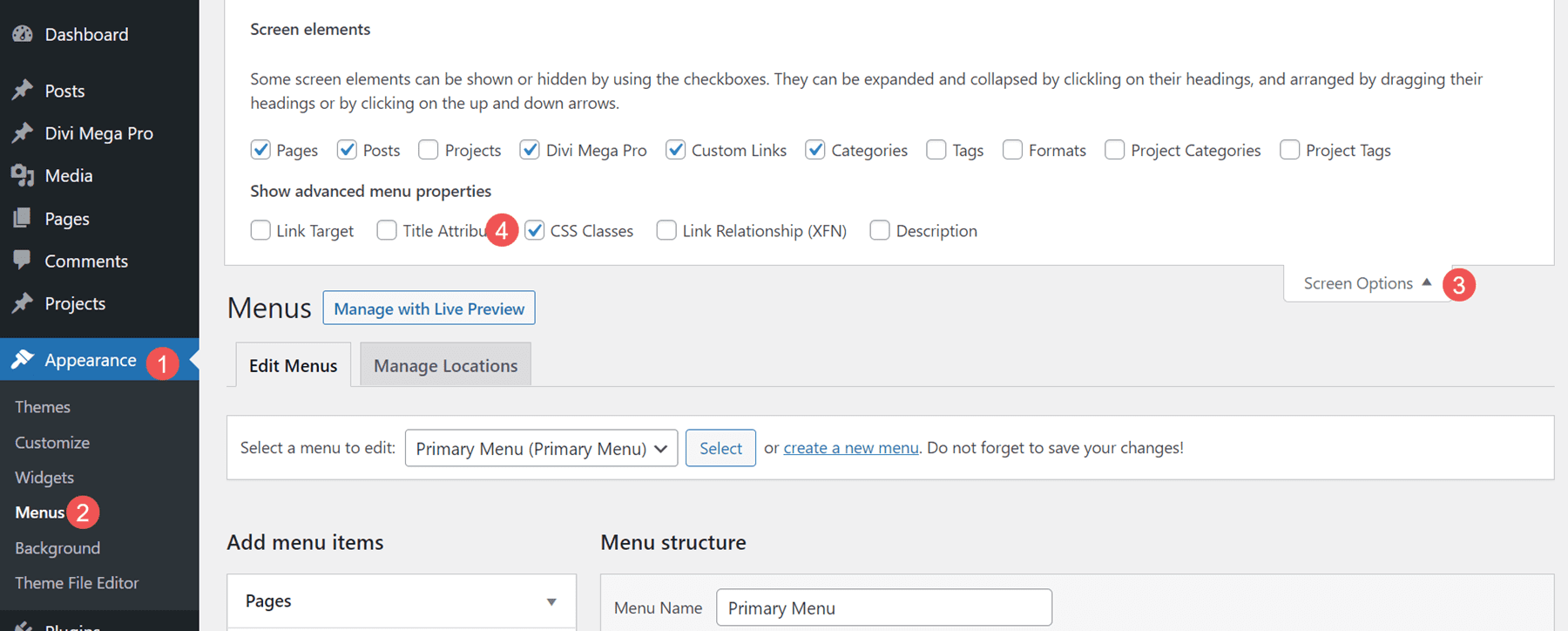
    To achieve this design, you will need to add a custom CSS class to some of the menu items. In the WordPress dashboard, navigate to Appearance > Menus. At the top of the page, open the Screen Options and enable CSS Classes.

    Divi Product Highlight DiviWP Header Sections Pack Layout 3 Enable CSS

    Then, open the menu item you would like to display as a button and add the CSS class diviwp-menu-button.

    Divi Product Highlight DiviWP Header Sections Pack Layout 3 CSS button

    Next, add the CSS class diviwp-menu-right-align to the menu item you would like to align to the right. Anything to the right of this item will be aligned to the right of the header, and everything to the left of this item will be center-aligned.

    Divi Product Highlight DiviWP Header Sections Pack Layout 3 CSS

    Header Layout 4

    Header Layout 4 is similar to Layout 3, except with slide-in mobile menu transitions and fade-in drop-down transitions for tablet and mobile sub-menus. Additionally, the parent menu item for the sub-menu is not linked.

    Divi Product Highlight DiviWP Header Sections Pack Layout 4 Desktop

    Divi Product Highlight DiviWP Header Sections Pack Layout 4 Tablet

    Divi Product Highlight DiviWP Header Sections Pack Layout 4 Mobile

    I used Header Layout 4 to demonstrate a mega menu layout. To achieve this design, first follow the instructions to create a mega menu. Be sure to enter the CSS class mega-menu on the parent item. Each of the header sections in the DiviWP Header Sections Pack supports mega menus.

    Divi Product Highlight DiviWP Header Sections Pack Layout 4 Mega Menu CSS

    Header Layout 5

    Layout 5 is a right-aligned header with a dark background. It features fade-in mobile menu transitions.

    Divi Product Highlight DiviWP Header Sections Pack Layout 5 Desktop

    Divi Product Highlight DiviWP Header Sections Pack Layout 5 Tablet

    Divi Product Highlight DiviWP Header Sections Pack Layout 5 Mobile

    Header Layout 6

    Header Layout 6 also features a dark background section. The sub-menu also has a dark background style.

    Divi Product Highlight DiviWP Header Sections Pack Layout 6 Desktop

    Divi Product Highlight DiviWP Header Sections Pack Layout 6 Tablet

    Divi Product Highlight DiviWP Header Sections Pack Layout 6 Mobile

    Header Layout 7

    Layout 7 has a light background and has a 3/4 – 1/4 row column layout with the button on the right. The button also appears alongside the hamburger menu icon on tablet and mobile.

    Divi Product Highlight DiviWP Header Sections Pack Layout 7 Desktop

    Divi Product Highlight DiviWP Header Sections Pack Layout 7 Tablet

    Header Layout 8

    Layout 8 features social media icons on the right. On mobile and tablet devices, social media icons appear alongside the hamburger menu icon. The header also uses fade-in drop-down transitions for the tablet and mobile sub-menus.

    Divi Product Highlight DiviWP Header Sections Pack Layout 8 Desktop

    Divi Product Highlight DiviWP Header Sections Pack Layout 8 Tablet

    Divi Product Highlight DiviWP Header Sections Pack Layout 8 Mobile

    Header Layout 9

    Header Layout 9 has a dark top row with blurb modules for contact information and social media follow icons. The main menu is the same as Header Layout 1.

    Divi Product Highlight DiviWP Header Sections Pack Layout 9 Desktop

    Divi Product Highlight DiviWP Header Sections Pack Layout 9 Tablet

    Divi Product Highlight DiviWP Header Sections Pack Layout 9 Mobile

    Header Layout 10

    Header Layout 10 has a top row with a menu module and a social media follow module, allowing you to add additional menu items or links to the top menu bar. Again, the main menu is the same as Header Layout 1.

    Divi Product Highlight DiviWP Header Sections Pack Layout 10 Desktop

    Divi Product Highlight DiviWP Header Sections Pack Layout 10 Tablet

    Divi Product Highlight DiviWP Header Sections Pack Layout 10 Mobile

    Header Layout 11

    The top row of Header Layout 11 features a blurb module, social media follow icons, and a button. Again, the main menu is the same as Header Layout 1.

    Divi Product Highlight DiviWP Header Sections Pack Layout 11 Desktop

    Divi Product Highlight DiviWP Header Sections Pack Layout 11 Tablet

    Divi Product Highlight DiviWP Header Sections Pack Layout 11 Mobile

    Header Layout 12

    Header Layout 12 places social media icons on the left side of the top row and two blurb modules on the right. Once again, the layout for the main menu is the same as Header Layout 1.

    Divi Product Highlight DiviWP Header Sections Pack Layout 12 Desktop

    Divi Product Highlight DiviWP Header Sections Pack Layout 12 Tablet

    Divi Product Highlight DiviWP Header Sections Pack Layout 12 Mobile

    Header Layout 13

    Header Layout 13 features a blurb module, a menu, social media icons, and a button on the top menu. It also comes with a 2-column mega menu layout for desktop with an optional button at the bottom. To achieve this design, you will first need to create a menu with a parent menu item, two sub-menu items for the two columns (labeled Col 1 and Col 2 in the screenshot below), and the menu items below.

    Divi Product Highlight DiviWP Header Sections Pack Layout 13 Desktop

    Divi Product Highlight DiviWP Header Sections Pack Layout 13 Tablet

    Divi Product Highlight DiviWP Header Sections Pack Layout 13 Mobile

    First, add the CSS Class mega-menu two-column to the parent item.

    Divi Product Highlight DiviWP Header Sections Pack Layout 13 Mega Menu CSS

    Then add the CSS Class diviwp-menu-col-1 to the first column menu item, and diviwp-menu-col-2 to the second column menu item.

    Divi Product Highlight DiviWP Header Sections Pack Layout 13 Column CSS

    Finally, add the CSS Class fullwidth to the button menu item.

    Divi Product Highlight DiviWP Header Sections Pack Layout 13 Button CSS

    Header Layout 14

    Header Layout 14 is a 3-column mega menu variation of Layout 13. For this layout, follow the steps for Header Layout 13 and add another column.

    Divi Product Highlight DiviWP Header Sections Pack Layout 14 Desktop

    Divi Product Highlight DiviWP Header Sections Pack Layout 14 Tablet

    Divi Product Highlight DiviWP Header Sections Pack Layout 14 Mobile

    To the third column item, add the following CSS Class: diviwp-menu-col-3

    Divi Product Highlight DiviWP Header Sections Pack Layout 14 Column 3 CSS

    Finally, add the CSS class mega-menu three-column to the parent item.

    Divi Product Highlight DiviWP Header Sections Pack Layout 14 Mega Menu 3 Column

    Header Layout 15

    Layout 15 features two blurb icons on the top menu bar. The primary menu has a light background and is the same as Layout 1.

    Divi Product Highlight DiviWP Header Sections Pack Layout 15 Desktop

    Divi Product Highlight DiviWP Header Sections Pack Layout 15 Tablet

    Divi Product Highlight DiviWP Header Sections Pack Layout 15 Mobile

    Header Layout 16

    Header Layout 16 is mostly the same as Header Layout 15, except the blurb icons are on the left side of the top menu bar.

    Divi Product Highlight DiviWP Header Sections Pack Layout 16 Desktop

    Divi Product Highlight DiviWP Header Sections Pack Layout 16 Tablet

    Divi Product Highlight DiviWP Header Sections Pack Layout 16 Mobile

    Header Layout 17

    Layout 17 features two blurbs on the left side of the top menu bar and social media icons with a round white background on the right side of the top menu bar.

    Divi Product Highlight DiviWP Header Sections Pack Layout 17 Desktop

    Divi Product Highlight DiviWP Header Sections Pack Layout 17 Tablet

    Divi Product Highlight DiviWP Header Sections Pack Layout 17 Mobile

    Header Layout 18

    Layout 18 is a slight variation of Layout 17. In this design, the social media icons are on the left and the blurbs are on the right side of the top menu bar.

    Divi Product Highlight DiviWP Header Sections Pack Layout 18 Desktop

    Divi Product Highlight DiviWP Header Sections Pack Layout 18 Tablet

    Divi Product Highlight DiviWP Header Sections Pack Layout 18 Mobile

    Header Layout 19

    Layout 19 features the blurb icons on the left and the social media icons on the right, as well as a button on the very right.

    Divi Product Highlight DiviWP Header Sections Pack Layout 19 Desktop

    Divi Product Highlight DiviWP Header Sections Pack Layout 19 Tablet

    Divi Product Highlight DiviWP Header Sections Pack Layout 19 Mobile

    Header Layout 20

    The final layout, Layout 20, is a variation of Layout 19. In this design, the blurb icons are on the left and the button icon is on the right. The social media icons are on the very right.

    Divi Product Highlight DiviWP Header Sections Pack Layout 20 Desktop

    Divi Product Highlight DiviWP Header Sections Pack Layout 20 Tablet

    Divi Product Highlight DiviWP Header Sections Pack Layout 20 Mobile

    Customizing the DiviWP Header Sections Pack

    The DiviWP Header Sections Pack is completely customizable since it is built with the Divi Builder. You can easily change any of the colors, fonts, text, and icons just like you would customize any other Divi module. There is also extensive support and documentation for the DiviWP Header Sections Pack so that you can further customize the look of your header.

    Purchase the DiviWP Header Sections Pack

    The DiviWP Header Sections Pack is available in the Divi Marketplace. It costs $19 for unlimited website usage and lifetime support and updates. The price also includes a 30-day money-back guarantee.

    Final Thoughts

    The DiviWP Header Sections Pack comes with 20 premade header sections that can be completely customized to fit the design of your website. If you want to view a live demo of the different headers, you can do so here. This pack could be very useful if you don’t want to spend the time to create a custom header for your website but want to have a unique design for your header beyond the default Divi layouts.

    We would love to hear from you! Have you tried DiviWP Header Sections Pack? Let us know what you think about it in the comments!

    The post Divi Product Highlight: DiviWP Header Sections Pack appeared first on Elegant Themes Blog.

  • Divi SEO Agency Theme – Divi Child Theme Overview

    The Divi SEO Agency Theme features 30+ prebuilt pages, ideal for an SEO agency or a web service provider website you want to build using Divi. The site consists of dynamic pages full of eye-catching motion and comes with variations of several pages, giving you some flexibility with your website design. In this post, we’ll take a look at the Divi SEO Agency theme to help you decide if it’s the right Divi child theme for you.

    Let’s get started!

    Installing Divi SEO Agency Theme

    To install the Divi SEO Agency Theme, open your WordPress Dashboard and navigate to the add new themes page. Click Upload Theme, upload the ZIP file containing the child theme, and click import. Once installed, activate the theme.

    Divi SEO Agency Theme Divi Child Theme Overview Install-2

    Once the child theme is installed and activated, you will see a new menu item in your Dashboard called “Imports Demo Data”. Click the Easy Demo Import tab and import the demo content. Once the import is complete, you are all set to begin replacing the demo content with your own.

    Divi SEO Agency Theme Divi Child Theme Overview Install-1

    Divi SEO Agency Theme

    The Divi SEO Agency theme consists of 30+ pages. Let’s take a look at each page, starting with the home page, which has four variations.

    Divi SEO Agency Theme Home V1

    Divi SEO Agency Theme Home V1 Header and Introduction

    The header features a large image that moves up and down on the page. The geometric shapes in the background of this section also move. On the right side are the header text and a call-to-action button. Below there are four blurb sections with an icon, a title, some text, and a link to read more. These modules move up on hover.

    Divi SEO Agency Theme Divi Child Theme Overview Home V1 Header

    Divi SEO Agency Theme Home V1 About

    The next few sections are where you can introduce your services. The first section features a couple of paragraphs of about text and an image that floats up and down. Next are three blurbs with an icon featuring three different services. These sections also move up on hover and the geometric shapes in the background move while you are on the page. The third section features six blurbs with icons where you can introduce your services. The image in the middle moves up and down.

    Divi SEO Agency Theme Divi Child Theme Overview Home V1-7

    Divi SEO Agency Theme Home V1 Lead Magnet

    Next is a lead magnet section where visitors can submit their website and email address to receive an SEO check.

    Divi SEO Agency Theme Divi Child Theme Overview Home-V1-6

    Divi SEO Agency Theme Home V1 Benefits

    This section is where you can outline the benefits for your customer to use your services. It uses a moving image on the left and bar graphs on the right.

    Divi SEO Agency Theme Divi Child Theme Overview Home-V1-5

    Divi SEO Agency Theme Home V1 Social Proof

    This section features company logos for social proof.

    Divi SEO Agency Theme Divi Child Theme Overview Home V1-4

    Divi SEO Agency Theme Home V1 Team

    Divi SEO Agency Theme Divi Child Theme Overview Home V1-3

    In this section, you can feature your team members. On hover, the blue and orange circles around the profile photo rotate. This section features social media icons for each team member.

    Divi SEO Agency Theme Home V1 Testimonials

    Divi SEO Agency Theme Divi Child Theme Overview Home V1-2

    This section features a slider with client testimonials. The blue circle over this section moves as you are on the page.

    Divi SEO Agency Theme Home V1 Latest News

    This is the final section on the home page and it features the latest blog posts. The blog category is listed over the featured image and there is a read more link to bring readers to the full post.

    Divi SEO Agency Theme Divi Child Theme Overview Home V1-1

    Divi SEO Agency Theme Home V2

    The second version of the home page features a large header with some text and buttons with moving geometric shapes. Then there is the list of company logos and a list of three features highlighted below. Following this is a number counter which counts up as the page loads. Next is a section highlighting benefits, with 4 numbered blurbs.

    Divi SEO Agency Theme Divi Child Theme Overview Home V2-1

    These two sections continue to introduce the services. In the first section, you have six blurbs with icons and some description text. On hover, the background turns white. In the second section you have five tabs with a description, a read more link, and an image under each tab. This page also has the same team section and recent news section as was found on Home V1.

    Divi SEO Agency Theme Divi Child Theme Overview Home V2-2

    Divi SEO Agency Theme Home V3

    The third version of the home page has a floating menu bar and a large graphic background with text on the left. The main header image floats up and down and the geometric shapes move while you are on the page. Below are three blurbs highlighting some features.

    Divi SEO Agency Theme Divi Child Theme Overview Home V3-2

    This page also has a pricing table with the cost, features, and a button to choose the plan. In addition to the unique features we covered, this page also has the SEO check lead magnet, company logos, benefits with numbered blurbs, benefits with progress bars, and latest news sections we saw on other pages.

    Divi SEO Agency Theme Divi Child Theme Overview Home V3-1

    Divi SEO Agency Theme Home V4

    The fourth version of the home page is all on a darker background. The header has some text and a button on the left with a moving image on the right. Below is a number counter. The about section features three text sections connected with the dotted heart icon.

    Divi SEO Agency Theme Divi Child Theme Overview Home V4-2

    Another unique section for home version 4 is the “we deliver success” section. There is some introductory text with a dynamic moving image. Below are round number counters representing percentages relevant to the services the company provides. Aside from these unique sections, home version 4 features company logos, blurbs with icons, an SEO check lead magnet, team members, and recent posts.

    Divi SEO Agency Theme Divi Child Theme Overview Home V4-1

    Divi SEO Agency Theme Landing Page

    The landing page features a dynamic header with moving elements, feature blurbs with icons, and placeholders for images that link to inner pages. This page also features several sections with text, images, and call-to-action buttons where you can describe your services and unique features.

    Divi SEO Agency Theme Divi Child Theme Overview Landing-1

    Divi SEO Agency Theme Coming Soon Page

    The coming soon page features a countdown timer and some text. There is also an email sign-up form and social media icons.

    Divi SEO Agency Theme Divi Child Theme Overview Coming Soon

    Divi SEO Agency Theme About Us Page

    The about us page features many of the same sections found on the home pages. It starts with a dynamic header with moving geometric shapes. The following section has some about text and a number counter. The page also features team members, testimonials, and company logos.

    Divi SEO Agency Theme Divi Child Theme Overview About Us

    Divi SEO Agency Theme Our Team Page

    This page starts with a dynamic header and a section with some about text, an image, and number counters. Then follows the company logos and the team members section. Finally, there is a contact form at the bottom and some numbered blurbs featuring company benefits.

    Divi SEO Agency Theme Divi Child Theme Overview Our Team

    Divi SEO Agency Theme Single Team Page

    This page features a single team member. It has a profile card at the top with the name, title, social media icons, photo, and other relevant information. Below is a longer bio section with personal info, press and awards, professional info, and a contact form.

    Divi SEO Agency Theme Divi Child Theme Overview Single Team

    Divi SEO Agency Theme Our Process Page

    The our process page features a timeline with an orange dot that moves as you scroll. As the orange dot moves past each step, the icon gets covered with an orange border. Also on this page is the SEO check lead magnet, some features highlighted in a blurb with an icon and description text, and a section introducing services with three tabs.

    Divi SEO Agency Theme Divi Child Theme Overview Our Process

    Divi SEO Agency Theme Pricing Tables Page

    The pricing tables page features two different pricing tables. The first layout has two pricing cards at an angle. When you hover over the card it comes to the front and straightens out. The second version is what was on the home page version 3.

    Divi SEO Agency Theme Divi Child Theme Overview Pricing

    Divi SEO Agency Theme FAQ Page

    The FAQ page begins with some blurbs with icons, then features a call-to-action section with a button. Then there are the FAQ questions listed under a toggle.

    Divi SEO Agency Theme Divi Child Theme Overview FAQ

    Divi SEO Agency Theme Headers

    The headers page features three header styles that can be used on the website. The first header style features the address, phone, email, and social media information at the top. The menu bar is on a white background and features the logo, menu items, search icon, and another icon that reveals a sidebar with contact information.

    The second header style also features the address, phone and email, and social media information at the top. It also features the logo, menu items, search icon, and sidebar icon with contact information.

    Finally, the third header style has a dark blue background for the top bar. It features social media icons, the phone number, and email address. The main menu bar features the logo and menu items on a red background.

    Divi SEO Agency Theme Divi Child Theme Overview Header 1

    This is the sidebar that appears when you select the icon with the four rounded squares on Header V1 and V2.

    Divi SEO Agency Theme Divi Child Theme Overview Header 2

    Divi SEO Agency Theme Footers Page

    The footers page features the footer variations available for the theme. Footer 1 features the phone and email information as well as a newsletter sign-up form. Below is some about text with social media links, quick links to pages, a useful services section linking to other pages, and a latest news section featuring a couple of recent posts.

    Footer 2 features the logo and about text with social media icons below. Additionally, there are some quick links and a useful services section. The final column features contact information. Below this is a newsletter sign up form and copyright information.

    Footer 3 features a red background with a headline and a call-to-action button. Below this is some about text and social media icons, contact information, useful links, and latest news. At the bottom of the footer you have the terms of use, privacy policy, and copyright information.

    Divi SEO Agency Theme Divi Child Theme Overview Footer

    Divi SEO Agency Theme Services V1

    The services page features blurbs with icons and a short description of the services. The next section features a large image, some text, and two icons highlighting some features. There is also a pricing table and number counters on this page, as well as a bar graph counter.

    Divi SEO Agency Theme Divi Child Theme Overview Services V1

    Divi SEO Agency Theme Services V2

    The second version of the services page starts with some tabs with large icons. Each tab has text and an image explaining the service. Next, there is the SEO check lead magnet and company logos, followed by a section with blurbs. The geometric shapes on these blurbs move as you are on the page. The page ends with a form to sign up for free SEO analysis, some about text with checkmarks, and a number counter.

    Divi SEO Agency Theme Divi Child Theme Overview Services V2

    Divi SEO Agency Theme Services V3

    The third services page layout begins with a some text alongside an image. Below this there are some blurbs with icons on the left and some tabs with service details on the right. Following this are numbered feature highlights with icons. The blue circle around these icons move as you hover. Also on this page is the SEO check lead magnet, a bar graph counter, and company logos.

    Divi SEO Agency Theme Divi Child Theme Overview Services V3

    Divi SEO Agency Theme Services List Page

    This page is where you can list all of your services. It is designed with an image on one side an text on the other describing the service, as well as a button to go to the full dedicated services page. Below this are two SEO check lead magnet forms, company logos, and a number counter.

    Divi SEO Agency Theme Divi Child Theme Overview Services List

    Divi SEO Agency Theme Single Service Page

    The single service page is a dedicated page for each service. It features a large image at the top, description text, a bar graph counter, blurbs with icons, tabs with service descriptions, and a team members section. On the left there is a sidebar with links to other service pages, blurbs highlighting phone and email support, and a form for the SEO check lead magnet.

    Divi SEO Agency Theme Divi Child Theme Overview Single Service

    Divi SEO Agency Theme Portfolio Page

    The portfolio page features two layouts, one with large featured images and a title and category that appear on hover. The second layout is similar to the first but features a category filter at the top.

    Divi SEO Agency Theme Divi Child Theme Overview Portfolio

    There are two variations of this page, one with two columns and one with three columns.

    Divi SEO Agency Theme Divi Child Theme Overview Portfolio 2

    Divi SEO Agency Theme Divi Child Theme Overview Portfolio 3

    Divi SEO Agency Theme Portfolio Category

    The portfolio category features the relevant projects. When you hover over the featured image you can see the title and category.

    Divi SEO Agency Theme Divi Child Theme Overview Portfolio Category

    Divi SEO Agency Theme Portfolio Project Page

    The portfolio project page features a large image, icons to represent some project details, and text and images to review the project. The page ends with related projects and a comment section.

    Divi SEO Agency Theme Divi Child Theme Overview Portfolio Project

    Divi SEO Agency Theme Blog Page

    The blog page features a grid layout with recent posts. There is also a two-column and four-column version of this page.

    Divi SEO Agency Theme Divi Child Theme Overview Blog Grid

    Divi SEO Agency Theme Blog Listing Page

    The blog listing page features recent posts with a preview and featured image. On the right, you have a search bar, recent posts, categories, a calendar, and recent comments.

    Divi SEO Agency Theme Divi Child Theme Overview Blog Listing

    Divi SEO Agency Theme Blog Grid 2 Columns with Sidebar Page

    This layout uses the grid layout for recent posts and features the sidebar that is on the blog listing page as well.

    Divi SEO Agency Theme Divi Child Theme Overview Blog Grid Sidebar

    Divi SEO Agency Theme Single Post Page

    This page features a single post with a sidebar. The page ends with latest posts and a comment section.

    Divi SEO Agency Theme Divi Child Theme Overview Single Post

    Divi SEO Agency Theme Single Category Page

    The single category page features a single blog category. It uses a 3 column grid layout.

    Divi SEO Agency Theme Divi Child Theme Overview Single Category

    Divi SEO Agency Theme Contact Page

    The contact page features the contact information next to an image, a contact form, and a map.

    Divi SEO Agency Theme Divi Child Theme Overview Contact

    Where to Purchase the Divi SEO Agency Theme

    The Divi SEO Agency Theme is available in the Divi Marketplace. It costs $39.99 for unlimited website usage and lifetime support and updates. The price also includes a 30-day money-back guarantee.

    Divi SEO Agency Theme Tutorial

    Final Thoughts

    The Divi SEO Agency Child Theme is modern, clean, and full of dynamic layouts to capture your website visitor’s attention and convert new customers. It is perfect for SEO agencies, software companies, and web service providers, but can be customized to fit many different types of websites. If you are looking for a modern and dynamic website with lots of graphics and movement, this could be a great option for you.

    We would love to hear from you! Have you tried the Divi SEO Agency theme? Let us know what you think about it in the comments!

    The post Divi SEO Agency Theme – Divi Child Theme Overview appeared first on Elegant Themes Blog.

  • Divi Plugin Highlight: Divi SuperTabs

    Divi SuperTabs is a third-party plugin for Divi that adds a tab module to the Divi Builder. Although the Divi Builder already has a tab module, this plugin offers some unique design options and features that allow you to create more complex tabs for your Divi website. In this plugin highlight, we’ll see what Divi SuperTabs can do and help you decide if this is the right plugin for your website.

    Let’s get to it!

    Installing Divi SuperTabs

    Installing Divi SuperTabs is simple and straightforward. Navigate to the plugin page on your WordPress dashboard, then click upload plugin. Upload the ZIP file for the plugin, then activate the plugin once it is installed.

    Divi Plugin Highlight Divi SuperTabs Install

    Divi SuperTabs Module

    A new module is added to the Divi Builder called SuperTabs. This module allows you to add complex and customizable tabs to your Divi layout. Let’s look at the main features.

    Divi Plugin Highlight Divi SuperTabs Add Module

    Divi SuperTabs Tab Settings

    Under the content tab for the SuperTabs settings, you can add your tabs. Each tab also has its own settings menu, allowing you to customize the design of each individual tab.

    Divi Plugin Highlight Divi SuperTabs New Tab

    Tab Settings – Content

    Within each tab’s settings, you can add the tab content such as the title, subtitle, and tab content.

    Divi Plugin Highlight Divi SuperTabs Tab Content

    In the Layout section, you can select from a variety of layouts for the content in your tab. In the example above, I used the Image Left, Text, Button layout.

    Divi Plugin Highlight Divi SuperTabs Tab Layout

    Alternatively, you can select the library option to use any Divi Library layout in a tab, allowing you to create more complex designs using other Divi modules.

    Divi Plugin Highlight Divi SuperTabs Library Layout 2

    To use a library item with Divi SuperTab, save your desired layout to the Divi Library and make sure to add it to the “Tabs Content” category.

    Divi Plugin Highlight Divi SuperTabs Add To Library

    Then, select Library under the tab layout settings and add your Divi Library layout.

    Divi Plugin Highlight Divi SuperTabs Library Layout

    Also under the content tab of the tab settings, you can add an icon to your tab. SuperTab allows you to use Divi’s default icons, FontAwesome’s icons, and even upload your own custom icons.

    Divi Plugin Highlight Divi SuperTabs Tab Icon

    You can also set a tab to link to a URL so that the link opens when the tab is selected. This is a handy way to link to external websites alongside your tab content. You can also set a link for the entire module as well under the Link settings.

    Divi Plugin Highlight Divi SuperTabs Tab Link

    Finally, you can set a unique background for your tab. The background settings include all of Divi’s default background options (color, gradient, image, video, pattern, and mask). In this example, I added a simple color background to this tab.

    Divi Plugin Highlight Divi SuperTabs Tab Background

    Tab Settings – Design

    Under the design tab of the tab settings, you can find many options to completely customize the look of your tab. When you customize the design this way, your changes are only applied to the individual tab you are editing, not the rest of the tabs. The design options within the individual tab settings are the same as the design options within the SuperTabs settings, so the main difference is whether you want your design to apply to every tab or only apply to a single tab.

    With the design settings, you can edit the look of the navigation, tab, content, layout, text, sizing, spacing, etc. We’ll go over all of the design options in detail later on in this article.

    Divi Plugin Highlight Divi SuperTabs Tab Design Settings

    Tab Settings – Advanced

    Under the Advanced tab, you have all of the default Advanced Divi options including Custom CSS, Conditions, Visibility, Transitions, Position, and Scroll Effects.

    Divi Plugin Highlight Divi SuperTabs Tab Advanced Settings

    Divi SuperTabs Content Tab

    Now that we have covered the settings for the individual tabs within the Divi SuperTabs module, let’s explore the general settings for the SuperTabs module, starting with the content tab. As we already covered, here is where you add each of your tabs.

    Arrow

    With this option, you can add an arrow to your tabs that will display on the active tab. You can see an example of this above. The arrow color can be customized in the design tab.

    Divi Plugin Highlight Divi SuperTabs Arrow

    Link

    This option is a default Divi module option allowing you to link the module to a URL.

    Background

    You can add a background to the module with the Background option. When you add a background this way, the color spans the tab navigation and the content area. In this example, I added a yellow background to the module. There are other background options in the Design tab, which allow you to add different colors for the tabs and content area. We’ll go over those design options in the next section.

    Divi Plugin Highlight Divi SuperTabs Background

    Divi SuperTabs Design Tab

    The design tab is where this plugin really shines. There are many options for you to customize every aspect of the SuperTabs module. Let’s take a look.

    Nav Settings

    Under the Nav settings, you can change the navigation placement, alignment, and subtitle placement. In the example above, the navigation placement is set to Left. You can also make the tabs sticky so that they stick to the top of the page as you scroll through the tab content.

    Divi Plugin Highlight Divi SuperTabs Nav Settings

    Also under the nav settings, you can completely customize the nav spacing by changing the nav width, margin, padding, and gutter. In this example, I removed the left padding and changed the nav width to 20%. Finally, you can customize the colors and overall design of the navigation bar by changing the background color, adding rounded corners, or adding a border. I changed the navigation bar background to green.

    Divi Plugin Highlight Divi SuperTabs Nav Settings 2

    Tab Settings

    In the tab settings, you can customize the tab padding, the active tab background color, and the inactive tab background color. You can also change the icon placement, alignment, margin, and size. Finally, you can choose to hide the icon or title, add rounded corners, or add a border.

    In the example below I changed the active tab background color to a lighter green and changed the icon placement to left and added an icon margin.

    Divi Plugin Highlight Divi SuperTabs Active Tab Background

    Arrow Settings

    In the arrow settings, you can change the arrow color. I changed it to a lighter green to match the active tab background color.

    Divi Plugin Highlight Divi SuperTabs Arrow Settings

    Content Settings

    Here you can customize the overall design for the content in your tabs. You can add padding, rounded corners, and a border. I added some padding to the content section to bring a better balance to the overall design.

    Divi Plugin Highlight Divi SuperTabs Content Settings

    Layout

    In the layout settings, you can set the nav bar to be inset, displaying within the frame of the tab.

    Divi Plugin Highlight Divi SuperTabs Inset

    Nav Item Text

    Here you can customize the nav item font, font weight, style, color, size, spacing, line height, and shadow. Here I changed the nav item font color to white, This also changes the icon color.

    Divi Plugin Highlight Divi SuperTabs Nav Font

    Active Nav Item Text

    The Active Nav Item Text settings have the same settings as the nav item text settings, but these options apply only to the nav item when it is active (selected). Here I changed the active nav item text color to orange.

    Divi Plugin Highlight Divi SuperTabs Active Nav Text Color

    Sub Title Text

    Here you can customize the subtitle text design. The options are the same as the nav text options.

    Divi Plugin Highlight Divi SuperTabs Subtitle Text

    Active Tab Sub Title Text

    And in this section you can customize the active subtitle text design. Again, we have the same customization options as the last three sections, but these settings only apply to the subtitle when it is active.

    Other Design Settings

    In addition to the unique settings we covered, there are also other default options such as sizing, spacing border, box shadow, filters, transform, and animation.

    Divi Plugin Highlight Divi SuperTabs Design Settings

    Divi SuperTabs Advanced Tab

    The Advanced tab for Divi SuperTabs is pretty standard. You can add custom CSS to customize the module even more, and you can use the other settings such as conditions, visibility, transitions, position, and scroll effects to bring your SuperTabs design to the next level.

    Divi Plugin Highlight Divi SuperTabs Advanced

    Divi SuperTabs Examples

    Here are a few examples of how you can use Divi SuperTabs.

    Pricing Table

    The first example is a pricing table. The content is from the Device Repair layout pack. I saved each of the pricing tables to the Divi Library and used the Library layout feature to add the content to each tab. This makes it easy to add more complex content layouts in the tabs.

    Divi Plugin Highlight Divi SuperTabs Example 1

    How It Works

    The second example uses the tabs to organize different steps of a process. This layout was made using the Estate Planning layout pack. I used the individual tab settings to set a different tab color and background for each of the tabs.

    Divi Plugin Highlight Divi SuperTabs Example 2

    Features

    The final example uses the Divi Home Staging Layout Pack. I used SuperTabs to organize some of the features being highlighted on the page. Additionally, I used custom icons to add some visual interest to the tabs.

    Divi Plugin Highlight Divi SuperTabs Example 3

    Purchase Divi SuperTabs

    Divi SuperTabs is available in the Divi Marketplace. Marketplace. It costs $29 for unlimited website usage and 1 year of support and updates. The price also includes a 30-day money-back guarantee.

    Final Thoughts

    Divi SuperTabs is a feature-packed plugin for the Divi Builder that allows you to create complex tabs for your Divi website. This plugin’s strong suit is definitely the ability to import layouts from your Divi library as a tab, allowing you to add complex tab content containing other Divi modules. Additionally, the customizability of the plugin is great. With all of the settings available you can customize and fine-tune the tabs to achieve the exact look you want.

    Overall Divi SuperTabs is very easy to set up and use, and you can create great-looking tabs to organize the information on your website. If you feel limited by Divi’s native tabs module or want to use Divi Library content within your tabs, this plugin might be a great option for you.

    We would love to hear from you! Have you tried Divi SuperTabs? Let us know what you think about it in the comments!

    The post Divi Plugin Highlight: Divi SuperTabs appeared first on Elegant Themes Blog.

  • Divi Plugin Highlight: Divi Ajax Filter

    Divi Ajax Filter is a third-party plugin that adds several new modules to the Divi Builder. These modules work together to create simple or complex filters. Divi Ajax Filter works with pages, posts, projects, and custom post types such as WooCommerce products and Advanced Custom Fields. In this post, we’ll look at Divi Ajax Filter and see how it works to help you decide if this is the right product for your needs. We’ll be using the Divi Whiskey Layout Pack to showcase how you can use this plugin in the wild.

    Divi Ajax Filter Modules

    Divi Ajax Filter adds a block to the Divi Builder. Clicking this opens a submenu with the Ajax Filter Modules. The modules work together to a list of posts with a filter. You can use them to create layouts or display layouts you’ve created.

    The Divi Ajax Filter Modules

    Archive Loop – Divi Ajax Filter

    The Archive Loop Module displays any loop layout that you choose to display products or posts. In other words, it displays a list of the custom post type you choose. If you choose the product post type, it will display a list of your products. It can’t be used in the Custom Loop Layout. It’s designed to be used with archives, category pages, and general pages.

    Until you create and specify a loop layout, you’ll see a message to create one. The loop layout should be created with the Divi Ajax Modules such as the Post Title and Thumbnail. You can also choose the default WooCommerce loop.

    Module Options

    Archive Loop – Divi Ajax Filter

    You can also choose the post type such as posts, pages, media, projects, and products. Have it auto-detect your post type or set variable products as single products.

    Archive Loop – Divi Ajax Filter Post Type

    For the loop style, choose between a WooCommerce layout or a custom layout. If you choose Custom Layout, you’ll see another dropdown box where you can choose a layout from your Divi Library.

    Archive Loop – Divi Ajax Filter Loop Style

    Choose the number of posts to display. This gives you control over the number that’s displayed within the module’s area, but you can show more posts with pagination a Load More button. Setting it as the main loop makes it the list of posts the filter controls. You can also add an order by sorting option and show the number of results.

    Archive Loop – Divi Ajax Filter Show Results and Order by Menu

    The number of results still shows 1-9 results in the Divi Builder, but it will show the correct number of results on the front end as shown in the example below.

    Archive Loop – Divi Ajax Filter

    There are several options for how pagination is displayed. Choose from Load More, standard pagination, an infinite scroll, or none.

    Archive Loop – Divi Ajax Filter - Pagiation

    Have it scroll to the top after the ajax update or disable the feature. You can also fine-tune the pagination’s position.

    Archive Loop – Divi Ajax Filter - Pagination

    Disable, exclude, or include lots of elements such as products when the category has child categories, specific categories, and products. You can also set certain items to be included on load only. Enter them into the fields with commas.

    Archive Loop – Divi Ajax Filter - Pagination

    Choose the animation for the filter and the infinite scroll option. It has six animations to choose from including three lines vertical, three lines horizontal, three dots bouncing, donut, donut multiple, and ripple. The animations are smooth and give it an extra sparkle.

    Archive Loop – Divi Ajax Filter - Pagination, Scrolling

    Custom Layout Options

    The Custom Layout Options let you choose a layout that you’ve created to use as your custom taxonomy. You can also specify the custom taxonomies to include.

    Archive Loop – Divi Ajax Filter - Custom Layout Options

    Default Layout Options

    The default layout options let you choose between a grid or a classic blog layout. For the grid, choose the number of columns to display. You can also show the rating, excerpt, price, and the add to cart button.

    Archive Loop – Divi Ajax Filter - Default Layout Options

    Here’s how it looks on the front end. I’ve set it to display a grid with 4 columns. I’ve also disabled the excerpt option.

    Archive Loop – Divi Ajax Filter - Default Layout Options

    This one also includes color and padding options. Change the color of the sale badge, star ratings, and the product’s background. Use the slider to add padding to all four sides of the product. I’ve added some padding, colored the stars, and changed the color of the Sale Badge color.

    Color and Padding Options

    Here’s how it looks on the front end.

    Color and Padding Options

    Design Settings

    Design settings include detailed options for every element including fonts, colors, spacing, and the rest of the standard Divi settings.

    Pagination Color and Styling

    Filter Posts – Divi Ajax Filter

    The Filter Posts Module works with the Archive Loop Module to filter the posts it displays. It shouldn’t be used in the custom loop layout. The filter items are submodules. You can add as many as you want to create the filter.

    Filter Posts – Divi Ajax Filter

    New Filter Item

    Adding a new filter item opens its submodule. This includes lots of settings. The Main Settings let you choose what to filter between categories, tags, prices, ratings, attributes, and custom taxonomies. You can also create a search box. Choose the post types, values, exclude options, etc.

    Filter Posts – Divi Ajax Filter

    Layout lets you choose to show the filter parameters, show the label, and select the filter width.

    Filter Posts – Divi Ajax Filter

    The Select options let you enable Select2 and change the option text.

    Select Options

    Category, Tags, and Taxonomy lets you choose how the terms are ordered in the list, the display mode, the prefix, and the collapse options.

    Filter Posts – Divi Ajax Filter

    Range gives you full control over the filter’s range settings. Hide the labels, choose the value type, set the range, choose the step levels, adjust the appearance, choose before and after text, and more.

    Filter Posts – Divi Ajax Filter

    Conditional Logic lets you create logic rules for the filter. This means you can fine-tune the filter to control the filter and make it as smart as possible.

    Filter Posts – Divi Ajax Filter

    Add multiple filter items to create the exact filter you want. I’ve created a filter with a search option, categories, tags, and prices. Users can select one of the filter tools or use them together.

    Filter Posts – Divi Ajax Filter

    Main Filter Post Settings

    The Main Options include the filter update type (choose from a button click or a field change), choosing where it scrolls, adding text for the search and reset buttons, and enabling Select2.

    Filter Posts – Divi Ajax Filter

    The Layout Options determine the layout of the filter elements. Choose a side Colome or full-width column, set the sizes, the filter style between toggle and slide, and hide or show the buttons.

    Filter Posts – Divi Ajax Filter

    Mobile Options add toggles, let you choose the toggle style, change the button text, and toggle the filters individually.

    Filter Posts – Divi Ajax Filter

    Post Title – Archive Pages

    The Post Title Module displays the title and lets you choose the heading level, link to a single page, open a new tab, and enter the URL.

    Filter Posts – Divi Ajax Filter

    The Design tab includes separate settings for post titles and product titles. All the standard settings are included.

    Filter Posts – Divi Ajax Filter

    Thumbnail – Divi Ajax Filter

    The Thumbnail Module lets you choose the image size, link the image to a single page, use placeholder images with Advanced Custom Fields, open in a new tab, enable a title tag, and choose the image style.

    Filter Posts – Divi Ajax Filter

    The Thumbnail Image Sizes include lots of options.

    Filter Posts – Divi Ajax Filter

    Building a Product Filter

    Firstly, I’ll build a product filter using the Archive Loop Module and the Filter Posts Module.

    Building a Product Filter

    Next, for the Archive Loop Module, I’ve set it to Products and selected the default WooCommerce layout. This gives us the image, title, and price by default. I’ve set it as the main loop and enabled the Order By Menu and the Results Count. I selected Load More for the loading option. The Layout is set to a grid with 3 columns. I’ve also selected to show the rating, price, excerpt, and Add to Cart Button. The Sale Badge and Star Ratings have custom colors, and I’ve added some padding to the product.

    Filter Posts – Divi Ajax Filter

    Next are the design settings. I’ve adjusted the colors and styles of the individual text elements as well as the Add to Cart button.

    Filter Posts – Divi Ajax Filter

    Lastly, for the filter, I’ve added search, categories, price, and rating.  For the category filter, I selected Radio Buttons. The Price is set between $5 and $100.

    Filter Posts – Divi Ajax Filter

    For the Filter’s design settings, I’ve adjusted the font colors, button colors, etc.

    Filter Posts – Divi Ajax Filter

    Product Filter Results

    Here’s how it looks on the front end with the stylings of the Divi Whiskey Layout Pack.

    Filter Posts – Divi Ajax Filter

    Here’s the sorting feature. User’s can select the default sorting, sort by popularity, average rating, latest, price low to high, or price high to low.

    Filter Posts – Divi Ajax Filter

    Here are the results for the search option. I’m using the WooCommerce demo products. I searched for “pink” and found two results.

    Filter Posts – Divi Ajax Filter

    For the categories, I selected the “Kitchen” category radio button and found the four results.

    Filter Posts – Divi Ajax Filter

    In this example, I’ve filtered the products by price range. I’ve selected 5-30 and sorted by price from low to high.

    Filter Posts – Divi Ajax Filter

    You can also use the filters together. For this example, I’ve selected the “Kitchen” category and set the price range from $30 to $50. It shows the products in my inventory in that category and price range.

    Filter Posts – Divi Ajax Filter

    Where to Purchase Divi Ajax Filter

    Divi Ajax Filter is available in the Divi Marketplace for $97. It includes one year of support and updates and a 30-day money-back guarantee.

    Where to Purchase Divi Ajax Filter

    Ending Thoughts

    That’s our look at Divi Ajax Filter. This is a powerful set of modules for the Divi Builder that creates amazing filters for lots of WordPress post types. Divi Ajax Filter is complex. It does take some time to learn, but it’s not too difficult to understand and use once you get started. Following the demos will save you some time and reduce the learning curve considerably. If you’re interested in an advanced filter for your post types, Divi Ajax Filter is a great choice.

    We want to hear from you. Have you tried Divi Ajax Filter? Let us know what you think about it in the comments.

    The post Divi Plugin Highlight: Divi Ajax Filter appeared first on Elegant Themes Blog.

  • Divi Plugin Highlight: Divi Mega Pro

    Divi Mega Pro is a third-party plugin for Divi that adds the ability to create mega menus and tooltips with the Divi Builder. Since the mega menus and tooltips are created with the Divi Builder, you can use any modules you want, including third-party modules, shortcodes, and code, and style them with Divi’s tools. In this post, we’ll take a look at Divi Mega Pro to help you decide if Divi Mega Pro is the right product for your needs.

    Divi Mega Pro Builder

    Rather than adding modules to the Divi Builder, Divi Mega Pro adds a new post type created with Divi layouts that WordPress menus and Divi Modules can display. Create and add as many as you want to any page and menu. A new menu item is added to the WordPress dashboard called Divi Mega Pro. This includes the Divi Mega Pro list, editor, and settings. Here, you can create and manage your mega menus and tooltips. We’ll look at each menu item in reverse order.

    Divi Mega Pro Settings

    The settings allow you to add a slide transition to the header, content, and footer. You can enable them independently. They’re disabled by default. The transition will change the content within the menu or tooltip while keeping its container visible. This forces the mega menu and tooltips into hover mode. I recommend enabling them unless you need to use the click mode.

    Divi Mega Pro Builder

    Add New

    To create a mega menu item or a tooltip, click Add New. This opens an editor where you can create the menu or tooltip. It includes the TinyMCE editor, and you can enable the Divi Builder to create it with Divi Modules. You’ll need to create a new item for every mega menu element you want to display. For example, if you want four different links in your header to show a different mega menu layout, you’ll need to create four different items.

    The editor includes lots of tools in the right sidebar and at the bottom including the standard publishing tools and custom fields options. Let’s take a close look at each of the custom tools.

    Divi Mega Pro Builder

    Display Locations

    Choose where the mega menu can display. Select between all posts and pages, all posts, all pages, or specific pages. You can add exceptions for all posts or pages to the field. If you choose specific locations, then you can enter them into the field. You can also select to show the menu on author pages and archive pages, and force render.

    Divi Mega Pro Builder

    Mega Pro Animation

    Choose the animation the menu or tooltip will use when it’s opened. Choose Shift Away, Shift Toward, Perspective, Fade, or Scale. These give the mega menus an elegant look and feel when they’re opening and closing.

    Divi Mega Pro Builder

    Mega Pro Triggers

    Enter the CSS selector trigger into the field. It also shows the Mega Pro Unique Class that you’d enter into the CSS Class fields to display the layouts.

    Divi Mega Pro Builder

    Mega Pro Display Settings

    The settings include a lot of options. Choose the display direction, add top and bottom margin, choose the width, enter the maximum height, choose the CSS position from absolute or fixed, and enable an arrow.

    Divi Mega Pro Builder

    If you enable the arrow, you’ll see some styling tools to choose the type, color, width, and height. It shows a preview, so you’ll know how it looks on the front end.

    Divi Mega Pro Builder

    Custom Close Button Customizations

    The close button customizations allow you to enable the close button on desktops and phones independently.

    Divi Mega Pro Builder

    If you choose to customize the close button, you’ll see another set of options to adjust the colors, font size, border radius, and padding. It also includes a preview so you can see how it will look on the front end.

    Divi Mega Pro Builder

    Mega Pro Additional Settings

    The additional settings allow you to disable the menu on phones, tablets, and desktops individually. Chose the trigger type between hover and click, the exit type between hover and click, and enter the exit delay in the field.

    Divi Mega Pro Builder

    Mega Pro Background

    This one is placed under the editor. It has a color picker where you can specify the background color of the menu.

    Divi Mega Pro Builder

    Divi Mega Pro List

    This shows the list of Divi Mega Pro items that you’ve created. Each one includes the Unique Mega Pro Class. This is what you’ll copy to paste where you want the mega menu or tooltip to display. You’ll need to create and copy each menu item individually to build your mega menu.

    Divi Mega Pro Builder

    Adding the Mega Menu

    To add the mega menu to your WordPress header and footer menus, you’ll need to have CSS Classes enabled. First, go to Appearance > Menus in the WordPress dashboard. Select Screen Options in the upper right corner of the screen and make sure CSS Classes is checked.

    Adding the Mega Menu

    Next, open the menu item that you want to display the mega menu item. Paste the Unique Mega Pro Class for the mega menu into the CSS Classes field.

    Adding the Mega Menu

    Repeat this process for every mega menu item you want to display.

    Adding the Mega Menu

    Here’s a look at this mega menu on the front end. I’ve used one of the demos that’s included, as we’ll see later.

    Adding the Mega Menu

    Adding Tooltips

    You can also use Divi Mega Pro to create mega tooltips. Simply add the CSS class to the element you want to show the tooltip. You can set the tooltip to open on hover or click. Any Divi Module can show a tooltip. Style the module as normal with the Divi tools.

    To add the tooltip, open the Divi Module you want to show the tooltip. Go to the Advanced tab and paste the Unique Mega Pro Class into the CSS Class field. Save your settings and you’re ready to display tooltips.

    Adding Tooltips

    Now when someone hovers over the element you’ve added the class to, the tooltip appears.

    Adding Tooltips

    The tooltips also work to create mega menus for headers in the Divi Theme Builder. Create the menu items with Divi Modules such as Text Modules, Button Modules, Image Modules, etc. I only recommend using Menu Modules to display standard menus as each link will either open a submenu or the page the menu points to.

    Add the Unique Mega Pro Class to the CSS Class field in each element you want to have a mega menu item. You can use this method to create custom headers and footers. In the example below, I’ve created a menu using standard Text Modules as the menu links. I’ll add a mega menu layout to each one.

    Adding Tooltips

    The menu items will work as a normal menu and display the mega menu items on hover or click, depending on your settings. In the example below, I’ve hovered over the first menu link and the mega menu for that Text Module has opened.

    Adding Tooltips

    Divi Mega Pro Templates

    Divi Mega Pro includes 15 templates to get you started. They’re provided as JSON files. Upload them to your Divi Mega Pro editor and use them to create your Divi Mega Pro layouts. They include eCommerce banners, tabs, CTA’s, contact information, a login form, blog posts, and lots more. The layouts are well-designed and work great with any style of the website.

    Divi Mega Pro Templates

    The templates are fully customizable, so you can adjust them to include your branded fonts and colors. This is template number 9, which creates eCommerce menus for featured brands. This shows the wireframe view within the back-end editor. You can also view the layouts on the front end. Mine displayed the layout with the sidebar by default, although I’m sure that can easily be disabled to show the layout in full width.

    Divi Mega Pro Templates

    Here’s how it would look on the front end. This is the back-end editor showing the desktop view.

    Divi Mega Pro Templates

    Where to Purchase Divi Mega Pro

    Divi Mega Pro is available in the Divi Marketplace for $79. It includes unlimited website usage, one year of support and updates, and a 30-day money-back guarantee.

    Where to Purchase Divi Mega Pro

    Ending Thoughts

    That’s our look at Divi Mega Pro. I found creating and using the mega menus to be intuitive. Since it uses any Divi Builder module, creating the menus and tooltips works the same as building any Divi layout. The extra features, such as animations, buttons, etc., provide even more control over the design and specify how the menus and tooltips work. It works well with pages, posts, WooCommerce products, and more. The added templates are a great way to get started. If you’re interested in creating mega menus and tooltips for your Divi websites, Divi Mega Pro is worth a look.

    We want to hear from you. Have you tried Divi Mega Pro? Let us know what you think about it in the comments.

    The post Divi Plugin Highlight: Divi Mega Pro appeared first on Elegant Themes Blog.

  • Divi Plugin Highlight: Divi Shop Builder

    The Divi Shop Builder adds 14 new modules to the Divi Builder that allow you to customize the design of default WooCommerce pages with Divi. The plugin also comes with some premade shop layouts to give you a jump start on customizing your site. If you run an online store using WooCommerce and want to be able to customize WooCommerce just like you would any other Divi Module, this could be a great plugin for you! In this plugin highlight, we’ll take a close look at the features that come with Divi Shop Builder to give you an idea of what you can accomplish with this plugin.

    Let’s get started!

    Installing Divi Shop Builder

    Divi Shop Builder can be installed just like any other WordPress plugin. Open the plugins page in the WordPress dashboard and click Add New. Click Upload Plugin at the top, then select the .zip plugin file from your computer.

    Divi Plugin Highlight Divi Shop Builder Upload

    Once the plugin is installed, activate the plugin.

    Divi Plugin Highlight Divi Shop Builder Activate

    Divi Shop Builder

    To add the Divi Shop Builder modules to your website open a page with the Divi Builder. Add a new section and row, then click the grey plus button to add a new module. You will see 14 new modules added to the insert module section, which you will use to build the shop. Let’s take a look at each module below.

    Woo Shop + Module

    Start by adding the Woo Shop + module to your shop page.

    Divi Plugin Highlight Divi Shop Builder Woo Shop Module

    Here is how the shop module looks when it is first loaded.

    Divi Plugin Highlight Divi Shop Builder Shop First Load

    Content Tab

    Let’s take a look at the Woo Shop + module settings.

    Products

    The first section under the content tab is where you can choose and reorder the components displayed in the shop module. You can add a component by clicking the Add New Item button below.

    Divi Plugin Highlight Divi Shop Builder Add New

    There are 11 components to select from: Sale Badge, New Badge, Featured Image, Title, Ratings, Price, Add to Cart Quantity, Add to Cart, Categories, Stock, and Description. These options give you total control over what elements to display in the shop module, what order they are placed in, and more. When we get into the design settings, you’ll see how easy it is to completely customize the design of each of these components as well.

    Divi Plugin Highlight Divi Shop Builder Choose Component

    Here I’ve reordered the product components so that the new badge appears below the featured image.

    Divi Plugin Highlight Divi Shop Builder Component Settings

    Next in the next part, you can find the product view type setting. This allows you to change the type and order of products displayed in the module. You can select from Default (Menu ordering + name), Latest Products, Featured Products, Sale Products, Best Selling Products, Top Rated Products, and Product Category.

    Divi Plugin Highlight Divi Shop Builder Product View Type

    Below this, you can modify the number of products displayed in the module and change the order of products.

    Divi Plugin Highlight Divi Shop Builder Order

    Here I modified the product description length to 10. You can also enable or disable Ajax, enable filtering with the Woo Products Filters module, change the layout, and change the number of product columns. This is the list view using the Grid/List View Switch layout, which adds a button to the top where you can switch between grid and list view.

    Divi Plugin Highlight Divi Shop Builder Description Length

    The description content setting allows you to display a short description or a custom description. Following this, you can choose to display the product count results, product sorting, and pagination either above, below, above and below, or hide them entirely. You can also enable or disable sale flashes.

    You can change the position of the new badge with the badge position settings. The default option is don’t overlay on product image, which adds a banner that spans the width of the featured image. Alternatively, you can select an overlay position (top left, top right, bottom left, bottom right) which adds a small badge over the image. You can also change the text for the new badge. Following this are the exact same settings for the sale badge.

    Divi Plugin Highlight Divi Shop Builder Badge Position

    Last in this section are some display options. You can choose to display the add to cart button, the add to cart quantity field, change the default add to cart quantity, the product image, prices, ratings, categories, stock, and new badge.

    Divi Plugin Highlight Divi Shop Builder Display Settings

    No Products Found

    Here you can change the heading and message text for the No Products Found page.

    Default Content Tab Settings

    The Woo Shop + module also features the default content tab settings such as Link, Background, and Admin Label.

    Divi Plugin Highlight Divi Shop Builder Background

    Design Tab

    The design tab is where you can fully customize every aspect of the Woo Shop + module.

    Overlay

    First up, overlay settings. This is where you can customize the overlay that appears over the featured image on hover. In this example, I added a dark overlay and a white icon.

    Divi Plugin Highlight Divi Shop Builder Overlay

    Image

    With the image settings, you can change the padding and margin, add rounded corners, customize the border, and modify the image with any of the filter settings such as hue, saturation, brightness, and more.

    Divi Plugin Highlight Divi Shop Builder Image

    Star Rating

    Here you can customize the design of the star rating. You can change the non-active and active star rating color as well as the alignment, size, and spacing.

    Divi Plugin Highlight Divi Shop Builder Star Rating

    New Badge

    Next is the new badge settings. You can customize the padding and margin, set how many days the new tab stays, and completely customize the design with all of the background, font, and border options.

    Divi Plugin Highlight Divi Shop Builder New Badge

    Button

    The button settings group has all of the default button customization options such as background, font, border, icon, and box shadow settings. Here I customized the text color, background, font, and border radius.

    Divi Plugin Highlight Divi Shop Builder Button

    Quantity Field

    With the quantity field options you can change the background color, text color, focus background color, focus text color, spacing, font, border, and shadow. I modified the spacing options to add space between the quantity field and the button. I also changed the font and border radius.

    Divi Plugin Highlight Divi Shop Builder Quantity

    Product Container

    Here you can change the design of the product container, which surrounds each individual product listed. You can change the padding, margin, background, rounded corners, border, and shadow. I added a gray background to the section and changed the grid columns to 3, then added a white background to the product container. I also added rounded corners and a shadow to achieve this design.

    Divi Plugin Highlight Divi Shop Builder Product Container

    Product Description

    This is where you can customize the product description text. It includes settings for the description padding and margin as well as all of the default font options.

    Divi Plugin Highlight Divi Shop Builder Product Description

    Sorting Dropdown

    Next, in this section you can customize the design of the sorting dropdown for the shop module. You can change the background color, text color, focus background and text color, set the dropdown margin and padding, modify the font options, and customize the border. For this example, I kept it simple by changing the font and adding a gray border.

    Divi Plugin Highlight Divi Shop Builder Sorting Dropdown

    Results Count

    The results count options allow you to customize the font settings for this text. Here I changed the font.

    Divi Plugin Highlight Divi Shop Builder Results Count

    Pagination

    You can customize the design of the pagination here. There are options for the current page text color, current page text background, pagination color background, pagination text color, pagination font, and pagination border. In this example, I modified the current page text color, pagination text color, pagination font, pagination text size, and pagination wrapper rounded corners.

    Divi Plugin Highlight Divi Shop Builder Pagination

    View Cart Button

    The view cart button appears once a user adds a product to their cart. I enabled custom styles for the button and changed the text size, color, button background, border radius, font, icon, margin, and padding.

    Divi Plugin Highlight Divi Shop Builder View Cart

    Grid/List View Button

    The grid/list view button options allow you to change the icons, modify the icon and background colors, adjust the padding and margin, and customize the border and box shadow. I left the options default for this example.

    Divi Plugin Highlight Divi Shop Builder Grid List Button

    No Products Found

    In this settings group you can change the text and heading font, the spacing, the border, and the colors for the no products found message. I modified the text and heading font and added some bottom padding to the section.

    Divi Plugin Highlight Divi Shop Builder No Products Design

    Text

    Here you can change the text alignment and add a text shadow.

    Divi Plugin Highlight Divi Shop Builder Text

    Title Text

    Next is the title text settings, where you can customize the product title font. For this example, I changed the font and the text size.

    Divi Plugin Highlight Divi Shop Builder Title Text

    Price Text

    All of the font options are available for the price text as well. Again, I changed the font and the text size for the price.

    Divi Plugin Highlight Divi Shop Builder Price

    Old Price Text

    The old price text appears with a strikethrough effect whenever a product is on sale. You can customize the font options here. I changed the font and increased the text size to match the regular price font.

    Divi Plugin Highlight Divi Shop Builder Old Price

    Category Text

    For the category text, I used the font options to change the font and text color.

    Divi Plugin Highlight Divi Shop Builder Category

    In Stock Text

    You can customize the in stock text with all of the font options as well. I changed the font and text color.

    Divi Plugin Highlight Divi Shop Builder In Stock

    Out of Stock Text

    Next is the out of stock text. I kept it simple and changed the font for this example.

    Divi Plugin Highlight Divi Shop Builder Out of Stock

    Available On Backorder Text

    Here I changed the available on backorder font and changed the text color to orange.

    Divi Plugin Highlight Divi Shop Builder Backorder

    Sale Badge Text

    Here you can customize the design of the sale badge. I changed the font and the background color.

    Divi Plugin Highlight Divi Shop Builder Sale Badge

    Sale Price Text

    Finally, I adjusted the font for the sale price text with the font options available.

    Divi Plugin Highlight Divi Shop Builder Sale Price

    Default Design Tab Settings

    That’s it for the new settings added to the design tab. The module also comes with several of the default design tab options such as sizing, spacing, border, box shadow, filters, transform, and animation. You can use these design options to further enhance your Woo Shop + module.

    Advanced Tab

    The advanced tab is fairly standard and comes with all of the sections you would expect to find in order to customize your module with CSS and more. Under the Custom CSS section, you can add CSS to individually customize aspects of the shop module, such as product, onsale, new badge, image, and more.

    Divi Plugin Highlight Divi Shop Builder Custom CSS

    Woo Products Filter Module

    Now that we’ve taken a close look at the shop module, let’s take a look at the Woo Products Filter module. This module adds a filter to your page that you can use to modify your shop results. Click the grey plus button to insert a module and select the Woo Products Filters module.

    Divi Plugin Highlight Divi Shop Builder Filters

    Once you add the module, you may see this error message about enabling filtering.

    Divi Plugin Highlight Divi Shop Builder Filter Error

    Open your Woo Shop + module and select the option to enable filtering with the Woo Products Filters module. This will help connect the filter module and the shop module so that the shop items will change depending on the filters you select.

    Divi Plugin Highlight Divi Shop Builder Enable Filtering

    Content Tab

    Under the content tab, you can add a new item to your filter module.

    Divi Plugin Highlight Divi Shop Builder New Item

    Once you add a new item it will open up in an individual settings window where you can select the type of filter and customize many aspects of the filter. There are individual design options for each filter which you can use to individually style the look of the filter. Each of these options are also available in the filter module design tab, where you can customize the overall design of each filter type.

    There are 8 types of filters you can add: Category, Tag, Attribute, Search, Rating, Price, Stock Status, and Sale. Here I added a column to the row so that the filter can be placed to the side of the shop module.

    Divi Plugin Highlight Divi Shop Builder Filters

    Under the filter settings for the individual filter, you can select the filter type, choose to display or hide the filter title, and add custom filter title text.

    Divi Plugin Highlight Divi Shop Builder Filter Settings

    Category Filter

    The advanced filter settings for the individual filter change depending on the type of filter you have selected. For the category filter, you can choose to show parent categories only, parent categories and subcategories non-hierarchical, or parent categories and subcategories hierarchical. You can also change how the filter is displayed: checkboxes list, radio buttons list, dropdown single select, dropdown multi select, or tag cloud. For this example, I selected the dropdown multi select. Also in this section, you can enable or disable display as toggle, choose to show or hide the number of products, and change the “please select” text.

    Divi Plugin Highlight Divi Shop Builder Advanced Filter Settings

    Tag Filter

    For the tag filter, I am enabling the tag cloud display and disabling the toggle display.

    Divi Plugin Highlight Divi Shop Builder Tag Filter

    Search Filter

    Here are the search filter settings. Once again I’ve disabled the toggle view.

    Divi Plugin Highlight Divi Shop Builder Search

    Rating Filter

    The rating filter has several display options: single line stars (selected rating and up), single line stars (only selected rating), radio buttons stars, radio buttons text, checkboxes stars, checkboxes text, dropdown stars, dropdown text. I have selected the single line stars (selected rating and up) option.

    Divi Plugin Highlight Divi Shop Builder Rating

    Price Filter

    Next is the price filter. You can choose between a from-to slider, a from-to number input, or a from-to slider and number input. For this example I selected the from-to slider and adjusted the maximum amount.

    Divi Plugin Highlight Divi Shop Builder Price Filter

    Stock Filter

    You can display the stock filter as a checkbox list, a radio button list, a dropdown single select, a dropdown multi select, or a tag cloud. I selected the radio buttons list for this filter and selected to display the number of products.

    Divi Plugin Highlight Divi Shop Builder Stock

    Sale Filter

    The sale filter options are pretty simple – you can enable or disable the toggle display and change the on sale text.

    Divi Plugin Highlight Divi Shop Builder Sale

    Attribute Filter

    Finally, we have the attribute filter. I’ve chosen to use colors for the attribute example, and I have selected the checkboxes list display option.

    Divi Plugin Highlight Divi Shop Builder Attribute

    Content Tab Filters Settings

    Back in the content tab of the filter module settings, there are some additional options listed under the filters settings group.

    First, you can select to display selected filters at the top or bottom, or hide them entirely. I chose to display them at the top. You can also choose to display or hide the selected filters title and change the title text.

    Divi Plugin Highlight Divi Shop Builder Selected Filters

    Also in this section are options for the apply filters and clear filters buttons. You can choose to display them before or after the filters, or not at all. You can also change the button text. I chose to display both buttons after the filters.

    Divi Plugin Highlight Divi Shop Builder Filter Buttons

    The content tab also has a section for background settings and admin label settings.

    Design Tab

    The design tab for the filter module has an extensive amount of design options for you to completely customize the filter designs. You can customize the font, spacing, border, and background for each of the filter types. You can also customize the buttons, selected filters, sizing, spacing, border, box shadow, filters, transform, and animation options. We won’t go into much detail here, but just know that you can modify just about any aspect of the filter module to your liking.

    For this example, I modified the font, added rounded corners to the selected filters, decreased the bottom margin between filters, added a border to the dropdown filter, changed the color of the active tag, price filter, stock status, and checkmarks to match the color scheme, customized the button design, and added a rounded corner and box shadow to the filter module. Here is the final design with the filter module and shop module.

    Divi Plugin Highlight Divi Shop Builder Shop Page Design

    Cart List Module

    Now let’s move over to the cart page. First, the cart list module. This module will display the contents of your cart.

    Content Tab

    Within the module settings, you can change the content that is displayed. You can choose to show or hide certain columns such as the remove product column, the product column, the thumbnail, the product name, the price, the quantity, the subtotal, and the coupon code.

    Divi Plugin Highlight Divi Shop Builder Cart Contents

    You can also rename any of the columns with custom text.

    Divi Plugin Highlight Divi Shop Builder Cart Labels

    Additionally, you can customize the empty cart text, button text, and button URL.

    Divi Plugin Highlight Divi Shop Builder Empty Cart

    The content tab also features the default background and admin label settings.

    Design Tab

    Here you can completely customize the design of the cart module. Every aspect of the cart module can be changed, including the buttons, the text, the table, and more.

    Divi Plugin Highlight Divi Shop Builder Cart Design

    I’ve customized the design by adding a white background and rounded corners, changing the font, increasing the image thumbnail size, and customizing the buttons.

    Divi Plugin Highlight Divi Shop Builder Cart Final Design

    Cart Totals Module

    The cart totals module should also be added to the cart page. It will display the subtotal and total for the cart items and has a button to proceed to checkout.

    Content Tab

    Within the module settings, you can change the text such as the title, subtotal text, total text, and proceed to checkout button text. You can also add a background and change the admin label.

    Divi Plugin Highlight Divi Shop Builder Cart Total Content

    Design Tab

    With the design settings, you can customize every aspect of the cart totals module. For this example, I added a background, a box shadow, and rounded corners to the module. I changed the font to match the rest of the design, and also customized the proceed to checkout button.

    Divi Plugin Highlight Divi Shop Builder Cart Totals Design

    WooCommerce Notices Module

    The WooCommerce Notices module can also be placed on the cart page. This module will display any error messages or notices that may come up. I’m adding it to the top of the cart page, above the cart list module.

    Content Tab

    Under the content tab you can enable test mode, which will display all of the notices on the front end while you test the design. Here is what the three different notices look like by default.

    Divi Plugin Highlight Divi Shop Builder Woo Commerce Notices

    Design Tab

    Here you can modify the design of the notices. I changed the background colors to correspond with the type of notice, and changed the styling to match the rest of the design.

    Divi Plugin Highlight Divi Shop Builder Notices Designed

    Checkout Billing Module

    Moving on to the checkout page, first up is the billing module. This is where you can collect billing details to complete the transaction.

    Content Tab

    Under the content tab, you can change the billing title text as well as any of the field labels. You can also add a link or background and change the admin label. Here I added a background color to the layout.

    Divi Plugin Highlight Divi Shop Builder Billing Content

    Design Tab

    The design tab has options to customize everything from the heading and labels to the fields and borders. For this example, I kept the design in alignment with the other modules and added a rounded border and a box shadow, changed the spacing, and modified the font.

    Divi Plugin Highlight Divi Shop Builder Billing Design

    Checkout Coupon Module

    Next, we can add the checkout coupon module to the checkout page.

    Content Tab

    In the content tab, you can choose to show the coupon section via toggle or to have it always displayed. I chose to have it displayed. Here you can also change the text for any of the coupon module elements.

    Divi Plugin Highlight Divi Shop Builder Coupon Content

    Design Tab

    Here is the designed coupon module. I added a background, box shadow, and rounded corners. I also changed the font and customized the button.

    Divi Plugin Highlight Divi Shop Builder Coupon Design

    Checkout Order Module

    Now let’s move on to the checkout order module. This is another module for the checkout page and it displays the customer’s order information such as the selected products, the subtotal, shipping, the total cost, payment options, and a privacy policy checkbox.

    Content Tab

    In the content tab you can change the heading text and the place order button text. You can also choose to show or hide the privacy policy and terms and conditions. Of course, you can also add a background and change the admin label here as well.

    Divi Plugin Highlight Divi Shop Builder Checkout Order Content

    Design Tab

    Just like the other modules, the checkout order module can also be completely customized. Here I changed the font, added a background and rounded corners, and customized the button.

    Divi Plugin Highlight Divi Shop Builder Checkout Order Design

    Checkout Shipping Module

    The last module for the checkout page is the checkout shipping module.

    Content Tab

    In the content tab, you can change the title text, choose to have the title toggle, and show or hide order notes. You can also change any of the field labels.

    Divi Plugin Highlight Divi Shop Builder Shipping Content

    Design Tab

    Here is the customized design. Again, I added a background, rounded borders, a box shadow, and changed the font.

    Divi Plugin Highlight Divi Shop Builder Shipping Design

    And here is the full design for the checkout page.

    Divi Plugin Highlight Divi Shop Builder Checkout Page Design

    Account Content Module

    Divi shop builder also comes with some modules to customize the account page. Let’s take a look at the account content module first. There are different elements you can add to the page and you can rearrange them however you would like. These elements include dashboard, orders, subscriptions, downloads, addresses, account details, login, register, and lost password sections. Each element has its own settings page where you can customize the individual element’s design. The account content module also has design options where you can customize the overall design.

    Divi Plugin Highlight Divi Shop Builder Account Content

    Here is the styled default dashboard view, along with the notice messages at the top.

    Divi Plugin Highlight Divi Shop Builder Dashboard

    This is the styled orders page, where customers can see all of their completed and pending orders.

    Divi Plugin Highlight Divi Shop Builder Orders

    This is an example of a downloads page.

    Divi Plugin Highlight Divi Shop Builder Downloads

    As you can see, this plugin gives you total control over the design of the account page as well. Let’s take a look at a couple more modules that work with the account page.

    Account Navigation Module

    This module adds a navigation menu to the page so that users can view the different pages in their account. Just like the account content module, you can add and remove any of the pages from the menu and change their order. Here is the styled navigation module.

    Divi Plugin Highlight Divi Shop Builder Account Navigation

    Account User Image Module

    The account user image module adds the user’s profile image to the page. Here it is in action.

    Divi Plugin Highlight Divi Shop Builder Account User Image

    Account User Name Module

    Similarly, the account user name module adds the user’s username to the page. You can alternatively select to display the first name, last name, full name, or display name.

    Divi Plugin Highlight Divi Shop Builder Account Username

    Here is the full account interface on the front end. This is the account details page.

    Divi Plugin Highlight Divi Shop Builder Account Details

    Thank You Module

    The final module we’ll cover is the thank you module. This will appear after an order has been completed. You can change any of the labels using the content tab settings, and of course the entire module can be customized with its design settings. Here is the styled thank you page.

    Divi Plugin Highlight Divi Shop Builder Thank You

    Divi Shop Builder Layouts

    Divi Shop Builder also comes with several premade shop layouts that you can use to jump-start the design process. Let’s take a look at a couple of the designs.

    Woo Shop + Module Demo 1

    This is one of the shop demo layouts. It has a card-style design and features a green border that appears on hover.

    Divi Plugin Highlight Divi Shop Builder Demo 1

    Coffee Cart and Checkout Layouts

    The coffee layout comes with a cart layout and a checkout layout. Here is the cart layout.

    Divi Plugin Highlight Divi Shop Builder Coffee Cart

    And here is the checkout layout.

    Divi Plugin Highlight Divi Shop Builder Coffee Checkout

    Woo Shop + Food Layout

    This is another shop module layout with a creative “sweet or salty” split layout. This layout features a round product image with a colored border.

    Divi Plugin Highlight Divi Shop Builder Food

    Purchase Divi Shop Builder

    Divi Shop Builder is available in the Divi Marketplace. It costs $109 for unlimited website usage and 1 year of support and updates. The price also includes a 30-day money-back guarantee.

    Divi Shop Builder Tutorial

    Final Thoughts

    That was our look at Divi Shop Builder. As you can see, this plugin is jam-packed with modules and design options that give you complete control over the design of your shop, cart, checkout, account, and thank you pages. As comprehensive as this plugin is, it is also very easy to use and customize. The plugin author also has extensive documentation for the product, which is very helpful. If you are looking for a way to customize your WooCommerce shop with Divi, this is a great option. We would love to hear from you! Have you tried Divi Shop Builder? Let us know what you think about it in the comments!

    The post Divi Plugin Highlight: Divi Shop Builder appeared first on Elegant Themes Blog.