EDITS.WS

Tag: Divi Resources

  • Download a FREE Blog Post Template for Divi’s Home Remodeling Layout Pack

    Hey Divi Creators! Thanks for joining us for the next installment of our weekly Divi Design Initiative where each week, we give away brand new freebies. This time around we’re building upon the Home Remodeling Layout Pack with a brand new blog post template that matches the rest of the pack perfectly. Hope you enjoy it!

    divi layout

    Check Out The Home Remodeling
    Blog Template Below

    Get it for free today!

    Desktop View

    Divi Home Remodeling Blog Template for desktop

    Tablet/Mobile View

    Divi Home Remodeling Blog Template for tablet or mobile

    Download The Blog Post Template For The Home Remodeling Layout Pack

    To lay your hands on the free Home Remodeling Blog Post Template, you will first need to download it using the button below. To gain access to the download you will need to subscribe to our newsletter by using the form below. As a new subscriber, you will receive even more Divi goodness and a free Divi Layout pack every Monday! If you’re already on the list, simply enter your email address below and click download. You will not be “resubscribed” or receive extra emails.

    How to Upload The Home Remodeling Blog Template

    Go to Divi Theme Builder

    To upload the template, navigate to the Divi Theme Builder in the backend of your WordPress website.

    Getting started with the Divi Conference Layout Pack

    Upload Website Template

    Then, in the top right corner, you’ll see an icon with two arrows. Click on the icon.

    Importing the Header and Footer Layout into the Divi Theme Buidler

    Navigate to the import tab, upload the JSON file that you could download in this post, and click on ‘Import Divi Theme Builder Templates’.

    Import settings for the header and footer layout pack

    Save Divi Theme Builder Changes

    Once you’ve uploaded the file, you’ll notice a new template with a new body area that has been assigned to All Posts. Save the Divi Theme Builder changes as soon as you want the template to be activated.

    Save the imported blog post layout within the Divi Theme Builder

    How to Modify The Home Remodeling Blog Template

    Open Post Template

    To modify the template’s elements, start by opening the template.

    Begin editing the blog post body template within the Divi Builder

    Inside the Body Layout Editor, you can edit the design on the front end using the Divi Builder just like you would with a normal Divi page.

    Since this is a template that has been assigned to all posts for the site, there is a post content module that is necessary for displaying the post content. You will need to keep that module in place, but you can adjust the post content module’s design elements, which will design the post content that is displayed dynamically.

    Update the Post Content Module with styling from your brand or business

    About the Home Remodeling Blog Template

    This blog post template possesses many dynamic elements that will work with your blog posts immediately. For example, the entire post header is made up of dynamic elements and modules that will update automatically so you don’t have to do so for every blog post that you write. You can tweak the design of each of those elements if needed.

    The modules that are used to make up your home remodeling blog template include

    • Post Title Module: Used to show the post title and featured image
    • Blurb Module: Used to show multiple post meta elements such as the comment count, post author, post date and post categories
    • Post Content Module: We use this to show the content within the actual blog post itself
    • Post Navigation Module: Move from one blog post to another within the same category
    • Comment Module: Allow your users to interact with your blog posts
    • Blog Module: We use the Blog Module to show other posts within the same blog categories

    Here is a quick illustration that identifies the elements of the Home Remodeling blog post template.

    Divi Home Remodeling Blog Template overview

    New Freebies Every Week!

    We hope you’ve enjoyed the Home Remodeling Layout Pack and the blog post template freebie that goes along with it. We look forward to hearing your opinions in the comment section below. Make sure you check back next week for more freebies!

    The post Download a FREE Blog Post Template for Divi’s Home Remodeling Layout Pack appeared first on Elegant Themes Blog.

  • How to Include a Contact Form in Your Divi Footer

    Divi’s footer is a great place to add a contact form. Fortunately, this is easy to do with the Divi Theme Builder. Of course, we don’t want to just add it anywhere as there are a few things to keep in mind for usability. In this post, we’ll see how to include a contact form in your Divi footer. We’ll go through a couple of examples to help you get started.

    Let’s get started!

    Preview

    Desktop Divi Footer Contact Form Example One

    Desktop Divi Footer Contact Form Example One

    Phone Divi Footer Contact Form Example One

    Phone Divi Footer Contact Form Example One

    Desktop Divi Footer Contact Form Example Two

    Desktop Divi Footer Contact Form Example Two

    Phone Divi Footer Contact Form Example Two

    Phone Divi Footer Contact Form Example Two

    About the Contact Form in Your Divi Footer

    Why Include a Contact Form in Your Divi Footer?

    The footer is a location where visitors will look for specific information. This includes ways to contact you. Adding a contact form to the footer not only makes that contact information visual but also simplifies the process.

    Where to Add the Contact Form

    When choosing a location for the contact form, look at the other footer elements to see what would clash for attention.

    It’s best to place the contact form near other contact information, but you don’t want it fighting the email form. Placing two forms next to each other can confuse your visitors. Place the contact form in a different Row or Section from the email form. Add enough whitespace around the contact form so that it stands apart from the rest of the content.

    The example below is from the free Header and Footer Template for Divi’s Stone Factory Layout Pack. This is a great example of how to use a contact form in the footer. This layout includes a contact form and an email form. The contact form is placed with the contact information in a different Row from the links and email form. It’s also a different color than the email form and it’s labeled well, so visitors will know at a glance which form is which.

    Where to Add the Contact Form

    How to Include a Contact Form in Your Divi Footer

    The best way to add a contact form to your Divi footer is by building the footer in the Divi Theme Builder. A contact form can also be added to any existing footer. The process of adding the form is the same.

    Import Your Divi Footer Layout

    In the WordPress dashboard, go to Divi > Theme Builder. Select Add Global Footer if you don’t have a global footer, select Add New Template, or choose the footer template you want to add the contact form to. We’ll import a new footer. For this example, we’ll add a contact form to the Header & Footer for Divi’s Financial Services Layout Pack.

    Select the Portability icon in the upper right corner of the Theme Builder. Navigate to your header and footer template on your computer, select it, and click Import Divi Theme Builder Templates. Save your changes.

    Import Your Divi Footer Layout

    Next, select the Edit icon for the footer template. This will open the footer template in the builder where we’ll make our changes.

    Import Your Divi Footer Layout

    How to Add the Divi Footer Contact Form

    Next, we’ll add the contact form to the footer layout. First, we’ll need to make some adjustments to the layout’s design. We see the layout has two Sections. The top Section has a title to identify that it’s the contact information. This Section includes three types of contact information lined up horizontally.

    We’ll stack the contact information on the right, above the email subscription form. Then, we’ll place a Divi Contact Form Module on the left. This increases the size of this Section and balances the footer with a form on each side.

    How to Add the Divi Footer Contact Form

    Move the Contact Information

    First, drag and drop the Text Modules to the right column. Stack them to show Email on top, Office in the middle, and Phone on the bottom.

    Move the Contact Information

    Adjust the Row

    Next, adjust the Row to show two columns instead of three.

    Adjust the Row

    Add the Contact Form

    Finally, add a Contact Form Module to the left Column.

    Add the Contact Form

    We now have a contact form added to our Divi layout. The contact form balances well with the email form on the other side of the layout. Of course, it works but it won’t fit well with the layout’s design until we style it.

    Add the Contact Form

    How to Style the Divi Footer Contact Form

    Now, let’s see how to style the Divi Contact Form Module to match the layout. We’ll look at two examples, including the one we’ve already started. We’ll use design cues from the layout itself.

    Divi Footer Contact Form Example One

    For this one, we’ll style the form we added in the previous section.

    Text

    Open the Contact Form Module’s settings. Enter the text for the Title and Submit Button.

    • Title: Contact Us Today
    • Submit Button: Get in touch

    Divi Footer Contact Form Example One

    Fields

    Next, go to the Design tab. Change the Fields Background Color to #ffba52 and change the Fields Text Color to #0f1154. Leave the focus colors at their default settings. This allows them to use the same colors as the regular fields.

    • Background Color: #ffba52
    • Text Color: #0f1154

    Divi Footer Contact Form Example One

    Next, change the Fields Font to Montserrat. Set the Weight to Bold and the Size to 16px.

    • Font: Montserrat
    • Weight: Bold
    • Size: 16px

    Divi Footer Contact Form Example One

    Title Text

    Next, scroll down to Title Text. Choose H3 for the Heading Level. The title of this section uses H2, so selecting H3 will build the proper page structure. Select Montserrat for the Font. Select Bold for the Weight and change the Color to #1d4eff.

    • Heading Level: H3
    • Font: Montserrat
    • Weight: Bold
    • Color: #1d4eff

    Divi Footer Contact Form Example One

    Captcha Text

    Next, scroll down to Captcha Text. We’ll make changes to the Captcha Text in this setting, but we’ll also add some CSS to change the field color. Change the Font to Roboto, the Weight to Medium, and the Color to #1d4eff. We’ll add the CSS at the end.

    • Font: Roboto
    • Weight: Medium
    • Color: #1d4eff

    Divi Footer Contact Form Example One

    Button

    Next, scroll down to Button and enable Use Custom Styles for Button. Change the Font Size to 16px, the Font Color to white, and the Background Color to #1d4eff.

    • Use Custom Styles for Button: Yes
    • Size: 16px
    • Text Color: #ffffff
    • Background Color: #1d4eff

    Divi Footer Contact Form Example One

    Set the Border Width and Border Radius to 0px for both. Change the Font to Roboto and the Weight to Medium.

    • Border Radius: 0px
    • Border Width: 0px
    • Font: Roboto
    • Weight: Medium

    Divi Footer Contact Form Example One

    Next, scroll down to Button Padding. Enter 14px for the Top and Bottom Padding and 24px for the Left and Right Padding.

    • Padding: 14px Top and Bottom, 24px Left and Right

    Divi Footer Contact Form Example One

    Captcha Background

    Finally, go to the Advanced tab and scroll down to the Captcha Field. Enter the CSS below into the field. This gives the background a different color from the rest of the form, so users will know it’s different. Now, close the module and save your settings.

    • Captcha Field CSS:
      background-color:rgba(255,186,82,0.2)

    Divi Footer Contact Form Example One

    Divi Footer Contact Form Example Two

    Let’s look at another example. For this one, I’m using the global footer from the free Header & Footer for Divi’s Podcaster Layout Pack. We’ll replace the contact email with a contact form.

    Divi Footer Contact Form Example Two

    Delete Email Text Module

    First, delete the Contact Us and email Text Modules. We’ll replace the title with the one from the Contact Form Module.

    Divi Footer Contact Form Example Two

    Change Row Column Width

    Next, change the column layout to display two equal columns. This gives us more room for the contact form.

    Divi Footer Contact Form Example Two

    Adjust Column

    Next, we’ll change the Background of the column for the contact form. This gives us more control over the form’s design. Open the settings for the right column.

    Divi Footer Contact Form Example Two

    Scroll down to Background and select the Background Gradient tab. Set the first Gradient Stop’s Color to #f52791 and leave it at its position of 0%. Set the second Gradient Stop’s Color to #3742fb and leave its position at 100%. Change the Direction to 120deg.

    • First Gradient Stop: #f52791, 0%
    • Second Gradient Stop: #3742fb, 100%
    • Direction: 120deg

    Divi Footer Contact Form Example Two

    Next, go to the Design tab. Change the Top and Bottom Padding to 40px and the Left and Right Padding to 30px.

    • Padding: 40px Top and Bottom, 30px Left and Right.

    Divi Footer Contact Form Example Two

    Next, scroll down to Border and adjust the Rounded Corners. Set the Top Left to 0px, the top Right to 15px, the bottom Left to 15px, and the bottom right to 0px. Close the Column and Row settings.

    Rounded Corners:

    • Top Left: 0px
    • Top Right: 15px
    • Bottom Left: 15px
    • Bottom Right: 0px

    Divi Footer Contact Form Example Two

    Add a Contact Form Module

    Next, add a Contact Form Module in place of the Text Modules.

    Divi Footer Contact Form Example Two

    Contact form Content

    Add the Title content.

    • Title: Contact Us

    Divi Footer Contact Form Example Two

    Spam Protection

    Scroll down to Spam Protection and disable it.

    • Use Basic Captcha: No

    Divi Footer Contact Form Example Two

    Fields

    Go to the Design tab. Change the Fields Background Color to rgba(255,255,255,0.12) and change the Text Color to white.

    • Fields Background Color: rgba(255,255,255,0.12)
    • Fields Text Color: #ffffff

    Divi Footer Contact Form Example Two

    Change the Fields Font to Sarabun. Set the Weight to Bold, the Style to TT, and the Letter Spacing to 2px.

    • Fields Font: Sarabun
    • Weight: Bold
    • Style: TT
    • Letter Spacing: 2px

    Divi Footer Contact Form Example Two

    Title Text

    Next, scroll down to Title Text. Change the Title Font to Sarabun, the Weight to Bold, the Style to TT, and the Color to white.

    • Heading Level: H3
    • Fields Font: Sarabun
    • Weight: Bold
    • Style: TT
    • Color: #ffffff

    Divi Footer Contact Form Example Two

    Button

    Next, scroll down to Button and enable Use Custom Styles for Button. Change the Font Size to 14px, the Font Color to white, and the Background Color to black.

    • Use Custom Styles for Button: Yes
    • Size: 14px
    • Text Color: #ffffff
    • Background Color: #000000

    Divi Footer Contact Form Example Two

    Change the Border Width to 0px and Border Radius to 50px. Set the Letter Spacing to 2px, the Font to Sarabun, the Weight to Bold, and the Style to TT.

    • Border Width: 0px
    • Border Radius: 50px
    • Letter Spacing: 2px
    • Font: Sarabun
    • Weight: Bold
    • Style: TT

    Divi Footer Contact Form Example Two

    Next, scroll down to Button Padding. Enter 15px for the Top and Bottom Padding and 45px for the Left and Right Padding. Close the module and save your settings.

    • Padding: 15px Top and Bottom, 45px Left and Right

    Divi Footer Contact Form Example Two

    Results

    Desktop Divi Footer Contact Form Example One

    Desktop Divi Footer Contact Form Example One

    Phone Divi Footer Contact Form Example One

    Phone Divi Footer Contact Form Example One

    Desktop Divi Footer Contact Form Example Two

    Desktop Divi Footer Contact Form Example Two

    Phone Divi Footer Contact Form Example Two

    Phone Divi Footer Contact Form Example Two

    Ending Thoughts

    That’s our look at how to include a contact form in your Divi footer. The Divi Contact Form Module is simple to add to any Divi footer layout and it’s easy to style to match any Divi layout. Following a few design principles will ensure you get the most out of the footer’s space.

    We want to hear from you. Do you include a contact form in your Divi footer? Let us know in the comments.

    The post How to Include a Contact Form in Your Divi Footer appeared first on Elegant Themes Blog.

  • Get a Free Financial Technology Layout Pack for Divi

    Hey Divi Nation! Thanks for joining us for the next installment of our weekly Divi Design Initiative; where each week, we give away a brand new Layout Pack for Divi.

    This time around, the design team has created a beautiful Financial Technology Layout Pack that’ll help you get your next Financial Technology website up and running in no time!

    This layout pack includes:

    8 Premade page layouts strategically designed for any Financial Technology website (including a footer design)
    – Original, royalty-free photos and graphics + customizable source file (see below)
    – Plus, a large collection of pre-designed website elements that are customizable and reusable anywhere.

    This layout pack is available right inside Divi for all Divi customers for FREE as the latest addition to our growing Divi library of hundreds of premade layout packs, thousands of page designs, and countless web design elements and resources.

    divi layout

    Check Out The Divi Financial Technology Layout Pack Below

    Get it for free today!

    Financial Technology layout pack

    Landing Page Design

    Financial Technology Pack for Divi

    View The Live Layout Demo

    Home Page Design

    Financial Technology Layout Pack for Divi

    View The Live Layout Demo

    Features Page Design

    Financial Technology Layout Pack for Divi

    View The Live Layout Demo

    Feature Page Design

    Financial Technology Layout Pack for Divi

    View The Live Layout Demo

    Pricing Page Design

    Financial Technology Layout Pack for Divi

    View The Live Layout Demo

    About Page Design

    Financial Technology Layout Pack for Divi

    View The Live Layout Demo

    Blog Page Design

    Financial Technology Layout Pack for Divi

    View The Live Layout Demo

    Contact Page Design

    Financial Technology Layout Pack for Divi

    View The Live Layout Demo

    Key Features

    If you need an eye-catching design for your Financial Technology business, look no further than the Financial Technology Layout Pack for Divi. With bright color gradients, eye-catching shapes, and bold text, you’ll have everything you need to make your Financial Technology business stand out from the crowd.

    Live Demos

    Click the links below to see a live demo for each of the layouts included in the pack.

    1. Financial Technology Landing Page (live demo)
    2. Financial Technology Homepage (live demo)
    3. Financial Technology Features Page (live demo)
    4. Financial Technology Feature Page (live demo)
    5. Financial Technology Pricing Page (live demo)
    6. Financial Technology About Page (live demo)
    7. Financial Technology Blog Page (live demo)
    8. Financial Technology Contact Page (live demo)

    Access This Layout Right Now
    Directly from Your Divi Builder

    Since Version 3.0.99 of Divi, you can find and import any of the layouts included in this pack (along with ALL of Divi’s Premade Layout packs) directly from the Divi Builder. They are already waiting for you.

    To access your new layout, simply activate the Visual Builder when editing a page and look for the “Load From Library” icon in the page settings bar (it looks like a plus symbol). Click this icon to launch the Load From Library popup. Under the Premade Layouts tab, you can easily find the new layout by scrolling through the list of layout packs. Once you find the Financial Technology Layout Pack, click on it. You will see all the individual layouts included in the pack. Select the layout you want to use and then click the “Use This Layout” button.

    Financial Technology Layout Pack for Divi

    For more, check out this video to learn how you can get this layout pack up and running today.

    Subscribe To Our Youtube Channel

    Authentication Required

    Before you can download Premade Layouts from the Divi Library you must authenticate your Elegant Themes Subscription. You can do this by navigating to Divi > Theme Options > Updates. There you can enter your username and API key and save changes.

    Financial Technology Layout Pack for Divi

    You can find your API Key under your members area on the Elegant Themes site. After you enter the Username and API Key, you will gain immediate access to our library of hundreds of free layouts (including this one). If you haven’t done this, when you click to import a layout to your page, you will be prompted to enter your Elegant Themes Membership Username and API Key.

    Use Layout Images for FREE with No Licensing Restrictions

    Divi Financial Technology Layout Pack for Divi

    The image assets included with these layouts (icons, illustrations, photos, etc.) have no licensing restrictions. This means you can use them in all of your commercial projects without having to worry about paying licensing fees or attributing the photographer. Use them in your commercial websites, sell them within your Divi child themes, include them in your own Divi layout packs or just use them on your blog. We know how challenging it can be to find good photos and how confusing and scary the licensing that governs those photos can be. We want to fix that problem for our users.

    Download the Full Res Image Assets

    New Layout Pack Every Week!

    We hope you enjoy this layout pack. We look forward to hearing your opinions in the comment section below. Make sure you check out next week’s layout pack as well!

    The post Get a Free Financial Technology Layout Pack for Divi appeared first on Elegant Themes Blog.

  • Molti – Divi Child Theme Overview

    Molti is a multi-purpose Divi child theme with over 15 pages, 6 headers, 6 footers, and over 50 element designs to create any type of website you need. It’s designed with service-based businesses in mind and includes multiple versions of the design elements to help you create your Divi website. In this post, we’ll take a look at Molti to help you decide if it’s the right Divi child theme for your needs.

    Installing Molti Divi Child Theme

    Molti installs differently than most Divi child themes I’ve used. It’s installed as a plugin. It installs fast and easily. First, upload and activate the plugin.

    Installing Molti Divi Child Theme

    Next, go to Molti Demo Importer in the WordPress dashboard. Select everything you want to import. I recommend leaving everything at their default. Lastly, click Begin site import.

    Installing Molti Divi Child Theme

    Wait for the import to complete. Once it’s finished, you can uninstall the plugin. That’s it.

    Installing Molti Divi Child Theme

    Molti child theme is now the active theme in your WordPress Themes directory. All the pages, templates, menus, and styling are now in place and ready for your content.

    Installing Molti Divi Child Theme

    Here’s the default homepage with menus and a mega menu. This is a demo page with screenshots of the other pages and information about the features. You’ll need to set the actual home page by going to Settings > Reading in the WordPress dashboard.

    Installing Molti Divi Child Theme

    Molti Divi Child Theme Pages

    The 15 pages include a home page, pricing, portfolio, services, about, blog, careers, contact, and more. Some of the pages are built with Divi Theme Builder templates, while most are available as a page. Let’s look closer at a few of the pages and elements.

    Molti Home Page

    The homepage includes 10 sections. They include the hero section, services, about, features, number counters, pricing, testimonials, and a blog. It has a light orange color scheme and dummy images. Each of the elements includes custom styling and animations. They look great. I especially like the blurbs and the blog section. This page is ideal for any type of business and is especially well-suited for a service business.

    Molti Divi Child Theme Pages

    Molti Contact Us Page

    The Contact Us page includes 4 sections with a hero section, contact information, a contact form, and an FAQ. It has lots of whitespace and many of the elements take the full width of the screen.

    Molti Divi Child Theme Pages

    Molti About Us Page

    The About Us page includes 8 sections. It includes a hero section with a CTA, a company history with a CTA, clients with logos, a team section that reveals information on hover, features with blurbs, testimonials, and a hiring section with a CTA.

    Molti Divi Child Theme Pages

    Molti Careers Page

    The careers page includes 4 sections. It includes the standard hero section with a CTA, a benefits section with blurbs, a location section with images, and job openings with blurbs that include a hover animation that covers the blurb with the button’s color.

    Molti Divi Child Theme Pages

    Molti Single Job Page

    The single job page includes 4 sections with the last section only revealed with the application button selected. The hero section shows the job title. The second section uses Text Modules to create buttons to switch between the job information and form. The largest section displays the job overview with Text Modules.

    Molti Divi Child Theme Pages

    Molti Services Page

    The services page contains 8 sections. They include the standard hero section, information with an alternating layout, popular features with blurbs, services with animated blurbs, company logos, testimonials with an interesting image mosaic layout, and benefits of choosing the company with tilted images.

    Molti Divi Child Theme Pages

    Molti Blog Page

    The blog page includes two sections. The first is a unique hero section with a blog search. Second is a blog section with a styled Blog Module that matches the blog on the home page. Blog posts are displayed as cards in three columns.

    Molti Divi Child Theme Pages

    Molti Portfolio Page

    The portfolio page includes 3 sections. The first is the hero section with a CTA to view all the projects. Next is the portfolio with a styled filter. Following this is a CTA.

    Molti Divi Child Theme Pages

    Molti Pricing Page

    The pricing page includes three sections. First is the pricing tables. This section uses CTA Modules, Text Modules, and Blurb Modules to create a unique price table design. A button changes the prices and blurbs to create a table with check marks. Next is the FAQ section. Lastly is a CTA banner.

    Molti Divi Child Theme Pages

    Molti Divi Child Theme Divi Theme Builder Templates

    Molti uses the Divi Theme Builder to create and assign 7 templates. Here’s a quick look at a few of them.

    Molti Divi Child Theme Divi Theme Builder Templates

    Molti Header

    The header includes a standard design for the menu, but then adds a hamburger menu to open a section of Blurb Modules.

    Molti Divi Child Theme Divi Theme Builder Templates

    In the Divi Theme Builder, the header displays two rows with the contact information in the top bar and the logo, menu, CTA, and custom hamburger icon in the second row. It includes a shadow effect to stand apart from the page.

    Molti Divi Child Theme Divi Theme Builder Templates

    The CTA opens to show the blurbs. They include hover effects and a button to see all the services. This is the desktop version.

    Molti Divi Child Theme Divi Theme Builder Templates

    Here’s the phone version. It only displays the regular menu with a hamburger menu icon. The menu shows a custom icon with collapsed submenus.

    Molti Divi Child Theme Divi Theme Builder Templates

    Molti Footer

    The footer includes two sections and four rows. The first section doesn’t contain rows. It’s used to create the divider. The second section contains four rows with lots of Text and Blurb Modules, an Image Module, and a Social Media Follow Module to create all the footer elements.

    Molti Divi Child Theme Divi Theme Builder Templates

    Here’s the desktop version of the footer. The modules create five columns with the email form taking a larger portion of the screen’s width.

    Molti Divi Child Theme Divi Theme Builder Templates

    The phone version places the email form in a single column and sets the links in two columns. All the elements in the bottom row stack in a single column.

    Molti Divi Child Theme Divi Theme Builder Templates

    Molti 404 Page

    The Molti 404 page is simple. It includes a single section with two columns. The first column displays an image, while the second column displays text and a button.

    Molti Divi Child Theme Divi Theme Builder Templates

    It still shows the header and footer on the front end, but you can disable them in the Divi Theme Builder if you want. Here’s the desktop version.

    Molti Divi Child Theme Divi Theme Builder Templates

    Here’s the phone version of the Molti 404 page.

    Molti Divi Child Theme Divi Theme Builder Templates

    Molti Posts

    The blog post layout is extensive. It includes four sections and includes an interesting title, content layout, tags, navigation, comments, newsletter form, and similar blog posts. Here’s the wireframe view.

    Molti Divi Child Theme Divi Theme Builder Templates

    Here’s how the post layout looks on a desktop. This is a clean design.

    Molti Divi Child Theme Divi Theme Builder Templates

    Here’s a portion of the layout for the phone view.

    Molti Divi Child Theme Divi Theme Builder Templates

    Molti Divi Child Theme Elements

    The Molti Divi child theme also includes lots of custom elements. They include a Blog Module, card designs, a content switch, team cards, and more. These elements are used within the pages and they’re available separately as Divi pages so you can easily use them in other pages, posts, and templates. Here’s a look at a few of them.

    Card Designs

    The page for card designs includes six types of cards. They include images, buttons, hover animations, and more. They’re designed to show team members, services, contact information, and CTA’s.

    Molti Divi Child Theme Divi Theme Builder Templates

    Content Switch

    Content switch elements change the content that’s displayed when they’re selected. They include two designs. The first changes the prices in the pricing table from monthly to yearly. The second switches blog posts from featured posts to recent posts.

    Molti Divi Child Theme Divi Theme Builder Templates

    Blog Module Designs

    Blog elements include three Blog Module designs. The first design places the posts in three columns and includes a styled meta and places the date over the image. The second design displays two posts with large images and the title and meta over the image. This one also includes overlays. The third design is similar to a magazine layout with multiple posts on a card and images on the left and the title on the right.

    Molti Divi Child Theme Divi Theme Builder Templates

    Where to Purchase Molti Divi Child Theme

    Molti Divi child theme is available in the Divi Marketplace for $25. It includes unlimited website usage, a 30-day money-back guarantee, and one year of support and updates.

    Where to Purchase Molti Divi Child Theme

    Ending Thoughts

    That’s our overview of the Molti Divi child theme. Molti is easy to use. Installation is the simplest I’ve seen. I was surprised at the design quality. It includes a lot more pages and elements than I expected for its price. The page designs are especially good for businesses with services. If you’re looking for high quality and low-cost business child theme for Divi with a clean and modern design, Molti is a great choice.

    We want to hear from you. Have you tried the Molti Divi child theme? Let us know what you think about it in the comments.

    The post Molti – Divi Child Theme Overview appeared first on Elegant Themes Blog.

  • Download a FREE Blog Post Template for Divi’s Jewelry Designer Layout Pack

    Hey Divi Creators! Thanks for joining us for the next installment of our weekly Divi Design Initiative where each week, we give away brand new freebies. This time around we’re building upon the Jewelry Designer Layout Pack with a brand new blog post template that matches the rest of the pack perfectly. Hope you enjoy it!

    divi layout

    Check Out The Jewelry Designer
    Blog Post Template Below

    Get it for free today!

    Desktop View

    Jewelry Designer Blog Post Template

    Tablet/Mobile View

    Jewelry Designer Blog Post Template

    Download The Blog Post Template For The Jewelry Designer Layout Pack

    To lay your hands on the free Jewelry Designer Blog Post Template, you will first need to download it using the button below. To gain access to the download you will need to subscribe to our newsletter by using the form below. As a new subscriber, you will receive even more Divi goodness and a free Divi Layout pack every Monday! If you’re already on the list, simply enter your email address below and click download. You will not be “resubscribed” or receive extra emails.

    How to Upload The Template

    Go to Divi Theme Builder

    To upload the template, navigate to the Divi Theme Builder in the backend of your WordPress website.

    Getting started with the Divi Conference Layout Pack

    Upload Jewelry Designer Blog Layout Template

    Then, in the top right corner, you’ll see an icon with two arrows. Click on the icon.

    Importing the Header and Footer Layout into the Divi Theme Buidler

    Navigate to the import tab, upload the JSON file that you could download in this post, and click on ‘Import Divi Theme Builder Templates’.

    Import settings for the header and footer layout pack

    Save Divi Theme Builder Changes

    Once you’ve uploaded the file, you’ll notice a new template with a new body area that has been assigned to All Posts. Save the Divi Theme Builder changes as soon as you want the template to be activated.

    Save the imported blog post layout within the Divi Theme Builder

    How to Modify The Jewelry Designer Blog Layout

    Open Post Template

    To modify the template’s elements, start by opening the template.

    Begin editing the blog post body template within the Divi Builder

    Inside the Body Layout Editor, you can edit the design on the front end using the Divi Builder just like you would with a normal Divi page.

    We have assigned this template to all posts for the site, there is a post content module that is necessary for displaying the post content. You will need to keep that module in place, but you can adjust the post content module’s design elements, which will design the post content that is displayed dynamically.

    Edit or update the Post Content to suit your needs and branding

    About the Divi Jewelry Designer Blog Layout

    This blog post template has a number of dynamic elements that will work with your blog posts immediately. For example, the entire post header is made up of dynamic elements including a featured image, the post title, and some of the post metadata (date and author). This content won’t need updating, but you can tweak the design of each of those elements if needed. Here’s a quick illustration of the different modules and dynamic elements used within the Divi Jewelry Designer Blog Layout:

    An overview of the dynamic elements within the Divi Jewelry Design blog post template

    Dynamic Elements in the Divi Jewelry Designer Blog Layout

    1. Featured Image [Image Module]
    2. Post Publish Date [Text Module]
    3. Post Title [Text Module]
    4. Post Author [Text Module]
    5. Post Content [Post Content Module]
    6. Post Navigation [Post Navigation Module]
    7. Post Categories, Post Comment Count, Post Author and Post Publish Date [Multiple Blurb Modules]
    8. Comments [Comments Module]
    9. Related Posts [Blog Module]

    All of the modules listed above have and use Divi’s Dynamic Content feature. This means that they’ll automatically populate with the content referred within it.

    New Freebies Every Week!

    We hope you’ve enjoyed the Jewelry Designer Layout Pack and the blog post template freebie that goes along with it. We look forward to hearing your opinions in the comment section below. Make sure you check back next week for more freebies!

    The post Download a FREE Blog Post Template for Divi’s Jewelry Designer Layout Pack appeared first on Elegant Themes Blog.

  • How to Reveal a Hover Background Image in Your Divi Fullwidth Header Module

    Divi’s Fullwidth Header Module has lots of features that add interesting design elements to any Divi website. One example is the ability to reveal a background image when the user hovers over the module. This adds an extra level of detail that most users would not expect. This is easy to do with Divi.

    In this post, we’ll see how to reveal a hover background image in your Divi Fullwidth Header Module. We’ll also create a fullwidth header from scratch based on one of Divi’s free Layout Packs.

    Let’s get started.

    Preview

    First, let’s see a preview of what we’ll build in this post. Since hovering with a mouse isn’t an option for phones, I’ve included the design for phones when the user touches the background.

    Desktop Without Hover

    Desktop Without Hover

    Desktop With Hover

    Desktop With Hover

    Phone Without Hover

    Phone Without Hover

    Phone With Screen Tap

    Phone With Screen Tap

    Build the Hover Background Image Fullwidth Header

    First, let’s build the fullwidth header that we’ll use in the example. Open the Divi Theme Builder and click Add Global Header to build a new template. Choose Build a Global Header to build it from scratch.

    Build the Hover Background Image Fullwidth Header

    Next, add a Fullwidth Section and delete the Regular Section.

    Build the Hover Background Image Fullwidth Header

    Finally, add a Fullwidth Header Module to your new section.

    Build the Hover Background Image Fullwidth Header

    Now, we can create our hover revealed background and style the module. For this example, I’m using design cues from the hero section from the free Financial Services Landing Page that’s available within Divi.

    Create the Hover Background Image

    Before we style the module, let’s start with creating the hover reveal feature for the Fullwidth Header Module. Once we see how to create it and how it works, we’ll style the rest of the module to match our preview example.

    Hover Reveal Background Image

    The hover revealed background has two elements. The first is the background color that shows as normal. We could also use a gradient or image if we wanted. The second is the element that shows when the user hovers over the Fullwidth Header Module. In our case, this is an image, but we could just as easily use a background color or gradient.

    First, scroll down to Background. On the Background Color tab, change the Color to #f0f3fb.

    • Background Color: #f0f3fb

    Hover Reveal Background Imag

    Next, select the Hover State icon. This is a mouse cursor icon. Clicking it opens a set of tabs that allow us to choose between the regular and hover state settings. Select the Hover State tab to change to the hover options. Next, choose the Background Image tab and choose your background image. I’m using the background image from the Financial Services Layout Pack called financial-services-9.

    • Hover State Background Image: financial-services-9

    Hover Reveal Background Imag

    We now have an image that will reveal when the user hovers over the Fullwidth Header Module. All hover state options work in this way.

    Style the Hover Background Image Fullwidth Header Module

    Now that we have our hover background image in place, let’s style the rest of the module.

    Hover Background Image Content

    Let’s start with the content for the fields, body, and buttons. Add your Title, Subtitle, Button One, Button Two, and Body content.

    • Title: Plan Your Financial Future
    • Subtitle: Welcome to Divi
    • Button One: Get Started
    • Button Two: Get a Free Quote
    • Body Content: your content

    Hover Background Image Content

    Hover Background Image Layout

    Next, select the Design tab. Change Logo & Text Alignment to Centered.

    • Logo & Text Alignment: Centered

    Hover Background Image Layout

    Hover Background Image Scroll Down Icon

    Select Show Scroll Down Button. Select the third icon and change the Color to #1d4eff. Leave the Size at its default setting.

    • Show Scroll Down Button: Yes
    • Icon: 3rd
    • Color: #1d4eff

    Hover Background Image Scroll Down Icon

    Hover Background Image Title Text

    Next, scroll down to Title Text. Select H1 for the Heading Level. Choose Montserrat for the Font, set the Weight to bold, and change the Color to #0f1154.

    • Heading Level: H1
    • Font: Montserrat
    • Weight: Bold
    • Color: #0f1154

    Hover Background Image Title Text

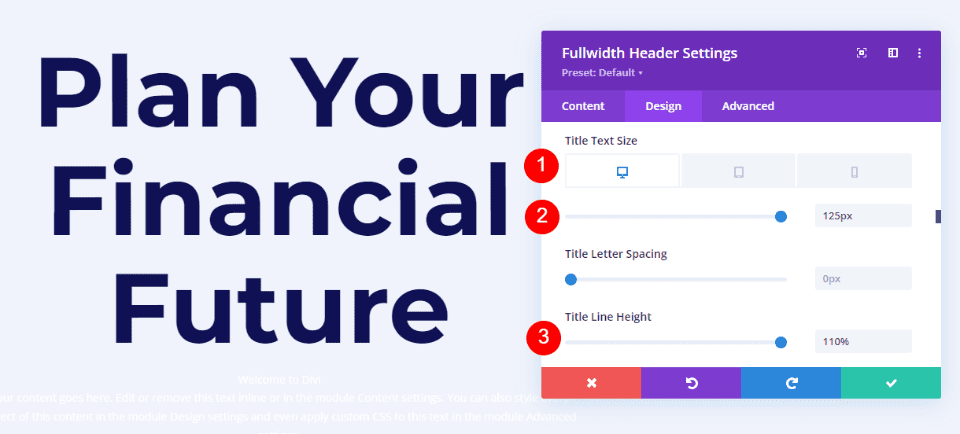
    Change the Font Size to 125px for desktops, 40px for tablets, and 24px for phones. Set the Line Height to 110%. This gives us an oversized title that looks great on any screen size.

    • Size: 125px desktop, 40px tablet, 24px phone
    • Line Height: 110%

    Hover Background Image Title Text

    Hover Background Image Body Text

    Next, scroll to Body Text. Change the Font to Roboto, set the Weight to medium, and change the Color to #0f1154.

    • Font: Roboto
    • Weight: Medium
    • Color: #0f1154

    Hover Background Image Body Text

    Change the Font Size to 18px for desktops and tablets, and 14px for phones. Set the Line Height to 180%. This gives the body text plenty of breathing room.

    • Size: 18px desktop and tablet, 14px phone
    • Line Height: 180%

    Hover Background Image Body Text

    Hover Background Image Subtitle Text

    Next, scroll to Subtitle Text. Change the Font to Montserrat. Set the Weight to bold, change the Style to TT, and change the Color to #1d4eff.

    • Font: Montserrat
    • Weight: Bold
    • Style: TT
    • Color: #1d4eff

    Hover Background Image Subtitle Text

    Change the Font Size to 16px for desktops, 14px for tablets, and 12px for phones. Change the Line Spacing to 0.3em and the Line Height to 1.6em. This sets the subtitle apart from both the title and content without taking up much room.

    • Size: 16px desktop, 14px tablet, 12px phone
    • Letter Spacing: 0.3em
    • Line Height: 1.6em

    Hover Background Image Subtitle Text

    Hover Background Image Button One

    Next, scroll down to Button One and enable Use Custom Styles for Button One. Change the Text Size to 18px. Change the Text Color to white and the Background Color to #1d4eff.

    • Use Custom Styles for Button One: Yes
    • Text Size: 18px
    • Text Color: #ffffff
    • Background Color: #1d4eff

    Hover Background Image Button One

    Next, change the Border Width and Radius to 0px. Choose Roboto for the Font and set the Weight to Medium.

    • Width: 0px
    • Radius: 0px
    • Font: Roboto
    • Weight: Medium

    Hover Background Image Button One

    Scroll down to Button One Padding. Add 14px for the Top and Bottom Padding, and 24px for the Right and Left Padding.

    • Padding: 14px Top and Bottom, 24px Left and Right

    Hover Background Image Button One

    Hover Background Image Button Two

    Next, scroll down to Button Two and enable Use Custom Styles for Button Two. Most of these settings are the same as Button One. Change the Text Size to 18px, the Text Color to white, and the Background Color to #00c9c9.

    • Use Custom Styles for Button Two: Yes
    • Text Size: 18px
    • Text Color: #ffffff
    • Background Color: #00c9c9

    Hover Background Image Button Two

    Next, change the Border Width and Radius to 0px. Choose Roboto for the Font and set the Weight to Medium.

    • Width: 0px
    • Radius: 0px
    • Font: Roboto
    • Weight: Medium

    Hover Background Image Button Two

    Scroll down to Button Two Padding. Add 14px for the Top and Bottom Padding, and 24px for the Right and Left Padding.

    • Padding: 14px Top and Bottom, 24px Left and Right

    Hover Background Image Button Two

    Hover Background Image Spacing

    Next, scroll down to Spacing and add 100px Padding to the Top and Bottom. This increases the size of the fullwidth header without using the Fullscreen option in the Layout settings. In my examples, the fullwidth header leaves a little bit of space at the bottom of the screen where the next section shows. Of course, you could use the full-screen setting in place of the padding if you wanted.

    • Padding: 100px Top and Bottom

    Hover Background Image Spacing

    Hover Background Image Box Shadow

    Lastly, scroll down to Box Shadow and choose the 6th Box Shadow option. This gives the header a more unique look. Close the Fullwidth Header Module and save your settings.

    • Box Shadow: 6th

    Hover Background Image Box Shadow

    Results

    Desktop Without Hover

    Desktop Without Hover

    Desktop With Hover

    Desktop With Hover

    Phone Without Hover

    Phone Without Hover

    Phone With Screen Tap

    Phone With Screen Tap

    Ending Thoughts

    That’s our look at how to reveal a hover background image in your Divi Fullwidth Header Module. The hover state for background images is a simple setting, but it can have a huge impact on the site’s design. It’s a great way to get attention. You can take the design even further if you wanted to add Gradient Stops, overlays, change images, and more. I recommend playing around with the Divi Fullwidth Header Module’s hover background settings to see what you can create.

    We want to hear from you. Do you use a hover background image in your Divi Fullwidth Header Module? Let us know about it in the comments.

    The post How to Reveal a Hover Background Image in Your Divi Fullwidth Header Module appeared first on Elegant Themes Blog.

  • Get a Free Alteration Shop Layout Pack for Divi

    Hey Divi Nation! Thanks for joining us for the next installment of our weekly Divi Design Initiative; where each week, we give away a brand new Layout Pack for Divi.

    This time around, the design team has created a beautiful alteration shop Layout Pack that’ll help you get your next Alteration Shop website up and running in no time!

    This layout pack includes:

    8 Premade page layouts strategically designed for any Alteration Shop website (including a footer design)
    – Original, royalty-free photos and graphics + customizable source file (see below)
    – Plus, a large collection of pre-designed website elements that are customizable and reusable anywhere.

    This layout pack is available right inside Divi for all Divi customers for FREE as the latest addition to our growing Divi library of hundreds of premade layout packs, thousands of page designs, and countless web design elements and resources.

    divi layout

    Check Out The Divi Alteration Shop Layout Pack Below

    Get it for free today!

    Alteration Shop layout pack

    Landing Page Design

    Alteration Shop Pack for Divi

    View The Live Layout Demo

    Home Page Design

    Alteration Shop Layout Pack for Divi

    View The Live Layout Demo

    Services Page Design

    Alteration Shop Layout Pack for Divi

    View The Live Layout Demo

    Service Page Design

    Alteration Shop Layout Pack for Divi

    View The Live Layout Demo

    About Page Design

    Alteration Shop Layout Pack for Divi

    View The Live Layout Demo

    Pricing Page Design

    Alteration Shop Layout Pack for Divi

    View The Live Layout Demo

    Blog Page Design

    Alteration Shop Layout Pack for Divi

    View The Live Layout Demo

    Contact Page Design

    Alteration Shop Layout Pack for Divi

    View The Live Layout Demo

    Key Features

    The Alteration Shop Layout Pack for Divi offers a high contrast design complete with dark backgrounds and bold white text to showcase your alteration business. The warm dark gold accents allow for your site’s visitors to easily identify call to actions, as well as other points of interest. This classic design gives you everything you need to show off your alteration business with class.

    Live Demos

    Click the links below to see a live demo for each of the layouts included in the pack.

    1. Alteration Shop Landing Page (live demo)
    2. Alteration Shop Homepage (live demo)
    3. Alteration Shop Services Page (live demo)
    4. Alteration Shop Service Page (live demo)
    5. Alteration Shop About Page (live demo)
    6. Alteration Shop Pricing Page (live demo)
    7. Alteration Shop Blog Page (live demo)
    8. Alteration Shop Contact Page (live demo)

    Access This Layout Right Now
    Directly from Your Divi Builder

    Since Version 3.0.99 of Divi, you can find and import any of the layouts included in this pack (along with ALL of Divi’s Premade Layout packs) directly from the Divi Builder. They are already waiting for you.

    To access your new layout, simply activate the Visual Builder when editing a page and look for the “Load From Library” icon in the page settings bar (it looks like a plus symbol). Click this icon to launch the Load From Library popup. Under the Premade Layouts tab, you can easily find the new layout by scrolling through the list of layout packs. Once you find the Alteration Shop Layout Pack, click on it. You will see all the individual layouts included in the pack. Select the layout you want to use and then click the “Use This Layout” button.

    Alteration Shop Layout Pack for Divi

    For more, check out this video to learn how you can get this layout pack up and running today.

    Subscribe To Our Youtube Channel

    Authentication Required

    Before you can download Premade Layouts from the Divi Library you must authenticate your Elegant Themes Subscription. You can do this by navigating to Divi > Theme Options > Updates. There you can enter your username and API key and save changes.

    Alteration Shop Layout Pack for Divi

    You can find your API Key under your members area on the Elegant Themes site. After you enter the Username and API Key, you will gain immediate access to our library of hundreds of free layouts (including this one). If you haven’t done this, when you click to import a layout to your page, you will be prompted to enter your Elegant Themes Membership Username and API Key.

    Use Layout Images for FREE with No Licensing Restrictions

    Divi Alteration Shop Layout Pack for Divi

    The image assets included with these layouts (icons, illustrations, photos, etc.) have no licensing restrictions. This means you can use them in all of your commercial projects without having to worry about paying licensing fees or attributing the photographer. Use them in your commercial websites, sell them within your Divi child themes, include them in your own Divi layout packs or just use them on your blog. We know how challenging it can be to find good photos and how confusing and scary the licensing that governs those photos can be. We want to fix that problem for our users.

    Download the Full Res Image Assets

    New Layout Pack Every Week!

    We hope you enjoy this layout pack. We look forward to hearing your opinions in the comment section below. Make sure you check out next week’s layout pack as well!

    The post Get a Free Alteration Shop Layout Pack for Divi appeared first on Elegant Themes Blog.

  • Divi Product Highlight: Header Layout Pack

    The header is one of the first elements to load for any Divi website you create. This means the header often makes the first impression anyone sees for a website, making header design a crucial part of every website. Fortunately, you don’t have to create your header from scratch. There are lots of header layouts in the Divi Marketplace to give you a head start. Header Layout Pack is one example. This is a set of over 80 custom headers that work for just about any type of website. In this post, we’ll look at Header Layout Pack to help you decide if it’s the right product for your needs.

    Upload Header Layout Pack

    Header Layout Pack includes two zipped files. The first is a single file that contains all 81 layouts. These layouts are uploaded together. The second is a supplementary file and includes six files. These are the categories of the header layouts. This allows you to upload just the layouts in a particular category, such as WooCommerce. This is also helpful if you have a file-size upload limit and can’t upload all the files at the same time.

    The process to upload the layouts is the same for all the files:

    1. Go to Divi
    2. Select Divi Library
    3. Click Import & Export
    4. Select the Import tab
    5. Click Choose File and navigate to the unzipped JSON files on your computer
    6. Click Import Divi Builder Layouts

    Upload Header Layout Pack

    Once the import completes, you’ll have 81 new items in your Divi Library (if you chose the main JSON file). They’re labeled and named according to their categories, so they’re easy to identify. These layouts are standard Divi Library layouts, so they can be used with any Divi layout for a page, post, or any layout in the Divi Theme Builder, and stored in Divi Cloud for use on any Divi website. We recommend using them in the Divi Theme Builder and assigning them to global or individual categories.

    Upload Header Layout Pack

    Header Layout Pack Examples

    Let’s look at a few header layouts from each of the six categories. In my examples, I’ll load each layout into the Divi Theme Builder. New layouts are often added to the Header Layout Pack. I’m selecting them at random, but I’ll focus on a mix of older and newer layouts. When viewing them in the Your Saved Layouts tab, you can select the categories or view all the layouts.

    Header Layout Pack Examples

    For my screenshots, I’m using the home page from the free Home Remodeling Layout Pack that’s available within Divi. We’ll look at the wireframe, desktop, and phone versions of the headers.

    Advanced Headers

    Firstly, here’s a look at Advanced Headers, which contains 30 layouts.

    Advanced Header V1

    The first Advanced Header includes a Menu Module, Button Module, and two Text Modules. It also includes a Code Module with CSS.

    Advanced Headers

    The header includes styled dropdown submenus. A quote CTA button stretches on hover.

    Advanced Headers

    While the menus in the desktop version open on hover, the CSS creates a custom mobile menu toggle with buttons that include arrows showing if the menu can be opened or collapsed.

    Advanced Header v1 - Mobile View

    Advanced Header V20

    The Advanced Header version 20 includes four Image Modules, three Blurb Modules, a Menu Module, and a Code Module.

    Advanced Headers

    The Image Modules can be used for logos. All Blurb Modules are clickable buttons for contact information, services, and a CTA to get a quote.

    Advanced Headers

    Mobile menu toggles are added to the phone version with CSS.

    Advanced Header v20 - Mobile View

    Advanced Header V30

    Advanced Header V30 includes three Text Modules, and Menu Module, and a Code Module.

    Advanced Headers

    The Desktop version displays a red top menu bar with a short message and a phone number in large text. A logo and menu are placed under this and include a dropdown submenu styled to match the top menu bar.

    Advanced Headers

    While the desktop version includes red highlights, the Phone Version removes the red background of the submenus and includes the CSS toggles.

    Advanced Header v30 - Mobile

    Fullscreen Overlay Headers

    Secondly, we’ll see Header Layout Pack’s Fullscreen Overlay Headers, which includes 3 layouts.

    Fullscreen Overlay Header V2

    Fullscreen Overlay V2 comes with lots of elements including text, images, buttons, blurbs, code, social media, a menu, etc.

    Fullscreen Overlay Headers

    It includes a hamburger menu icon with a hover animation. The CTA button widens on hover.

    Fullscreen Overlay Header v2 - Desktop

    The menu opens full screen when clicked and includes clickable submenus.

    Fullscreen Overlay Header v2 - Desktop, Open

    Here’s the phone version, which follows the same design.

    Fullscreen Overlay Header v2 - Mobile

    Fullscreen Overlay Header V3

    Fullscreen Overlay Header V3 utilizes similar modules as the previous layout but creates a different design for the full-screen overlay.

    Fullscreen Overlay Headers

    The desktop header includes the CTA and hamburger icon with hover animation.

    Fullscreen Overlay Header v3

    Its menu covers half the screen while an image takes the other half of the screen.

    Fullscreen Overlay Header v3 - Open

    The phone version follows the same design for the menu, but doesn’t include the image.

    Fullscreen Overlay Header v3 - Mobile

    Header with Slide-ins

    Thirdly, we’ll look at Header Layout Pack’s Header with Slide-ins, which includes three layouts.

    Header with Slide-ins V2

    Version 2 creates the slide-in with a Blurb Module, several Text Modules, a Menu Module, a Button Module, and code.

    Header with Slide-ins

    The slide-in menu displays the submenus under a message. At the bottom of the menu, you can find a CTA and an image.

    Slide In v2

    The phone version removes the image while keeping the menu design.

    Slide In v2 - Mobile

    Header with Slide-ins V3

    Version 3 includes Blurb Modules to create the slide-ins.

    Header with Slide-ins

    The desktop slide-in includes hover animation and displays text and icons. Each of the elements is clickable.

    Slide In v3 - Desktop

    The clickable elements for the phone slide-in menu are much larger than the desktop version, making them easy to use on mobile.

    Header with Slide-ins

    Simple Headers

    Fourthly, Simple Headers includes 30 layouts.

    Simple Headers V15

    Simple Headers version 15 has two Rows and includes a Social Media Module and several Blurb Modules.

    Simple Headers

    The desktop version includes a top bar with contact information. A logo is centered, and the menu includes submenus.

    Simple Headers

    The phone version adds the toggle buttons for the submenus.

    Simple Menu 15 - Mobile

    Simple Headers V22

    This one includes two Rows to create the header.

    Simple Headers

    The top bar displays a CTA with a hover animation, the logo in the center, and a phone number. Its menu includes styled submenus.

    Simple Headers

    The phone version displays the submenus with toggles created in the Code Module.

    Simple Menu 22 - Mobile

    Square Logos Headers

    Fifthly, the Square Logos Headers includes five layouts. They’re ideal if you have a logo that’s taller than most logos.

    Square Logos Headers V3

    This one was built with a Specialty Section to include a multi-column layout. The square logo is created with an Image Module in its own column.

    Square Logos Headers

    The desktop version includes a top bar with a search box and contact information. All menus are styled to match the top bar’s background.

    Square Logos Headers

    The phone version includes the submenu toggles created with CSS.

    Square Logo Menu v3 - Mobile

    Square Logos Headers V4

    Version 4 includes three columns to create the logo, menu, and CTAs.

    Square Logos Headers

    The desktop version displays the logo and phone number in the two outer columns. A center column includes two Rows. The top Row shows contact information and a CTA, while the bottom Row displays the menu with a background styled to match the icons and the button of the top Row.

    Square Logos Headers

    The phone version includes a large logo area. The submenus include the toggles created with CSS.

    Square Logo Menu v4 - Mobile

    Woo Headers

    Lastly, we’ll look at Header Layout Pack, which includes 10 WooCommerce headers.

    Woo Headers V3

    Our first Woo Header includes two Rows. The top Row includes a Text Module, while the second Row displays a Menu Module and several Icon Modules.

    Woo Headers

    The Text Module for the top Row creates a sales banner. Graphics include Person, Heart, and Cart icons that can link to the person’s account login, their favorites list, and their shopping cart.

    Woo Headers

    The phone version moves the icons above the hamburger menu. Like the others we’ve seen, this submenu includes toggles created with CSS.

    Woo Header v3 - Mobile

    Woo Headers V7

    Woo header version 7 was built with three Rows that include Blurb Modules to create interesting WooCommerce links.

    Woo Headers

    The desktop version shows a message and the Woo links in the top bar. A middle bar displays a logo and a WooCommerce product search. The menu bar includes social media buttons.

    Woo Headers

    This is the phone version, which places the social media icons under the hamburger menu icon. Everything is spaced well on the phone screen, and it even includes the WooCommerce links and the product search box.

    Woo Header v7 - Mobile

    Woo Headers V10

    Woo Header version 10 also includes three Rows. It includes a product search and uses a Text Module to create a banner.

    Woo Headers

    The desktop version displays a green sales banner at the top. The icons, button, and highlights match the green bar. The middle bar includes the WooCommerce icons, while the menu and search at placed at the bottom.

    Woo Headers

    Here’s the phone version, which places the search box under the hamburger menu. This one also includes the submenu toggles created with CSS.

    Woo Headers v10 - Mobile

    Purchase the Header Layout Pack

    Header Layout Pack is available in the Divi Marketplace for $15. It includes lifetime updates, unlimited website usage, and a 30-day money-back guarantee.

    Purchase Header Layout Pack

    Ending Thoughts

    That’s our look at Header Layout Pack. There are a lot of layouts in this header pack. They look elegant, have lots of design options, and they’re easy to use. Since the layouts were created by the same person, they share a commonality that I find makes them easier to use. The methods are standardized, so if you know how to customize one of the layouts you can customize the rest. If you’re interested in an extensive set of headers, Header Layout Pack is work considering.

    We want to hear from you. Have you tried Header Layout Pack for your Divi website? Let us know about your experience in the comments.

    The post Divi Product Highlight: Header Layout Pack appeared first on Elegant Themes Blog.

  • Download a FREE Header & Footer for Divi’s Streamer Layout Pack

    Hey Divi Nation! Thanks for joining us for the next installment of our weekly Divi Design Initiative where each week, we give away brand new freebies. We recently shared a brand new Streamer Layout Pack. To help you get your website up and running as soon as possible, we’re sharing a global header & footer template that matches this layout pack perfectly as well! Hope you enjoy it.

    divi layout

    Check Out The Streamer
    Global Header & Footer Template Below

    Get it for free today!

    Header Design

    Desktop View

    Header design for the Divi Streamer Layout Pack for desktop

    Tablet & Mobile View

    Header design for the Divi Streamer Layout Pack for tablet and mobile

    Footer Design

    Desktop View

    Footer design for the Divi Streamer Layout Pack for desktop

    Tablet and Mobile View

    Footer design for the Divi Streamer Layout Pack for desktop

    Download The Global Header & Footer Template For The Streamer Layout Pack

    To lay your hands on the free global header & footer template, you will first need to download it using the button below. To gain access to the download you will need to subscribe to our newsletter by using the form below. As a new subscriber, you will receive even more Divi goodness and a free Divi Layout pack every Monday! If you’re already on the list, simply enter your email address below and click download. You will not be “resubscribed” or receive extra emails.

    How to Upload The Divi Streamer Template

    Go to Divi Theme Builder

    To upload the Divi Streamer template, navigate to the Divi Theme Builder in the backend of your WordPress website.

    Getting started with the Divi Conference Layout Pack

    Upload Global Default Website Template

    Then, in the top right corner, you’ll see an icon with two arrows. Click on the icon.

    Importing the Header and Footer Layout into the Divi Theme Buidler

    Navigate to the import tab, upload the JSON file which you were able to download in this post, and click on ‘Import Divi Theme Builder Templates’.

    Import settings for the header and footer layout pack

    Save Divi Theme Builder Changes

    Once you’ve uploaded the file, you’ll notice a new global header and footer in your default website template. Save the Divi Theme Builder changes as soon as you want the template to be activated.

    Save global header theme builder

    How to Modify The Divi Streamer Template

    Open Header Template

    To modify the global header template’s elements, start by opening the template.

    Editing the global header within the Divi Theme Builder

    Select Your Menu of Choice

    Select a menu of your choice in the Menu Module.

    Update menu within the Divi Streamer header

    Upload Your Logo

    Within the same Menu Module, upload your logo.

    Update logo within the Menu Module

    Add CTA Link URLs

    The header of the Divi Streamer template has a button on the top right. Open the settings of each to update the link URL to the destination of your choice.

    Update button URL for the main header section

    Update Announcement Bar

    This header template also comes with a secondary menu. Edit the text and add a URL – if you’d like – for this announcement bar.

    Update Text Module within the secondary menu/announcement bar

    Open Divi Streamer Template Footer

    Continue by opening the global footer inside the default website template.

    Editing the footer template within the Divi Theme Builder

    Update Footer Content

    You will need to go through the footer of the Divi Streamer template and make some updates. If need be, you can modify the content that comes with the template. You may also want to update the Social Media Follow Module with your social networks as well as their corresponding links. Don’t forget about the copyright text at the bottom of the footer as well.

    Update footer static content and social media networks

    Update Footer Menu

    Similarly to the header, we will need to connect our footer menu to the Menu Module.

    Update your footer menu in your Divi Streamer Layout Pack

    Connect Email Marketing Platform

    Our footer design has an Email Optin Module. As such, remember to connect your email marketing service provider to the module to begin to collect email addresses from your users.

    Connect your email marketing platform of choice

    New Freebies Every Week!

    We hope you’ve enjoyed the Streamer Layout Pack and the Header & Footer freebie that goes along with it. We look forward to hearing your opinions in the comment section below. Make sure you check back next week for more freebies!

    The post Download a FREE Header & Footer for Divi’s Streamer Layout Pack appeared first on Elegant Themes Blog.

  • How to Design a WooCommerce Cart Flow Timeline for Your Divi

    WooCommerce is one of WordPress’ most beloved eCommerce plugins. To support this, Divi came out with several new Woo-centric modules that allow you greater control over designing your default WooCommerce pages. In today’s post, we will work through developing a WooCommerce cart timeline for Divi. For this timeline, we’ll be creating a visual representation of the user journey. We want to visually show the user how they move from shop to checkout.

    Cart Page Template

    Desktop View

    Divi Toy Store Cart with Cart Flow Timeline - Cart Template

    Tablet and Mobile View

    WooCommerce Cart Page Timeline Tablet and Mobile View

    Checkout Page Template

    Divi Toy Store Checkout Page with Cart Flow Timeline - Checkout Template

    Tablet and Mobile View

    Divi Toy Store Checkout Page in tablet and mobile

    Download The Cart & Checkout Template for FREE

    To lay your hands on the free cart & checkout template, you will first need to download them using the button below. To gain access to the download you will need to subscribe to our newsletter by using the form below. As a new subscriber, you will receive even more Divi goodness and a free Divi Layout pack every Monday! If you’re already on the list, simply enter your email address below and click download. You will not be “resubscribed” or receive extra emails.

    How to Download & Install the Cart & Checkout Templates

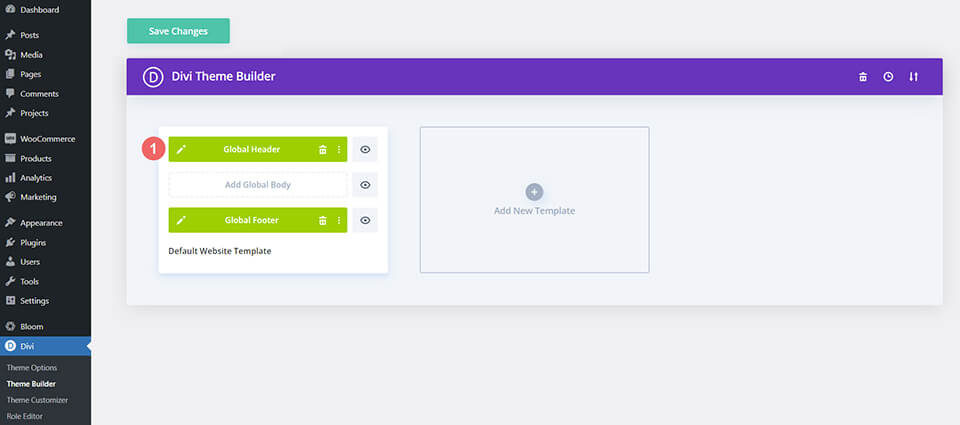
    Go to Divi Theme Builder

    To upload the template, navigate to the Divi Theme Builder in the backend of your WordPress website.

    Open Divi Theme Builder

    Upload Global Default Website Template

    Then, in the top right corner, you’ll see an icon with two arrows. Click on the icon.

    Import the template into the Divi Theme Builder

    Navigate to the import tab, upload the JSON file which you were able to download in this post, and click on ‘Import Divi Theme Builder Templates.

    Finish importing the template into the Divi Theme Builder

    Save Divi Theme Builder Changes

    Once you’ve uploaded the file, you’ll notice a new cart, checkout, and shop template. Save the Divi Theme Builder changes as soon as you want the templates to be activated.

    Save Theme Builder Changes for WooCommerce Templates

    How to Create the WooCommerce Cart Timeline from Scratch

    If you want a bit more of a challenge, the next part of our blog post will show you how to recreate the WooCommerce cart timeline for Divi. You can use the steps in this tutorial to customize your own cart timeline. Use it as inspiration for your next WooCommerce and Divi project! The WooCommerce cart timeline that we’ll be creating looks like this:

    Cart Page

    WooCommerce cart timeline on the cart page

    Checkout Page

    WooCommerce cart timeline on the checkout page

    This Woocommerce cart timeline for Divi is also mobile responsive. It stays as a horizontal timeline on mobile devices:

    WooCommerce timeline on mobile

    Now that we have a visual guide as to what we’ll be building, let’s get started!

    Setup the Divi Theme Builder

    We will be creating these templates to affect the cart and checkout pages of WooCommerce. As such, we begin our task in the Divi Theme Builder.

    Open Divi Theme Builder

    Create Cart Template

    Click on the plus icon within the Add New Template card.

    Create Cart Template

    Next, select Build New Template.

    Select Build New Template

    After, you’ll be presented with a modal box of all the various assignments that you can attach to the new template that you’re creating. In our case, we’ll be creating a template for the cart page of our WooCommerce store. So, scroll down the modal box, and select Cart under the WooCommerce heading. Once, selected, click Create Template. When we do this, we are assigning the newly created template to the cart page.

    Finish Create Cart Template

    Create Checkout Template

    We will be going through the same steps to create the checkout template. Click on the plus icon within the Add New Template card.

    Create Cart Template

    Again, select Build New Template.

    Select Build New Template

    For the checkout page, we’ll need to scroll down the modal box, and select Checkout under the WooCommerce heading. Once, selected, click Create Template.

    Save Templates and Assignments

    Now that our cart and checkout templates have been created, we can save them. Click on the green Save Changes button at the top of the Divi Theme Builder.

    Save Templates and Assignments

    Let’s Start Building the WooCommerce Cart Flow Timeline

    Setting Up the Cart Page Template

    Now the fun begins! We’re going to start creating our cart flow timeline for the cart page. To do this, we click on the Add Custom Body button within the Cart template that we just created.

    Add Body to Cart Page Template

    Similar to when we create these templates and their assignments, we’re going to click on the Build Custom Body button that appears in the modal box.

    Add Body to Cart Page Template

    Add a New Section and Row

    Now that we’re in the Divi Builder, we’re going to add a new row. This row will have five columns.

    Add a new row with five columns

    Add Blurb Modules

    Add three Blurb Modules to columns 1, 3, and 5 of your new row.

    Add Blurb Modules to columns

    Here is the content for each Blurb Module that we will be using:

    First Blurb (Column 1)

    • Title: Shop
    • Body: Leave empty
    • Use Icon: Yes
    • Icon: See screenshot below
    • Module Link URL: /shop (Or your custom link to your shop page)

    Second Blurb (Column 3)

    • Title: Review
    • Body: Leave empty
    • Use Icon: Yes
    • Icon: See screenshot below
    • Module Link URL: /cart (Or your custom link to your cart page)

    Third Blurb (Column 5)

    • Title: Checkout
    • Body: Leave empty
    • Use Icon: Yes
    • Icon: See screenshot below
    • Module Link URL: /checkout (Or your custom link to your checkout page)

    Now, our WooCommerce timeline will look like this at this point:

    The WooCommerce cart timeline without styling

    Adding Links to Blurbs

    As we are creating templates for the cart and checkout page, we need our Blurb Modules to be easy to access no matter which pages customer land on. A core feature of the WooCommerce timeline is that the end user – your customer – will be able to easily navigate between the various stages of the checkout process. To add the link to the default shop, cart, and checkout pages of our site, we will first enter the module settings of the first blurb, shop.

    Adding Links to Shop Blurb

    Once the module’s settings box appears, we’re going to scroll down to the Link heading. We’ll be adding the link to the Module Link URL box because this will ensure that irrespective of where your custom clicks – whether it’s the Blurb Title or the icon itself – they will be directed to the page that they need to navigate to.

    Add links to the Blurb Modules in the checkout timeline process

    We’ll be adding the links to the standard WooCommerce pages to each Blurb Module. If you have created custom links for these pages on your WooCommerce install, adjust the links accordingly. First, we begin with the Shop Blurb Module. For the Module Link URL, we enter /shop. This is the default URL for the shop page in WooCommerce. Remember, if you have changed this URL, enter your custom URL here instead.

    Add /shop link to link to the default WooCommerce Shop page link

    Click the green checkmark button to save your changes. Next, we move to the Review Blurb Module. This module serves as the link to the cart page. Again, we navigate to the Link tab, and then we add the Module Link URL /cart, to the Module URL.

    Add link to Cart Blurb Module

    For the last Blurb Module, the Checkout Blurb Module, we will be linking to the default WooCommerce checkout page link which is /checkout.

    Add link to the WooCommerce standard Checkout Page link

    Style Blurb Modules

    Next, we will begin to style our added Blurb Modules. We will be using hover styles on the modules. This helps with the user experience (UX) of the WooCommerce cart timeline. We want the Blurb Module that represents the page that we are currently on to be a different color. And, we also want the icon to enlarge when we hover over it and change color.

    Blurb Module Styling

    • Icon Color: #eac989
    • Hover Icon Color: #9fa2ce
    • Text Alignment: Center

    Blurb Icon Color

    • Title Text:
      • Title Heading Text: H4
      • Title Font: Baskerville
      • Title Font Weight: Bold
      • Title Text Color: #354e7c

    Blurb title text styling

    Transform:

    • Transform Scale (Desktop): 100%
    • Transform Scale (Hover): 115%

    Blurb Transform Settings

    After we’ve set the design settings for the first Blurb Module, we’re going to extend them to the other Blurb Modules in our row.

    Extending Blurb Module styling to all the blurbs in our section

    We want to extend our styles only to Blurb Modules within our section. This is important to note especially if you are working on a page that already has content within.

    Extending Blurb Module styling to all the blurbs in our section

    Styling the Cart Blurb Module

    To denote the different stages of the checkout process, we’re going to give a different icon color to the current stage that our user is on. For example, if they are on the cart page, we’ll change the color of the Blurb Module referencing the cart stage of the process.

    Updating current page Blurb Module color

    Cart Page Blurb Module:

    • Icon Color (Desktop): #f6c6c5
    • Icon Color (Hover): #9fa2ce

    Add Timeline Dividers

    Once we have created and styled our Blurb Module, we will begin adding and styling our Divider Modules. We use the Divider Module in columns two and four of our row.

    Add dividers to WooCommerce cart timeline

    Style Timeline Dividers

    Next, we will add our styling to our Divider Modules.

    Divider Settings

    Visibility:

    • Show Divider: Yes

    Line:

    • Line Color: #354e7c
    • Line Style: Dotted
    • Line Position: Vertically Centered

    Sizing

    • Divider Weight: 5px

    Settings for the Divider Modules

    Let’s use another really cool Divi feature to copy and paste the styles of this Divider Module to the other module within our row. First, we’re going to right-click on our completed Divider Module. Secondly, we’re going to click Copy Module Settings. Next, we right-click on the Divider Module that is currently unstyled. Finally, we click Paste Module Settings. Time saved is time earned!

    Copy and paste module styles for the Divider Modules

    Adding Custom CSS

    This is what our WooCommerce cart timeline looks like presently:

    WooCommerce Cart Checkout Timeline

    To ensure that our Divider Modules are aligned correctly and to make our timeline module mobile-responsive, we’re going to add some CSS to our row.
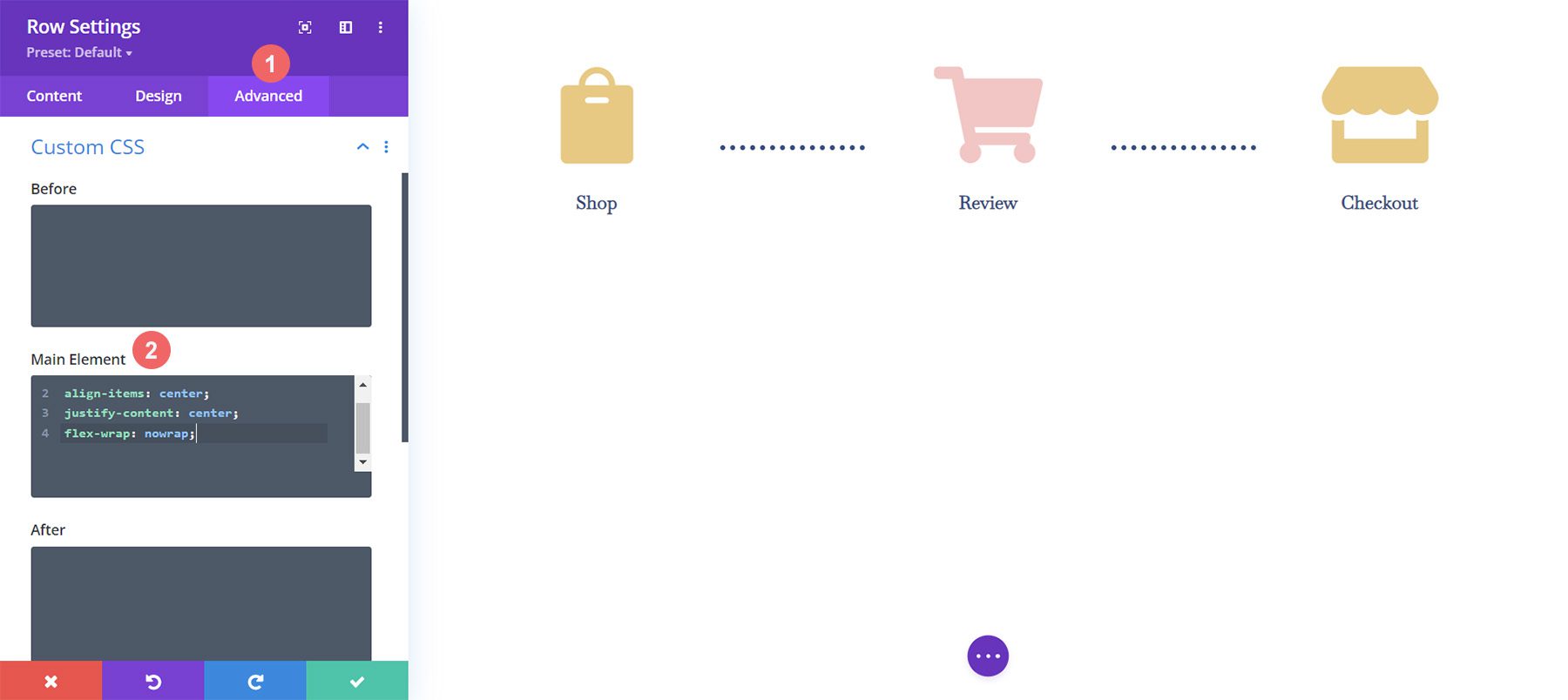
    WooCommerce Cart Timeline row with custom CSS

    To add our Custom CSS, we first need to enter the Row Settings for our WooCommerce Cart Timeline. Next, we select the Advanced Tab. Finally, we will add the following CSS to the Main Element:

    Custom CSS:

    display:flex;
    align-items: center;
    justify-content: center;
    flex-wrap: nowrap;
    

    Once we’ve added this to the Row Settings, we click the green checkmark to save our settings.

    Final Customization for Mobile Responsiveness

    One amazing benefit of Divi is the fact that you can customize various elements quite deeply. We need to make one final edit to the last Blurb Module in the last column in our row. This change will help it look better on mobile and smaller screens. The fact that Divi allows us to get granular with our styling ensures that our work looks good for our clients as well as our own websites.

    Editing padding, margin and CSS for columns

    Notice how the last column, on mobile, is slightly lower than the other Blurb Modules. We’re going to change that! To do this, we’re going to enter the settings for the third and final module. Next, we’re going to go to Spacing > Margin. We’re going to leave the margin for the desktop view. However, we’re going to add a bottom margin of 15px for tablets.

    Add a bottom margin to your Blurb Module

    Finally, we’re going to add a bottom margin of 21px for mobile devices.

    Add a bottom margin to your Blurb Module for mobile devices

    Now, we have a truly mobile responsive Woocommerce cart timeline that we can use to guide users from shop to checkout.

    Setting Up the Checkout Page

    We have set the foundation for our WooCommerce cart flow timeline on our cart page. However, we need to complete our timeline by adding the work that we’ve done to our checkout page template. We’ll be using Divi’s OG feature, the Right-Click Menu to help make our process for the checkout page easier. Let’s get started!

    Copy WooCommerce Cart Flow Timeline from Cart Page

    We’ll be going back to the cart page. However, we won’t be entering into the Divi Builder for the body.

    Prepare the cart body for the checkout page

    Right-click on the Custom Body of the cart template. Next, click on the Copy option from the right-click menu.

    Right click, copy the body template from the cart template, to the checkout template

    Now that we have copied the work that we did within the cart template, we will now paste this into the checkout template. To do this, we right-click on the Add Custom Body button within the checkout page template. Once you have done this, the menu will show the option to Paste. Click on Paste to copy the Custom Body from the cart page template to the checkout page template.

    Right click to paste the body content of the cart template

    Now, you’ll see that both the cart and the checkout page templates have a custom body. This will help us save time on our web design process. Thanks, Divi 🙂 To save our changes within the checkout template, we’ll click the green Save Changes button at the top of the builder.

    Save changes for the body template of the checkout page

    Update Checkout Page Template

    Now that we’ve shaved some time off of our design process, let’s do the final edits to the checkout page to ensure that it works well with the rest of our project. First, click the pencil icon to edit the Custom Body of the checkout page template.

    Edit checkout custom body module

    Style Checkout Icon

    Let’s begin styling our checkout icon. Click on the gear icon which will open the Module Settings of the checkout icon.

    Edit checkout icon

    Move to the Design tab of the Module Settings module. Click on the Image & Icon title. We will be editing the icon color. As such, click on the eyedropper icon and enter the hex code #f6c6c5. This will make the icon the pink color that we are using to denote the current page.

    Update checkout icon color

    Update Cart Icon

    We will need to go back and update the icon color of the cart icon. To do this, we’re going to go back to the module settings of the module. Next, we click the gear icon of the cart icon.

    Update the cart icon color on the checkout page template

    Again, we will move to the Design tab of the module settings. Next, under the Image & Icon title, click on the eyedropper tool. Next, add the hex code #eac989. 

    Updated cart icon color on the checkout page template

    Remember to save your settings and all your hard work once you have exited the Divi Builder.

    Save all changes

    Putting it All Together

    While we have focused this tutorial on building the cart timeline, there are other WooCommerce modules used to complete the template. For this tutorial, we used the FREE Divi Toy Store Layout Pack as the inspiration for the styling. Here are the other WooCommerce modules that you’ll need to add to each template page to complete your store.

    Cart Page Template

    • Woo Cart Products: This will display the WooCommerce cart
    • Woo Cart Totals: Showcase the subtotal, taxes, and more with this module

    Overview of the cart pages with the other Woo modules

    Checkout Page Template

    • Woo Notice Module: We use this module to show any errors, information or notices that relate to checking out
    • Woo Checkout Billing: This module will color the billing details of your customers
    • Woo Checkout Details: Unlike the cart totals, this module will show the actual product names, quantity, and more
    • Woo Checkout Billing: To show available payment methods, we have this module added to the checkout page

    Overview of the checkout pages with the other Woo modules

    In Conclusion

    Having a cart timeline adds a visual representation of the process that your customers take on your store. With Divi, you have the power to customize and create an added piece to your WooCommerce store. Divi gives you the tools to be able to take what you’ve learned here to your own client and personal websites. I’d love to hear from you if you use this tutorial in the wild!
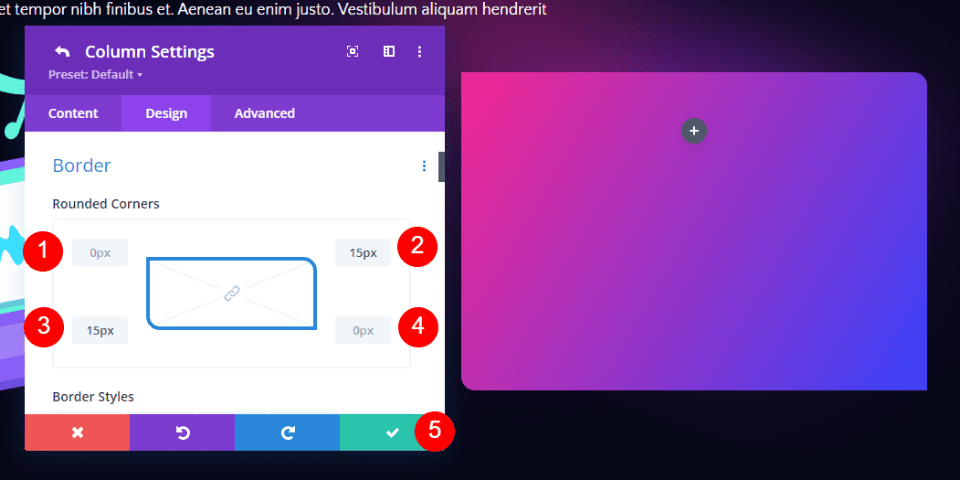
    The post How to Design a WooCommerce Cart Flow Timeline for Your Divi appeared first on Elegant Themes Blog.