EDITS.WS

Tag: WordPress Full Site Editing

  • How to Create a Block Theme for WordPress (The Easy Way)

    Creating a WordPress Block Theme for your website isn’t as hard as you might think. WordPress Block themes have been growing in popularity since their introduction in WordPress 5.9 with a growing number of premade block themes available in the WordPress repository. And, for those who want to create a WordPress block theme on your own, you’re in luck. The Create Block Theme plugin simplifies the process so you create a custom block theme quickly without extensive coding. Plus, you can even use it to create a child theme for your site.

    In this post, we’ll explain the benefits of using the Create Block Theme plugin and how to create your own block theme in a few clicks.

    What is a WordPress Block Theme?

    WordPress block theme

    A WordPress block theme is a full site editing theme for WordPress based on blocks. A block theme allows you to create any page or post using a drag-and-drop interface with blocks and block patterns you can use to build your content. You can even create custom templates and template parts (like headers and footers using the site editor.

    Additionally, it is easier to add custom styles to a block theme. There’s no need to edit the functions.php, style.css, or other theme files to create custom blocks, fonts, or add theme styling. Everything can be accomplished by editing one file – theme.json. WordPress considers block themes to be the future of WordPress. Thankfully, there are quite a few advantages to using them.

    Intro to the Create Block Theme Plugin

    For this post, we’ll be highlighting the Create Block Theme plugin, which is a free plugin available in the WordPress plugin repository. It allows you to create a new theme, blank theme, or child theme quickly. You can also embed Google fonts – either via CDN or locally.

    The Create Block Theme plugin saves you a ton of work creating child themes by allowing you to create and install one in a matter of minutes. Let’s take a look at the steps you’ll need to take to use the plugin.

    Key Features

    The Create Block Theme plugin has some amazing features to make theme creation easy and fast:

    • Create a block child theme with a single click.
    • There’s no extensive coding required.
    • It’s easy to clone a theme.
    • You can export WordPress block themes for use on other projects.
    • You can create a blank block theme.
    • Add a new style variation to the global styles in site editor

    How to Create a WordPress Block Theme?

    Before we use the plugin to create a block theme, you must first install and activate a parent block theme. For this tutorial, we’re going to use the Twenty Twenty-Three theme.

    Install A Parent Block theme

    To get started, log in to your WordPress dashboard. Next, navigate to Appearance > Themes.

    WordPress dashboard

    You can choose any theme you wish – as long as it’s a WordPress block theme. If you’d like to use a block theme other than Twenty Twenty-Three, start by clicking the Add New button in Appearance > Themes.

    Add new theme

    Click the block theme tab to reveal the options for available block themes.

    choose WordPress block theme tab

    Once you find the desired theme, hover over it, then click the Install button.

    Install block theme

    Install Create Block theme Plugin

    The next step is to install the Create Block Theme plugin. There a few ways to install a WordPress plugin, but this one can easily be installed from the dashboard. Start by navigating to Plugins > Add New in the WordPress dashboard.

    Add new plugin

    Type Create Block Theme in the search box. When the page refreshes, select the plugin, then click Install Now.

    Install Create Block Theme plugin

    Once installed, simply activate the plugin.

    activate plugin

    Configure the Create Block Theme Plugin

    Now that the plugin has been installed, navigate to Appearance > Create Block Theme.

    configure Create Block Theme plugin

    In the plugin’s settings, you’ll have a few options:

    create block theme settings

    1. Export (theme name)
    2. Create child of (theme name)
    3. Clone (theme name)
    4. Overwrite (theme name)
    5. Create blank theme
    6. Create a style variation

    Export Theme

    This setting allows you to export the activated theme along with any changes you’ve made. Any templates, global styling, fonts, or other structural changes will be present. Using this setting, you can export the theme, then use it in other WordPress installations. All of your settings will be preserved.

    To export your currently installed theme, select the export option, then click the generate button. The file will be downloaded to your downloads folder as a zip file, like any other WordPress theme.

    Create Child Theme

    create child theme

    This option allows you to create a child theme based off of your current parent theme. Before generating the child theme, be sure to give your theme a name, description, URL, note the author, as well as the author URL if you choose to. Once you click the generate button, the plugin will automatically download your child theme as a zip file.

    Clone Theme

    clone block theme

    When cloning your block theme, the plugin will create a new theme. The clone will retain all assets of the parent theme, as well as any user changes. Similarly to creating a child theme, be sure to name your theme, give it a description, and note a theme URL, author, and author URL.

    Overwrite Theme

    overwrite theme

    When you overwrite your block theme, all user changes will be saved and converted to theme changes. Any templates you create or style changes you make will be saved into theme files, making them a permanent part of the theme.

    Create Blank Theme

    create blank theme

    When you select this option, a blank theme will be created within your website’s theme directory. Before generating your new theme, give it a name, description, and theme URL (if desired), note the author, and author URL. Upon clicking the generate button, you can navigate to Appearance > Themes to view your new blank theme.

    new blank theme

    Create a Style Variation

    Style variations are located in Appearance > Editor. To locate them, navigate to the theme editor, then click the styles button at the top right corner of the editor. There, you can create new styles for text, colors, and buttons. There are additional options for styling individual blocks, too.

    theme styles

    Once you’ve created styles, you can create a style variation in the Create a Block Theme plugin by choosing the last option in the settings. Give your style a name, then click Generate.

    new style variation

    To view your new style, navigate back to Appearance > Editor, click the style icon, and select browse styles. There you can browse through the styles to locate the new one you just created.

    custom style

    Manage Theme Fonts

    To manage the fonts installed in your theme, navigate to Appearance > Manage Theme Fonts. There you’ll be able to view all of the installed fonts in your theme.

    manage theme fonts

    One of the most surprising and amazing features of the Create Block Theme plugin is the ability to manage your theme’s fonts. In this section of the plugin, you can remove entire font families or a single variation. Additionally, you can easily add Google fonts to your theme either by hosting them locally or calling them through the Google Fonts CDN. Here are some of the best Google fonts for the web.

    To remove a font family or font variation, simply click the remove link next to the family or variation you’d like to remove from your site.

    remove font

    Add a Google Font

    To add a Google font, start by clicking the Add Google Font button at the top of the page.

    add Google font button

    When the page refreshes, use the dropdown menu to select a font. You’ll be able to choose any font in Google’s font library.

    select a font

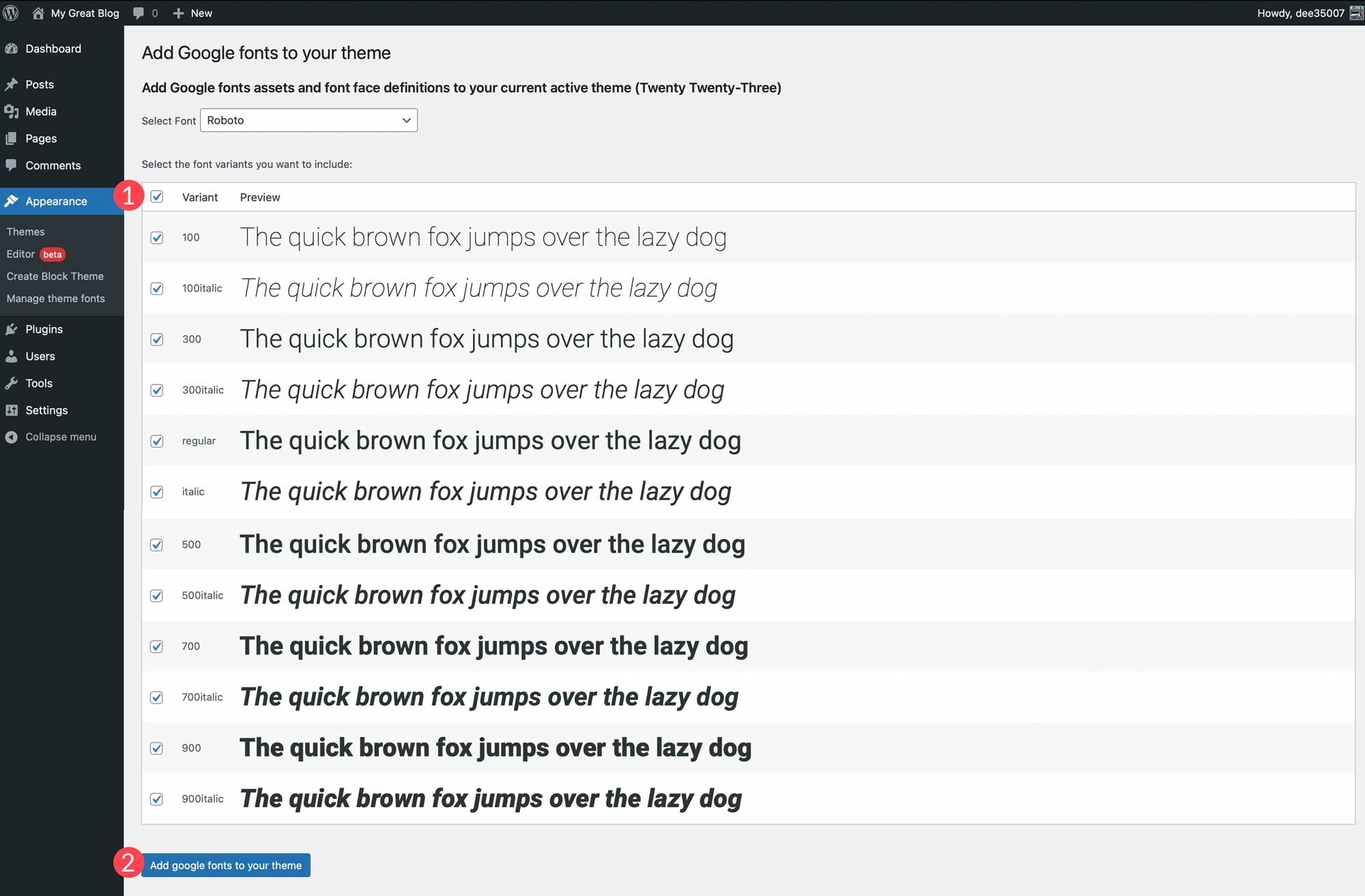
    Once you make a font selection, you’ll have the option to choose the variants you wish to include. You can choose all by clicking the checkbox at the top or choose individual ones. After choosing variants, click the Add google fonts to your theme button.

    Add Google font

    You can also add local fonts to your theme. Start by clicking the Add Local Font button. Fonts in the ttf, off, and woff2 file formats are supported.

    add local font button

    Upload a font by choosing a file saved on your local machine. Next, give it a name, and apply a font style, and font weight. Finally, click Upload local fonts to your theme.

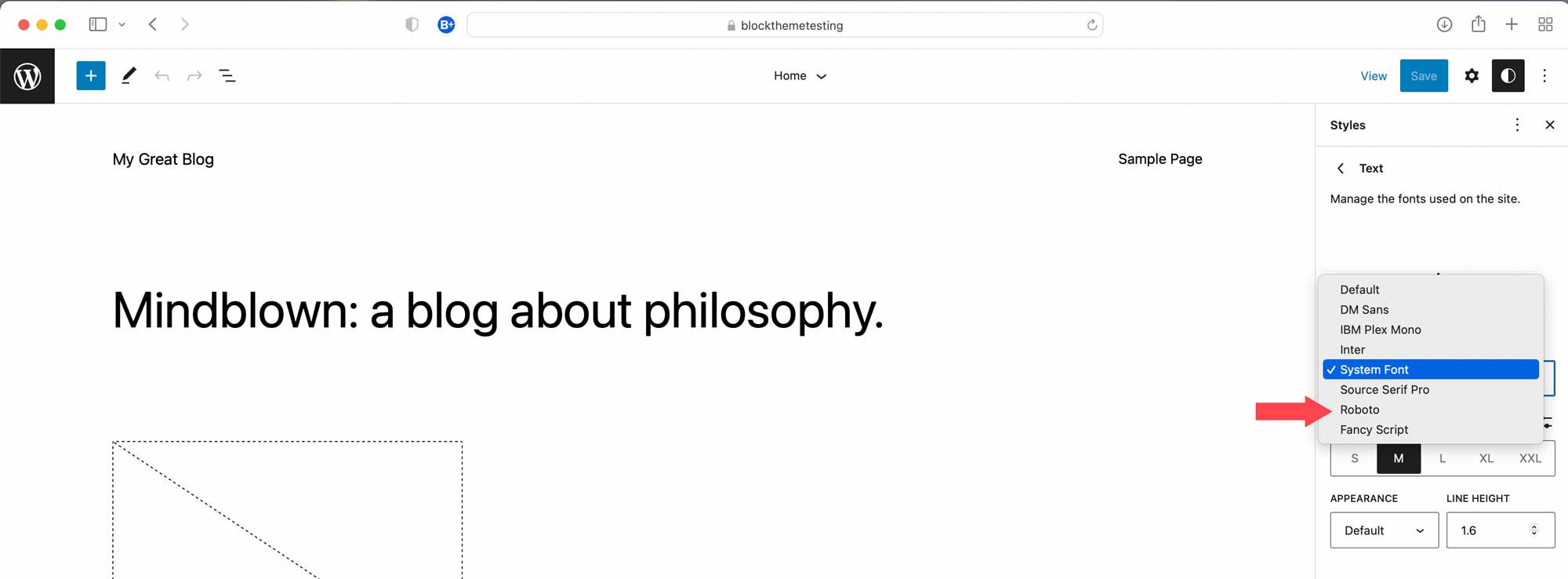
    Once fonts are installed, they can be managed within the Create Block Theme plugin and applied to styles in the site editor.

    fonts in style editor

    After fonts are added, you can head back over to the Create Block Theme tab to apply one of the options to create a child theme, export it, clone it, or overwrite your current theme. All fonts will be preserved along with style variations, as well as templates that you create.

    Creating a WordPress Block Theme Doesn’t Have to Be Hard

    Thanks to the Create Block Theme plugin, it’s easier than ever to create a block theme for your website. You can create your own theme templates using the full site editor, add new styles, add and manage fonts, and even export your block themes for use on other projects. There’s no coding, no theme files to alter, and it’s all done within a few clicks. If you’re looking to start using block themes, or are looking for an easy way to manage them, consider using the Create Block Theme plugin.

    For those using page builders, there should be built-in options for creating custom themes. With Divi, you can easily import and export all of your templates and designs using the theme builder. This allows you save entire site styles to be used like a child theme to kickstart new website builds in a few clicks.

    Have you made the switch to WordPress block themes? If so, let us know in the comments below.

    The post How to Create a Block Theme for WordPress (The Easy Way) appeared first on Elegant Themes Blog.

  • How to Use the WordPress Stack Block

    Thanks to the introduction of Gutenberg blocks in version 5.8, WordPress makes it easy to organize your content and create awesome patterns. With the help of the WordPress Stack Block, you can add any type of block you choose, then display it vertically to create beautifully stunning layouts with ease.

    What is the Stack Block in WordPress?

    The WordPress Stack Block is a useful block that allows you to stack multiple blocks in a vertical column. Similar to the row block, it allows you to group multiple blocks together, making it easier to keep your blocks nice and tidy. It’s a versatile block because you can add any block you wish within it such as headings, images, buttons, and more.

    How to Add the Stack Block to your Template

    Adding the Stack Block to your page using the WordPress Editor is a simple process. Start by clicking the block inserter icon near the top left of the site editor screen.

    click block inserter

    Next, you can either search for the Stack Block or type /stack into the page editor directly. Then, simply click the block to add it.

    add Stack Block

    Stack Block Settings and Options

    There are two settings groups within the WordPress Stack Block – toolbar and additional settings. Let’s go over each group to give you a better understanding of how to use it.

    Toolbar Settings

    As with every block in WordPress, there are a few standard toolbar settings for the Stack Block. They can be observed by viewing the screenshot below:

    Stack Block toolbar settings

    1. Transform to
    2. Drag
    3. Move arrows
    4. Justification
    5. Alignment
    6. More options

    The first setting in the Stack Block is Transform To. With this option, you can turn the Stack Block into a quote, unwrap (ungroup) it, convert it to columns, or convert it into a cover block.

    transform settings

    The next two settings – drag and move – allow you to either drag your block into a different position on the page, or use the move arrows to move it up and down.

    The Justification option in the toolbar settings controls the justification of the blocks within the stack. They can either be aligned to the left, center or right.

    justification settings

    Next is the Align option. This option doesn’t necessarily control alignment, but rather the width of the stack. You can set it to None, which will allow the stack and all interior blocks to occupy a maximum of 650px. Wide width will allot 1000px for the stack, and Full width will stretch the Stack Block and all interior blocks across the full width of the page.

    Stack Block alignment settings

    The last toolbar settings group is more options. Within it, you can copy, duplicate, insert, move, lock, group, remove, or create a reusable block.

    Stack Block more settings

    The Stack Block Settings

    There are quite a few additional settings specific to the Stack Block. First, there is the Layout setting. Under the Layout options, you can control the justification and orientation of the stack, as well as control whether the blocks within the stack should be allowed to wrap to multiple lines. Justification options include left center, and right. For orientation, you can choose whether to orient them horizontally or vertically.

    Note that if you choose the horizontal orientation, the Stack Block will automatically be converted to a row block.

    Stack Block layout settings

    Next is the Color settings. When selecting a text color on the stack, it will control the color of the text on every block inserted into it. Alternatively, when choosing a background color, it will only apply a background color to the stack itself, rather than its contents. Finally, link color settings control any links added within the Stack Block.

    color settings

    Within the Typography settings, you can set the font size, appearance, line height, letter spacing, text decoration, and letter case for any block inserted into the Stack, which contains the text.

    typography settings

    Next are the Dimension settings. Here you can control the padding around the Stack. You can either set padding as a whole, or individually for the top, left, bottom, and right. Additionally, you can control the block spacing for all blocks contained within the stack.

    dimension settings

    The Border options allow you to add a border and/or a border radius to the Stack.

    border settings

    Tips and Best Practices for Using the WordPress Stack Block Effectively

    Even though the block is fairly simple to use, there are a few best practices that you should follow.

    When adding blocks to the Stack, a great way to stay organized and view your blocks is to use the WordPress List View. List view enables you to view each block within the stack, and allows you to easily drag them around to move them. To access the list view, simply click the list view icon to reveal all of the blocks in your stack.

    list view

    Also, make sure to keep the orientation option set to vertical. Swapping to a horizontal view in the layout settings will convert your Stack to a row. As previously mentioned, rows display blocks horizontally rather than vertically.

    Lastly, when setting colors for your stack, keep in mind that if you set a text color on the Stack Block itself, it will apply to other child blocks containing text as well. If you don’t want to apply a color to all blocks within the stack, be sure to apply color settings to individual blocks within the stack.

    WordPress Stack Block FAQs

    The WordPress Stack Block is a versatile block that can be utilized in pages, posts, and templates. So you will likely have a few questions. Hopefully, these will help.

    What’s the Difference Between a Row Block and a Stack Block?

    While Row Blocks and Stack Blocks allow you to group a series of blocks together, the difference is in orientation. You should use a row block when you want to display blocks horizontally. A great example of when to use a row block is when building a header. Typically, you want to have your site logo, as well as navigation links displayed horizontally. The Block works in much the same way. It can house a group of blocks. However, a Stack Block displays the block vertically. A great way to use the block is to build a sidebar with your post categories.

    Can I Use the Stack Block in a Template?

    Yes! Stack Blocks are a great way to display a group of blocks vertically, and help to keep blocks organized. This is especially useful when creating a template using full site editing in WordPress. For example, when creating a blog post template, it’s a good idea to use the block to house your post title, post meta, post content, and other post-related blocks.

    Wrapping Things Up

    Building a website in WordPress starts with adding structural elements like rows and columns. The Stack Block is a convenient way to add a row of content that is aligned vertically instead of horizontally. The block can be easily configured to help you design a page in WordPress using the built-in settings in the toolbar and sidebar block settings. Though this block is native to WordPress, page builders like Divi have more robust design options for optimizing the structure of your page using modules.

    For more, check out our other WordPress Block tutorials as well as our complete guide to WooCommerce Blocks.

    Have you experienced using the Stack Block on your website? Let us how in the comments below.

    The post How to Use the WordPress Stack Block appeared first on Elegant Themes Blog.

  • How to Use the WordPress Site Title Block

    Your WordPress website’s title is an incredibly important part of your brand, and knowing how to utilize it properly is important for any WordPress user. In this article, we’ll be delving into the Site Title Block, giving you some tips on how to use it properly to maximize its effectiveness on your WordPress website.

    What is the WordPress Site Title Block?

    The site title block in WordPress is one of many theme blocks available in the WordPress editor. This block gives you the ability to change or add your site’s title to a WordPress page template or main header.

    The Site Title block is also dynamic because it pulls your site title from your website’s data (on the backend) as dynamic content. So changing your site title via the site title block or on the backend will automatically update all iterations of the Site Title Block throughout your site. Furthermore, when using the Site Title Block on a template, you have easier control over the design of the site title globally. This type of functionality is one of many new WordPress features that has come with full site editing.

    Important Note: Updating the Site Title Block name WILL update the official name of your website that appears in Settings > General. Changing this will also change it on your browser title bar and in search engine results.

    How to Add the Site Title Block to your WordPress Header

    For this example, we are going to use the Twenty Twenty-Two theme to add the site title to WordPress header area of the template.  From the WordPress dashboard, go to Appearance  > Editor.

    There should already be a Site Title inside the header area of the page template on the right of the Site Logo Block. You can also open the list view to find it as well.

    To add a Site Title block, start by clicking the Block Inserter (+).

    Then search for “Site Title” in the search bar.

    Either click on it or drag it to your desired location to add the block to your header.

    You can also type /site-title to quickly add your site’s title to any part of your page.

    From here, you can click on the block and update your Site Title for your entire site and subsequently on all Site Title Blocks throughout your site. So don’t change it unless you know the consequences of doing so.

    To change your website’s title away from the WordPress editor, you can navigate to Settings > General

    If you change your title here, your site title blocks will update on all the pages they are on.

    Site Title Block Settings and Options

    The Site Title Block comes with additional settings and options that make it easy to edit or customize the display of your title on your website. Here is a brief overview of the settings available.

    Toolbar Settings

    If you hover over the block, you’ll see a formatting menu that includes the following options:

    1. Transforming the block into another type of element
    2. Changing the heading level
    3. Changing the alignment of the text (left, center, right(
    4. More settings

    Here’s a quick cheat sheet that shows where each of those options is within the formatting toolbar:

    Additional Settings

    If you click on the three vertical dots on the right side of the toolbar and select show more settings or the cog in the upper right corner you can access the sidebar to view the additional block settings available.

    From here you can access additional settings, first you can see Link Settings:

    1. Make the title link to your home page.
    2. Open the home page in a new tab

    Below Link Settings, you can view the Color tab, here you can:

    1. Change the text color.
    2. Change the background color of the text.
    3. Change the link color of the text.


    Under the color section, you can view more settings by clicking the three vertical dots next to Typography.

    You can change the font from the font setting section.

    Adjust the font size under the size setting.

    The font-weight (bold, thin, etc.) can be changed in the appearance section.


    You can also adjust the letter spacing and line height in their respective sections.


    In the letter case setting, you can adjust the capitalization of the site title block.

    And you can underline or strikethrough your site title by selecting those options in the decoration section.

    Below the settings section, you can find the dimensions tab where you can adjust the padding and margin of your site title block.

    Tips and Best Practices for Using the Site Title Block Effectively

    Setting Global Styles for the Site Title Block

    An important distinction to note is that while the text of your site title block will update on all iterations of the block, the style (Background color, text color, etc) will not update unless specified in the site styles sidebar. For example, here we have set our Site Title block in our WordPress Template header to have a blue background color.

    If we open a blog post, we can see that the header changes with the updated style (1), but if we put the site title block elsewhere on the page, the style doesn’t match (2).

    To change the styles of all the site title blocks we can navigate to the styles tab by clicking the half-white, half-black circle in the top right of our template editor and selecting blocks.

    Here we can search and select site title from the search bar.

    From here we can make changes that will change the style for all iterations of the site title block.

    Optimize Your Site Title for SEO

    For algorithms and search engine bots, keywords are crucial. In terms of maximizing your WordPress website’s SEO, it’s excellent practice craft the perfect SEO title for your site and pages. Before choosing your title, do some simple keyword research to find what best describes the information on your website.

    Your Site Title Should be Consistent with Your Branding

    Every component related to the branding of your website should be consistent, you should choose the right webfont and utilize the same style for your title as you do the other elements on each page of your site.

    This consistency will help keep your audience engaged with your site and not confused or disoriented. Another good practice is making sure you are linking your title to your homepage, as this will help your users navigate your website more effectively.

    Frequently Asked Questions About the Site Title Block

    Even if using the site title block is pretty straightforward, you may still have some concerns regarding this specific component. Let’s break down some of the most often-asked questions about the functionality of the title block.

    When Should I Change My Title?

    You shouldn’t change your title too often because you risk losing users that already know your branding as well as confusing search engine bots that know your original title. You should only change your site when your first create your site, are focused on rebranding, have shifted into another field of expertise, or have a better SEO title.

    Where Should I Use the Title Block?

    Displaying your site title isn’t necessary. But there are instances where adding this dynamic content to your site makes sense. For example, putting a title next to your site logo, or header would be the best placement for a site title block.

    Can I Change the Font Settings for the Title Block?

    You can change the font of your site title block through the advanced settings, by clicking the three vertical dots next to Typography (Pictured Above.)  You can also change a variety of style options from here as well.

    Using the Dynamic Site Title in the Divi Page Builder

    If you are using Divi, you can use the Divi theme builder to add a site title to your global header (or anywhere on your site) in just a few easy steps. You can start by clicking the edit button next to Global Header in your Divi Theme Builder.

    Next, add a new module (in this case, a Call to Action Module) in your header.

    Under the content settings, hover over the title input box and click the “Use Dynamic Content” icon. Then select “Site Title” from the list.

    It’s just that easy! Dynamic content is now supported by all of Divi’s main content inputs. To view a complete list of all content that is accessible, simply click the dynamic content symbol. Next, choose the item you want, alter its output, and connect it to the module. The module, the page, and the rest of your website will all immediately update if that piece of content is modified.

    Learn more about how to add a dynamic site title in Divi.

    Conclusion

    Simple yet essential, your website’s WordPress site title is an integral aspect of your site. It’s one of the first forms a WordPress site owner fills out, and it’s easy to overlook.

    Using the site title block you can easily incorporate your title into your posts and edit them based on your preferences and style. We hope this article gave you some useful tips on optimizing your title!

    Let us know in the comments if you have any questions regarding the WordPress site title block!

    The post How to Use the WordPress Site Title Block appeared first on Elegant Themes Blog.

  • WordPress Full Site Editing: A Beginner’s Guide

    Full site editing (FSE) is the newest buzz in WordPress. Although there have been premium themes utilizing this up-and-coming technology for several years now, it’s finally made it’s way into the mainstream thanks to the adoption of Gutenberg back in 2018. In this post, we’ll give you the low down on what WordPress full site editing is, what it’s built on, and how to use it. Let’s get to it.

    What is WordPress Full Site Editing?

    Full site editing header

    In years past, WordPress has had a very distinct structure. You would use the WordPress Editor to add content to posts and pages, then install plugins for extra functionality. WordPress core files were responsible for headers, footers, content areas, sidebars, and other elements. In recent years, WordPress full site editing has changed all of that. Based on blocks, full site editing makes it much more possible to edit every aspect of your WordPress site. You can create custom headers, footers, and build custom content just about anywhere. Full site editing also extends beyond the core of WordPress with page builders like Divi that take it to a whole new level of design capabilities.

    Benefits of Full Site Editing in WordPress?

    One of the greatest benefits of full site editing is the ability to customize your site any way you want from top to bottom. For example, you can now create and edit post and page templates, headers, and footers all on the front end. Plus you can add global styles to your site and blocks and create your own color palettes, fonts, spacing, and more. It allows WordPress users to create custom sites easier than in the past because of minimal coding requirements. As previously mentioned, full site editing themes use blocks, so you can utilize them throughout all areas of your site to create a custom site tailered specifically to you.

    Easy to Use

    Another benefit of full site editing in WordPress is the ease of use for your clients. If you’re a freelancer or web agency professional who wants to be able to hand off a website after completion, FSE themes are the way to go. There’s no need for them to dig down into the theme’s code to make design changes. You see, full site editing themes utilize a theme.json file which allows developers to add styles and functionalities easily. Creating a global color palette, assigning fonts, and other styles can be set globally, making it easy for end users to add and edit content.

    Optimized For Speed

    Lastly, FSE’s are typically faster. They generally have less bloat, are optimally configured, and process requests much faster than traditional WordPress themes. That being said, hosting is a factor, so you should choose a reputable hosting provider that utilizes caching, is compatible with the latest version of PHP, and preferably provides cloud hosting options. For more, check out how to optimize page speed for SEO.

    WordPress Full Site Editing Is Only Available on Block Themes

    It’s important to note that not every theme supports full site editing. Built on Gutenberg blocks, which launched back in 2018, is the foundation for FSE. When first introduced, blocks were only supported in the content area of websites – such as posts and pages. With FSE themes, that functionality expands to literally every aspect of the theme. As previously mentioned, the theme.json file controls all of the site’s global settings and styles. In previuos generations, the theme customizer controlled site settings. Now the WordPress Site Editor controls all global styles and settings, plus give users the ability to add blocks throughout the theme.

    WordPress full site editor

    That being said, there still aren’t a ton of options for full site editing themes out there. There are thousands of WordPress themes out there, with only a smidge over 160 FSE themes currently available. While full-site editing is growing in popularity, the technology is just now starting to take hold.

    What is a Block Theme?

    To put it plainly, a block theme is a WordPress theme that contains templates completely built on blocks. This not only includes posts and pages, but literally everything else. Sidebars, footers, headers, post templates, and every other aspect of the content on the theme.

    In the past, WordPress websites consisted of a series of traditional PHP files. Now, block themes are all built on block templates. As previously mentioned, all block themes have a theme.json file that allows for developers and users to add additional functionalities, set global styles, and more.

    Default themes such as Twenty Twenty-Two are considered block themes. Instead of using the old WordPress customizer to add your site’s taglines, choose colors, or select fonts, you use the WordPress Site Editor to control those things. Additionally, you use blocks to add content to templates to personalize it.

    What is the Difference Between Static and Dynamic(Theme) Blocks

    Before we start showing you how to use full site editing in WordPress, there are a couple of basics to understand in regards to WordPress blocks. There are two types of blocks in WordPress FSE – static blocks and dynamic Theme Blocks. Static blocks are made up of content that is known at the time you create and publish a post. Some examples of static blocks are paragraph, heading, image (although those can be dynamic too), quote, page breaks, buttons, and more.

    On the other hand, the new FSE dynamic blocks (called Theme Blocks or Site Blocks) are designed to be used when building templates and can pull content from the backend of your site dynamically to display it on your site. These dynamic Theme Blocks can generate for blog post feeds (with a query loop block), post titles, post content, featured images, and many more. The post content block is a great example because any changes to the post content on the backend will automatically update each instance of that post content block throughout your site.

    Static and Dynamic blocks

    Getting Started with Full Site Editing in WordPress

    Now that you have a basic understanding of what full site editing is, let’s talk about how to use it. In this section, we’ll help you understand how to choose a block theme, how to customize templates contained within the theme, set global styles, use dynamic theme blocks, and introduce you to block patterns.

    Choosing a Theme that Supports Full Site Editing

    Full Site Editing themes WordPress

    Currently, there are 150+ full site editing themes available in the WordPress repository. There are two ways to choose a FSE theme. You can choose a free one from the WordPress repository, or purchase one from a premium vendor. For this post, we’ll choose a FSE in the WordPress repository.

    First, log in to your WordPress dashboard and click Appearance > Themes. Next, click the Add New button.

    Add a new theme

    Next, click the Feature Filter link to set filtering options.

    WordPress feature filter

    There are three options to sort by including subject, features, and layout. You can choose the subject of the theme if you desire, otherwise you only need to tick the Site Editor box. Once you make your selections, click Apply Filters.

    site editor

    Your screen will refresh and reveal the choices available to you. You can choose a theme to follow along with this tutorial, or simply choose the Twenty Twenty-Two theme, which is what we’ll be using for this post. Once you make your choice, activate your theme to get started.

    Customizing a Template

    With your new theme active, the next step is to start customizing. For this tutorial, we won’t go into editing theme.json. We’re going to stick to the basics of Twenty Twenty-Two to get you acclimated to how full site editing themes work. That being said, head over to Appearance > Editor.

    WordPress Site Editor

    Once the site editor loads, you’ll be defaulted to the home page template.

    Edit home page template

    To edit other templates within your theme, simply click the WordPress logo in the upper left corner of the site editor, then click Templates. In Twenty Twenty-Two, there are a number of templates you can edit including single post, page, 404, blank, search arhive, and more. To select a different template to edit, click on it to activate the site editor for that page. Additionally, you can create a new template for your site by clicking the Add New button on the top right hand corner in the dashboard.

    Edit templates

    There are several options for new templates in Twenty Twenty-Two including front page, author, category, date, tag, and taxonomy pages. That being said, these options will differ depending on which theme you chose in the previous section.

    Add new template

    Template Parts

    The next area you can edit in a page template are template parts. In Twenty Twenty-Two, you can edit the header and footer template parts on each template. However, each template has different template parts that are editable. For example, the home page template offers a blog template part as well.

    WordPress template parts

    For this example, let’s edit the header template part. Here you can edit the existing blocks or add new ones to the template. To add more blocks, toggle the block inserter by clicking the blue + button in the top left corner of the editor.

    Add new blocks

    This will reveal all of the blocks available to you. You can add a block in one of two ways. Either click and drag your chosen block into the template part, or click the + icon to add one.

    Customize template part

    Additionally, you can edit existing blocks within a template. Simply click on the block you wish to edit to bring up its options. For example, if you want to edit the site logo, click on it to add a new image.

    edit existing block

    How to Set Global Styles

    Another great feature of a full site editing theme is the ability to set global styles. You can choose fonts, colors, color themes, and adjust spacing. You can opt to set styles across your entire site, or only on certain blocks. This is a huge timesaver compared to themes of the past.

    To access the styles for your site, click the styles icon at the top right of the site editor.

    Access site styles

    Once activated, you can browse the available styles in the Twenty Twenty-Two theme by clicking the browse styles link to choose a color scheme for your site.

    Browse styles

    The next option, typography, allows you to choose the font options for your text and links. This includes font family, size, line height, and font weight (appearance).

    Site editor font options

    Under colors, you can edit the colors used in your global color palette. You can assign colors to the background, text, and links. In Twenty Twenty-Two there are 17 solid colors and 20 gradients. Additionally, you can add custom colors and gradients to your site, which is great for branding purposes.

    Full Site Editing WordPress global colors

    Lastly, you can adjust the padding to your layout. Padding can be set for top, left, right, and bottom as a whole, or set individually.

    WordPress layout settings

    Using Dynamic Theme Blocks

    The block editor contains more than 90 blocks that can be utilized to build page templates in the site editor. Among those, there are some dynamic theme blocks that will populate dynamic content shown on the front end of your site. For example, when clicking into the single post template, you’ll see a few that are used including the post title, post featured image, and post content blocks. These are useful for building a dynamic template to display your blog posts dynamically.

    Dynamic theme blocks

    When editing themes, you can utilize theme blocks to build headers, footers, and more. In all, there are 27 theme blocks. We won’t go through all of them here, but we’ll go over a few so that you get a good understanding of what you can do.

    Full site editing theme blocks WordPress

    Building a New Header for Your Templates

    Let’s demonstrate how to use a few theme blocks to build a new header template part for your site. Start by navigating to the Templates menu. Next, click Blank template to start.

    new blank template

    If you want to be able to see which blocks are utilized in your page, you can use the layers view. It’s accessbile by clicking the layers icon in the top left part of your site edtior screen.

    full site editing layers menu

    Click the blue + icon to reveal the blocks, then scroll down to the theme block options. The first theme block we’ll select is the template part block. This is very useful for creating global sections for your site. We’re going to use a template part to create a custom header for your site that can be assigned to certain pages.

    Drag the template part block into your site editor’s blank page. Select start blank to build a new template part.

    full site editing template part

    Assign a name for your template part, then click create.

    name template part

    First, bring up the blocks and search for spacer, then add it to your pasteboard. Give it a height of 20px. This will add 20px of space at the very top of your template.

    Next, find the columns block. Drag it into the pasteboard. Select the 33/33/33 column variation. This will put three columns in your row. The each column will occupy 33% of the available site space.

    Your template part should now look like this:

    Three column layout

    Add Blocks to Your Header Template

    Bring up the blocks menu by clicking the blue + icon. Scroll down to the theme blocks and drag the site logo block into the first column. Upload an image or assign one from your media gallery.

    site logo full site editing theme block

    Next, drag the navigation block into the second column. For the navigation block, you can add pages from your website to the menu, or create custom links. Adding menus in full site editing themes is a bit different than in other themes. You no longer use Appearance > Menus to add them. Now, all menus are created and added in the site editor. Click start empty to create links for your site or select pages. To add them, hit the enter key on your keyboard.

    navigation theme block

    Finally, add the social links block to your third column. Add the social media icons you wish to feature by clicking the + at the right site of the social icons block.

    social icons block

    NOTE: You are not limited to adding Theme Blocks to your templates. You can use any WordPress Block. In this example, the social links block isn’t a dynamic theme block but is still a useful element to add to a header.

    With your blocks all added, your header should now look like this.

    header with blocks added

    Adjusting the Layout of the Template

    Now that you have all of the blocks in your new header, you’ll notice that the spacing seems a bit off. No worries, as is with every aspect of full site editing, you can adjust that too. First, click on the first column in the layers view. In the settings panel under Column Settings > Width, click the dropdown to reveal the different sizing options. Choose %. Type in 20 for the width of the first column.

    full site editing column width

    Repeat the steps to adjust the second column to 60%, then the third column to 20%. You header should now have better spacing. Save your template by clicking the Publish button in the top right hand corner.

    Your template should now look like this.

    published blank page template

    Using Block Patterns to Jumpstart Your Designs

    When building templates, there is an easy way to drop in a series of blocks to make the design process easier. These groups of blocks are called block patterns. WordPress comes standard with a few block patterns you can use, or you can build your own to reuse them throughout your site. To access block patterns, click the blue + icon at the top left in the site editor, then click the patterns tab. There are several categories of block patterns to choose from including footers, headers, buttons, galleries, columns, and more.

    full site editing block patterns

    Each block pattern can be edited to suit your design choices. Color, font, and padding styles can be adjusted within individual blocks in the pattern. If you want to save a block pattern you’ve created, simply click the ellipsis menu in the list view, then click Add to Reusable Blocks. Alternatively, you can also save it as a Template Part.

    Save a reusable block pattern

    Divi: The Ultimate Full Site Editing Theme for WordPress

    Divi by Elegant Themes

    If you are looking for a versatile, feature-packed full site editing theme for WordPress, look no further than Divi. Take full site editing to a completely different level by utilizing the most advanced Visual Builder in the world. Users can apply hover effects, add shape dividers, apply animations, edit elements in bulk, and apply global styles and color palettes, to name a few features. Plus, Divi has over 200 elements in its arsenal to help you create a stunning, highly functional website. With elements such as blogs, sliders, call to actions, pricing, testimonials, and more, users can create a truly unique website.

    Divi modules

    Divi Theme Builder

    Divi template builder

    In addition to the unlimited design capabilities of Divi, users can also expand customizations to their entire website. You can design headers, footers, product templates, category and archive pages, 404 templates, post templates and more. Plus, you can do all of this with Divi’s proprietary Visual Builder, which allows you to see design changes in real time. There’s no limit to the number of templates you can create. Additionally, Theme Builder templates can be assigned as global elements, or to individual pages if desired.

    Divi Dynamic Content

    Divi dynamic content

    Divi also has the built-in capability to create dynamic content for your website. Using the Template Builder and/or Visual Builder, users can assign dynamic content to posts, pages, products, and templates. You can use dynamic content in all Divi elements, which allows you to build dynamic modules to display information pulled directly from your database.

    Dynamic Modules in Divi

    Dynamic modules are great for use in all types of websites. They can be used to build modules for travel websites, recipes, rental services, and more. Using Divi’s Visual Builder, you can assign dynamic content based on the type of template you wish to build. For example, when building post or category templates, the dynamic content available for a text module has options that differ from those of an image module. For modules with text, you can choose things like post/archive title, post excerpt, publish date, comment count, tags, category description, and more. On the other hand, image modules are used to set dynamic content such as featured image, author profile picture, and site logo image.

    Dynamic WooCommerce Modules

    Divi product template

    Ecommerce website owners get an added bonus with Divi. When WooCommerce is installed, Divi adds a series of dynamic WooCommerce modules that offer the ability to add dynamic content when building product, cart, and checkout page templates. It’s no longer necessary to utilize CSS when using WooCommerce in order to make your site’s product and cart pages match your branding. Plus, WooCommerce modules can be used anywhere within Divi to highlight products, create product galleries, and much more.

    FAQs About WordPress Full Site Editing

    After all of the information that we’ve handed you, we’re sure you have some questions. Not to worry, we have answers for you.

    If I Swap To a Full Site Editing Theme, What Will Happen To My Website?

    Thankfully, full site editing themes are built on blocks. So, if you are swapping from another theme based on blocks, you should only have to do a few things to get your site looking good. The first thing is to set a site logo and navigation by creating a header template part. Chances are, your old theme used the Customizer. With FSE themes, the site editor is used to create your site’s header.

    Where Can I Find a Full Site Editing Theme?

    There are two ways to find a full site editing theme. The first way is to conduct a filtered search in the WordPress theme section of your admin dashboard. There are more than 160 themes to choose from. The second way is to purchase a premium full site editing theme such as Divi.

    My Old Site Uses Widgets. Will They Stay in Place if I Swap to a Full Site Editing Theme?

    Since a FSE theme is built entirely on blocks, it doesn’t utilize widgets the same as in the past. However, there are widget blocks that are available. You’ll probably need to replace old widgets with new widget blocks or add new block patterns to help speed up the process.

    What Version of WordPress Do I Need to Use a Full Site Editing Theme?

    Full site editing is compatible with versions of WordPress since the release of 5.8 and more Theme blocks have been added in recent versions. If your install doesn’t have 5.8, you’ll need to upgrade it in order to use a FSE theme. The good news is that you need to upgrade anyway, as using outdated versions of WordPress leaves your site vulnerable to security hacks and all sorts of other nasty issues.

    I’m Not Very Tech Savvy. Can I Use a FSE?

    Yes! It’s easy for nearly everyone to learn how to build a website using Full site editing. Because FSE themes utilize drag-and-drop visual editing, it’s easy to build beautiful layouts with ease.

    Will Using a Full Site Editing Theme Speed Up My Site?

    Yes, it can, but there’s more to it than that. First, full site editing themes can give you a performance boost because they are built in a way that requires fewer plugins for added functionality. So, you shouldn’t need to install many to get the site where you want it. That being said, FSE themes aren’t automatically designed to be faster out of the box. There are other considerations such as hosting providers. A good hosting provider such as SiteGround, will run the latest version of PHP, and provide a CDN and other speed enhancements that will make websites run faster.

    Full Site Editing is the Future of WordPress

    Full Site Editing is gaining ground in the WordPress community. With the ability to edit every aspect of websites, developers and creatives are beginning to see the value in it. Premium themes such as Divi have been using this technology since 2021, and have stayed ahead of the curve. That being said, with the release of WordPress Twenty Twenty-Two theme at the beginning of this year, we can expect full site editing themes to become the norm shortly. Knowing how to utilize full site editing in WordPress development is an essential step to keep you set up for the future.

    Do you use full site editing in WordPress? Give us your thoughts on it below.

    The post WordPress Full Site Editing: A Beginner’s Guide appeared first on Elegant Themes Blog.

  • Full-Site Editing Themes in WordPress; Are They There Yet?

    The goal of this article is to bring you the latest opinions on Full-Site Editing Themes in WordPress and whether FSE is gaining footage in the WordPress ecosphere. I’ve been following the development of FSE for a while now and I’m happy to say that there has been a lot of progress over the past year.

    The post “Full-Site Editing Themes in WordPress; Are They There Yet?” first appeared on WP Mayor.